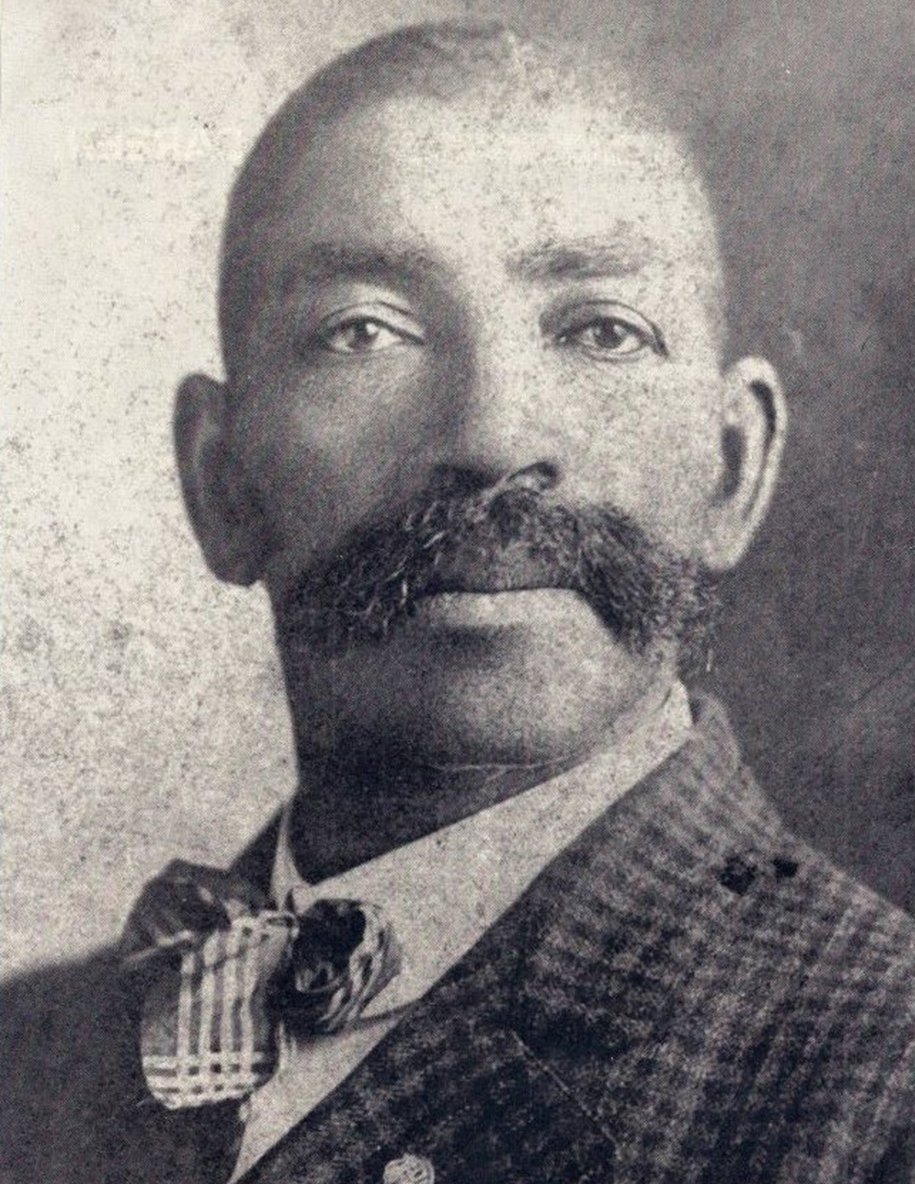
Bass Reeves was born enslaved in Arkansas in 1838 and grew up in Lamar and Grayson counties, Texas, the property of Col. George R. Reeves, later speaker of the Texas house. When the Civil War came, Reeves escaped into Indian Territory and became acquainted with the Cherokee, Creek and Seminole there. The Oklahoma Historical Society says it is believed he served with the Union Indian Home Guard regiments during the war — believed, not documented, a distinction worth keeping with Reeves.
After the war he settled near Van Buren, Arkansas, farmed, and hired out as a scout and tracker for deputy U.S. marshals riding out of Fort Smith. His own boast, preserved by the Historical Society, was that he knew Indian Territory “like a cook knows her kitchen.”
A federal badge in 1875
In 1875, Judge Isaac C. Parker took over the federal court at Fort Smith and commissioned Reeves as a deputy U.S. marshal. The court’s jurisdiction ran to more than 75,000 square miles of Indian Territory; Parker could hire 200 deputies, though the National Park Service notes only twenty to thirty usually worked at once.
Reeves is believed to be one of the earliest Black Americans commissioned as a deputy U.S. marshal west of the Mississippi — believed, because the stronger claim that he was the very first does not hold up; the curator of the U.S. Marshals Museum in Fort Smith is among those who say so.
Thirty-two years on the warrant trail
He kept the job for thirty-two years. By the Park Service’s account, Reeves is the only deputy who began with Parker’s court in 1875 and was still serving when Oklahoma became a state in 1907. It was lethal work — more than 120 federal peace officers lost their lives in the territory before statehood — and Reeves, six foot two and 180 pounds, became an expert with pistol and rifle. In a 1901 newspaper interview, he put his arrests at more than 3,000 men and women. Territorial newspapers reported that he killed fourteen outlaws, all in self-defense by his own account, and the Park Service records that he was never wounded despite repeated shootouts and assassination attempts.
He couldn’t read. Enslavement had seen to that, so he memorized his warrants, and by the Park Service’s account he never arrested the wrong person in thirty-two years. He worked in disguise to get close to fugitives. Once, he was given the warrant for Belle Starr — the one time she turned herself in at the Fort Smith court.
The authority itself cut against the grain of the country around him. As the Park Service points out, Black deputy marshals in Indian Territory could arrest white, Black or Native offenders alike, a striking reality in the Jim Crow decades that followed Reconstruction.
Analysis: The standard Western lawman of film and television — the lone white sheriff holding a white town together — describes Hollywood’s casting habits better than it describes federal law enforcement in Indian Territory, where the surviving paper trail has a Black American deputy, born enslaved, hauling white outlaws back to Fort Smith by the wagonload for three decades.
The warrant for his own son
The episode the Historical Society calls the greatest testimony to his devotion to duty came late. His son Bennie was wanted for the murder of his wife. Reeves took the warrant himself, brought his own son in, and saw him convicted and sent to Leavenworth. The encyclopedia entry does not dress it up, and neither, by all accounts, did he.
Muskogee, and a quiet beat
Statehood in 1907 abolished his job. Reeves joined the Muskogee police force and walked a downtown beat for about two years, and local reports say not a single crime was reported on his beat in that time. He retired in 1909 and died in Muskogee on January 12, 1910.
Famous, forgotten, famous again
Territorial newspapers had made him a celebrity while he lived. One of the only original photographs of him, taken around 1902 — star-shaped badge, holstered gun, a riding whip called a quirt in hand — now sits in the collection of the Smithsonian’s National Museum of African American History and Culture. Yet after his death the culture largely dropped him. The Oklahoman notes that Reeves “disappeared from the American conversation from the 1940s to the 1980s,” the very decades when Wyatt Earp, Doc Holliday and Bat Masterson became permanent fixtures of American screens.
The way back was slow. He was inducted into the Hall of Great Westerners in 1992. A 25-foot bronze statue of Reeves on horseback went up in Fort Smith in 2012. HBO’s Watchmen opened in 2019 on a boy in Tulsa watching a Bass Reeves picture show. Delroy Lindo played him in The Harder They Fall. Then, in November 2023, came *Lawmen: Bass Reeves*, an eight-episode Paramount+ series created by Chad Feehan, executive produced by Taylor Sheridan and starring David Oyelowo — a prestige Western built around the man the genre had skipped.
The Lone Ranger claim
One part of the revival still outruns the evidence. It is often said that Reeves was the real-life inspiration for the Lone Ranger, a claim repeated so widely that even the Justice Department’s museum page on his photograph states it flatly. But no archival document connects the 1933 radio character to Reeves. Radio historian Martin Grams tracked down the creators’ correspondence, and it points elsewhere: the character was patterned on screen cowboy Tom Mix, with Robin Hood in the mix. Treat the Reeves link as folklore — a good story, but not a documented one, and the documented life does not need it.
Featured portrait: Deputy U.S. Marshal Bass Reeves, circa 1902. National Park Service photograph, public domain, via Wikimedia Commons.
Sources
- National Park Service, Fort Smith National Historic Site — “Bass Reeves,” by Art T. Burton: https://www.nps.gov/fosm/learn/historyculture/bass_reeves.htm?fbclid=IwAR2mX5KYmvKUnAOYfyynkvjJtp8nkFK8tnL36ncOAyc7YYB-VWA-_CNR-FI
- Art T. Burton, “Reeves, Bass,” The Encyclopedia of Oklahoma History and Culture, Oklahoma Historical Society: https://www.okhistory.org/publications/enc/entry?entry=RE020
- U.S. Department of Justice Museum, “Artifact Spotlight: Loan from the National Museum of African American History and Culture” (Bass Reeves photograph, ca. 1902): https://www.justice.gov/history/blog/artifact-spotlight-loan-national-museum-african-american-history-and-culture
- Steve Lackmeyer, The Oklahoman — “Escaped slave Bass Reeves brought fugitives to justice in Oklahoma” (Feb. 17, 2022): https://www.ndinsider.com/story/news/2022/02/17/bass-reeves-muskogee-oklahoma-us-marshall-lone-ranger-black-history/6671046001/
- Wikipedia — “*Lawmen: Bass Reeves*” (series details, premiere and episode count): https://en.wikipedia.org/wiki/Lawmen:_Bass_Reeves