Listen to this article
Take the story with you. Choose a voice and a pace that suits you.
Or listen in another language / choose a voice
Getting your device voices ready…
The voice follows the displayed language and your browser’s regional preference when available. You can choose another narration voice.
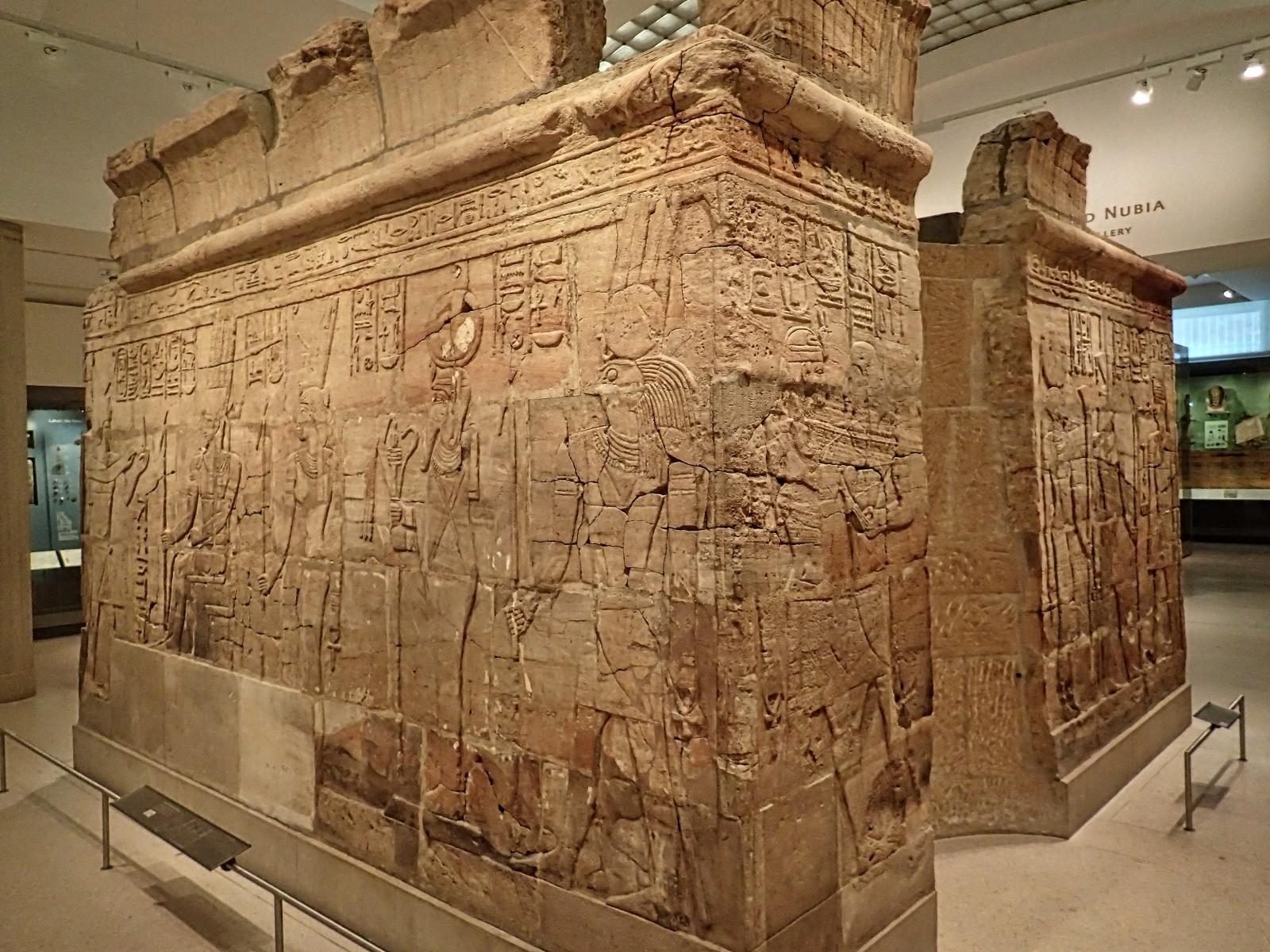
Stand in front of the Shrine of Taharqa in Oxford and you see carved sandstone, the colour of dry earth. That is not what its makers saw. Research announced on 2 November 2026 has recovered the Taharqa shrine original colours — red, yellow and a brilliant blue — from pigment traces no visitor could pick out, and from 13 November the Ashmolean Museum will project those colours back onto the stone in a free installation in its Ancient Egypt and Sudan galleries, according to The Art Newspaper.
The shrine is an unlikely survivor. Built around 680 BCE at Kawa in what is now northern Sudan, it is the only freestanding building in Britain dating from the time of the pharaohs, and it has stood in Oxford for 90 years. It arrived in 150 crates in 1936, a gift from the Sudanese government to the Oxford University Excavations in Nubia, and was given to the museum by Nora Griffith in memory of her husband Francis Llewellyn Griffith, who had led the expeditions, The Art Newspaper reports. The museum’s own gallery guide notes that the shrine was rebuilt where it stands now, on a foundation two metres deep to hold its weight, and that wind and sand had worn away the bright paint its reliefs once carried (Ashmolean Museum).
How the Taharqa shrine original colours were found in invisible light
Some colour never quite left. Fragments of red paint survive in the crevices of the carvings, visible if you know where to look. The rest had gone past visibility. Researchers combined microscopic analysis with hyperspectral imaging — a technique that pairs photography with spectroscopy — and found evidence of yellow and of Egyptian blue, a pigment used to depict divine figures, where the naked eye sees only stone (The Art Newspaper; USA Art News).
Egyptian blue is the key to the whole recovery, and it behaves oddly. It is the world’s first synthetic pigment, in use since at least 2500 BCE, and it glows in the near-infrared when ordinary visible light falls on it — at wavelengths far beyond human perception. A hyperspectral camera records hundreds of narrow wavelength bands rather than the three broad channels of a normal photograph, so traces of the pigment register as a distinct spectral fingerprint even when the surface looks uniformly beige (TechTimes). Nothing is scraped, sampled or touched. The stone keeps its secrets and gives them up anyway.
Egyptian blue pigment: the colour that carried meaning
This was never decoration for its own sake. The shrine’s reliefs show Taharqa — king of Kush in Nubia, and pharaoh of Egypt — in two identities at once: wearing the Double Crown of Upper and Lower Egypt in some scenes, and in others a Kushite crown surmounted by two cobras, with a ram’s head and sun disc earrings. He appears before the gods of Memphis and Heliopolis, and before Amun-Re shown both as a Theban god and as a local Gematen deity (The Art Newspaper).
Which figures were painted blue, and which were not, turns out to be a theological statement. A 2015 study by Caroline Armstrong in the Journal of Egyptian Archaeology found that the Amun-Re on the shrine’s western wall was painted blue, in line with convention for divine figures, while the Amun-Re on the eastern wall, shown in a different guise, was not. The new imaging confirms that distinction at the level of pigment chemistry: the blue is physically there on one figure and absent on the other, a deliberate choice preserved under two millennia of damage (TechTimes).
The carvings also tell the shrine’s own origin story. Liam McNamara, the Ashmolean’s keeper of antiquities, explains that the inscriptions describe a young Taharqa travelling north towards Thebes and finding an earlier brick temple to Amun-Re, built by Tutankhamun, with “the sand drifted to its roof.” At his coronation he vowed to restore it, and built the new shrine inside a new temple. Scorch marks on the stones, also documented by the project, record its eventual destruction in turn (The Art Newspaper).
What hyperspectral imaging in ancient art can change next
Analysis: The choice of a projection, rather than repainting, matters. The stone itself stays untouched — no conservator has to guess at a brushstroke — yet a visitor can stand where a worshipper stood and see roughly what that worshipper saw: plastered, painted relief glowing in a temple court. The same non-invasive method has mostly been applied to manuscripts and small objects. The Ashmolean’s gallery guide describes the shrine as the centrepiece of its Egypt and Sudan displays (Ashmolean Museum), and demonstrating the technique at architectural scale, on a four-metre-square monument, widens the list of painted buildings elsewhere whose lost colour might be recoverable in the same way (TechTimes).
McNamara puts the point plainly: the monument is “a fascinating insight into the art and archaeology of ancient Sudan,” and the projection with the research behind it will let visitors “appreciate and understand the shrine’s original painted decoration like never before” (USA Art News).
The projection opens on 13 November 2026 and is free to all visitors to the Ashmolean’s Ancient Egypt and Sudan galleries. Information verified through 3 November 2026.
Photo: via Wikimedia Commons (CC BY-SA 4.0)
Sources
- https://www.theartnewspaper.com/2026/11/02/new-research-reveals-original-colours-of-ancient-egyptian-shrine-at-oxford-museum
- https://www.techtimes.com/articles/329903/20261102/ashmolean-museum-finds-egyptian-blue-taharqa-shrine-hidden-since-roman-era.htm
- https://usaartnews.com/news/ashmolean-museum-to-digitally-restore-3000-year-old-shrines-colors/
- https://www.ashmolean.org/ancient-egypt-and-nubia-gallery
Leave a comment
Comment as a guest and verify your email, or sign in or create a reader account. Guest comments reach our review queue after email verification; account holders can submit directly for review.