Listen to this article
Take the story with you. Choose a voice and a pace that suits you.
Or listen in another language / choose a voice
Getting your device voices ready…
The voice follows the displayed language and your browser’s regional preference when available. You can choose another narration voice.
The Al Jazeera The Core AI newsroom is no longer a press release. The first phase of The Core — the network’s AI-integrated news model, built with Google Cloud as its main technology provider — was scheduled to launch on 1 November 2026, the network’s 30th anniversary, and November reporting describes that phase as under way (BroadcastPro ME; Magica). It arrives alongside a channel overhaul: three Arabic channels and 33 programmes (explainx.ai). Information verified through 26 November 2026.
What makes this launch different from a usual software deal is the raw material. One part of the system learns from Al Jazeera’s own reporting archive — three decades of it. That choice is where the argument sits.
How the Al Jazeera The Core AI newsroom is built
Al Jazeera and Google Cloud announced The Core on 21 December 2025. The network describes it as a cognitive operating model meant to shift AI “from a passive tool to an active partner in journalism,” with agents taking on data processing and operational tasks so journalists can concentrate on storytelling (Al Jazeera / Google Cloud release).
The design has six connected parts, as described in the companies’ launch materials (Magica):
- AJ Now — the central news platform, using Google Cloud compute, Vertex AI Search and Gemini Enterprise to suggest questions, develop angles and draft summaries.
- AJ-LLM — the “Editorial Brain”: a large language model fine-tuned on Al Jazeera’s archives, wired into Gemini Enterprise for translation and summarisation, with NotebookLM supplying analytical context.
- AJ Vision — a production hub using generative tools including Imagen and Veo to create visual content.
- AJ Data Lake — BigQuery and Gemini Data Agents for data analysis and predictive dashboards.
- The Ops Engine — Gemini for Workspace, automating internal workflows.
- A training arm — staff education in the tools, using Google Workspace and Gemini Enterprise.
A workflow coordinator called Orbit sits across the operation, helping organise monitoring, commissioning, interviews, translation and assignments (BroadcastPro ME).
Two cautions belong here. These six parts are the launch design, not a verified inventory of what the November phase switched on; the releases do not identify the underlying model behind AJ-LLM (Magica). And the Google Cloud Al Jazeera The Core relationship did not start in 2025 — the two sides announced work on distribution, advertising, cloud services and training back in April 2017. The Core extends Google from distributor into the editorial workflow itself (Magica).
The AJ-LLM Al Jazeera archive model is the argument
Every newsroom has a memory. AJ-LLM turns one network’s memory into a machine that answers back.
Fine-tuning on the archive means the model absorbs the network’s past choices — which stories led, which framings recurred, which voices got quoted — and can reproduce that house style at speed. Supporters inside the project frame this as depth: a reporter can pull real-time analytical context from decades of the network’s own reporting (Al Jazeera / Google Cloud release). Critics frame the same mechanism as amplification: archive material, processed through generative tools, can be repackaged faster, lending past editorial choices a fresh, machine-made neutrality. Toby Dershowitz, a senior adviser at the Foundation for Defense of Democracies — an organisation highly critical of Qatar — has argued that processing the archives this way would accelerate the repackaging of Al Jazeera’s material (Magica).
One technical point cuts through part of the dispute. Fine-tuning a model for Al Jazeera on its archives does not, by itself, mean those archives train Google’s public models. Google Cloud’s published data commitments say customer data is not used to train its models without permission — though this contract’s permissions have not been disclosed (Magica).
The network’s funding sits behind the whole debate. Qatar’s government founded Al Jazeera in 1996, and the network is Qatar-funded and Doha-based — facts neither side disputes. What they dispute is control. Al Jazeera says its journalists and editors make editorial decisions and that no government, including Qatar’s, directs its coverage (Magica). Critics dispute that independence. The launch documents settle neither position.
AI newsroom human oversight Al Jazeera promises, and what would prove it
The network’s answer to every concern is one sentence, repeated in several forms: humans remain in the loop at every stage of any work the tools assist. Director general Sheikh Nasser bin Faisal Al Thani put it as a pairing — human expertise and artificial intelligence working in tandem — and, in the anniversary coverage, as a line worth quoting exactly: “Artificial intelligence enables the human and does not replace him” (Al Jazeera / Google Cloud release; explainx.ai).
As a promise, it is clear. As evidence, it is thin — so far. The announcements disclose no contract value, no archive corpus size, no accuracy benchmark and no description of the review process: who can reject a suggested angle, a translation, a generated visual, and how that rejection is recorded (Magica). Google, asked about the partnership in February reporting, referred inquiries back to the launch release; it did not respond before the November report describing the first phase as launched (Magica).
There is a comparison point for what testable oversight looks like. The Associated Press begins each automation experiment with a journalist’s work, requires journalist review before publication, and calls for disclosing the technology’s use in translations (Magica). Nothing in The Core’s public materials yet matches that level of detail.
So two honest statements stand side by side. A major global newsroom has rebuilt its workflow around a cloud AI stack, archive model included, and says its people stay in charge. And nobody outside the building can currently verify how that charge is exercised — which components are live, which archive material they draw on, how errors get caught. The next disclosure from either company, if it names components, review steps and correction handling, will matter more than the launch itself did.
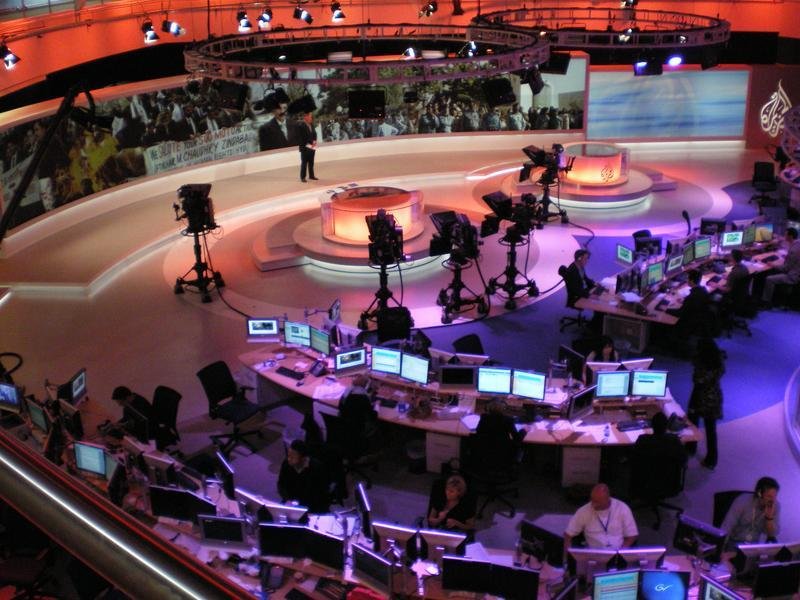
Photo: CMDavid, via Wikimedia Commons (public domain).
Sources
- Al Jazeera Media Network / Google Cloud — Al Jazeera Media Network launches ‘The Core,’ an AI-integrated news model built on Google Cloud (21 December 2025): https://mailchi.mp/38d9f8162c67/press-release-al-jazeera-media-network-launches-the-core-an-ai-integrated-news-model-built-on-google-cloud
- BroadcastPro ME — Al Jazeera marks 30th anniversary with editorial and technology overhaul: https://www.broadcastprome.com/news/al-jazeera-marks-30th-anniversary-with-editorial-and-technology-overhaul/
- Magica — Al Jazeera’s Google AI rollout raises oversight questions: https://magica.com/news/google-al-jazeera-core-ai-archives-editorial-control
- explainx.ai — Al Jazeera The Core + Google Cloud: AJ-LLM, archives and six newsroom pillars: https://www.explainx.ai/blog/google-al-jazeera-the-core-gemini-archives-newsroom-november-2026
Leave a comment
Comment as a guest and verify your email, or sign in or create a reader account. Guest comments reach our review queue after email verification; account holders can submit directly for review.