Listen to this article
Take the story with you. Choose a voice and a pace that suits you.
Or listen in another language / choose a voice
Getting your device voices ready…
The voice follows the displayed language and your browser’s regional preference when available. You can choose another narration voice.
UNESCO has given World Philosophy Day 2026 a question instead of a slogan: how can we coexist in a world in crises? The day falls on Thursday 19 November, and the Paris programme built around that question runs across 18 and 19 November at UNESCO Headquarters, UNESCO’s programme sets out. Four pressures are named — migration, climate, artificial intelligence and health — and the framing is pointed: in the face of disinformation, democratic backsliding and systemic crises, philosophy is cast as a catalyst for action and resistance, not a decorative extra. Information verified through 16 November 2026.
The centrepiece is an evening lecture on 19 November by Souleymane Bachir Diagne, the Senegalese philosopher and professor emeritus at Columbia University. Its title, “Living the Earth Together,” is also its thesis in miniature. A round table follows under the heading “Thinking and acting together: philosophy to inhabit a world with plural challenges,” UNESCO’s event listing confirms.
Living the Earth Together: Souleymane Bachir Diagne and the human universal
Diagne’s lecture, as UNESCO’s programme describes it, takes up three ideas that have been circulating in recent philosophy and puts them under pressure. The first is “planetary consciousness,” associated with Dipesh Chakrabarty. The second is Achille Mbembe’s notion of an “earthly community.” The third is older: Pierre Teilhard de Chardin’s “planetization.” Diagne’s stated aim is to examine those notions in the light of one that is, in the programme’s words, somewhat decried today — the human universal.
That last move is the interesting one. A universal that everyone shares has fallen out of fashion in much contemporary thought, where it is often heard as a cover story for one culture’s particular values. Diagne’s career has largely been an argument that the universal can be rebuilt differently: reached through translation and encounter between traditions rather than handed down by one of them. Whether the Paris lecture persuades will depend on how concretely he handles the four crises UNESCO lists. A universal that cannot say anything specific about a border, a flood or a hospital queue is just a mood.
The setting carries its own weight. UNESCO notes a lineage of thinkers welcomed since its founding, including Claude Lévi-Strauss, Amartya Sen and Edgar Morin. Placing a Senegalese philosopher formed in both the École normale supérieure and African intellectual traditions in that line is itself a statement about whose philosophy counts as world philosophy.
How can we coexist in a world in crises: the wider World Philosophy Day 2026 UNESCO programme
Paris is not the whole event. The 2026 edition is rooted in UNESCO’s Management of Social Transformations (MOST) programme and built, UNESCO says, on three pillars: intellectual rigour in the face of real-world crises, civic engagement and youth empowerment, and pluralism across disciplines and peoples. Students from partner universities — Université Paris-Est Créteil, the University of Caen Normandy and Université Côte d’Azur — take part in sessions ranging across deliberative citizens’ assemblies, simulated AI trials, futures literacy, narrative medicine and the mapping of peace vocabularies, UNESCO describes. The two days are meant to end in a public Citizen Manifesto, drawn from the student work and published on UNESCO’s website.
Teacher training runs alongside, this year under the theme of “Otherness,” with sessions on fostering critical thinking from an early age and a workshop on philosophy with children. A short disputatio asks, in plain terms, “Can philosophy save the world?” — a question the programme itself seems happy to leave hanging.
Beyond Paris, the day spreads. At Wageningen University in the Netherlands, Beatrice Okyere-Manu of the University of KwaZulu-Natal will lecture on African relational ethics and generative AI under the title “From the Fireside to the Algorithm,” an annual public UNESCO lecture held under the patronage of the UNESCO Netherlands Commission, Wageningen University & Research lists. The pairing is neat. Oral tradition — knowledge held in relationship, spoken around a fire — set against systems that generate answers with no relationship at all. What an ethics built on relatedness asks of such systems is a harder question than most AI ethics checklists attempt.
Daily Nous, the philosophy profession’s news site, put the day’s purpose in UNESCO’s own older words: celebrating “the enduring value of philosophy for the development of human thought, for each culture and for each individual,” Daily Nous noted.
Analysis: A themed day can be pure ceremony, and some of this one will be. But the programme’s structure betrays a real anxiety worth taking seriously: the institutions built after 1945 to hold a shared human conversation are losing their audience, and philosophy is being asked to do repair work that politics currently won’t. Diagne is a credible choice for that ask precisely because his universal is not a possession but a practice — something made, repeatedly, in translation. The manifesto will be forgotten by December. The question in the title won’t be, because migration, climate, AI and health will still be sitting there, unanswered, on 20 November.
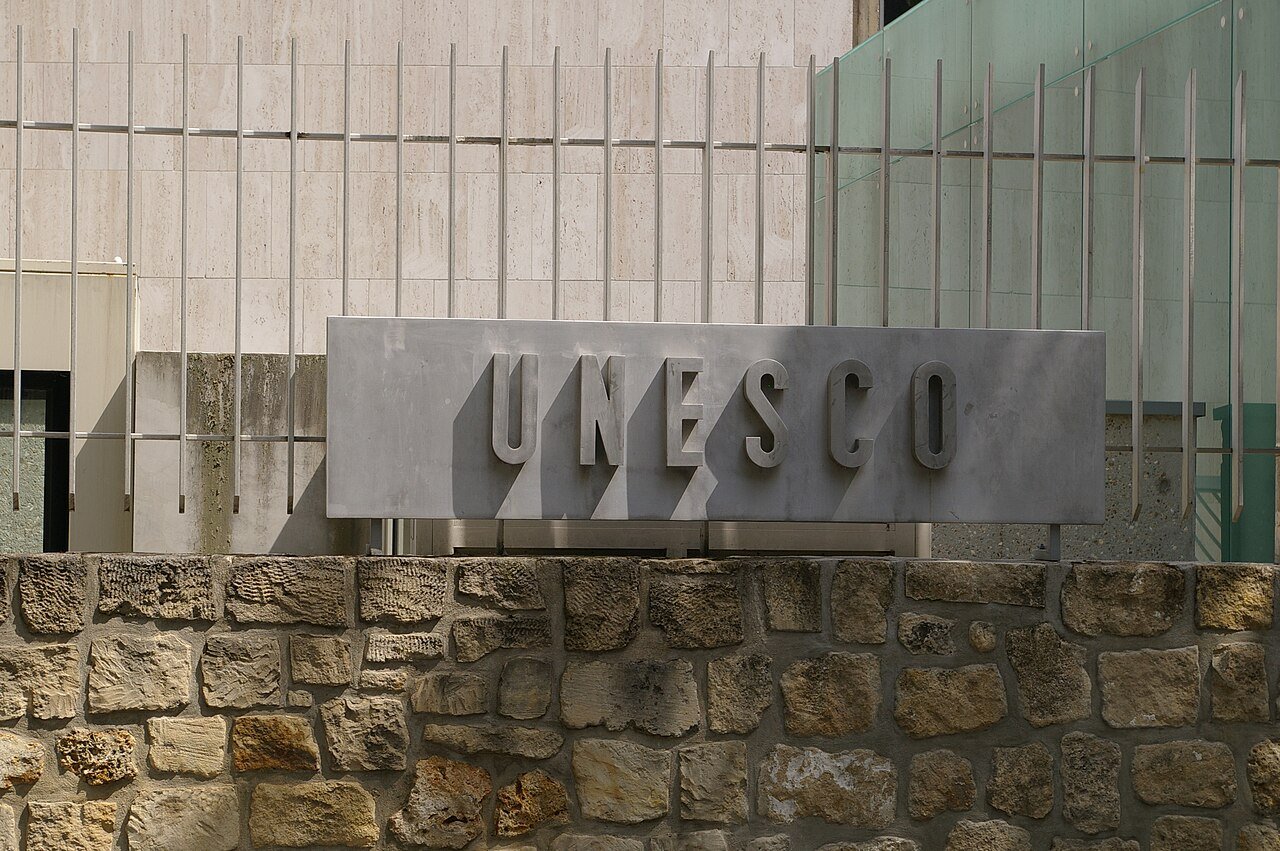
Photo: Christopher Lancaster, via Wikimedia Commons (CC BY-SA 2.0) — UNESCO Headquarters, Paris.
Sources
- https://www.unesco.org/en/articles/world-philosophy-day-2026?mc_cid=abcea08c30&mc_eid=44cffde754
- https://articles.unesco.org/sites/default/files/medias/fichiers/2026/10/World%20Philosophy%20Day%20Programme%202026.pdf
- https://dailynous.com/2026/10/26/reminder-world-philosophy-day-coming-up-next-month/
- https://www.wur.nl/en/activity/unesco-world-philosophy-day-2026
Leave a comment
Comment as a guest and verify your email, or sign in or create a reader account. Guest comments reach our review queue after email verification; account holders can submit directly for review.