Listen to this article
Take the story with you. Choose a voice and a pace that suits you.
Or listen in another language / choose a voice
Getting your device voices ready…
The voice follows the displayed language and your browser’s regional preference when available. You can choose another narration voice.
Transformative experience and rational decision making do not sit comfortably together, and that discomfort is the subject of a lecture in Toronto this week. Yale philosopher Laurie Paul will give the University of Toronto’s UNESCO World Philosophy Day lecture on Thursday 19 November 2026, from 3pm to 5pm in Jackman Humanities Building 100, according to the university’s philosophy events listing. Her announced subject is the paradox at the heart of her best-known work: some of the biggest choices a person makes cannot be weighed in advance, because the weighing equipment — your own values — is one of the things the choice will change. Information verified through 17 November 2026.
Paul is the Millstone Family Professor of Philosophy and Cognitive Science at Yale. Toronto’s listing describes her territory as the nature of the self, transformative experience, preference change, subjective value, temporal experience, causation, time and perception. A wide map. The paradox sits right in the middle of it.
The Laurie Paul transformative experience paradox, stated plainly
Standard decision theory asks you to list the outcomes, value each one, weigh the odds, and pick the best total. Paul argues that the method quietly assumes two things a transformative choice takes away. In an interview published by In-Sight Publishing, she puts it this way: before the experience, you cannot fully understand what it will be like, and you do not know how it will change your preferences. The outcome is, in her terms, epistemically inaccessible and personally transformative at once.
Her stock example is parenthood. You can read the books. You can interview every parent you know. None of it tells you, in the first person, what having your child will be like — or how completely your sense of what matters may be rearranged by it. Paul traces her own version of this to reading What to Expect When You’re Expecting during pregnancy and finding, afterwards, that the preparation had missed the thing itself; her early paper on the problem was titled “What You Can’t Expect When You’re Expecting”.
Other examples travel further from the nursery: enlisting, a religious conversion, emigration, a diagnosis, falling in love. The shape stays the same. The person who decides is not quite the person who lives with the decision.
An epistemic wall transformative experience puts in front of you
Paul’s newer image for the first half of the problem is the epistemic wall transformative experience builds between present and future selves. In her Big Think account, she describes standing in front of a high, featureless wall: you know that tomorrow you will be on the other side of it, able to see the landscape, but right now you cannot see two inches ahead.
Testimony does not knock the wall down. That is the uncomfortable part. People on the other side — parents, converts, veterans — can tell you it was worth it. But their preferences have already changed, which is exactly why their report cannot settle your question. Paul makes the point with a deliberately absurd case: imagine every friend and relative has become a vampire and urges you to join them, thrilled with a life you, still human, have no way to value from the inside. Their enthusiasm is real. It is just not evidence you can use in the standard way.
None of this makes the choice irrational to attempt. Paul’s claim is narrower and more useful: the standard calculus is silent here, and pretending otherwise is its own kind of error. What she recommends, in the Big Think telling, is something like epistemic humility — knowing what you cannot know, and choosing anyway with your eyes open about that limit.
World Philosophy Day 2026 Laurie Paul lecture Toronto — transformative experience and rational decision making in public
The Toronto lecture is one event in a crowded calendar. World Philosophy Day falls on the third Thursday of November and was first celebrated on 21 November 2002 in Paris, under UNESCO, to encourage critical thinking and more tolerant societies. This year it lands on 19 November 2026.
Paris gets its own headline act. UNESCO will host Souleymane Bachir Diagne of Columbia University at its headquarters to deliver a keynote titled ‘Living the Earth Together’, on the concept of the Universal Human, followed by a round table on thinking and acting together in a world of plural challenges. Toronto’s choice of speaker pulls the same day in a more inward direction: not how humanity shares a planet, but how a single person shares a life with a future self they cannot meet yet.
Analysis: there is a quiet fit between Paul’s paradox and a public philosophy day. Most people will never read decision theory. Almost everyone has stood in front of some version of that wall — a move, a child, a career thrown over, a treatment with no certain outcome — and felt the odd guilt of being unable to “decide properly”. Paul’s work gives that feeling a structure and, oddly, a permission slip. The failure is not yours. It is built into the choice. If the Toronto audience leaves with one sentence, it may be that one — delivered, fittingly, two days before anyone in the room can know what they will do with it.
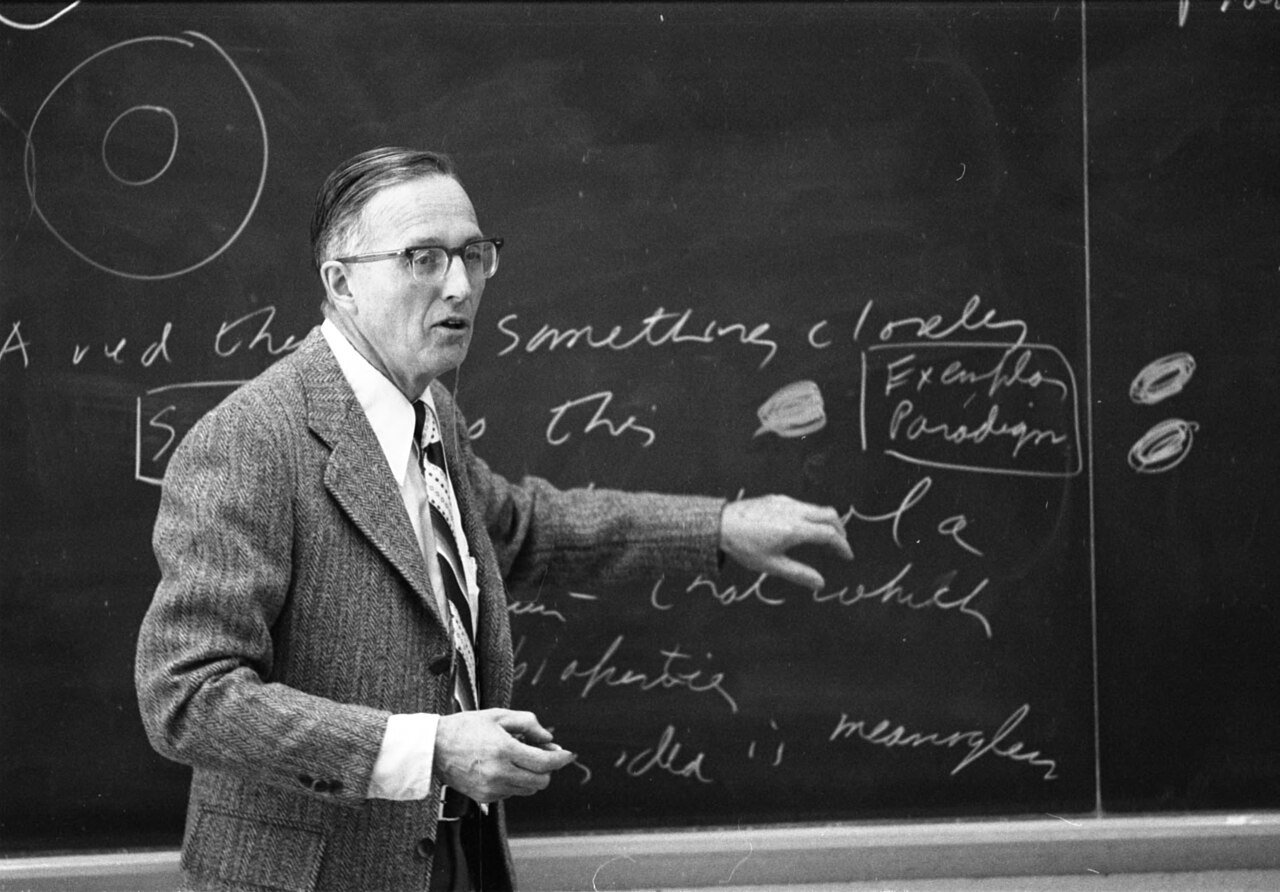
Photo: University of Michigan News and Information Services, via Wikimedia Commons (CC BY 4.0)
Sources
- https://philosophy.utoronto.ca/events/category/st-george/list/?posts_per_page=13
- https://in-sightpublishing.com/2026/01/01/choosing-when-the-chooser-changes-laurie-paul-on-transformative-experience/
- https://bigthink.com/the-well/the-hidden-bias-in-every-life-changing-decision/
- https://www.islamicity.org/107313/the-journey-of-philosophy-from-ancient-greece-to-the-muslim-world/
Leave a comment
Comment as a guest and verify your email, or sign in or create a reader account. Guest comments reach our review queue after email verification; account holders can submit directly for review.