Listen to this article
Take the story with you. Choose a voice and a pace that suits you.
Or listen in another language / choose a voice
Getting your device voices ready…
The voice follows the displayed language and your browser’s regional preference when available. You can choose another narration voice.
A Canada lynx New Mexico camera photo has done what years of looking could not: it proves the cat is there. In June 2026, a motion-activated camera in Carson National Forest photographed a Canada lynx, and New Mexico State University (NMSU) announced the find on 23 October — describing the species as last documented in the state about a quarter-century ago (NMSU). The story reached a wider science audience on 7 November, when Phys.org carried the university’s account. Information verified through 9 November 2026.
The photo nearly stayed buried. William Grooms, an NMSU Ph.D. student, spent the summer running cameras across the forest, then worked through the images months later. Hidden among squirrels, rabbits, bears and foxes was the lynx — clear photographic evidence from the San Juan Mountains, which straddle the New Mexico–Colorado border (Phys.org).
“We sent the photos to experts to confirm that it was indeed a lynx, and we’re confident it’s a lynx — no question about it,” Grooms said (NMSU).
One discrepancy is worth stating plainly, because the sources state it differently. NMSU puts the previous documented record at about 25 years ago. Wildlands Network, the conservation group co-running the study, describes the same photo as “the first Canada lynx documented in New Mexico in nearly fifteen years” (Wildlands Network). Both agree on the substance: no confirmed record for well over a decade, and this camera settles the question of presence.
The Canada lynx New Mexico camera photo and the study behind it
Grooms wasn’t hunting lynx. The Canada lynx Carson National Forest study is his project — a collaboration between NMSU and Wildlands Network, building on work Wildlands started in 2022 — studies 10 species and measures the forest structure each one prefers: the arrangement and composition of trees and other vegetation (NMSU). Cameras ran at 120 sites across Carson National Forest this past summer, and a second season of documentation follows next summer (Phys.org).
“This study grew directly out of our marten research in the San Juan Mountains, and this is the first lynx we’ve documented since that work began,” said Aaron Facka, senior wildlife biologist at Wildlands Network, who stresses that forest managers need science-based evidence of which animals are actually using these forests (Wildlands Network).
The stated goal is practical: give forest managers science-based advice on how fuel-reduction treatments and timber harvesting affect wildlife tied to closed-canopy coniferous forest in the Southern Rocky Mountains (Phys.org).
A Canada lynx threatened under the Endangered Species Act, built for snow
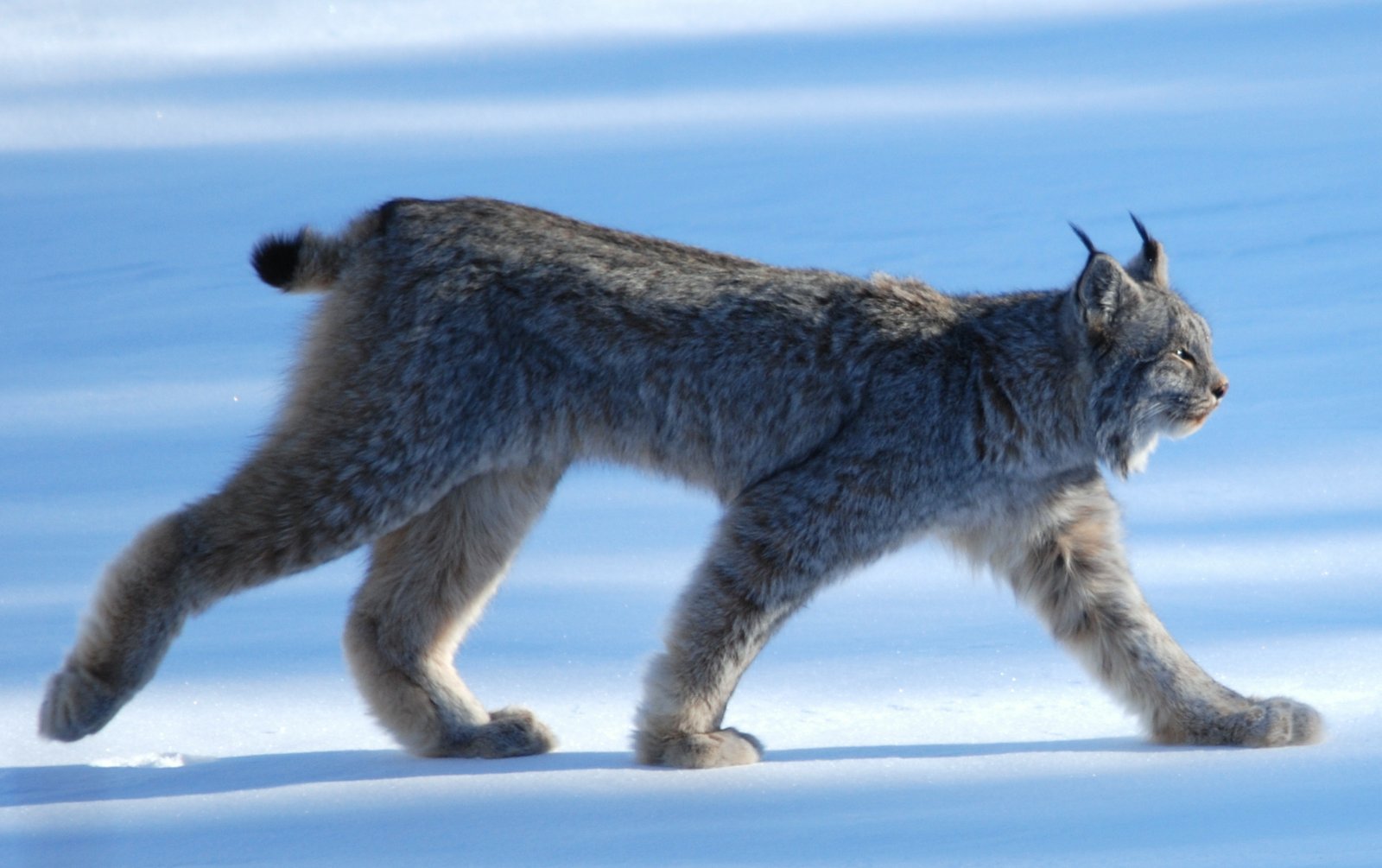
The animal in the frame is built for a climate most of New Mexico doesn’t suggest. Canada lynx broadly inhabit dense boreal and subalpine forests across most of Canada and Alaska. They resemble bobcats and weigh up to 20 pounds (9 kilograms), but carry a grayish or yellowish-brown coat, wide fur-lined paws and elongated legs suited to deep snow — and to catching snowshoe hares, their primary prey — according to Jennifer Frey, professor of mammalogy at NMSU and Grooms’s adviser (Phys.org).
Despite reintroduction efforts in the San Juan Mountains between 1999 and 2006, Canada lynx populations have remained stubbornly low across the contiguous United States, and the species is still considered threatened under the Endangered Species Act, Frey said (NMSU).
Where the New Mexico cat came from hasn’t been established in the sources — whether it wandered south from Colorado’s reintroduced population or represents something more settled is exactly what a single photo can’t answer.
Frey was clear that the record changes the paperwork, not just the mood. Proof of at least one Canada lynx in northern New Mexico “may create additional considerations for how state and federal governments manage this species and its habitat,” she said — even as she acknowledged the simpler reaction: “It’s very rare for people to see them, and to know that they’re here, I think, provides something like an inner joy for people” (NMSU).
The Canada lynx snowshoe hare forest habitat is the fire problem, too
Here is the tension the study exists to map. Lynx and snowshoe hares both need deep snow and spruce-fir forest. Hares shelter under downed trees, logs and dense understory vegetation — and that cover is what draws lynx in (Wildlands Network).
“These types of forests and conditions are often targeted for hazardous fuel removals,” Grooms said, “because when they do catch on fire, they contribute to big fires. But these are the types of conditions, though, that really are important to both the Canada lynx and the snowshoe hare” (NMSU).
Thin the forest and you cut wildfire risk while removing hare cover. Leave it dense and the habitat holds, in a warming, drying West where large fires are the standing threat. Grooms’s two-year study is designed to give managers evidence for threading that needle — which structures which species actually use — rather than treating every acre the same (Phys.org).
“Our study,” Frey said, “is dealing with how we manage forests to make sure that Canada lynx and other species are going to have a future here in New Mexico and the Southern Rocky Mountains” (NMSU).
Analysis: one photograph is not a population, and nobody involved claims otherwise. What it changes is the burden of proof. Before June, a manager thinning spruce-fir in Carson National Forest could treat lynx as a historical footnote — present in the files, absent on the ground. Now the species is a documented user of the forest, photographed by the very study measuring what thinning does. The second camera season next summer will matter more than the first: a second cat, or the same cat again, would turn a sighting into a pattern. Until then, the photo does its narrower job. The lynx is not a rumour in New Mexico any more. It’s a record.
Photo: Keith Williams, via Wikimedia Commons (CC BY 2.0)
Leave a comment
Comment as a guest and verify your email, or sign in or create a reader account. Guest comments reach our review queue after email verification; account holders can submit directly for review.