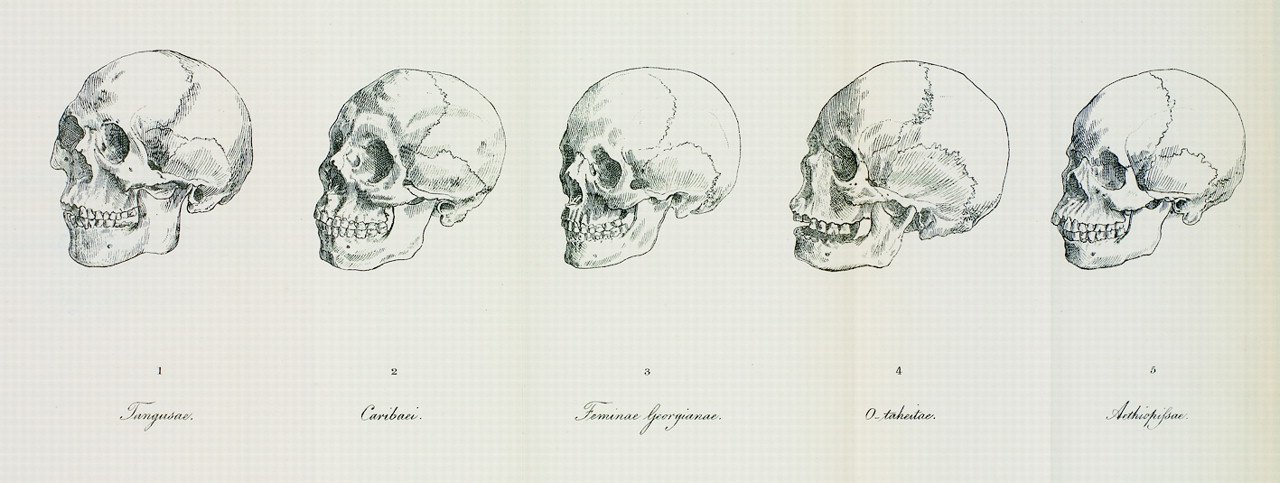
A young woman’s skull did the damage. Johann Friedrich Blumenbach, professor at Göttingen, kept a cabinet of skulls and prized one above the rest — a Georgian woman’s, “very symmetrical and beautiful.” In 1795 he arranged mankind around it. From the southern slope of the Caucasus, her variety — the first, in his telling the original — he named Caucasian. The word is now ticked on forms by hundreds of millions of people.
Image: Johann Friedrich Blumenbach, plate II from De generis humani varietate nativa (1795) — the five skulls he presented as type specimens of his five races. Public domain, via Wikimedia Commons.
Four varieties, four temperaments
Blumenbach was refining somebody else’s filing system. In 1735 the Swedish naturalist Carl Linnaeus published Systema Naturae and filed humans in the animal kingdom, beside the apes: four varieties of Homo sapiens, matched to continents and colours — the European white, the American red, the Asian tawny, the African black.
The tenth edition (1758) went further: each variety got a temperament, a character, a style of government. The European was sanguine: “light, wise, inventor,” governed by laws. The American was choleric, governed by custom. The Asian was melancholic — “stern, haughty, greedy” — governed by opinions. The African was phlegmatic: “sly, sluggish, neglectful,” governed by caprice. Linnaeus blamed colour on climate and never used the word race; it changed nothing about where his table put people. The Linnean Society states that this edition “became the basis for scientific racism.” Across every edition, one entry never moved: Africanus, last on the list, with the longest, most negative description.
The names that stuck
His 1775 dissertation argued, against many contemporaries, that humanity was one species. His varieties, he insisted, “run into one another by insensible degrees,” and he rejected claims of African inferiority, citing Black writers and artists. Raj Bhopal’s re-examination in the BMJ documents all of that — and then the trapdoor. Blumenbach centred his scheme on the Georgian skull he called “the most handsome and becoming,” and speculated that white “we may fairly assume to have been the primitive colour of mankind.”
The names conquered the world; the caveats didn’t. Caucasian, Mongolian, Ethiopian, American, Malay — fixed in the third edition of 1795.
Lead shot in Philadelphia
By the 1830s the filing had numbers. Samuel George Morton, a Philadelphia physician, filled nearly a thousand skulls — first with seed, then with lead shot — to measure cranial capacity. His Crania Americana (1839) printed the league table: “Caucasians” largest at a mean of 87 cubic inches, then Mongolians, Malays, Americans, and “Ethiopians” last at 78 — ammunition for the polygenists.
Stephen Jay Gould made Morton famous again in The Mismeasure of Man (1981), arguing the figures were unconsciously nudged to fit the ranking. In 2011, Jason E. Lewis and colleagues remeasured 308 of the skulls and reached the opposite verdict: the measurements were largely accurate, errors did not favour Morton’s prejudices, and several of Gould’s charges failed. Historians still argue the case between those poles. Both camps share ground: cranial capacity varies largely with climate, as Lewis’s team notes, and nothing in it measures intelligence. Morton ranked skulls. He never measured minds.
The categories get clerks
In Spanish America, the régimen de castas graded colonial subjects by ancestry. Eighteenth-century painters in New Spain produced casta paintings — labelled family panels — mapping the ladder: Spain-born at the top, Indigenous people below them, people of African descent at the bottom, a name for every mixture between. The paintings, in JSTOR Daily’s phrase, were “an attempt to make concrete the practices that were actually fluid in everyday life.”
Herbert Hope Risley, Census Commissioner for British India in 1901, measured noses and announced as law that “the social position of a caste varies inversely as its nasal index” — the narrower the nose, the higher the caste. His seven racial types structured the decennial census for decades.
South Africa ran the system latest and longest. The Population Registration Act of 1950 required every inhabitant to be classified — Black, White or Coloured, Indians later split out — in a register fixing where you could live, learn, work, and whom you could marry. Where a clerk hesitated, there was the pencil test: a pencil pushed into the hair. If it fell out, you passed as white or Asian; if it held, you were coloured. In 1966, eleven-year-old Sandra Laing, born to white parents, failed it — reclassified coloured, expelled from her whites-only school.
What the science left behind
The science has formally withdrawn. In 2019 the American Association of Physical Anthropologists declared that “race does not provide an accurate representation of human biological variation. It was never accurate in the past,” and that the Western concept of race “emerged from, and in support of, European colonialism” — owning its own complicity in the same document.
The categories did not withdraw with it. South Africa repealed the Registration Act in 1991, yet official statistics still count the same four population groups, retained to measure the inequality the register built. “Caucasian” remains ordinary usage worldwide, and scholars trace Risley’s scheme in India’s understandings of social identity still.
Analysis: the filing system
This series argues that the modern world did not inherit racism only as a feeling. It inherited it as paperwork.
Notice the consistency. Linnaeus shuffled his order; Africanus stayed last. The casta painters multiplied grades; African descent stayed at the foot. Risley’s broadest noses ranked lowest; Morton’s shot settled smallest in “Ethiopian” skulls. Four instruments — table, painting, caliper, pencil — and the sort order kept coming out the same. That is not four discoveries. It is one hierarchy, re-filed.
Feelings fade. Forms get photocopied. A register entry sorts school places, jobs and marriages for generations after its theory has been retracted by its own profession. The essays that follow trace the drawers still in use: Asia’s whitening markets, Latin America’s colour ladder, Black people — Black Americans included — inside Africa itself. The drawers were built centuries ago. People are still being put in them.
From the publisher’s portfolio
On his personal site, the publisher takes up the present-day version of the same machinery — how a beautiful image can carry an ugly assumption, and how to read pictures that turn people into symbols for someone else’s fears — in Perpetuating Harmful Stereotypes, an essay on representation and media literacy at iamarchie.com.
Sources
- The Linnean Society — “Linnaeus and Race” (the 1735 and 1758 classifications, temperaments, and the Society’s assessment): https://www.linnean.org/learning/who-was-linnaeus/linnaeus-and-race
- Raj Bhopal, “The beautiful skull and Blumenbach’s errors: the birth of the scientific concept of race,” BMJ (2007) — the five varieties of 1795, the Georgian skull, and Blumenbach’s own caveats: https://pmc.ncbi.nlm.nih.gov/articles/PMC2151154/
- Jason E. Lewis et al., “The Mismeasure of Science: Stephen Jay Gould versus Samuel George Morton on Skulls and Bias,” PLoS Biology (2011) — Morton’s table, Gould’s critique, and the 2011 remeasurement: https://pmc.ncbi.nlm.nih.gov/articles/PMC3110184/
- JSTOR Daily — “The Paintings That Tried (and Failed) to Codify Race” — the régimen de castas and casta paintings in New Spain: https://daily.jstor.org/the-paintings-that-tried-and-failed-to-codify-race/
- Gaurav Kalyani, Nishitha Mandava and Shivakumar Jolad — “Race and Caste in the early 20th century censuses (1901 and 1911): H.H. Risley’s Anthropometric Theory of Caste and Its Afterlives”: https://www.indiastatestory.in/post/26-race-and-caste-in-the-early-20th-century-censuses-1901-and-1911-h-h-risley-s-anthropometric
- Population Registration Act, 1950 — the Act’s classifications, register and history: https://en.wikipedia.org/wiki/Population_Registration_Act,_1950
- The pencil test in apartheid South Africa, including the case of Sandra Laing: https://en.wikipedia.org/wiki/Pencil_test_(South_Africa)
- American Association of Biological Anthropologists (AABA, formerly AAPA) — Statement on Race and Racism (adopted 27 March 2019): https://bioanth.org/about/aaba-statement-on-race-racism/
—