In Puerto Rico, the phrase still does its work at family tables. Mejorar la raza — “improve the race” — is what elders say, often approvingly, when a Black or darker-skinned relative brings home a white or lighter-skinned partner: the match will “better the race” in the family and “wash the darkness away.” The Caribbean Philosophical Association’s journal notes that the phrase is used most commonly by older generations, to celebrate exactly that kind of match. It now sits, pointedly, on the cover of a children’s book. Afro-Puerto Rican writer Yolanda Arroyo Pizarro titled her 2019 picture book Mejorar la raza to teach children the opposite lesson. A compliment, an instruction and a wound, all in three words.
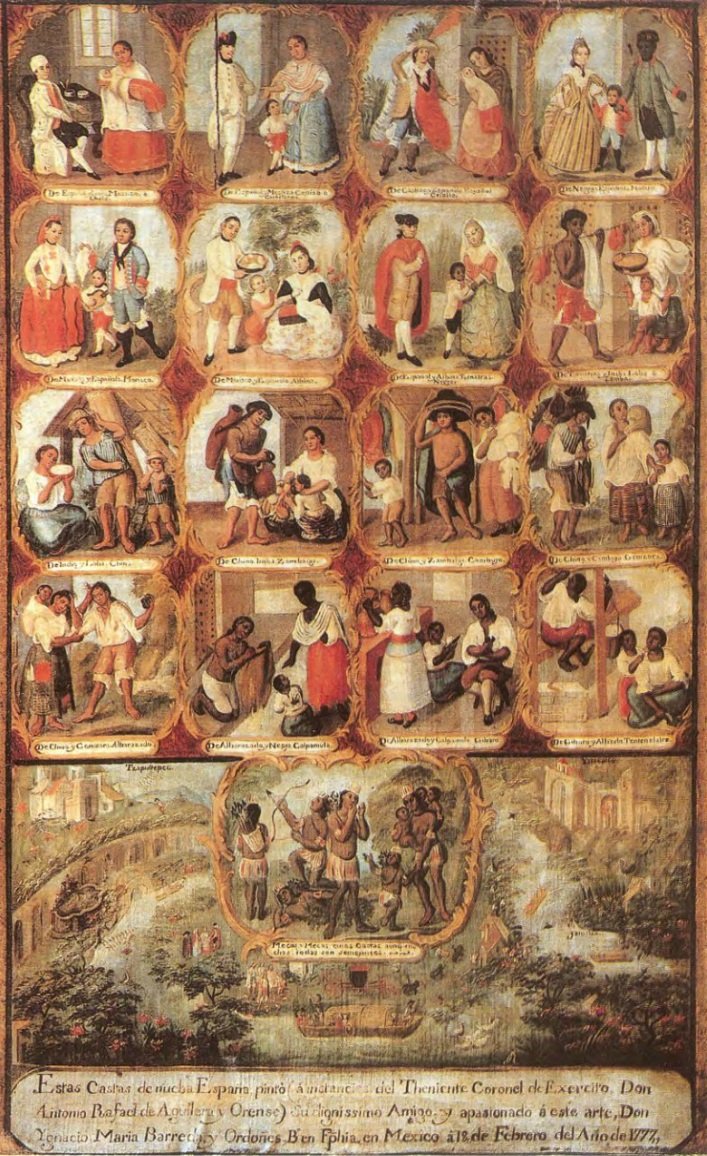
Image: Ignacio María Barreda, Las castas mexicanas (1777), public domain, via Wikimedia Commons.
Sixteen panels, one direction
Eighteenth-century casta paintings made the logic visible. Ignacio María Barreda’s 1777 canvas arranges sixteen family scenes that chart what Fordham University’s Vistas project calls “the progressive dilution of ‘pure’ Spanish, Indian, and African blood,” each panel inscribed with the caste name the mixture produced — mestizo, castizo, mulatto, and on down the grid. Spaniards stand at the top, well dressed. Moving down, the couples grow darker and poorer. The paintings were taxonomy with a destination built in: mixture was graded by how far it had travelled toward Spanishness, and the bottom rungs were reserved for the most mixed and the “barbaric.”
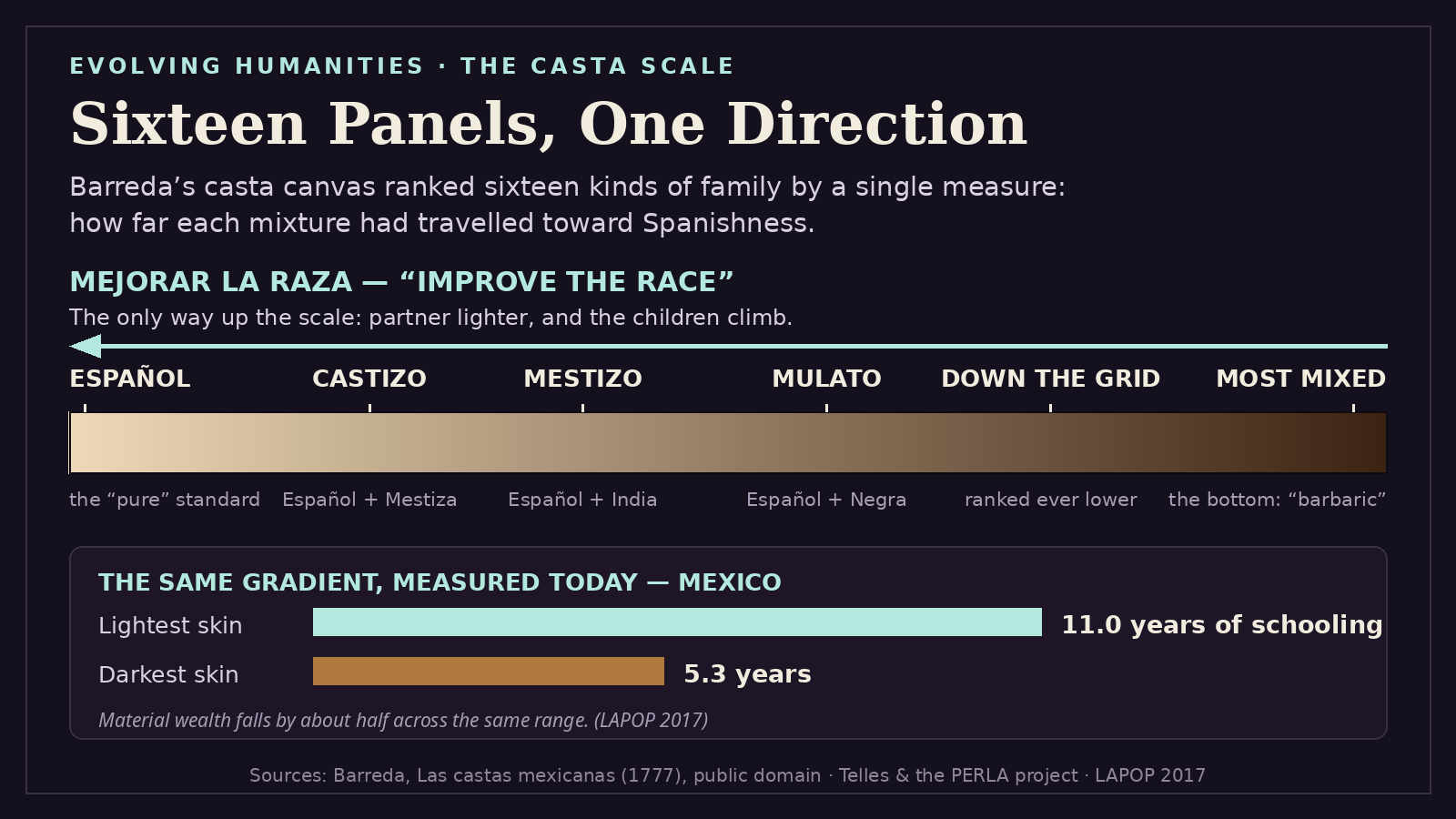
Graphic: Evolving Humanities. The casta scale — the hierarchy Barreda’s 1777 canvas taught, and the gradient modern surveys still measure, drawn from the article’s sources.
What the surveys found
Edward Telles, a sociologist at UC Irvine, set out to test whether that gradient survived into modern statistics. With PERLA, the Project on Ethnicity and Race in Latin America, his team gathered original survey data in Brazil, Colombia, Mexico and Peru — rating respondents’ skin colour directly, not relying only on how people identified themselves. The conclusion of their book Pigmentocracies is blunt: across those countries, “unequal social and economic status is at least as much a function of skin color as of ethnoracial identification.” Writing with Liza Steele in Americas Quarterly, Telles reported that interviewers using an eleven-point skin-colour palette found the most educated respondents consistently had the lightest skin. A 2017 analysis from Vanderbilt’s Latin American Public Opinion Project put numbers on the Mexican slope: the lightest-skinned Mexicans averaged 11 years of schooling, the darkest-skinned 5.3. Moving from the lightest to the darkest tone was associated with a drop of about half in measured material wealth — after accounting for ethnicity, region, rural or urban residence and gender. Telles calls such systems “pigmentocracies,” reviving a word coined by the Chilean anthropologist Alejandro Lipschutz in 1944.
Who gets to be the heroine
Television rehearses the ranking nightly. A 2025 study in the journal Comunicación y Sociedad coded the casts of 27 Mexican telenovelas and found the core of protagonists concentrated in the two lightest skin-tone ranges — lighter, the authors note, than the wider casts around them. Darker-skinned actors were pushed to the edges, cast as domestic workers, service personnel, criminals and police. No significant Indigenous, Afro-Mexican or other ethnoracialised characters appeared in any of the casts. Historian Andrew Paxman, quoted in the study, observed that even heroines written as teachers, orphans “or even scavengers” were white-skinned, often blonde. The authors describe racialisation as operating “furtively,” through casting, as a stratifying criterion — which is the marriage market’s logic rendered visible: the partner worth choosing, like the heroine worth casting, is the lighter one.
Whitening, by law and by jar
Blanqueamiento was once written into law. Brazil abolished slavery in 1888. Two years later, Decree 528 of 1890 subsidised European immigration — “full-bodied” men between eighteen and fifty — while ruling that natives of Asia or Africa could be admitted only with the authorisation of the National Congress. An analysis in the Du Bois Review describes the decree as the framework for a “biological project of racial whitening.” The numbers moved: Brazil’s foreign population rose from about 350,000 in 1890 to over a million by 1900, and employers preferred the newcomers to Black Brazilians, who were often better qualified. The private version of the project sits on pharmacy shelves today. Researchers at Mexico’s Advanced Materials Research Center bought sixteen skin-lightening creams on the local market in Chihuahua and tested them. Six contained mercury at between 878 and 36,000 parts per million. The US Food and Drug Administration’s limit for mercury in creams is under 1 ppm. None of the sixteen carried a warning on its packaging.
The pushback, counted
The inheritance is contested, and some of the contest is now official. Mexico recognised Afro-Mexican peoples and communities in its constitution only in 2019; the 2020 census counted 2,576,213 people — 2 per cent of the population — who identify as Afro-Mexican, Black or Afro-descendant. Brazil and Colombia operate race-based affirmative action policies. Arroyo Pizarro’s Mejorar la raza and its companion, Pelo Bueno, are taught in Puerto Rican schools, turning the family phrase into a classroom argument against itself. And PERLA’s researchers found something pollsters did not expect in countries whose national stories downplay race: multicultural and affirmative policies are widely supported by the populations surveyed.
Analysis: the solvent of mixture
Analysis. Latin America’s official story about itself is mixture, and the story is not false. The PERLA palette works as a research tool precisely because nearly everyone sits somewhere along it; “we are all mixed” describes the population accurately. But the same sentence also disarms the complaint. If everyone is mixed, no one is positioned. If no one is positioned, a 5.7-year schooling gap between the lightest and darkest Mexicans reads as misfortune rather than structure, and discrimination dissolves into the general blur of class and luck. Mejorar la raza survives because it speaks the language of mixture fluently — it is mixture with a direction, mixture managed as a family project, generation by generation, toward the light end of the grid Barreda painted. The hierarchy here does not need a fence. It has a gradient, a proverb, and a mirror in every pharmacy.
Sources
- PERLA (Project on Ethnicity and Race in Latin America), “Pigmentocracies,” UC Santa Barbara — Edward Telles and the PERLA project’s book on skin colour and inequality in Brazil, Colombia, Mexico and Peru. https://perla.soc.ucsb.edu/pigmentocracies
- Edward Telles and Liza Steele, “The Effects of Skin Color in the Americas,” Americas Quarterly, via AS/COA — LAPOP findings on skin colour and educational attainment; the term “pigmentocracy.” https://www.as-coa.org/articles/effects-skin-color-americas
- Daniel Zizumbo-Colunga and Iván Flores Martínez, “Is Mexico a Post-Racial Country? Inequality and Skin Tone across the Americas,” LAPOP Insights, Vanderbilt University, 2017 — 11 versus 5.3 years of schooling by skin tone in Mexico; wealth effects net of controls. https://www.vanderbilt.edu/lapop/insights/ITB031en.pdf
- Vistas: Visual Culture in Spanish America, 1520–1820, Fordham University — Ignacio María Barreda’s 1777 casta painting and the logic of “progressive dilution.” https://vistas.ace.fordham.edu/themes/mestizaje-images-06/
- “Racial Whitening as a Global ‘Innovation’,” Du Bois Review (Cambridge University Press) — Decree 528 of 1890 and whitening as Brazilian state policy. https://resolve.cambridge.org/core/journals/du-bois-review-social-science-research-on-race/article/racial-whitening-as-a-global-innovation/2675EBB583BEE2C057ED301018F153D2
- André Dorcé Ramos and Rodrigo Roque de Castro, “Telenovelas and Racism in Mexico: Towards an Ethnophenotypic Analysis of the Audiovisual,” Comunicación y Sociedad, 2025 — skin-tone analysis of 27 Mexican telenovela casts. https://comunicacionysociedad.cucsh.udg.mx/index.php/comsoc/article/download/e8912/6805
- Claudia P. Peregrino et al., “Mercury Levels in Locally Manufactured Mexican Skin-Lightening Creams,” International Journal of Environmental Research and Public Health, 2011 — six of sixteen creams contained 878–36,000 ppm mercury. https://rcastoragev2.blob.core.windows.net/bc64049e014026c41976777856568b03/PMC3138038.pdf
- Celia M. Ayala Lugo, “Pelo Bueno and Mejorar la Raza: (Re)Building our Puerto Rican Literary Canon,” Caribbean Philosophical Association — the phrase as elders use it, and Arroyo Pizarro’s picture books. https://caribbeanphilosophy.org/blog/rebuilding-our-puerto-rican-literary-canon
- “Afro-descendant community makes up 2% of the Mexican population,” Yucatán Magazine, reporting INEGI’s 2020 census and the 2019 constitutional recognition. https://yucatanmagazine.com/afro-descendant-community-makes-up-2-of-the-mexican-population/
- UC Irvine School of Social Sciences, summary of the Los Angeles Times report “Mexico’s new racial reckoning” (2022) — Telles on Mexico as a “pigmentocracy.” https://www.socsci.uci.edu/newsevents/news/2022/2022-10-20-telles-la-times.php
—