Listen to this article
Take the story with you. Choose a voice and a pace that suits you.
Or listen in another language / choose a voice
Getting your device voices ready…
The voice follows the displayed language and your browser’s regional preference when available. You can choose another narration voice.
A research synthesis — prepared 22 November 2026
Method, briefly: eight research lanes were run in parallel — the source reel itself, the central figure, the creator ecosystem, the ideology, the harm record, the exploitation cases, the comment sections, and the counter-voices. Every lane was then audited by an independent checker who re-fetched its sources, and every correction the audits raised — sixty-seven in total — was applied and verified before this article was written. Claims below sit in three tiers, and the tiers are kept visible: what is verified, what is credibly reported, and what could not be established at all. Where the evidence contradicts the framing this investigation set out to test, the contradiction is printed, not buried. Criminal matters are described at their exact procedural status: charged is not indicted, indicted is not convicted, and everyone named below who faces charges denies them or has pleaded not guilty unless stated otherwise.
1. The reel that started it — and what it actually is
The Instagram reel that prompted this research is two minutes long, and it is not what it first appears to be. It is not made by a looksmaxxing creator, and it is not an insider’s exposé. Its author is Jason Christian Vukovich, who posts as @therealalaskanavenger to roughly 337,000 followers. Vukovich is a predator-accountability vigilante: in 2016, as a survivor of childhood sexual abuse, he used Alaska’s public sex-offender registry to find three convicted offenders and attacked them with a hammer. He pleaded guilty in 2018, served about eight years of a 23-year sentence, and was paroled in late 2024. He now runs a channel built on a single thesis, which the reel states plainly: judge people by their conduct, not by their fame, their church, their politics or their follower count.
The reel, posted 21 November 2026 under the caption “TOUR FAVORITE INFLUENCERS ARE FALLING!” — the first word apparently a typo for “YOUR” — welds four criminal cases into one “influencers gone deviant” wave. All four cases are real. But they are four separate matters, in four states, spread across twelve months, and only two of the four men are looksmaxxing creators:
- Braden “Clavicular” Peters, the looksmaxxing streamer, indicted on 13 November 2026 in Massachusetts on two counts of rape and one count of providing alcohol to a minor, over an alleged May 2025 incident involving a 17-year-old. He has pleaded not guilty and denies the allegations through counsel.
- Mason “Hullo” Hull, an 18-year-old looksmaxxing TikTok creator, arrested in Florida in May 2026 and charged with fifteen counts of possessing child sexual abuse material. He has pleaded not guilty. The reel calls him one of Peters’s “little acolytes”; no source establishes any such relationship.
- Brian Divine, a 44-year-old fitness creator in Indianapolis, arrested in November 2025 — a full year before the reel — on six counts of child seduction. He has no looksmaxxing affiliation in any source.
- Adam Cease, a TikTok creator in California, indicted by a federal grand jury on 19 November 2026 for coercion and enticement of a minor and distribution of child sexual abuse material. Also no looksmaxxing affiliation in any source. The reel claims he faces “30 years minimum”; the Justice Department’s own release gives a mandatory minimum of ten years on the enticement count and five to twenty on the distribution count. There is no thirty-year minimum. That claim fails.
Named in the reel Who he is Status (22 Nov 2026) Looksmaxxing creator? Braden “Clavicular” Peters The scene’s biggest streamer Indicted 13 Nov 2026 — two rape counts + alcohol misdemeanour; pleaded not guilty; denies all charges Yes Mason “Hullo” Hull Looksmaxxing creator, ~400k followers Charged May 2026 — 15 counts of CSAM possession; pleaded not guilty; bond revoked June 2026 Yes Brian Divine Fitness creator, 44 Arrested Nov 2025 — six child-seduction counts; a year old, bundled by the reel without disclosure No Adam Cease TikTok creator Federally indicted 19 Nov 2026 — coercion/enticement + CSAM distribution; alleged, not proven No
So the reel is evidence of something real, but something slightly different from what it announces: it is evidence of an accountability wave hitting the looksmaxxing scene from outside — a vigilante commentator using the scene’s two freshest scandals as hooks — not of the scene policing itself, and not of a single connected crime wave inside it. Its comment section, all 43 retrievable comments, contains not one person who discloses being a minor; three comments reference children as victims, several trade scene in-jokes about the accused men’s stats, and at least three accuse Vukovich himself of using edited footage — an accusation this research could not resolve either way. The young register of the slang suggests the scene’s audience is present in his comments. It does not prove any individual commenter is a child, and nothing below pretends otherwise.
That distinction — between the wave framing and the underlying record — turns out to be the pattern for the whole subject. Almost everything about looksmaxxing is simultaneously worse than its defenders admit and more specific than its critics claim. The rest of this document tries to keep both halves of that sentence true at once.
2. The star: Braden Peters, called Clavicular
Braden Eric Peters was born in December 2005 and raised in Hoboken, New Jersey. He is twenty years old. By February 2026 the New York Times was profiling him under the headline “Handsome at Any Cost,” GQ and the Guardian followed within days, and by November he had roughly 1.2 million followers on TikTok and 463,000 on Kick. The Associated Press calls him the face of the looksmaxxing trend. His handle comes from the scene’s obsession with clavicle width as a marker of male attractiveness.
His biography, by his own account to those outlets, is the pipeline in one life. He found Looksmax.org — the scene’s flagship forum — at fourteen, during lockdown, when he was, in his words, online fourteen hours a day. He began injecting testosterone at fourteen. He hid supplements from his parents. He was expelled from Sacred Heart University after three weeks, he says, over peptides and steroids. He became a moderator on the forum that raised him, then a streamer, then the most famous looksmaxxer alive.
His fame was not organic in any simple sense. It was manufactured by a paid clipper army: hundreds of people paid to cut his long Kick livestreams into short clips and flood TikTok with them. He told GQ he had 950 clippers, paid $30 per thousand views. Bloomberg, citing the agency that runs the operation, counted 1,737 clippers, some 70,000 clips, and roughly 2.2 billion views in March and April 2026 alone. The New York Times reported that by February 2026 he was earning more than $100,000 a month from Kick. He sold a course and community — the “Clavicular System,” later “Clavicular’s Clan” — at about $50 a month, with guides on how to “ascend” and on which peptides to inject. In August 2026 he pivoted toward a sponsorship from Duel, an online casino.
What he teaches is documented mostly from his own mouth. He has described hitting his own facial bones with a hammer — “bonesmashing,” the scene’s practice of inducing micro-fractures in the belief the bone heals back stronger. He has admitted using methamphetamine as an appetite suppressant, “to remain thin.” He has taken testosterone since fourteen and says it left him infertile by 2025. His daily regimen, given to the Times, included testosterone, Accutane, the experimental weight-loss drug retatrutide, and nebivolol. In November 2025 a video circulated of him injecting his then-seventeen-year-old girlfriend with fat-dissolving peptides to reshape her jaw; on a later stream he injected another influencer with Aqualyx, a fat-dissolving acid. He has discussed planned double-jaw surgery costing around $30,000. In April 2026 he collapsed on a livestream in Miami and was hospitalised; the combination of substances reported around the collapse was never officially confirmed, and he afterwards denied overdosing, saying he had not eaten and had drunk too much — while also acknowledging, a month later, that he had been “overdoing” stimulants.
The platforms have pushed back in pieces. YouTube terminated his original channel in November 2025 for facilitating access to sites illegally selling regulated goods, then terminated two more channels in April 2026 and permanently banned his return attempts for ban evasion. Kick banned him temporarily after a December 2025 livestream in which he accelerated a Tesla Cybertruck with a man on its hood and, asked if the man was dead, answered “Hopefully.” No charges were reported over that incident. TikTok and Instagram never banned him at all.

His legal record, kept in strict order, is this. In Florida in March 2026 he was charged with misdemeanour battery and criminal conspiracy over a staged fight filmed for content; the charges were later dropped. In April 2026 he pleaded to unlawfully discharging a firearm in public — he had shot a dead alligator on a livestream — receiving six months’ probation, with related charges dropped that August. And in Massachusetts: a clerk-magistrate found probable cause on 4 September 2026; a criminal complaint issued on 8 September charging rape, drugging a person for sexual intercourse, and procuring alcohol for a minor; he pleaded not guilty on 22 October, posted $10,000 bail, surrendered his passport, and was ordered to stay away from the complainant and post nothing about her. On 13 November 2026 a Barnstable County grand jury indicted him on two felony counts of rape and the alcohol misdemeanour. The drugging count does not appear in the indictment. He awaits arraignment in Superior Court.
| Date | Event |
|---|---|
| 23 May 2025 | Alleged offence in Chatham, Massachusetts; complainant 17, Peters 19 |
| 4 Sep 2026 | Judge finds probable cause |
| 8 Sep 2026 | Criminal complaint: rape, drugging, procuring liquor for a minor |
| 21–22 Oct 2026 | Camp Looksmax profiled; Peters pleads not guilty; $10,000 bail; passport surrendered |
| 8 Nov 2026 | Camp Looksmax advertised on his Instagram — after arraignment |
| 13 Nov 2026 | Grand jury indictment: two felony rape counts + liquor misdemeanour; drugging count dropped |
He is indicted, not convicted. He denies everything, and his lawyer says the encounter was consensual.
The complaint’s account — and it is an account, an allegation a grand jury found sufficient to indict on, not a finding of fact — is the most consequential document in this entire research file. It alleges that Peters met the complainant through Instagram messaging; that he paid her to appear in “looksmaxxing” videos he streamed; that on 23 May 2025 he sent an Uber to bring her from her grandparents’ home to his family’s house in Chatham while he livestreamed on Twitch; that he knew she was seventeen, gave her vodka, and told her to tell viewers she was eighteen and to call the vodka “water,” so the stream would not be banned; that she became intoxicated, and that he raped her after she fell asleep. A parallel civil suit in Miami-Dade County, Florida — a separate matter, concerning an alleged November 2025 incident in which he is said to have injected the complainant’s face with Aqualyx during a livestream — pleads battery, fraud and emotional-distress claims in its amended form. Peters disputes those allegations too.
Two cautions belong here because the record demands them. First, one New York Post article described the Massachusetts rape charges as having been “dropped” in October. That is contradicted by the arraignment and the indictment, both later and both court-documented; the indictment is the true position. Second, no verified figure exists anywhere for what share of Peters’s own audience is under eighteen. Surveys of American men aged 18–29 (Equimundo/YouGov, 2026) find 55% recognise him and 10% follow him, and that among those familiar with him he is among the least liked and trusted figures tested. Commentary describes a large following among younger boys. A precise percentage of minors does not exist, and any article that prints one is inventing it.
3. The machine around him
Clavicular is the famous end of a layered industry, and the layers matter more than the man, because the layers will survive him.
At the respectable top sits the rating industry. QOVES Studio, with about a million YouTube subscribers and nearly 400 million views, produces polished facial-aesthetics explainers that carry the forum rating system — harmony, angularity, ratios — to a mainstream audience in scientific dress, and sells facial-analysis reports. Face IQ, with around 200,000 subscribers, does the cruder version: numerically scoring subscribers’ faces on camera (“around a 2.5… below a bottom 1% face”), selling private analyses, and running a paid academy at $29 a month. The older blackpill lecture channels, Wheat Waffles and Rehab Room, supply the doctrine in long form. The pattern to notice is that the rating itself is the product: the score is sold first, then the fix for the score.
Above and beside them sits an older establishment. Dr Mike Mew, in his fifties, a qualified dentist and the inheritor of his father’s “orthotropics” doctrine, has about 649,000 YouTube subscribers for his “mewing” content — tongue posture as facial destiny. He is the likeliest first looksmaxxing video a boy ever sees. In November 2024 the General Dental Council struck him off the UK dental register over his treatment of child patients, calling advice in his videos misleading; his appeal was dismissed in May 2026. He monetises through an app, consultations, and — since November 2026 — a paid clipping campaign of his own, industrialising the same clip-farm method that built Clavicular.
The money layer is the coach-schools. Kareem Shami, “SyrianPsycho,” mid-twenties, with around 1.8–1.9 million TikTok followers, runs Mogwarts, a paid community reported at $10–19 a month with two to three thousand members, weekly classes and guest lectures from Mew and others; Business of Fashion reports his $49.99 “debloating” powder sold some 32,000 units on TikTok Shop. Oscar Patel, twenty years old, runs what by membership is the largest looksmaxxing school on the Skool platform: roughly 6,500–7,200 members at $39 a month, which Business of Fashion calculated at about $257,000 a month — recruited entirely from free short-form video, with no age gate identified in any source consulted. Dillon Latham built 1.7 million TikTok followers on mewing and grooming tips, was eighteen when the New York Times profiled him, and was a minor for much of his rise; Agence France-Presse singled out his video instructing followers to whiten their teeth with hydrogen peroxide applied on a cotton bud.
Below them churns the Kick streaming layer — Androgenic, Cookie King, Zeta, Nocturnal Kent, Baby Stickley and a bench of ranked personas — whose hours of livestream are clipped for TikTok and who compete on kayfabe ranking boards, the “Official Chad Rankings,” as if faces were league positions. And beneath everything sit the forums, Looksmax.org above all: founded in 2018, somewhere between 100,000 and 150,000 members, where the doctrine is kept, the ratings are binding, and the next cohort of creators incubates. Clavicular was a moderator there. The pipeline is a loop: forums mint creators, creators recruit through clips, clips deliver new boys to the forums.
Researchers have mapped the conveyor. Dublin City University’s Anti-Bullying Centre gave blank phones personas of teenage boys interested in fitness, gaming and sport; every account was served manosphere content within 26 minutes, including accounts that never searched for it. A UCL/University of Kent study found misogynistic content rising from 13% to 56% of recommendations to teen-boy personas within five days. The Institute for Strategic Dialogue describes the soft end — mewing, skincare, “debloat” — as deliberate rebranding: incel ideology in palatable language that evades platform bans. A peer-reviewed case study of Clavicular’s rise models it as a five-stage “containment failure”: slang incubates in the forums, infrastructure assembles around the streamer, controversy breaks containment, mainstream coverage certifies the fame, and finally the persona becomes public parody, repeated far beyond the scene. At every stage of the conveyor, the person profiting is older than, or institutionally separate from, the teenager being rated.
4. The doctrine, tested: is it built on a Eurocentric hierarchy?
This research was commissioned to test a specific thesis: that looksmaxxing is framed on white supremacy and Eurocentric beauty standards. This site has followed the longer history of the displayed and ranked body, from Sara Baartman to the present. Tested against the scene’s own texts and the independent scholarship, the thesis holds in a structural form and fails in its cartoon form. Both halves matter.
The origins are not in dispute. “PSL” — the rating system’s name — is an initialism for three successive forums: PUAHate, founded in 2009 by disappointed pick-up artists who had concluded that technique does not overcome looks; SlutHate, founded in 2014 days after the Elliot Rodger killings closed PUAHate; and Lookism.net, created the same year. Looksmax.org followed in 2018–19 as the self-improvement-facing successor, carrying the same users, the same rating culture and the same doctrine: the blackpill, the fatalist belief that looks and genetics fix a man’s fate. Looksmaxxing is not a grooming trend that picked up stray forum slang. Its core institution — scoring faces against a fixed hierarchy and treating the score as a life sentence unless surgically revised — was built inside those boards.
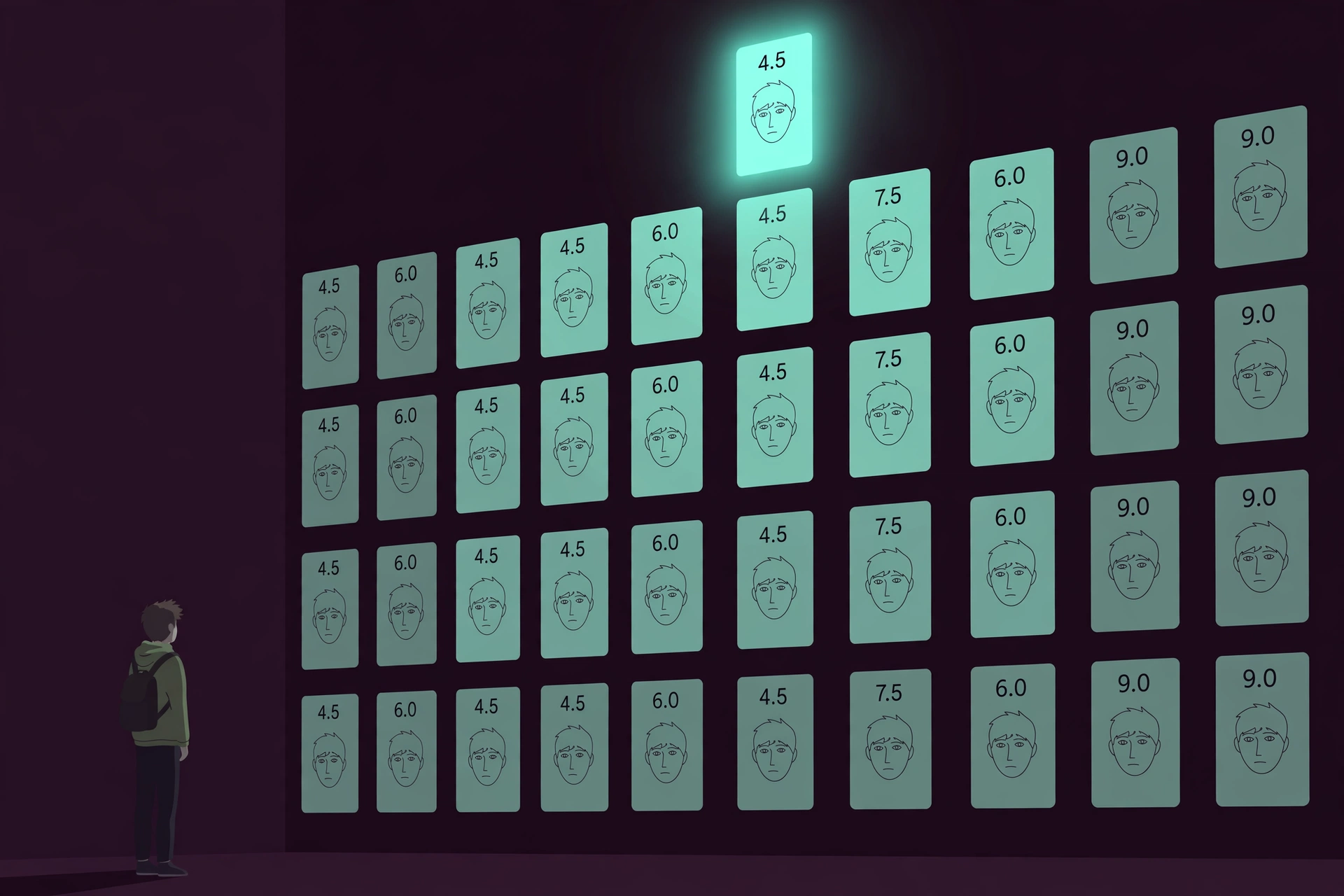
The hierarchy’s own texts are the strongest evidence about its content. The Incel Wiki’s glossary defines “Chad,” the top male archetype, as a physically attractive male, “typically white,” and then derives the rest of humanity from him as named ethnic variants: Tyrone for Black men, Chaddam for Arab men, Chadpreet for Indian men, Chang for East Asian men. The bottom of the scale is labelled “Subhuman” — the wiki reserves its zero rating for people “considered Subhuman by most,” naming burn victims and Joseph Merrick as examples. The wiki’s ceiling bands, the faces rated 7 and 7.5 out of the system’s effective maximum, are overwhelmingly European-descended: Sean O’Pry, David Gandy, Jordan Barrett, Francisco Lachowski, Henry Cavill, Brad Pitt. Non-European men appear — Jeremy Meeks, Zayn Malik, the forum user Salludon — as exceptions processed by the same apparatus, and the ratings themselves are chaos: the same face scores 6 in one “objective” thread and above 7 in another, which would fail any measurement standard the scene claims for itself.

The scene maintains dedicated doctrine for race. The “racepill” and “JBW” — “Just Be White” — theory hold whiteness to be the highest sexual-market value. A peer-reviewed thematic analysis (Gheorghe, Affilia, 2024) documents “whitemaxxing,” the prescribed approximation to it: skin bleaching with hydroquinone, light contact lenses, hair dye, lying about ethnicity, legal name changes, double-eyelid surgery, rhinoplasty for a thinner nose — and finds that participants largely conclude the techniques do not work, converting aspiration into resentment. One Looksmax.org phenotype guide, read directly during this research, states an explicit ethnic ordering — White above Latino above Black above Asian above Middle Eastern above South Asian — and crowns a type called North Atlantid whose superiority it explains as blue eyes with pale skin and dark hair, “the most high-contrast possible coloration while still being unmistakably white.” That exhibit must be handled honestly: two independent attempts to re-reach the thread failed, so it stands here as reported, not verified, and is not quoted as settled until it can be pinned to an archived copy. But the phenomenon it documents is corroborated by a guide that can be re-checked — a 2023 Looksmax.org text stating that non-Caucasoid bone structure is “subhuman compared to Caucasoid bone structure” and that good-looking non-white men are said to have Caucasoid features. That one is verified, in the forum’s own words.
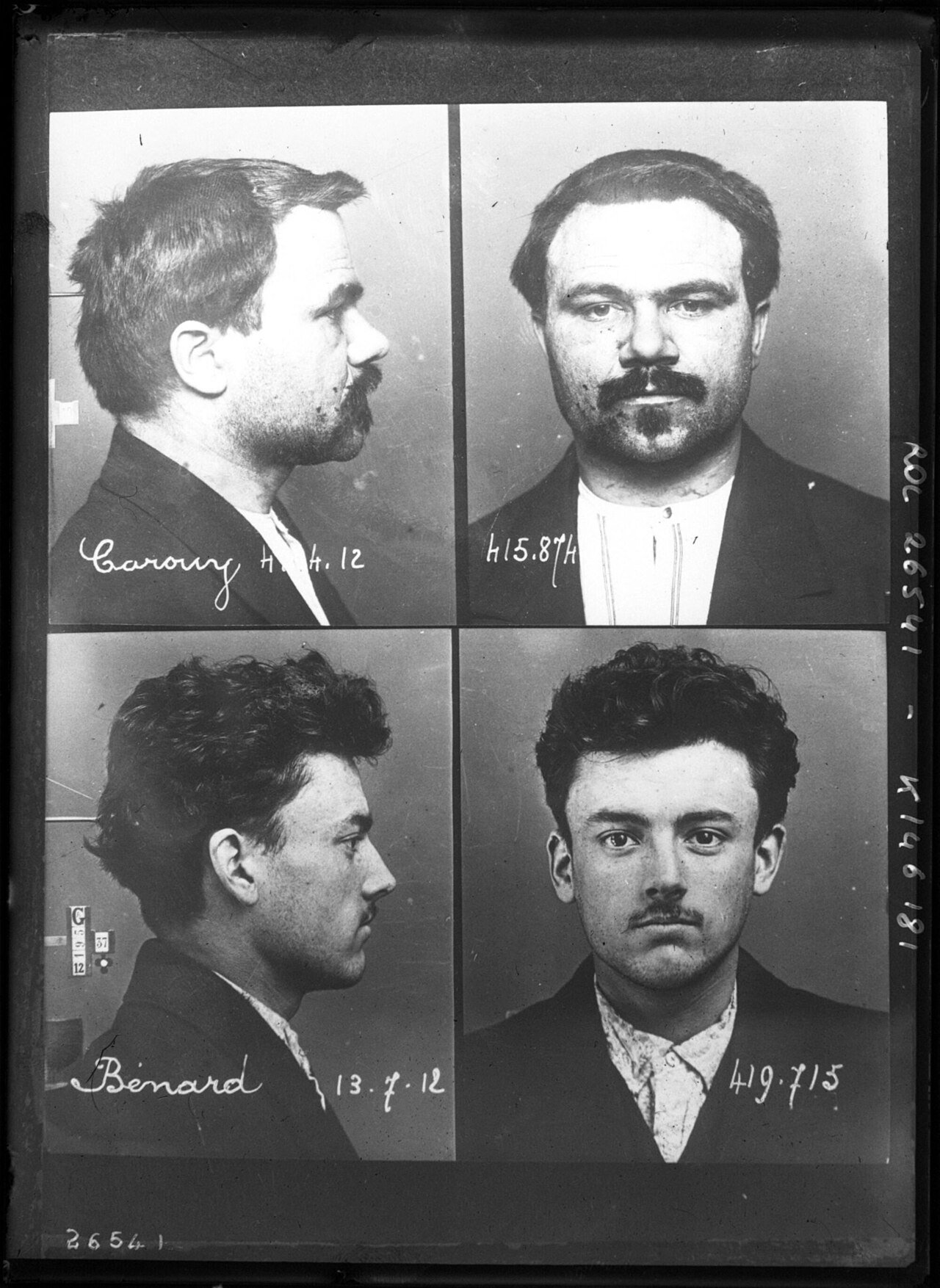
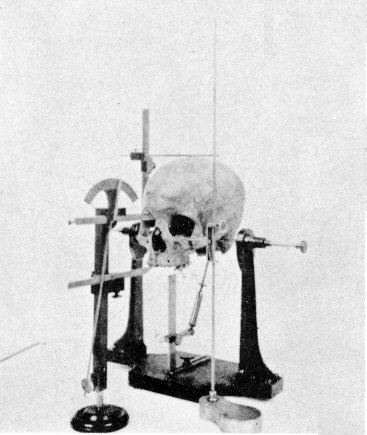
The measurement apparatus itself is inherited. The phenotype guides classify skulls as dolichocephalic, mesocephalic, brachycephalic — the cephalic vocabulary of nineteenth- and early-twentieth-century physical anthropology — and sort men into Nordid, Mediterranid, Alpinid and Armenoid sub-races drawn from sites cataloguing the racial types of a discarded science. The forum’s own guide concedes the taxonomy is “anthropological work done in the 20th century which has long since fallen out of fashion (guess why).” What cannot be shown is intent at the origin: no source found shows the founders citing phrenology or race-science texts as inspiration. The documented relationship is inheritance of vocabulary and method — skull indices, sub-racial types, worth inferred from bone structure — not a proven chain of citation. The wiki itself links its rating system to pages on physiognomy and eugenics, which tells you the adjacency is not a critic’s invention; it does not tell you anyone planned it.
The wider scholarship supports the gradient the scene worships, while refusing the scene’s conclusions. Colourism is one of the better-replicated findings in stratification research: in Hersch’s 2008 study of new immigrants to the United States, the lightest-skinned earned on average 17% more than the darkest-skinned with comparable qualifications; Woo-Mora’s 2025 study of 80,000 respondents across 25 Latin American and Caribbean countries found each step darker on the tone scale associated with about 2.7% less income, roughly 20% between darkest and lightest — within racial categories as well as across them. In rural Nicaragua, Jucker and colleagues found that more television exposure and more schooling predicted stronger preference for whiter faces, in communities with little direct contact with Europeans — close to a natural experiment on what imported media teaches. Endorsing Eurocentric beauty standards significantly predicts depression and anxiety in Black women (Williams et al., 2025), with strong identification with one’s own group buffering the effect — the precise opposite of the looksmaxxing prescription. At the same time, the honest complications are real. Cross-cultural agreement on attractiveness exists (Langlois et al., 2000); the scene did not invent beauty judgment. But agreement is asymmetric — raters in both Scotland and South Africa agreed more about European faces than African ones, which is what a media-familiarity account predicts — and the 2026 Springer Handbook of Beauty and Inequality review finds the health-and-fertility signalling story behind specific “ideal” traits largely unsupported where it has been tested at scale: masculinity did not predict male attractiveness in the cross-cultural data, and the golden ratio does not appear in measured attractive faces. The hierarchy’s specific ladder — its ratios, its phenotype ranks, its white default — is not a readout of biology. It is doctrine wearing a lab coat.
And the membership complicates the slogan. By survey self-reports, roughly a third to a half of the incel and looksmaxxing population is non-white. Much racepill writing is not celebration of the hierarchy but grievance at it, written by men who place themselves at its bottom and experience it as a hostile fact. No founder’s manifesto of race science exists in the record. So “white supremacist movement,” as a description of a conscious, organised programme, is not what the evidence supports — and an article asserting it will be rebutted, correctly, with the demographics. What the evidence does support is the structural claim, which is harder to escape: a standard whose own texts define the universal ideal as typically white, file every other group’s ideal as an ethnic derivative, rank faces by their distance from European features, preserve the catalogues of a discarded racial anthropology, and prescribe bleaching, lenses and surgery to the boys it ranks lowest — while telling them the approximation will fail. Two sociologists who studied the diffusion put it precisely: whatever individual users intend, the apparatus cloaks scientific racism in the language of self-improvement and legitimises it through ostensibly neutral, scientific rhetoric. Looksmaxxing did not invent the Eurocentric hierarchy. It inherited one that demonstrably exists and demonstrably costs people income, schooling and mental health — and gave it numbers, a vocabulary, and an algorithm.
5. The harm record: what is documented, and the line where documentation stops
Begin with the strongest negative finding in this investigation, because everything else must be read under it: no coroner, medical examiner, inquest or court has attributed the death of any identified looksmaxxing participant to looksmaxxing or its practices. Not one. Any sentence in any article that says otherwise is ahead of the record. What the record does contain is a clinical literature that has begun naming the scene, a set of deaths whose causation is officially unresolved, a documented complication trail for the procedures the forums promote, and an exposure experiment that should worry any parent.
The clinical record first, because it is the firmest ground. In November 2026 the Journal of Adolescent Health published a commentary led by Dr Kyle Ganson of the University of Toronto warning that looksmaxxing “exposes adolescent boys and young men to severe psychological and physical harms,” naming starvation, unregulated steroid and peptide abuse, chemical skin whitening and bonesmashing, and setting out a screening protocol for clinicians. Ganson’s own framing is the fairest sentence in the whole debate and deserves quoting against caricatures in both directions: looksmaxxing “exists on a spectrum, and it is important that we do not automatically pathologize normal grooming, exercise, or appearance-related behaviours… At the same time, clinicians need to recognize when these behaviours become extreme, unsafe, or connected with significant distress and impairment.” Professor S. Bryn Austin of Harvard and Boston Children’s Hospital told Harvard’s news service in October 2026 that her colleagues “have been alarmed by recent cases of boys and young men showing up in the emergency department with injuries related to looksmaxxing practices,” and that peptides sold online by influencers are often unapproved, their contents unverifiable, their sellers without medical credentials. The underlying population data is substantial: probable muscle dysmorphia in 2.8% of Canadian and American males aged 15–35 in one peer-reviewed sample; 25.7% of boys and men screening at clinical risk in a national Canadian sample of 2,256; 11% of males aged 16–25 in a large cohort reporting use of muscle-building products. In New South Wales, health authorities recorded 1,180 peptide-related emergency presentations between July 2025 and September 2026. The one coronial finding in the entire file that attributes a death to this product class concerns a 75-year-old man, the actor and stuntman Richard Norton, whose death a Victorian coroner found was triggered by unapproved peptide injections. He was not a looksmaxxer. The finding matters because the same compounds — CJC-1295, ipamorelin, retatrutide — are the ones marketed to teenagers as growth and skincare protocols.
The surgical record is peer-reviewed and specific. A 2024 case report in JPRAS Open describes a 28-year-old who booked bilateral cosmetic limb-lengthening in Turkey through a WhatsApp “consultation” he could not confirm was with a surgeon, and presented to an Irish emergency department with a chronically discharging hip wound, ten kilograms lighter and anaemic. A series reported from the Annals of the Royal College of Surgeons of England counts seven NHS patients treated for complications after leg-lengthening abroad in five years, two requiring major corrective surgery. The demand pipeline is documented from the other side too: Australian surgeons described “Jay,” a young man who found limb-lengthening in looksmaxxing forums — which named doctors and listed prices — and was quoted $50,000 to $100,000. He hesitated. The forums’ role in his story was to hand him the menu.
Then the deaths, each held at exactly the height its sourcing supports. Diego Peña Gonzalez, known on the forums as Schery6, was sixteen, autistic, and active on Incels.is, Looksmax.org and Discord from fifteen. He died by suicide on 2 June 2023. His mother’s statement — the family’s own account — says he was bullied at school for how he looked, dressed and talked, that the family sought therapy and medication, that he called her on the day he died saying he was sorry and that he was “too ugly for the world,” and it blames the school district’s refusal of homeschooling and the railway’s safety failures. It does not name the forums. The forums’ own record shows members had mocked him — one wrote afterwards, “I didnt know he would actually rope just cause we called him subhuman” — and the forum later voted him its posthumous User of the Year. No authority has apportioned causation, and honest copy preserves that shape exactly: a bullied, depressed teenager, deep in these forums, whose family blames a school and a railway. A seventeen-year-old creator known as Melo, who posted his own drug “cycles” — testosterone, trenbolone, insulin, clenbuterol, and DNP, an industrial chemical misused as a fat-burner with no antidote and a narrow margin between a tolerated dose and a fatal one — died in November 2026. The community attributes his death to DNP. No official cause of death exists in the record, and the attribution remains the community’s. Connor Murphy, a 32-year-old fitness creator in the orbit of the enhancement influencer Tony Huge, drowned in Thailand in July 2026, according to Thai police an apparent drowning with no signs of assault; no authority links his death to any practice. Around Huge himself — the precursor scene’s central figure, a former bankruptcy lawyer in Pattaya who promoted steroids and experimental compounds for a decade — two associates are dead in unresolved circumstances and a third case remains an open Thai police file; Huge has been charged with no crime in connection with any of them. A commentator at Daily Inference, reviewing the documentary record, wrote the sentence this article adopts as its standard: “The deaths are real and grave. What caused them is not established in public, and nothing reported so far shows that looksmaxxing or any substance killed anyone… selling certainty nobody has earned.”
The exposure evidence is newer and, in its way, the most damning material here, because it does not depend on any individual tragedy. The Centre for Countering Digital Hate — an advocacy and research organisation, labelled as such — registered six TikTok accounts as thirteen-year-old boys signalling body anxiety and recorded what the recommender did. Harmful looksmaxxing content — steroid promotion, peptide injection, bonesmashing, surgery promotion — arrived within eight minutes. Suicide and self-harm content arrived within five minutes on one account, and rose nineteen-fold as the accounts engaged. By the second hour, seven in ten recommended posts concerned body image or looksmaxxing, and one in four violated TikTok’s own written policies. TikTok’s guidelines do prohibit this content; the documented failure is enforcement, and TikTok has separately rejected the European Commission’s preliminary finding, under the Digital Services Act, that its recommender creates rabbit holes for vulnerable users. No looksmaxxing-specific statement from Meta or YouTube was located at all. The surveys around the experiment agree on scale: about two-thirds of males aged 16–25 regularly consume masculinity-influencer content (Movember); three in four boys aged 11–17 regularly encounter masculinity content (Common Sense Media); the UK Centre for Young Lives found 61% of boys following at least one masculinity influencer and documented the terminology entering school culture. TikTok’s own data, reported by the BBC, counts more than 300,000 looksmaxxing searches a day in February 2026, peaking at 1.9 million in late March — and the search term “bone smashing” is banned, which is to say the demand routes around the block by spelling.
6. The comment sections: what the audience actually says
Research for this project read comment sections the slow way: five sources end to end, every text-bearing comment counted — 132 in all, 63 from TikTok and 69 from two Looksmax.org rating threads — coded by a single coder into one primary category each, with the method and its limits printed in the underlying research file, including an honest appendix recording which splits can be re-derived from it and which rest on the author’s coding record.
The counted sample is not mostly despair; it is mostly machinery. Neutral chatter is the largest block at 28%. Ratings requested and given are 19.7%. Guru worship is 14.4%. Pushback and mockery of the scene are 16.7% — and on Clavicular’s own TikTok post, pushback is the dominant register: the top comment there, with 421 likes, reads “Furthest I ever went in terms of ‘looksmaxxing’ was get a haircut, go to the gym, and some skincare.” Self-hate and blackpill hopelessness are 16.7% overall. But the platform split is the finding: on TikTok, self-hate appears twice in 63 comments, usually phrased upward, as a question to the guru — “is it over for me?” In the forum threads, ratings and self-hate together are 61% of all posts, and self-hate alone is 20 of 69 posts, 29% — because the forum is where a boy has explicitly asked strangers to grade his face, and the grades are binding.
| Category | Share of 132 counted comments |
|---|---|
| Other / neutral | 28.0% (37) |
| Ratings given or requested | 19.7% (26) |
| Self-hate / blackpill | 16.7% (22) |
| Pushback / mockery | 16.7% (22) |
| Guru worship | 14.4% (19) |
| Suicide references | 2.3% (3) |
| Racial ranking | 1.5% (2) |
| Sales funnel | 0.8% (1) |
Read individually, the forum material is the hardest in this investigation. In one rating thread, a poster who states he is eighteen and describes his Pakistani father is told he is “currently below LTN facially with ethnic failo which makes you practically invisible,” that he needs “at least 3 invasive surgeries” to reach the lowest normal tier, that he is “Subhuman currently,” and that skincare “along with skin whitening” might elevate him to a 2 or 2.5. The only moderation visible in that thread is a moderator instructing a rater to add advice so the post would not count as low-effort. In another thread, a boy who states “I’m 16 approaching 17” posts his face for surgery recommendations, is told “no surgery can fix you, over,” and asks, verbatim, “Should I just rope?” The recorded reply, verbatim, is “definitely.” Adults in the same thread advise him: “Just genioplasty.” “Yes you just cut the bone.” A third thread, opened by an eighteen-year-old announcing he will kill himself that night — his post attributes his state, in his own words, to months of looksmaxxing and a daily “overdose on blackpill” — draws genuine pleas to stop, and also: “Not worth it. Go ER instead,” invoking Elliot Rodger; “I’ll be roping soon too”; and “Can you live stream it?” Whether that poster lived is not established by anything in the record and must not be asserted either way.
These quotations carry a caveat that honest work requires stating here rather than in a footnote: they were read directly on Looksmax.org by the researcher, but the forum’s threads could not be re-reached by the independent auditor, and repeated attempts to capture a screenshot archive of the most serious exchange failed. They are internally consistent and consistent with everything the auditor could verify — including another forum thread the auditor did open in full — but before any of them is used as the centrepiece of a published article, the page capture should be secured. In dedicated race threads, read separately, the vocabulary is systematic rather than incidental: “ricecel,” “currycel,” “ethnic failo,” and one poster describing his surgical plan, in his own term, as “white-affirming surgeries” — a Le Fort procedure “to look white/hapa passing,” after which, he writes, he might find a white partner and have “white passing, non-subhuman” children. The only pushback in that thread is a reply finding the term funny.
The sales funnel runs inside the comments, not beside them. A rating creator’s videos end with on-screen text inviting viewers to comment “rate” for a private analysis — the comment section is the intake form. Inside the sixteen-year-old’s thread, mid-argument, he posts his Discord handle so strangers can inspect his face on a call, and reports being rated simultaneously in the forum and on a Discord server. Journalism from inside a looksmaxxing Discord describes a face-rating channel with paid “verified face-raters” charging up to €30. A forum thread prices a celebrity surgery consultant at $200 a consult, with a dissatisfied customer reporting he “blew 250 on scans.” Under a Clavicular TikTok, a commenter announces, as a casual reply: “please give me tips id appreciate it, soon starting with cjc 1295 and ipamorelin” — the same peptide stack named in the Victorian coroner’s finding. What this research did not capture is any verbatim comment selling Clavicular’s own course. The documented funnel belongs to the ecosystem around him; he functions, in the comments evidence, as its top-of-funnel celebrity — the worshipped proof that the number can be escaped — while the ecosystem monetises the boys his fame delivers.
7. The gateway question
The second thesis this research was commissioned to test is that the scene operates as a gateway through which predatory adults reach boys. This is the section where precision matters most, because the subject is children’s safety and the law of defamation at once. Here is what the record supports, and then — stated just as plainly — what it does not.
There are exactly two documented criminal cases against named looksmaxxing influencers involving minors, and neither is a conviction. The first is Peters, covered above: indicted, not convicted, denying everything. Its significance for the gateway question is precise and limited: the complaint alleges that the contact route was the scene’s own machinery — Instagram messaging, payment to appear in looksmaxxing videos, transport to the influencer’s home, a livestream on which the minor was allegedly instructed to lie about her age. If the allegation is proven, the scene’s content-production apparatus was the vehicle. It is an allegation in a complaint that a grand jury has acted on. It is not a finding.
The second case is Mason Hull. The Sarasota County Sheriff’s Office news release of 7 May 2026 records that detectives, acting on a report from Hull’s ex-girlfriend — who had found Telegram chats on his phone discussing payment for child pornography — seized the phone and found images and videos of female children aged eight to fifteen; he was arrested on 6 May 2026 and charged with fifteen counts of possessing child sexual abuse material. He bonded out on $112,500, and a judge revoked his bond in June 2026 and returned him to jail. He has pleaded not guilty. Note what this case is and is not: the charged offence is possession; the affidavit alleges he paid Telegram sellers for access. The route was Telegram, not a looksmaxxing space. No source alleges he solicited anything from his followers. The victims in the material are girls he is not alleged to have contacted. Hull was eighteen — an adult in law, barely, and himself a product of the same audience pipeline.
Around those two cases, the structural conditions are documented, on the scene’s own ground. On Looksmax.org, publicly, today, boys who title their threads “Rate me 14M” and “rate me, 16yo” post photographs of their faces and are scored by older users; in the 14-year-old’s thread, a user saying he is almost twenty-five reminisces about wanting growth hormone at that age and tells the boy that his generation has the access now — “use this to your advantage.” A commercial rating app, UMAX, charged $3.99 a week to score uploaded headshots, and its founder told Fortune in 2024 that 90% of its users were males aged sixteen to forty-five: the rating economy’s own numbers include sixteen-year-olds, paying to have their faces graded. Camp Looksmax — a residential retreat run by Peters and a fellow creator in October 2026, priced at a reported $5,000–$7,500, livestreamed around the clock — was advertised on Peters’s Instagram on 8 November 2026, after his arraignment on the rape charges and five days before his indictment. The attendee whose story was followed in the press was nineteen; no source states any attendee was under eighteen, and none alleges sexual misconduct at the camp. And Peters himself is documented as having entered the forum at fourteen: the intake age of the pipeline is not hypothetical, because its most famous product walked it.
The adjacent crime is real and enormous. Financial sextortion of teenage boys is a mass, documented offence: the FBI recorded more than 13,000 reports between October 2021 and March 2023, at least 12,600 victims — primarily boys — and at least twenty suicides; NCMEC counted more than 50,000 reports in 2025 alone. But its documented doors are Instagram and Snapchat, through fake accounts. No FBI, NCMEC or Thorn source names a looksmaxxing forum, Discord or rating community as a first-contact venue.
So the gap, stated in the words the underlying research used, because they are the deliverable: no documented case was found in which a looksmaxxing Discord server, coaching Discord, or forum “rating” request was the proven entry point for grooming, solicitation of sexual images, or sextortion of the boy who posted. Searches were run for the scene’s other prominent named figures — Kareem Shami, Dillon Latham, Oscar Patel, “Androgenic” — and the documented controversies attaching to those names concern health misinformation, not sexual exploitation; there is no record connecting them to abuse of minors, and no honest article may imply otherwise. Neither documented case matches the commissioned framing of older adults preying on scene boys: one is a nineteen-year-old star and a seventeen-year-old girl; the other is an eighteen-year-old buying abuse material depicting girls. The “predatory adult grooms boys through the rating servers” pattern remains undocumented in the cases found.
What can be argued, at full strength and within the record, is the structural claim. The rating ritual normalises three things a predator would otherwise have to manufacture: a boy voluntarily publishing multiple angles of his face and body; a public statement of his exact insecurities and his desperation to be judged; and an open invitation for strangers — in an age-mixed, pseudonymous space with private messaging one click away — to evaluate him. The scene assembles those raw materials publicly, by design, at scale, and its biggest star stands indicted on an allegation that he used its content machinery on a seventeen-year-old in almost exactly that configuration. That is an argument from one documented case plus documented conditions, and it should be written as an argument — not asserted as a proven pipeline, because on current evidence it is not one.
8. The other side of the argument
An investigation that only prosecutes is a pamphlet. The defence of this culture, stated at its strongest, has five legs, and the research found each of them in sourced form.
First, the spectrum. The flagship forum brands itself “Men’s Self-Improvement & Aesthetics,” and the soft end of the practice — skincare, haircuts, the gym, sleep, posture — is ordinary health behaviour. The critics’ own clinical lead concedes this on the record. A word that covers sunscreen and jaw surgery is being prosecuted, the defence says, as if it only meant the surgery. Second, lookism is real. Attractiveness bias is among the most replicated findings in social psychology, and a 2026 study found it is also the least noticed: shown unfair hiring outcomes, 72% of participants spotted race bias and 65% gender bias, but only 23% mentioned looks. The forums did not invent the bias; they named it. Their error, in the moderate version of this argument, is converting a statistical tilt into a law of nature. Third, the grievance about neglect: boys’ body image was ignored for a decade. Dr Jason Nagata of UCSF states on the record that eating disorders in boys are “under-recognized, under-diagnosed and under-treated,” with diagnostic criteria built largely on research involving women. For a generation of boys, the forums were the only place their distress was treated as real. Fourth, agency: willing defenders exist, on the record, including a man profiled under the name “James” who credits the scene with giving him control of his appearance and defends even steroids and bonesmashing as legitimate methods. Fifth, the procedural caution: the causal chain from content to the deaths in the documentary record is not established in public; age-floor bans displace teenagers toward unregulated spaces and require identity infrastructure from everyone; and Meta’s response to Australia’s under-16 law — in force since December 2025, with the UK announcing its own version in June 2026 — argues the legislation was rushed past an unclear evidence base. The Centre for Young Lives recommends the age floor anyway, plus formal recognition of looksmaxxing as an online harm by Ofcom; by autumn 2026, school safeguarding bulletins and parent guides teaching the vocabulary — Chad, mogging, starvemaxxing — were circulating at school-gate level in Britain.
The exit voices complicate every simple story, including the prosecution’s. The most detailed insider testimony this research found belongs to a man who joined Looksmax.org at sixteen in 2018, began steroids at sixteen or seventeen, and left in 2020: “I was becoming incredibly mentally ill and was maybe even addicted to the forum… skipping school for 3 months straight at one point because I was too embarrassed to show my face there.” His exit did not hold. Mid-“exit,” in 2021, he started trenbolone; after five years away and a long relationship, the blackpill’s “aftereffects” pulled him back in 2025. His verdict is partial and he insists on both halves: he was “right about this, but not to the extent that I originally believed.” A creator with 1.4 million followers announced “I’m quitting looksmaxxing” in April 2026, naming “bone smashing, starve maxing… kids taking peptides and steroids” — and his own audience debated whether the exit was genuine or a rebrand. A streamer in Peters’s own circle posted, in November 2026, that he was “BOTCHED by jaw and chin filler” and miserable. And Peters himself, in May 2025, told his followers that most looksmaxxing influencers do not want them to ascend and leave, because a follower who gets better stops being revenue — “the gravy train stops.” It is the scene’s biggest figure describing its incentive structure, on the record, a year and a half before his indictment. Whatever his motives for saying it, the description matches the business models documented in this file.
The journalism has matured alongside the scene: Channel 4’s UNTOLD investigation in October 2024, when the phenomenon was still mostly forums and TikTok; Hulu’s three-part Get Huge: Looksmaxxing to Death in November 2026, which pointedly does not centre Clavicular but the older Thai enhancement scene around Tony Huge — a series its reviewers read as much as a story about loneliness and belonging as about danger. The Verge’s title for its review holds both: “the manosphere is here to make friends — with deadly consequences.” The product being sold, on that reading, is community. The looks are the membership fee.
9. What could not be established
Honest research ends with its gaps, because the gaps are where bad articles are born.
- No death has been officially attributed to looksmaxxing — by any coroner, medical examiner, inquest or court, anywhere in the record searched. The two minor deaths in the file rest on family, community and investigative sources, not news of record, and their causation is officially unapportioned.
- No proven case exists of a looksmaxxing space serving as a grooming or sextortion entry point, and no record connects any named scene figure other than Peters and Hull to a sexual offence against a minor. Both men’s cases are unresolved; both are presumed innocent.
- No verified percentage of minors exists in Clavicular’s audience, or the scene’s. The only age data point for the core forum is a self-selected 2022 poll suggesting 22.7% of respondents were under eighteen — a poll, not a measurement.
- Clinical causation is a research gap. Participation is documented alongside demoralisation, encouragement of self-harm in-thread (Halpin et al., 2025, analysing 8,072 forum comments), emergency-department presentations and population-level associations. A cohort study tying participation to diagnosed disorder does not exist yet.
- The explicit six-group racial hierarchy in one phenotype guide stands as reported, not verified, pending an archived copy of the thread; the corroborating 2023 guide quoted in section 4 is verified.
- The most serious comment-section quotations await screenshot archiving before centrepiece use in publication, for the reasons given in section 6.
- Platform positions are time-stamped negatives: no looksmaxxing-specific statement from Meta or YouTube, and none from TikTok responding to the CCDH report, had been located as of 22 November 2026. Case statuses — Peters’s Superior Court arraignment, Hull’s proceedings — were live and must be re-checked before anything is published.
10. The bottom line
Strip the subject to what eight audited lines of research can carry, and this is the shape of it.
A rating system for human faces was built, over fifteen years, inside forums that grew out of the incel movement. Its own texts define the ideal man as typically white and every other man’s ideal as an ethnic variant of him; rank boys as “subhuman”; preserve the skull-measuring catalogues of a discarded racial anthropology; and prescribe approximation to whiteness — bleach, lenses, surgery — to the boys it ranks lowest, while its doctrine insists the approximation cannot save them. Around the forums, independent scholarship confirms that the lightness-and-Europeanness gradient is a real feature of the societies the scene recruits from, with measurable costs — and that media exposure deepens it. The scene took that hierarchy, gave it decimals, and built a business on it: a clipper army manufacturing fame, courses grossing six figures a month, a rating economy whose own numbers include sixteen-year-olds, and forums where a boy who says he is sixteen can ask whether he should kill himself and be answered “definitely.” Its biggest star — himself a child of the forum at fourteen, on testosterone at fourteen — stands indicted on an allegation that he used the scene’s content machinery to bring a seventeen-year-old girl to his family’s home. He denies it, and the courts have not decided it. Another of its young stars sits in a Florida jail, charged with buying images of abused children through an unrelated app. No authority has yet attributed any death to the scene, no proven case yet shows its rating rooms used as a grooming pipeline, and the strongest version of every claim in this paragraph is the version the evidence supports — which is strong enough.
The thesis this research was commissioned to test survives in its structural form: the standard is Eurocentric in content, internalised by a heavily non-white membership, and the exploitation risk is structural and documented as conditions plus one grave allegation — not as a proven scene-wide predator pipeline, and not as an organised white-supremacist movement. The article that says exactly that cannot be honestly rebutted. The article that says more can be.
Sources and further reading
- U.S. Department of Justice, Eastern District of California — the Adam Cease indictment release
- Sarasota County Sheriff’s Office — news release on the arrest of Mason Hull (7 May 2026)
- FBI — financially motivated sextortion: the documented scale and venues
- Halpin et al. (2025), “When Help Is Harm,” Sociology of Health & Illness — 8,072 Looksmax.org comments analysed
- Centre for Young Lives (2026), Don’t Blame Life, Blame Your Face
- Centre for Countering Digital Hate (2026), The Looks Trap — an advocacy report, labelled as such wherever used above
- Ganson et al. (2026), clinical naming of looksmaxxing harms, Journal of Adolescent Health
- “Handsome at Any Cost,” The New York Times, 13 February 2026; the Clavicular profiles in GQ (19 February 2026) and The Guardian (18 February 2026)
- Dublin City University Anti-Bullying Centre (2024), Recommending Toxicity; UCL / University of Kent (2024), Safer Scrolling
- The Incel Wiki glossary and Looksmax.org’s own guides and rating threads — the scene’s primary texts, quoted as evidence
Case statuses and platform positions are as of 22 November 2026. Peters and Hull are presumed innocent; both have pleaded not guilty.
Leave a comment
Comment as a guest and verify your email, or sign in or create a reader account. Guest comments reach our review queue after email verification; account holders can submit directly for review.