Listen to this article
Take the story with you. Choose a voice and a pace that suits you.
Or listen in another language / choose a voice
Getting your device voices ready…
The voice follows the displayed language and your browser’s regional preference when available. You can choose another narration voice.
Social participation and cognitive health in older adults turn out to be linked in a way that has a sting in it. Older adults who stopped taking part in community activities during the pandemic showed poorer cognitive functioning in 2022 than people who stayed engaged, according to new findings published in The Journals of Gerontology, Series B and reported on 16 November 2026. The group that quit looked, on cognitive scores, much like the group that had never taken part at all. Information verified through 17 November 2026.
There is a brighter half to the same result. People who had not participated before the pandemic but started during it had cognitive functioning comparable to those who remained consistently engaged. Starting counted. That detail changes the story from a warning about loss into something closer to a door left open.
How the pandemic drop-off social participation cognitive decline pattern was measured
The team, led by Saint Louis University researchers, worked from the Health and Retirement Study social participation 2026 analysis — nationally representative longitudinal data with analytic samples of 2,457 older adults for depressive symptoms and 1,679 for cognitive function. The timeline runs from a 2016 pre-pandemic baseline, through participation in 2020, to follow-up in 2022.
Participants were sorted into four trajectories: consistently isolated (no participation in 2016 or 2020), pandemic drop-off (active in 2016, not in 2020), consistently engaged (active at both points), and pandemic initiators (inactive in 2016, active by 2020). Participation itself was ordinary stuff — volunteer work, educational courses, charitable activities, social, sports or hobby clubs and nonreligious organisations. Not a programme. Just community life, counted.
After accounting for previous health and demographic characteristics, the researchers found no significant association between participation trajectories and depressive symptoms in 2022. Cognition was different. The drop-off group had significantly poorer functioning than the consistently engaged group, with scores resembling the consistently isolated. The journal’s own abstract puts it the same way: compared with consistently engaged peers, the drop-off cohort showed significant cognitive decline by 2022, resembling the consistently isolated.
Lead author SangNam Ahn, an associate professor at Saint Louis University, framed the split carefully. “Older adults’ emotional well-being appeared resilient, while their cognitive functioning may have been more vulnerable,” Ahn said, in remarks reported by MedicalXpress. “The concerning finding was that older adults who stopped participating in community activities had cognitive outcomes resembling those of adults who had remained isolated.”
A secondary analysis added a tentative note: starting participation may have been especially beneficial for adults with a greater cumulative number of adverse childhood experiences. The authors describe that evidence as preliminary, and it should be read that way.
Why family contact did not fill the gap
One distinction in the reporting matters. Many older adults kept contact with family and friends during the shutdowns. What disappeared was a different layer — the community-based activities such as volunteering, attending clubs, taking courses and participating in public organisations that sit outside the household. Early pandemic research tracked loneliness, anxiety and depressive symptoms. The longer-term cognitive consequences were the open question this study set out to test.
Separate evidence points in a similar direction. A study reported on 4 November 2026, also using Health and Retirement Study data, found that older adults who regularly volunteered or helped others outside the home had substantially slower declines in memory and thinking skills than peers who did not — with the strongest association among people carrying the APOE-E4 gene variant linked to higher Alzheimer’s risk. That study is a different design, on a different question, so it does not prove the Saint Louis result. It does make the pattern harder to dismiss as a one-off.
A caution belongs here, plainly stated. The Saint Louis study is observational and longitudinal, not a trial. It shows that stopping, staying and starting track with later cognitive scores after adjustments. It cannot, on its own, show that quitting a club caused the decline — poorer health could push someone out of community life and lower scores at the same time.
Social prescribing cognitive health older adults — social participation and cognitive health in older adults in practice
The authors’ practical suggestion is social prescribing cognitive health older adults work: health care providers connecting patients with volunteer opportunities, courses, clubs, charitable activities and community organisations, the way a prescription connects a patient with a pharmacy.
Ahn argues social engagement should be treated as part of preventive health care. “With social prescribing and patient and family education on the importance of sustained social engagement, we may be able to support cognitive reserve and reduce the long-term cognitive consequences of social isolation,” he said, in the News-Medical report.
Analysis: the initiator result is the part community organisers should underline. If only lifelong joiners benefited, the finding would be a lecture aimed at people who already go out. Instead, people who began during the worst disruption on record ended up alongside the always-engaged. That suggests the relevant question for a local club, library course or volunteer rota is not how to keep members forever. It is how easy you make the first visit for someone who stopped going in 2020 and never came back.
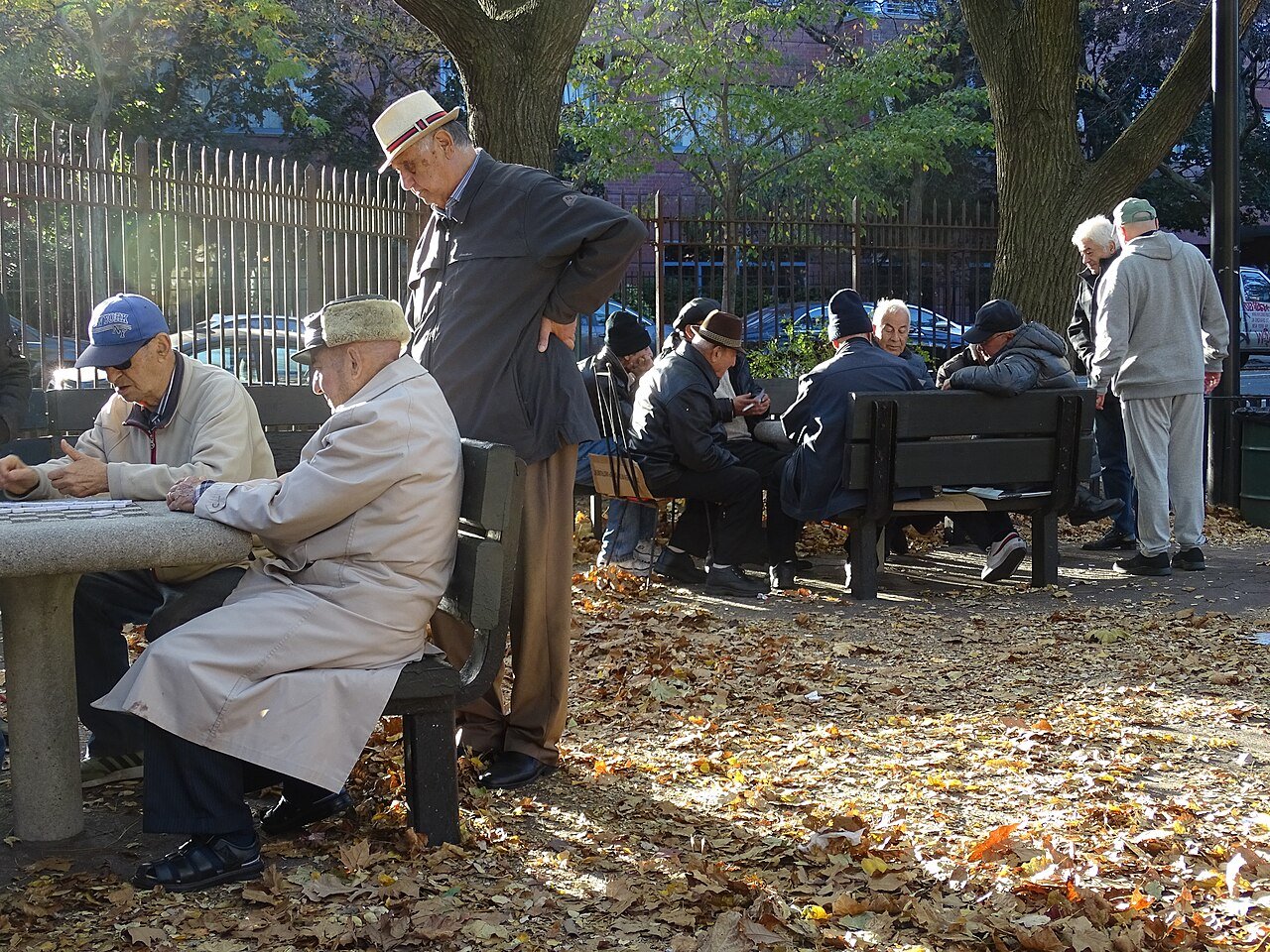
Photo: Adam Jones, via Wikimedia Commons (CC BY 2.0)
Sources
- https://medicalxpress.com/news/2026-11-pandemic-era-social-cognitive-decline.html
- https://www.news-medical.net/news/20261116/Pandemic-drop-in-social-activity-linked-to-cognitive-decline-in-older-adults.aspx
- https://academic.oup.com/psychsocgerontology/advance-article-abstract/doi/10.1093/geronb/gbag220/9051699
- https://www.alzinfo.org/articles/prevention/at-risk-for-alzheimers-volunteering-may-be-good-for-your-brain/
Leave a comment
Comment as a guest and verify your email, or sign in or create a reader account. Guest comments reach our review queue after email verification; account holders can submit directly for review.