Listen to this article
Take the story with you. Choose a voice and a pace that suits you.
Or listen in another language / choose a voice
Getting your device voices ready…
The voice follows the displayed language and your browser’s regional preference when available. You can choose another narration voice.
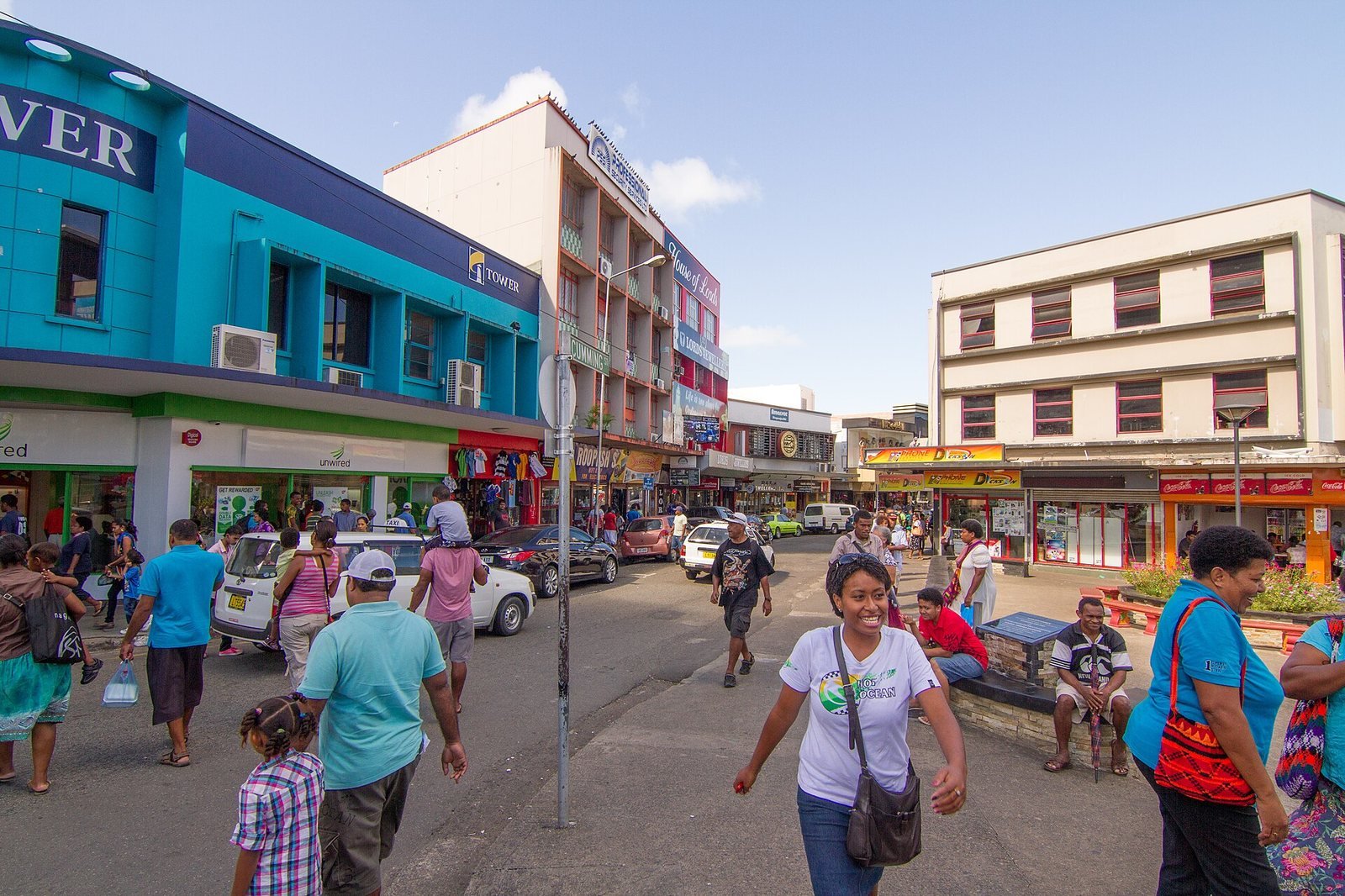
In November 2026, Fijian creator Alex Ligairi posted an Instagram reel. On-screen text read: "I can't say the N word. I'm not black." He then lip-synced to a song whose hook repeats the word he had just said he could not say. The video was light. The comment section was not. One camp handed him permission: Fijians are "Black too," so the word was his to use. The other camp — which included Fijians — refused the premise: Melanesian identity and Black American lineage are different things, and the word belongs to the second history, not the first. Ligairi himself, replying in the thread, said he does not use the word. The man at the center of the video had a clearer position than many of the people defending his right to say it.
The "Black too" claim leans on a real word. "Melanesia" — the region from New Guinea to Fiji — is Greek for "black islands," coined by French navigator Jules Dumont d'Urville in 1832 for the inhabitants' dark skin (Australian Museum). Dark skin does all the work in the argument: because Fijians are dark, an American slur coined for a different people, in a different system, supposedly transfers. That move — skin color treated as a universal passport — is the subject of this article, and the move a growing number of Black Americans are now organizing, formally and by name, to refuse. It is the same reduction — a person read as a body first — that we examined in The Body Displayed, the Person Withheld, on Sara Baartman and the dating apps.
A word with one address
The N-word is not a generic insult for minorities, poor people, or the oppressed in general. In Randall Kennedy's Nigger: The Strange Career of a Troublesome Word (2002), the Harvard law professor traces how the term hardened into an instrument of subordination in the early nineteenth century: it marked Black people as subordinate and its users as enforcers of that order. Jabari Asim's The N Word (2007) follows it through slavery, Jefferson-era pseudoscience, minstrelsy, and Jim Crow law, custom, and lynching. Linguist Jacquelyn Rahman's history (2012) adds the asymmetry: the in-group variant developed inside the enslaved community itself, and its surviving meanings — solidarity, censure, self-assertion — are constituted by membership and shared survival history, not offered to outsiders.
Kennedy's book contains the case: a Central Michigan basketball coach asked his mostly Black players for permission to use the word as they did. He got it. He used it. He was fired anyway. Even an explicitly granted pass did not settle it: the word's meaning lives not in individual permission but in a specific history — American chattel slavery and its Jim Crow afterlife.
Against that history, set entertainment's favorite fiction: that Black Americans live casually inside this word. The best national data says otherwise. In Pew Research Center's Race in America 2019 survey, 51 percent of Black adults said it is rarely or never acceptable for a Black person to use the word — and half of Black adults over 50 said never acceptable at all. The complication, honestly stated: political scientist Michael Tesler, analyzing the 2012 Cooperative Congressional Election Study, found almost two-thirds of Black respondents said they had used the word at least once or twice in the previous five years. But that question did not distinguish the word's two forms, and "once or twice in five years" is the shallowest possible use — fully compatible with telling Pew the word is rarely or never acceptable. No dataset supports the media image of universal, celebratory use.
Five defences, and the record of each
When a non-Black public figure is caught using the word, the defence arrives in one of five documented forms: we helped build the culture; I grew up around Black people; we are oppressed too; I was only singing along; and a Black writer wrote it for me. Each has been tested in public, and each has failed as a general rule.
Authorship — Jennifer Lopez, 2001. Lopez, Bronx-born and of Puerto Rican descent, sang the word in the "I'm Real" remix. Protesters demanded, as one told the Washington Post, "an apology to every African American that's within earshot of her music." Lopez's defence, printed by EURweb, was authorship plus intent: "The use of the word in the song — it was actually written by Ja Rule — it was not meant to be hurtful to anybody." She did not apologize. Ja Rule defended the line at the time, as widely reported — and was still defending it in 2014, describing an unwritten understanding that Spanish and Puerto Ricans and Black people are "all kind of in the same family" (VladTV).
Proximity — Fat Joe. On The Breakfast Club in October 2022, the Bronx rapper, of Puerto Rican and Cuban descent, grounded his claim in biography: "My grandmother's projects is 99.9% Black to be clear. So I'm Spanish, I knew I was Latino, but the whole time I thought I was Black anyway." On quitting: "I been saying this thing in my DNA… I been trying to stop." And in December 2024, on Math Hoffa's My Expert Opinion, he used the word against the lineage itself — attacking Foundational Black Americans, misnamed the "Foundational Black Authority," as "radical Black racists" and "broke" users of the word he claims as his own.
Sanford Richmond, a Black scholar of race and hip-hop, argues in "The Fat Joe Exception" that he personally trusts this one man with the word — and states the general rule in the same breath: "proximity doesn't mean permission" for most non-Black people, artists, DJs, journalists, and fans included. The exception, in its own defender's telling, is not transferable — a verdict on one man's life, not a pass.
Fandom — Gina Rodriguez, 2019, and the sing-along. Rodriguez posted an Instagram Story singing along to the Fugees' "Ready or Not," word included, then deleted it. Her first apology — sorry if she offended anyone; she "grew up on Lauryn Hill" — was rejected within hours. Her second conceded the argument: "In song or in real life, the words that I spoke, should not have been spoken." The Women's Media Center isolated the move inside the first apology: her appeal to a "community of color" implied the word belongs to all of them. The sing-along defence had already failed in its purest form in May 2018, when Kendrick Lamar stopped a concert to cut off a white fan performing "M.A.A.D City" uncensored. Lamar told Vanity Fair: "if I say this is my word, let me have this one word, please let me have that word." Fandom is not a defence anywhere. It is the delivery mechanism.
Endearment — Madonna, 2014. Madonna captioned an Instagram photo of her white, 13-year-old son boxing "#disnigga" and apologized to the Associated Press within a day: "There's no way to defend the use of the word… It was used as a term of endearment toward my son who is white."
The market's verdict — Wallen and Hogan. In February 2021, TMZ published video of country star Morgan Wallen using the word outside his Nashville home. His label suspended his contract indefinitely; radio groups, SiriusXM, CMT, the Academy of Country Music, and his agency all cut ties (NPR; Associated Press). Wallen apologized: "There are no excuses to use this type of language, ever." Then the audience answered: album sales rose 102 percent that week, downloads 67 percent (Associated Press, reporting Billboard/MRC Data). The institutions punished the word; the market rewarded the man. Hulk Hogan is the contrast: in July 2015 a leaked transcript showed him using the word repeatedly in private — "I am a racist, to a point" (Polygon). WWE said it terminated his contract and erased him from its Hall of Fame — Hogan's side maintained he resigned, a genuinely contested detail — and reinstated him three years later. Streaming runs the same uneven ledger smaller: Dellor lost his team and Twitch channel in 2017 (PCGamesN); Ninja ad-libbed it into a Logic song in 2018, apologized, and was not banned (Kotaku); PewDiePie's 2017 use drew no platform ban (his Disney/YouTube sanctions that year were for a separate antisemitism case). [Analysis: enforcement follows fame, apology choreography, and news cycles — not the word itself.]
Tailgating the struggle, anti-Black at home
The comment-section pass — I'm oppressed too — has an institutional ancestor; its paperwork survives. The League of United Latin American Citizens, founded in Corpus Christi in 1929 by Mexican Americans, built its founding-era legal strategy on a claim of whiteness. Ian Haney López names it the "other white" strategy: LULAC protested "not segregation itself, but the inappropriate segregation of Mexican Americans as a white racial group." The 1930 Census — the only one to list "Mexican" as a race — dropped the category after LULAC and Mexican-government protests; LULAC's 1948 Delgado case was framed as segregation of Mexican children from other White races; and in Hernandez v. Texas (1954) every party argued Mexican Americans were white. Historian Neil Foley states the cost: "African Americans can hardly be faulted for failing to find common ground with a civil rights strategy based on the premise that Mexican Americans were Caucasians."
The ledger is two-sided, and this article prints both sides. Thurgood Marshall's NAACP amicus in Mendez v. Westminster (1947) is treated by scholars as a dry run for Brown. In Cisneros (1970), Black and Mexican American parents sued together, the whiteness claim set aside. In 2005 the National Council of La Raza condemned Mexico's Memín Pinguín stamps alongside the NAACP. In June 2020 LULAC declared "We Stand United in Action with Black Lives Matter," documenting coalition talks with the NAACP and the National Urban League. Solidarity happened. So did the whiteness strategy.
Mexico is the pattern's deeper version: tailgating abroad, erasure at home. Africans were present in New Spain from 1519 and, by anthropologist Gonzalo Aguirre Beltrán's research, outnumbered Spaniards there until 1793 (Minority Rights Group International). Post-revolutionary mestizaje then wrote the African root out of the national identity. Recognition came late: the first national count of Afro-descendants was 2015 (1,381,853 people); constitutional recognition arrived August 9, 2019; the 2020 census counted 2,576,213 Afro-Mexicans. In May 2005, President Vicente Fox said Mexican migrants do jobs "not even blacks" want (Associated Press), and weeks later Mexico issued 750,000 stamps of Memín Pinguín, a Black comic character drawn in Jim Crow "pickaninny" style, which sold out and were never recalled despite condemnation from the NAACP, La Raza, and Mexico's own Asociación México Negro (U.S. House Resolution 347).
"Mejorar la raza" — improve the race — is documented in Puerto Rican ethnography (Isar Godreau, 2008) as the aspiration to whiten: children with a lighter partner, distance from Blackness and its assigned low status. Edward Telles and co-authors found darker skin predicting less schooling in all eight Latin American countries they surveyed. Pew (2021) found 41 percent of darker-skinned U.S. Latinos reported discrimination from other Hispanics. And the climb's destination is in the census data: about 49 percent of Hispanic immigrants identify their race as White, rising to roughly two-thirds by the second and third generations (Pew); the 2020 Census, in which 42 percent of Hispanics marked "some other race" alone, complicates any single percentage, but the generational direction is the finding. Black when the culture is useful; not Black when the bill arrives.
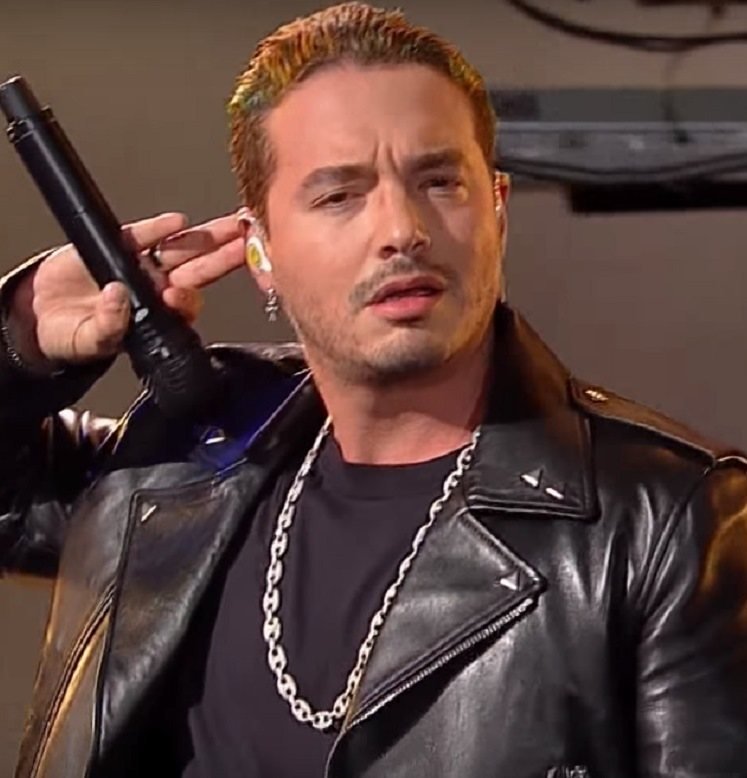
Reggaetón is the pattern with a soundtrack. Remezcla's June 2020 reckoning charged urbano artists with being "overwhelmingly silent" as the protests began, in a genre whose Black aesthetic had been reassigned to "a more popular collective of Latinx artists, the majority of them light skinned or white" — blanqueamiento, whitening. J Balvin's case carries a caveat the record insists on: he did post a Black Lives Matter statement on June 2, 2020 (Entertainment Tonight). What followed is also on the record. In 2021 his "Perra" video showed him walking two Black women on leashes; Colombia's vice-president called it racist and misogynistic; he removed it and apologized "especially to the Black community." That December he accepted an "Afro-Latino Artist of the Year" award — he is not Afro-Latino — and deleted his celebratory post after backlash. Petra Rivera-Rideau summarized the structure for Rolling Stone: "The Latin music industry borrows heavily from Afro-Latino cultural practices, but privileges and prioritizes white Latino artists to perform them."
The label shell game
Underneath the fight over the word sits a quieter fight over the name, because "African American" was never a lineage term. The sequence is documented: "African" in the colonial era; "Colored" dominant from the 1830s; "Negro" ascendant after 1900; "Afro-American" revived in the 1960s; "Black" in the Black Power years; then "African American," proposed by Ramona Edelin in 1972 and popularised in December 1988, when Jesse Jackson adopted it (Encyclopedia.com; Smitherman, 1991). Whether Edelin coined it is contested — the Oxford English Dictionary records 19th-century uses — but the popularisation is not, and the term is younger than most of the people it names. Built from a continent plus a country rather than a history, it fits anyone born in Africa who becomes American.
Teresa Heinz Kerry, born and raised in Mozambique in a Portuguese colonial family, "sometimes used this phrase ['an African American'] to describe herself" in 2004 (FactCheck.org). Paulo Serodio, born in Mozambique and naturalized, called himself a "white African-American" in a 2006 medical-school exercise, was suspended the next year (the school cited unrelated misconduct), sued, and lost in federal court in 2014. [Analysis: this is where the term breaks on its own terms. Read literally — born in Africa, now American — a white South African-born U.S. citizen qualifies as an "African American." That is not a fringe reading imposed on the word from outside; it is the word's own definition, and Heinz Kerry and Serodio show real people invoking it, in real institutions, on paper.] Charlize Theron and Elon Musk are simply the best-known illustrations of that literal reading: a 2000 Saturday Night Live sketch built the joke out of Theron's biography, and an October 2026 viral video called Musk "the most successful African American of all time" (BallerAlert). The joke lands because the definition, applied honestly, produces it. A lineage term could not be turned into that punchline. A geography term can.
Pew defines the U.S. Black population as everyone who self-identifies as Black — slavery's descendants, African immigrants, Caribbean immigrants, and their children in one figure. Roughly one in ten Black people in the U.S. is an immigrant (4.6 million in 2019; 11.4 percent by 2024), and immigrants plus their U.S.-born children make up a fifth to a quarter of the whole. Remedies, statistics, and cultural authority built for one people's history are administered to a category that no longer describes only that people.
Delineation is the organized response. ADOS — American Descendants of Slavery, founded in 2016 by Yvette Carnell and Antonio Moore — states its project in its own terms: shift the discussion "from melanin and properly center the discussion around lineage," with a distinct ethnic designation and eligibility rules that do not dilute slavery's specific debt. FBA — Foundational Black Americans, pushed by Tariq Nasheed from 2019 — is lineage only: descent from people enslaved in the American system. But delineation is no longer only a hashtag argument. On March 29, 2022, California's Reparations Task Force voted 5–4 to define eligibility by lineage, not race — descendants of chattel enslaved people, or of free Black people living in the U.S. before the end of the 19th century (Associated Press). A state body, applying evidence standards, reached the conclusion the comment sections keep circling: lineage is the unit that fits this history. The same lineage test runs through our investigation of a Delhi attraction’s two-tier pricing, The One-Way Door.
The deeper record
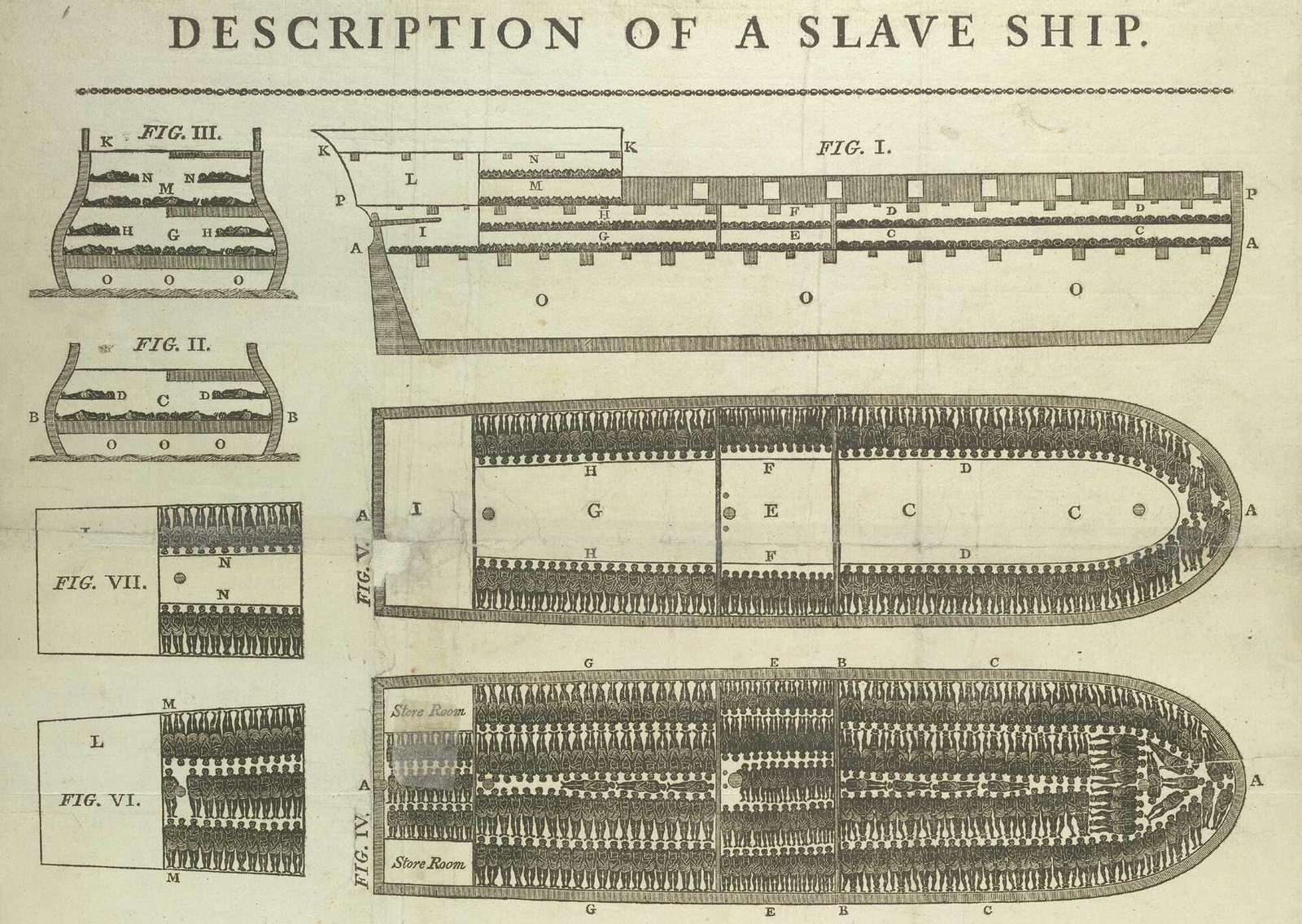
The trade's geography is usually read as making Black Americans a footnote to it. The numbers, from the SlaveVoyages database estimates:
| Region | Enslaved Africans disembarked |
|---|---|
| Brazil | 4,864,373 |
| British Caribbean | 2,318,252 |
| Spanish Americas | 1,292,912 |
| French Caribbean | 1,120,216 |
| Mainland North America | 388,747 |
| Total embarked in Africa | 12,521,337 |
Brazil alone received roughly twelve and a half times mainland North America's total; the future United States took about 3.6 percent of everyone who survived the crossing, and some 1.8 million people did not survive it. But the conclusion usually drawn — that Black American history is a small, derivative chapter — reverses the record, because what happened on this soil was demographically unique. Black presence here predates 1619: Juan Garrido, a free West African conquistador, crossed to Hispaniola in 1502 or 1503 and marched with Cortés (National Park Service). In 1526 the Ayllón colony at San Miguel de Gualdape brought the first documented enslaved Africans to the continental present-day United States — and the first slave rebellion in mainland North America (BlackPast). Estevanico, an enslaved Moroccan, reached Florida with the Narváez expedition in 1528 (Britannica). In 1738, Fort Mose became the first legally sanctioned free Black town in what is now the United States (National Park Service).
After the 1808 importation ban, the enslaved population grew from roughly 700,000 in 1790 to nearly four million by 1860 — overwhelmingly by natural increase, in a way no other major American slave society matched. The internal trade — Ira Berlin's "Second Middle Passage" — forcibly moved about one million enslaved people from the Upper South to the cotton frontier, more than twice the number who had arrived across two centuries of the transatlantic trade (Gilder Lehrman Institute). [Analysis: the founding generations survived the Middle Passage; the people who emerged — their language, churches, music, and word — were made in America, by Americans born into an American system. "Descended from U.S. slavery" names something specific, not a slogan.]
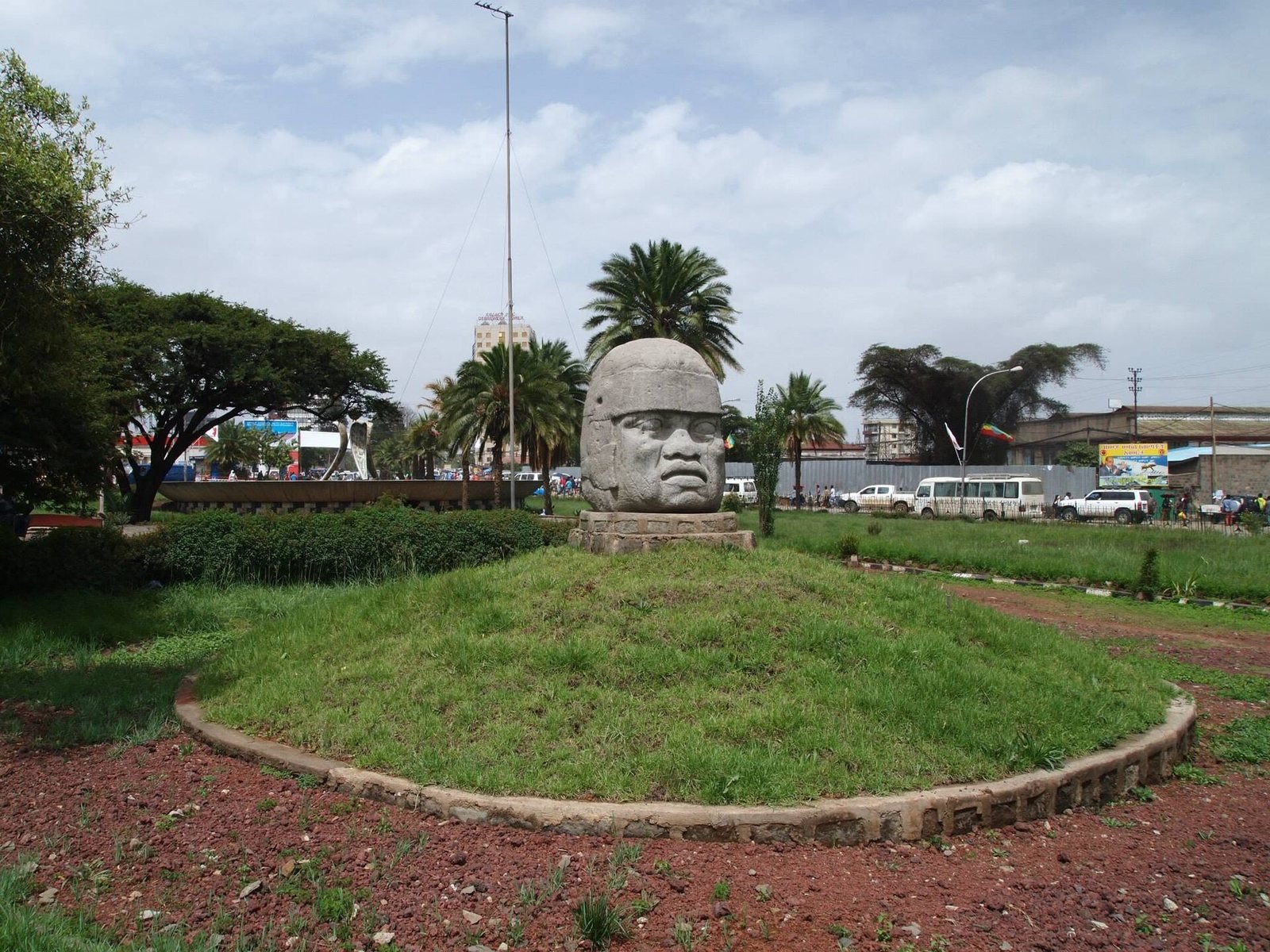
One question this record raises deserves to be shown rather than settled by slogan: whether Africans reached the Americas before Columbus. The documents exist, and so does the rebuttal. On one side stands a written record: the medieval Arabic historian al-Umari recorded Mansa Musa's account of his predecessor Abu Bakr II, who sent fleets into the Atlantic around 1311 that did not return. In 1976, Ivan Van Sertima's They Came Before Columbus argued the fleets arrived, marshalling the Olmec colossal heads' features, proposed plant transfers, and pyramid and mummification parallels. On the other side stands the fullest scholarly evaluation (Haslip-Viera, Ortiz de Montellano, and Barbour, Current Anthropology, 1997), which concluded the proposal is "devoid of any foundation": no genuine African artifact has been found in a controlled archaeological excavation in the New World; the colossal heads were carved centuries before the proposed contact, and their features — broad nose and full lips combined with epicanthic eye folds — match Indigenous Gulf Coast populations; and the plant evidence reflects transfers too ancient for human agency. The voyage account is a real document. A landfall has no archaeological, genetic, or botanical evidence behind it. Both sides are on the record, and readers can weigh them. What this article rests on does not require the contested claim.
The answer is a line
Return to the comment section in Fiji: a creator made a joke about a word he said was not his, and strangers rushed to hand it to him anyway, on the strength of his skin. Others — including people from his own islands, where the same debate is documented in New Zealand's Pasifika press — said no: "While we may share colonial histories and a higher concentration of melanin, Māori and Pasifika communities do not share the rest of the experience that comes with American Blackness" (Critic Te Ārohi).
Because the pattern is one pattern, at every scale. A slur built for one people's subjugation is treated as a costume anyone dark, adjacent, oppressed, raised nearby, or fond of the music may wear. A civil-rights organization litigates as white and marches as kin. A genre built by Black artists is whitened for market while its biggest stars accept Black awards and walk Black women on leashes. A label popularised in 1988 is stretched over white South Africans as a joke and over a fifth of a population as a statistic. And at each point, the people the word, the struggle, the music, and the name belong to are told that drawing the line is the real offense.
Delineation is the refusal of that arrangement. The word belongs to a lineage; the label should name a lineage; and the history — 1526 to Fort Mose to the Second Middle Passage to Jim Crow to the coach who got permission and got fired anyway — belongs to the specific people who lived it and their descendants. Alex Ligairi understood the rule well enough to put it in his own caption: I can't say the N word. I'm not black. The people arguing with him were arguing against the same line Black Americans are now drawing in census fights, in reparations law, and in their own name. The line is the point. It was always the point.
—
Sources
- NPR, "Country Star Morgan Wallen Suspended by Label, Dropped by Radio, CMT After Using Slur"
- Associated Press, "Album Sales Surge for Morgan Wallen After Racist Comment"
- TheWrap, "Gina Rodriguez Apologizes for Saying N-Word in Instagram Stories"
- Women's Media Center, "On Gina Rodriguez's Use of the 'N-word'"
- EURweb, "That Time J-Lo Thought She Could Say the N-Word"
- The Source, "Fat Joe Defends Use of the N-Word in His Music: 'I Thought I Was Black'"
- HotNewHipHop, "Fat Joe Rips Foundational Black Americans"
- Sanford Richmond, Culture Receipts, "The Fat Joe Exception: Race, Trust, and the N-Word"
- NME, "Madonna" (Instagram caption and AP apology)
- Polygon, "Hulk Hogan Racist Tirade, WWE Fired"
- PCGamesN, "Overwatch Toronto Esports Pro Racism" (Dellor)
- Kotaku, "Top Twitch Streamer Ninja Rapped a Slur"
- Pew Research Center, "Race in America 2019"
- Michael Tesler, Good Authority, "Using the N-Word Is More Common Than You (or President Obama) May Think"
- Randall Kennedy, Nigger: The Strange Career of a Troublesome Word (Pantheon, 2002)
- Jabari Asim, The N Word: Who Can Say It, Who Shouldn't, and Why (Houghton Mifflin, 2007)
- Jacquelyn Rahman, "The N Word: Its History and Use in the African American Community," Journal of English Linguistics 40(2), 2012
- Neil Foley, "Over the Rainbow: Hernandez v. Texas, Brown v. Board of Education, and Black v. Brown," Chicano-Latino Law Review 25 (2005)
- Ian Haney López, "Race and Colorblindness after Hernandez and Brown"
- Texas State Historical Association, Handbook of Texas, "Delgado v. Bastrop ISD"
- LULAC, "Black Lives Matter" / "We Stand United in Action with Black Lives Matter"
- Minority Rights Group International, "Afro-Mexicans in Mexico"
- Associated Press (June 30, 2005), Fox remarks and Memín Pinguín stamps, archived by the University of Texas
- U.S. House of Representatives, H.Res. 347, 109th Congress
- Isar P. Godreau, "Slippery Semantics: Race Talk and Everyday Uses of Racial Terminology in Puerto Rico," CENTRO Journal XX(2), 2008
- Edward Telles, René Flores & Fernando Urrea-Giraldo, "Pigmentocracies," Research in Social Stratification and Mobility 40, 2015
- Pew Research Center, "Majority of Latinos Say Skin Color Impacts Opportunity in America" (2021)
- Pew Research Center, "Hispanic Identity and Immigrant Generations" (2021)
- Pew Research Center, "Racial Identity of Latinos: How We Measured It" (2021)
- Remezcla, "Why Urbano Artists' Scarce Comments on the #BLM Movement Are a Problem" (2020)
- Entertainment Tonight, "J Balvin Urges Latinx Community to Do Better and Support Black Lives Matter" (2020)
- Remezcla, "J Balvin, Tokischa, Director Respond to Controversy over 'Perra' Video" (2021)
- Remezcla, "J Balvin Afro-Latino Artist of the Year Award Backlash" (2021)
- Encyclopedia.com, "Names Controversy"
- FactCheck.org, "Radio Ads Accuse Kerry of Not Helping Blacks" (2004)
- Saiber LLC, "Serodio v. Rutgers Dismissal" (2014)
- BallerAlert, "Spencer Pratt Calls Elon Musk the Most Successful African American"
- Pew Research Center, "One-in-Ten Black People Living in the U.S. Are Immigrants" (2022)
- Associated Press, "California Group Votes to Limit Reparations to Slave Descendants" (2022)
- SlaveVoyages, Trans-Atlantic Slave Trade Database, "Estimates"
- Gilder Lehrman Institute of American History, "The Cotton Economy, the Domestic Slave Trade, and African American Life in the Nineteenth Century"
- National Park Service, "Juan Garrido"
- BlackPast.org, "San Miguel de Gualdape Slave Rebellion (1526)"
- Encyclopaedia Britannica, "Esteban de Dorantes"
- National Park Service, "Fort Mose"
- Haslip-Viera, Ortiz de Montellano & Barbour, "Robbing Native American Cultures: Van Sertima's Afrocentricity and the Olmecs," Current Anthropology 38(3), 1997
- Australian Museum, "Our Global Neighbours: Melanesia"
- Critic Te Ārohi, "Māori, Pasifika and the N-word"
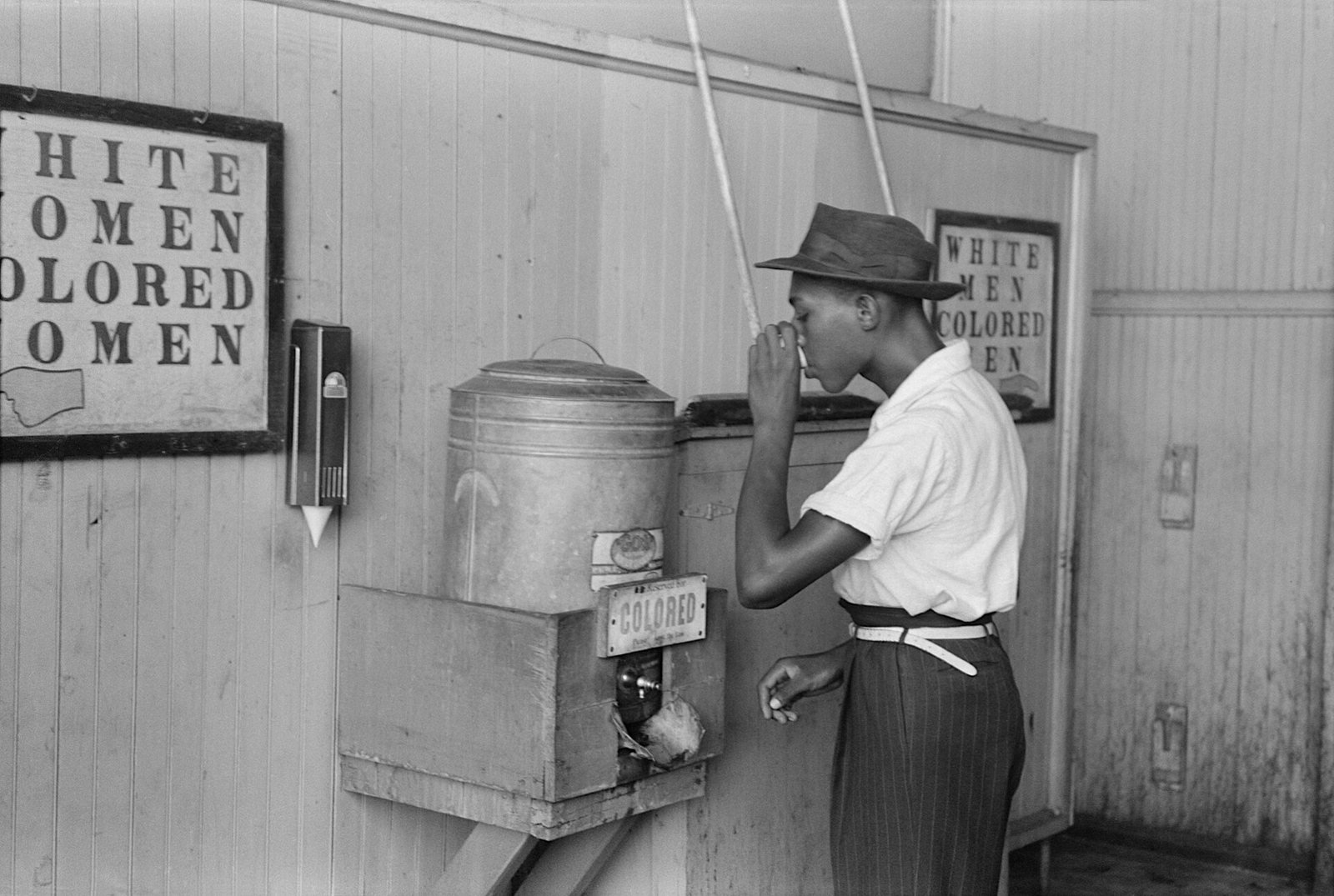
Cover photo: a man drinks at a “Colored” water cooler in an Oklahoma City streetcar terminal, 1939 — the Jim Crow order the word policed. Photograph by Russell Lee for the Farm Security Administration. Public domain, via Wikimedia Commons.
Leave a comment
Comment as a guest and verify your email, or sign in or create a reader account. Guest comments reach our review queue after email verification; account holders can submit directly for review.