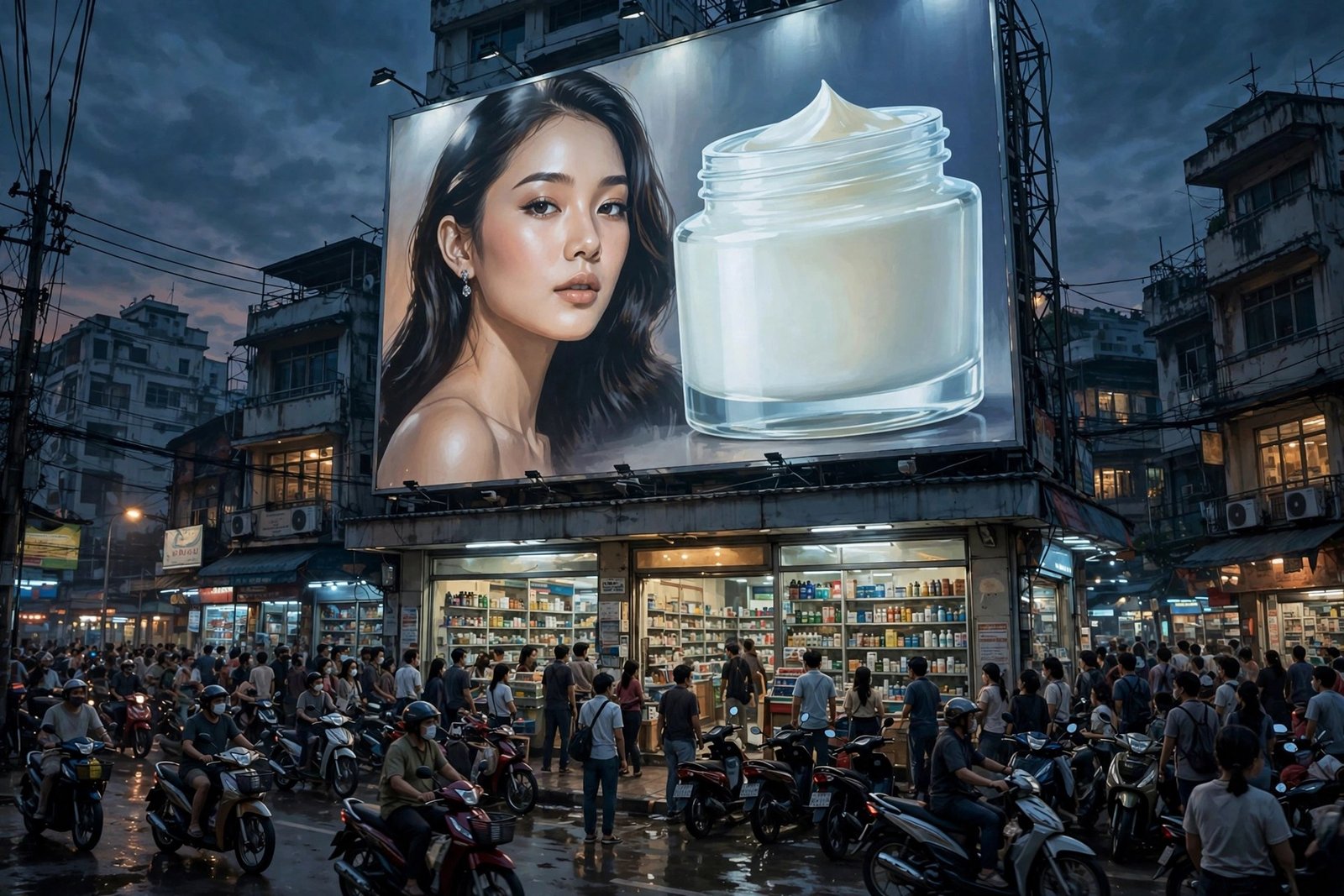
In early 2026, test buyers for Manila’s EcoWaste Coalition went shopping online. Twelve of the fourteen whitening creams they ordered carried mercury above the 1 ppm trace limit. The worst, sold as Ailkye Boost Luster Superior Whitening, measured 31,100 ppm. Some listings advertised their creams as safe for pregnant women.
None of it hides. In a separate 2026 sweep, EcoWaste bought twenty-seven contaminated products — most made in Pakistan, others from Taiwan, China, Indonesia and Thailand — and detected mercury up to 33,970 ppm. Pakistan-made Goree creams, flagged in Philippine FDA warnings since 2017, sat on shelves in twenty of the twenty-three Cavite municipalities checked.
A market measured in billions
Asia Pacific is the centre of this trade. Fortune Business Insights estimates the global skin-lightening market at $10.22 billion in 2025, with Asia Pacific holding a 54 per cent share — roughly $5.5 billion. Industry estimates, not audited figures. WHO survey numbers sketch the demand underneath: in 2004, nearly 40 per cent of women surveyed in parts of China, Malaysia, the Philippines and South Korea reported using skin lighteners, and lightening products made up 61 per cent of India’s dermatological market, per the WHO.
What the cream is really selling
The pitch was never only about blemishes. A Virginia Tech discourse analysis of Unilever’s Fair & Lovely advertising found the pre-2020 commercials built their stories on the disadvantages of darker skin — fewer marriage prospects, weaker employment chances — with fairness as the fix. The brand earned Unilever more than $500 million a year in India alone, according to Jefferies analysts cited by the Associated Press, with tubes selling for as little as $2. Indian matrimonial ads still list brides and grooms as “fair” or “wheatish.”
The vocabulary shifts by market; the promise doesn’t. Japan’s bihaku category — the characters mean beauty and white — has been sold for decades; Shiseido says its bihaku lines reduce melanin rather than bleach. South Korea’s drug safety ministry counted some 1,200 products using the word mibaek — whitening — since 2001. Since 2020 the preferred words have softened: brightening, glow, even tone.
Older than the colonies, hardened by them
It would be tidy to blame Europe for all of it. The record won’t cooperate. Pale skin signified rank in East Asia centuries before Western empires arrived. Sociologists Joanne Rondilla and Paul Spickard describe Asian colorism as a class imperative: to be light is to be rich, because dark skin comes from working outside in the sun. Japan coveted pale skin from at least the eleventh century, and its upper classes wore white-lead powder as a badge of status. In India, fair skin carried class and caste associations long before the British.
What colonialism added was race. European rule mapped the old class gradient onto a global ranking, with the rulers’ skin at the top — researchers in Pakistan cite colonial history when explaining the region’s fairness fixation. Hollywood and Bollywood then industrialised the image. The hierarchy predates the empire in much of Asia; the empire made it planetary.
The body keeps the bill
Mercury whitens because it suppresses melanin production. It also poisons. The WHO names kidney damage as the main adverse effect of the inorganic mercury in lightening soaps and creams, plus rashes, discoloration, scarring, weakened resistance to skin infection, and effects running to anxiety, depression, psychosis and peripheral neuropathy. The exposure doesn’t stop with the user: US health authorities have documented household members — children who never touched the creams — showing mercury poisoning from vapours and skin contact.
Hydroquinone, the industry’s other workhorse, can turn on its users. Dermatologists cataloguing chronic use of the standard trio — hydroquinone, mercury and potent corticosteroids — list exogenous ochronosis, a paradoxical blue-black darkening that resists treatment; steroid addiction syndrome; suppressed hormone function; skin that thins, tears and infects easily. The products go on over large areas, for years, in hot, humid climates that speed absorption.
Bans on paper, creams on shelves
On paper, the world has already decided. Article 4 of the Minamata Convention on Mercury requires parties to bar the manufacture, import and export of cosmetics containing mercury above 1 ppm, lightening soaps and creams included; the phase-out deadline was 2020. In 2023 the parties scrapped the 1 ppm threshold altogether — no mercury may be added to cosmetics — with a binding 2025 deadline. WHO and UNEP are running an elimination project with Sri Lanka among its pilot countries.
The shelves disagree, as the Philippine test buys show. Enforcement chases online listings that multiply endlessly; a Geneva Environment Network briefing notes Amazon blocked mercury-lightener sales only after a lawsuit under California law. The pushback isn’t only regulatory. India’s Dark is Beautiful campaign has argued for over a decade that multinationals, in founder Kavitha Emmanuel’s words, did not initiate skin-tone bias but capitalised on it. In 2020, under pressure after the murder of George Floyd, Unilever renamed Fair & Lovely to Glow & Lovely and dropped “fair,” “white” and “light” from its marketing; L’Oréal removed similar wording, and Johnson & Johnson dropped its Neutrogena fairness lines. The names changed. The products stayed.
Analysis
The industry does not invent the ranking. It rents it. The taxonomy essay in this set describes classifiers who sorted humanity into ranked varieties and built the ladder; the whitening industry sells people a step up it, one tube at a time, priced for a schoolgirl’s allowance.
Demand looks spontaneous only if you ignore the casting. When the drama heroines, the billboard faces and the brides in the matrimonial columns are all light, “preference” is doing heavy lifting for programming. Employable, marriageable, modern — the adjectives the market attaches to pale skin are job descriptions and wedding vows, not compliments. A ban can seize a cream. It cannot seize the logic that keeps manufacturing the want. Which is why the creams keep coming back under new names, in new listings, at 33,970 parts per million.
Sources
- World Health Organization — Elimination of mercury-containing skin lightening products (health impacts; Minamata Convention Article 4; WHO/GEF/UNEP elimination project): https://www.who.int/initiatives/elimination-of-mercury-containing-skin-lightening-products
- PAHO/WHO — Mercury in skin lightening soaps and creams (WHO information sheet: kidney damage, rashes, discoloration, reduced resistance to infection): https://www.paho.org/en/news/1-6-2012-mercury-skin-lightening-soaps-and-creams
- Business Mirror — Mercury-laced skin whiteners still available in marketplace despite global ban (EcoWaste Coalition’s 2026 test purchases; Goree creams on Cavite shelves; Minamata deadlines): https://businessmirror.com.ph/2026/08/10/mercury-laced-skin-whiteners-still-available-in-marketplace-despite-global-ban-group/
- Cosmetics Business — Philippines watchdog raises alarm over “mercury laden” cosmetics (online test buys; 31,100 ppm finding): https://www.cosmeticsbusiness.com/philippines-watchdog-raises-alarm-over-mercury-laden-cosmetics–143672
- Fortune Business Insights — Skin Lightening Products Market report (commercial estimates: $10.22 billion global market in 2025; Asia Pacific 54.02% share): https://www.fortunebusinessinsights.com/skin-lightening-products-market-110570
- Associated Press via YourStory — “‘Whitening’ creams undergo a makeover but colourism persists” (Fair & Lovely revenue and rebrand; bihaku; mibaek product counts; matrimonial ads): https://yourstory.com/herstory/2020/07/whitening-creams-makeover-colourism-fair-lovely
- Virginia Tech (VTechWorks) — Rebranding Pigmentocracy: Analyzing Marketing Strategies of Unilever’s Skin Lightening Products (advertising discourse analysis): https://vtechworks.lib.vt.edu/items/db0184d4-b74b-489d-95d5-e63a17c86097
- Olumide et al., International Journal of Dermatology (2008) — Complications of chronic use of skin lightening cosmetics (exogenous ochronosis, steroid and mercury complications), via PubMed: https://pubmed.ncbi.nlm.nih.gov/18377596/
- Geneva Environment Network / UNEP — Unmasking Mercury and Colorism in Cosmetics (COP5 removal of the 1 ppm threshold; marketing and colorism; Amazon sales block): https://www.genevaenvironmentnetwork.org/events/unmasking-mercury-and-colorism-in-cosmetics/
- The Global Fool — Skin Lightening Cosmetics and Mercury Toxicity (WHO usage figures; household exposure findings): https://theglobalfool.com/skin-lightening-cosmetics-and-mercury-toxicity-2/
—