Listen to this article
Take the story with you. Choose a voice and a pace that suits you.
Or listen in another language / choose a voice
Getting your device voices ready…
The voice follows the displayed language and your browser’s regional preference when available. You can choose another narration voice.
The signature mattered more than the crates. In Lagos in early November, Sweden returns Benin artefacts to Nigeria by transferring ownership of 39 objects from the Kingdom of Benin to Nigeria’s National Commission for Museums and Monuments (NCMM) — a legal act, signed by Britta Söderqvist, director general of Sweden’s National Museums of World Culture, and Olugbile Holloway, director general of the NCMM, the signing was reported. Six of the objects will stay in Sweden for ten more years. But they stay as a loan from their Nigerian owner. That reversal — who lends, who borrows — is the whole story in one detail. Information verified through 16 November 2026.
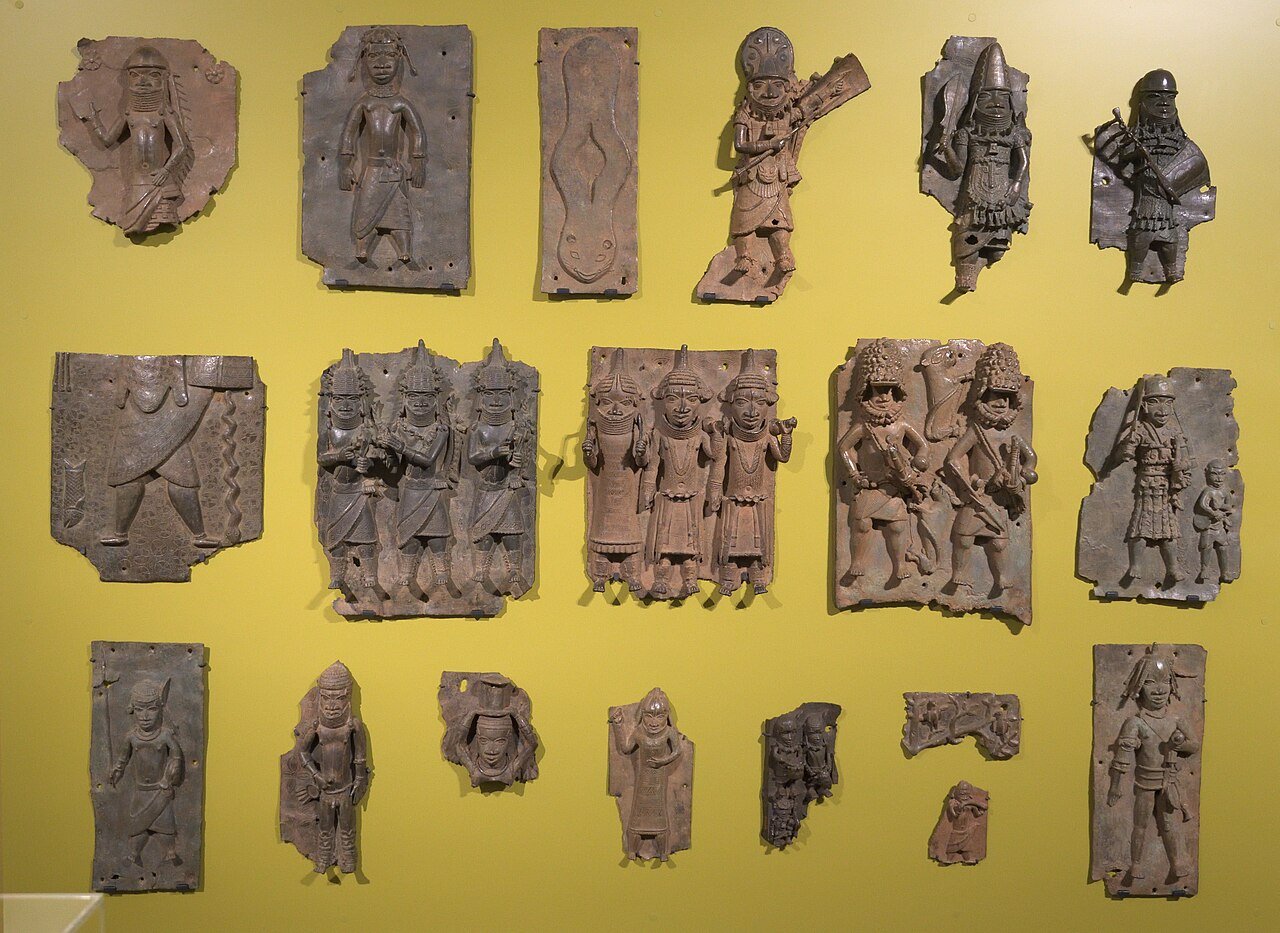
The objects are works in copper alloy, ivory and wood, connected to the Edo people and the royal court of Benin, in what is now Edo State, Nigeria. They are among several thousand objects seized when British forces attacked and burned Benin City in 1897. Sweden did not take them in that raid. Its former Ethnographic Department of the Natural History Museum in Stockholm acquired them between 1898 and 1908, through the international art market and European patrons, the Swedish museum authority records. Looted once, sold on, shelved in Stockholm: a common itinerary for Benin material, and the reason provenance research, not battlefield history alone, decides these cases.
Sweden returns Benin artefacts to Nigeria: a three-year road to Lagos
The 39 objects are known as Emwin Arre. The Swedish government authorised the return in 2023, after formal requests and museum research, and the National Museums of World Culture (SMVK) began the final phase in November 2026, The Art Newspaper reported. According to the SMVK, the process started after clear signals from the NCMM that it would welcome the return of all the objects.
Michael Barrett, the SMVK’s curator for Africa, was in Lagos for the signing. Returning violently looted belongings to their communities of origin is “a necessary first step,” he told The Art Newspaper, arguing that colonial legacies of violence and theft have stood in the way of museum practice that answers to a wider set of stakeholders. Söderqvist made the institutional version of the same point in a press release: the history of the Benin objects is closely intertwined with the colonial era and its power relations, and museums worldwide are examining their collections in light of changing ethical perspectives, Sweden Herald reported.
One researcher quoted in coverage, Staffan Lundén of the University of Gothenburg, noted how undramatic the Swedish decision was domestically: taken by a right-wing government, treated as common sense and moral justice, and in line with a Swedish self-image of international responsibility. Restitution debates that are parliamentary trench warfare elsewhere were, in this telling, close to administrative routine in Sweden.
National Museums of World Culture Sweden restitution had a second case the same week
The Benin signing was half of a paired final phase. The same week, 77 objects from the Niño Korin village in Bolivia — including the skull of a Kallawaya healer — were taken from storage in Gothenburg for transport to the National Museum of Archaeology in La Paz, The Art Newspaper reported. Those Kallawaya objects returned to Bolivia date to around 600 to 1000 AD, the Tiwanaku period. They were looted in grave robberies in the 1970s and later sold to the museum; the collection had been in Sweden since 1970, bought by the then director of the Ethnographic Museum in Gothenburg, and the government decided on its return in 2023, Sweden Herald reported.
Two continents, two different wrongs — a colonial military seizure dispersed through the art market, and modern grave robbery laundered through a purchase — resolved by the same principle: possession is not title.
Sweden joins a lengthening list. Germany handed over a substantial collection of Benin bronzes in 2022. The Netherlands returned 119 objects in 2025 and a Dutch museum returned one more plaque last month. Cambridge University transferred legal ownership of 116 objects in February. The British Museum, by contrast, ruled out imminent restitution last year and proposed collaboration instead, The Art Newspaper’s roundup notes. The contrast is now structural: each new transfer makes the remaining holdouts explain themselves, rather than the claimants.
Analysis: The detail to keep is the loan. Six objects remaining in Sweden could be spun as a partial return; legally it is the opposite. Before Lagos, Sweden owned 39 objects and Nigeria had a claim. After Lagos, Nigeria owns 39 objects and Sweden has permission to display six of them for a decade. Restitution done this way does not empty the European gallery — it changes whose name is on the label, and who can say no. That is why the signing, not the shipping schedule, was the event. The physical journey of the other 33 objects has no published timetable yet, and readers should treat any date offered for it, here or elsewhere, as unconfirmed until the NCMM or the SMVK publishes one.
Photo: Unknown author, via Wikimedia Commons (CC BY-SA 4.0) — Benin bronze relief plaques at the MARKK museum, Hamburg.
Sources
- https://www.theartnewspaper.com/2026/11/09/swedish-museums-restitute-objects-to-nigeria-and-bolivia
- https://staging.swedenherald.com/article/sweden-returns-looted-benin-artefacts-to-nigeria-and-sacred-kallawaya-objects-to-bolivia
- https://www.simpsonglobalmedia.com.ng/2026/11/sweden-transfers-ownership-of-39-looted.html
- https://ntm.ng/2026/11/10/swedish-museums-restitute-objects-to-nigeria-and-bolivia/
Leave a comment
Comment as a guest and verify your email, or sign in or create a reader account. Guest comments reach our review queue after email verification; account holders can submit directly for review.