Listen to this article
Take the story with you. Choose a voice and a pace that suits you.
Or listen in another language / choose a voice
Getting your device voices ready…
The voice follows the displayed language and your browser’s regional preference when available. You can choose another narration voice.
The latest Old Dongola Great Church of Jesus discovery comes down, literally, to a staircase. A Sudanese-Polish expedition has uncovered a monumental stair leading into the church, buttresses reinforcing its apse, and — for the first time — reached the building’s original floor, in findings announced by the Polish Centre of Mediterranean Archaeology, University of Warsaw on 4 November 2026. Information verified through 14 November 2026.
Old Dongola, known in medieval times as Tungul, was the capital of Makuria, a Christian kingdom on the Nile. The Great Church of Jesus is described by the expedition as the largest and wealthiest church in medieval Nubia, The Sudanist reported, drawing on the PCMA announcement. Wealthy, here, rests on Arab historical sources cited by researchers, Heritage Daily noted — a reminder to separate what the stones show from what texts claim.
The expedition is led by Professor Artur Obłuski, director of PCMA UW, working with Sudan’s National Corporation for Antiquities and Museums. The team first identified the monumental structure as the Great Church of Jesus in 2021, but excavation began only after funding was secured from Poland’s National Science Centre, The Sudanist reported.
A medieval Nubia largest church excavation measured in metres of wall
Size is the headline, so get the numbers straight — and keep their status straight. The church was about 47 metres wide and approximately 57 metres long, with a cautiously estimated height of around 21 metres, Obłuski said. Walls around the staircase survive to about 11 metres. “This was a building larger than the famous White House in Washington, DC — and we are planning to excavate it!” he said, in remarks reported by The Sudanist.
That comparison is the director’s, and the dimensions are estimates while most of the building remains buried. “Next season, we hope to finally resolve the question of the church’s overall size,” Obłuski said. Only a small part has been excavated so far.
The preservation that makes the site extraordinary also makes it hard. “Paradoxically, and fortunately for world cultural heritage, as well as the heritage of Africa and Sudan, the greatest challenge in excavating the church is its remarkable state of preservation,” Obłuski said. The staircase is the only area where the team has reached floor level, because digging beside walls 11 metres high means working through exceptionally deep deposits, with methods and resources beyond a normal dig, Heritage Daily reported on 8 November.
If the identification holds, a second building’s story changes too. Until now, a church outside the city walls had been regarded as Dongola’s cathedral. “We will probably have to revise our understanding of the role of that building and ask what its actual function was, if it was not a cathedral,” Obłuski said. One staircase, and a settled label comes loose.
The Great Church of Jesus original floor — and a second church above
Beside the cathedral sat a surprise. Archaeologists found another church built on the upper floor of a structure added to the Great Church. Its walls survive only to about a metre, but the interior was once richly painted. “We know that the paintings must have been magnificent — we now have six large shelving units filled with fragments of painted plaster,” Obłuski said, The Sudanist reported. A comparable church associated with King David, found in 2023 on the northern side and dating to the 13th century, gives the team a parallel, Heritage Daily noted.
Small fragments can carry the sharpest evidence. Plaster from the smaller church bears Greek inscriptions identified by the expedition’s epigraphist, Dr Agata Deptuła, as fragments of biblical canticles, or odes — liturgical songs appended to the Psalter. One fragment holds part of the Prayer of Hannah, mother of Samuel. The letters are in a careful book hand, only about half a centimetre high, Deptuła said. Psalm texts were already the most commonly attested biblical texts at Old Dongola; ode fragments are new at the site, she explained in the PCMA account.
Half a centimetre. Someone wrote prayer that small, on a wall, in a capital much of the modern world has never heard of.
Makuria capital Old Dongola archaeology amid flood and conflict
The work does not happen in a vacuum, and the expedition does not pretend otherwise. In autumn 2024, Old Dongola suffered its most severe flooding since 1988, damaging protective roofs over remains, so the season began with conservation work alongside the Faculty of Civil Engineering of Warsaw University of Technology, The Sudanist reported.
A photovoltaic installation funded by Polish Aid was completed during fieldwork, powering pumps that draw Nile water for homes of around 10,000 people and for irrigation, plus booster stations for homes left without water because of Sudan’s ongoing conflict, the team said. Heritage workshops have run locally, a community association now supports care of the site, and team members shared a Ramadan iftar with residents, the report added.
The site sits inside “Afropolis Tungul,” a European Research Council project reconstructing the city’s life between the 4th and 15th centuries, PCMA said via The Sudanist.
Analysis: Obłuski called buildings like this “trendsetters,” comparing the Great Church’s possible role in Nubia to Hagia Sophia’s in Constantinople — setting patterns in spatial planning and construction across a region. That is a hypothesis to test as more of the plan emerges, not a conclusion the staircase proves. The construction date is still unestablished, Coptic Solidarity noted in its 12 November account, though a 13th-century added church shows the main structure already stood by then, Coptic Solidarity reported.
What is firm is modest and remarkable at once: a floor, reached; a stair, cleared; Greek prayers, read. The rest of a 47-by-57-metre church is still underground, waiting for a season that flood, funding and war will partly decide.
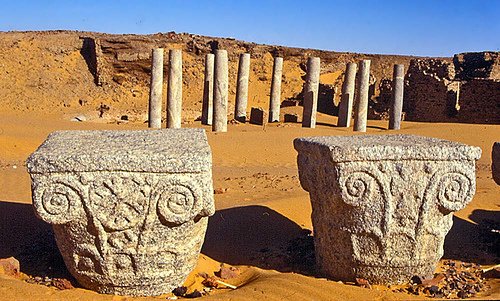
Photo: Lucio A, via Wikimedia Commons (CC BY-SA 3.0) — Church of the Granite Columns at Old Dongola.
Sources
- https://thesudanist.com/sudanese-polish-expedition-uncovers-more-of-medieval-nubias-great-church-of-jesus-at-old-dongola/
- https://www.heritagedaily.com/2026/11/monumental-medieval-cathedral-uncovered-at-old-dongola/159953
- https://www.copticsolidarity.org/2026/11/12/monumental-church-discovery-illuminates-nubias-forgotten-christian-civilization/
Leave a comment
Comment as a guest and verify your email, or sign in or create a reader account. Guest comments reach our review queue after email verification; account holders can submit directly for review.