Listen to this article
Take the story with you. Choose a voice and a pace that suits you.
Getting your device voices ready…
The voice follows the displayed language and your browser’s regional preference when available. You can choose another narration voice. Enhanced device voices are preferred; availability varies.
The record changed hands on an ordinary working day. On 30 October 2025, workers at the Sagrada Família in Barcelona lifted part of the cross for the central Tower of Jesus Christ into place, and the basilica reached 162.91 metres — just 1.38 metres above the spire of Ulm Minster in Germany, which had been the world’s tallest church since 1890. Nobody cut a ribbon. The crane simply went back down for the next piece.
Then, on 20 February 2026, the last piece went up: the upper arm of the cross. With that, the tower reached its full and final height of 172.5 metres, 144 years after the first stone was laid and exactly a century after the death of the architect who designed it, Antoni Gaudí. Information verified through 19 October 2026.
One metre of respect for a hill
The height was not chosen to break records. Gaudí fixed the top of the central tower at 172.5 metres because that put it one metre lower than Montjuïc, the hill overlooking Barcelona. His reasoning, as the project’s history records it, was that a human work should not out-top God’s. The tallest church in the world is, by its architect’s instruction, deliberately not as tall as it could have been.
Ulm Minster had held the title for 135 years, and it is still the taller building in one sense: a finished one. The Sagrada Família took the record while remaining, as it has been since 1882, a construction site.
Seventeen metres of glass, ceramic and German steel
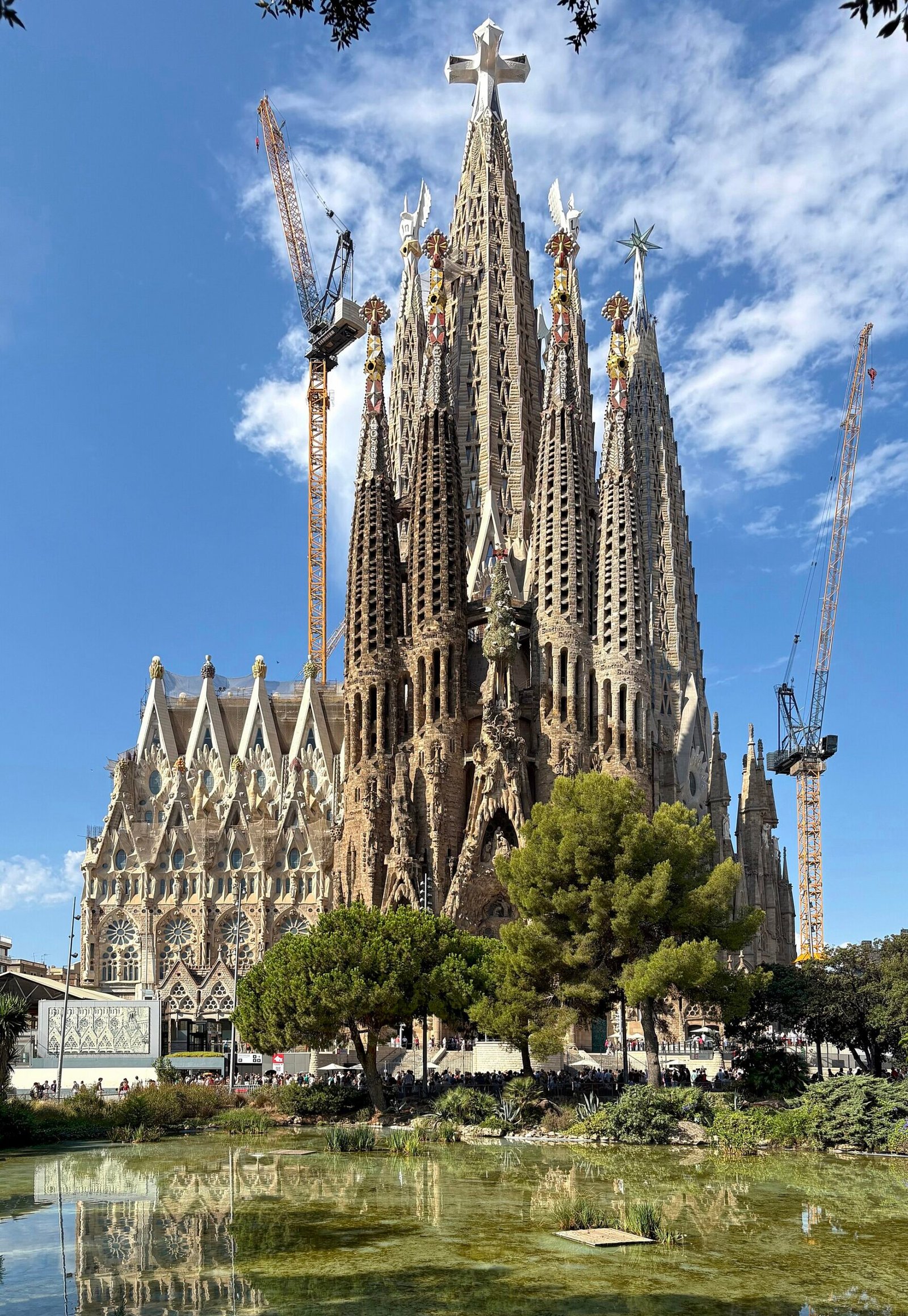
The cross itself is a building in miniature: 17 metres tall, 13.5 metres wide — roughly a five-storey house — with four arms. According to the Sagrada Família foundation, it was built in Germany in 2025, shipped to Barcelona in modules, and pre-assembled on a work platform 54 metres above the nave before being lifted into place in seven pieces. The white enamelled ceramic tiles, the stone interior and the glass were made in workshops in Catalonia. Inside the upper arm there is space for a sculpture of the Agnus Dei, the Lamb of God, by the artist Andrea Mastrovito.
Below the cross sits a 29-metre section of the pinnacle carrying a Latin inscription — Tu solus Sanctus, tu solus Dominus, tu solus Altissimus (“You alone are the Holy One, you alone the Lord, you alone the Most High”) — in white enamelled ceramic and brick, framed by sculpted palms. The tower beneath it was built using a tensioned-stone system, stone panels combined with steel so they could be manufactured off-site and installed level by level, which is how a design from the 1910s ended up being assembled with something close to flat-pack logic.
A project that has outlived everyone who started it
The first stone was laid on 19 March 1882, to a fairly conventional neo-Gothic design by Francisco de Paula del Villar. Villar resigned the following year, and Gaudí — thirty-one years old — took over and threw the design out, keeping little but the crypt. He devoted the rest of his life to the building and is buried in its crypt. When he died in 1926, after being struck by a tram, less than a quarter of the project stood.
What followed reads like a stress test for the idea of a building. The work has always been paid for privately, through donations and later visitor tickets, never from church or state coffers. In 1936, during the Spanish Civil War, anarchists set fire to the crypt and workshop, destroying Gaudí’s plans and plaster models; his successors rebuilt the design from fragments, photographs and the geometry he left behind. Pope Benedict XVI consecrated the unfinished church as a basilica in 2010. Computer-aided design and CNC stone-cutting did what hand carving could not, and the pace visibly changed.
On 10 June 2026, Pope Leo XIV blessed and inaugurated the completed Tower of Jesus Christ at the basilica — a hundred years to the day after Gaudí’s death. Head architect Jordi Faulí called the finished cross “much more than the culmination of a phase of construction: it is the result of years of work and studying the legacy Antoni Gaudí left us.”
Analysis: There is a temptation to treat the record as the story. It isn’t, quite. Plenty of churches are taller than they are interesting. What makes this one singular is that the silhouette Barcelona waited 144 years to see was fixed, on paper, by a man who knew he would never see it — and that his successors chose to keep negotiating with his drawings rather than simplify them. The height is the headline; the stubbornness is the architecture.
What is still missing
Stand in front of the basilica today and the completed central group is unmistakable: the Jesus Christ tower ringed by the four Evangelists’ towers and the Virgin Mary’s tower, fourteen of Gaudí’s eighteen spires now built. The four that remain belong to the Glory Façade, the south-facing main entrance Gaudí intended visitors to arrive through. It has not been built. Neither has the monumental stairway leading up to it, which has been argued over for years because of what stands in its path.
The foundation also says interior work on the Tower of Jesus Christ will continue through 2027 and 2028, even though its exterior is done. Full completion of the whole building is currently projected for the 2030s — nearly 150 years after groundbreaking. The Architects’ Journal noted the original plan had been to finish construction entirely for the centenary year; only the external works made it in time.
So the photograph at the top of this article is the honest one. The cross is up, the record is real, and there are still two tower cranes in the frame.
Sources
- Sagrada Família foundation release via PR Newswire — “Sagrada Família Crowned with Cross at 172.5 Meters in Gaudí Centenary Year” (Feb. 20, 2026): https://www.prnewswire.com/news-releases/sagrada-familia-crowned-with-cross-at-172-5-meters-in-gaudi-centenary-year-302693780.html
- Wikipedia — “Sagrada Família” (tallest-church record of Oct. 30, 2025, full height of Feb. 20, 2026, inauguration by Pope Leo XIV on June 10, 2026, Montjuïc height decision, construction history): https://en.wikipedia.org/wiki/Sagrada_Fam%C3%ADlia
- Gaudium Press — “Sagrada Familia Crowned World’s Tallest Church as Cross Segment Tops Jesus Christ Tower” (Oct. 31, 2025; 162.91 m vs. Ulm Minster’s 161.53 m, cross construction details, completion projected for the 2030s): https://www.gaudiumpress.ca/sagrada-familia-crowned-worlds-tallest-church-as-cross-segment-tops-jesus-christ-tower/
- Architects’ Journal — “Gaudí’s Sagrada Família reaches full height” (Feb. 23, 2026; upper arm installed Feb. 20, cross dimensions, centenary-year schedule): https://www.architectsjournal.co.uk/news/gaudis-sagrada-familia-reaches-full-height
Photo: Hokkī, via Wikimedia Commons, CC0.
Leave a comment
Comment as a guest and verify your email, or sign in or create a reader account. Guest comments reach our review queue after email verification; account holders can submit directly for review.