Listen to this article
Take the story with you. Choose a voice and a pace that suits you.
Or listen in another language / choose a voice
Getting your device voices ready…
The voice follows the displayed language and your browser’s regional preference when available. You can choose another narration voice.
Intergenerational housing benefits are easiest to spot at mealtimes. In one Chicago building, a 24-year-old resident assistant rehearses songs in her studio; down the corridor, a retired concert pianist knocks to say the voice is beautiful and offers to play piano for her sometime. “Music is how we talk,” the younger woman told Shelterforce, describing a friendship built across decades and two native languages (Shelterforce). That friendship exists because the building was designed for it. The housing came first. The music followed.
What is intergenerational housing, exactly?
Start with the definition, because the term covers two different things. Multigenerational living usually happens inside families — relatives under one roof, or in an accessory unit nearby. Intentional intergenerational housing is built on purpose between strangers. It “includes communities designed to bring people of different generations together, whether they live in the same home, [in] separate homes within the same development, or in colocated settings that intentionally foster interaction,” according to Sheri Steinig of Generations United (Shelterforce).
The model is still rare. The Harvard University Graduate School of Design counts roughly 160 such communities in the United States (Shelterforce). Interest is rising anyway, and Steinig links it directly to the housing shortage and the affordability crisis: younger adults need rooms they can pay for, and older adults often have rooms going spare.
Intergenerational housing benefits, counted in rent and routine
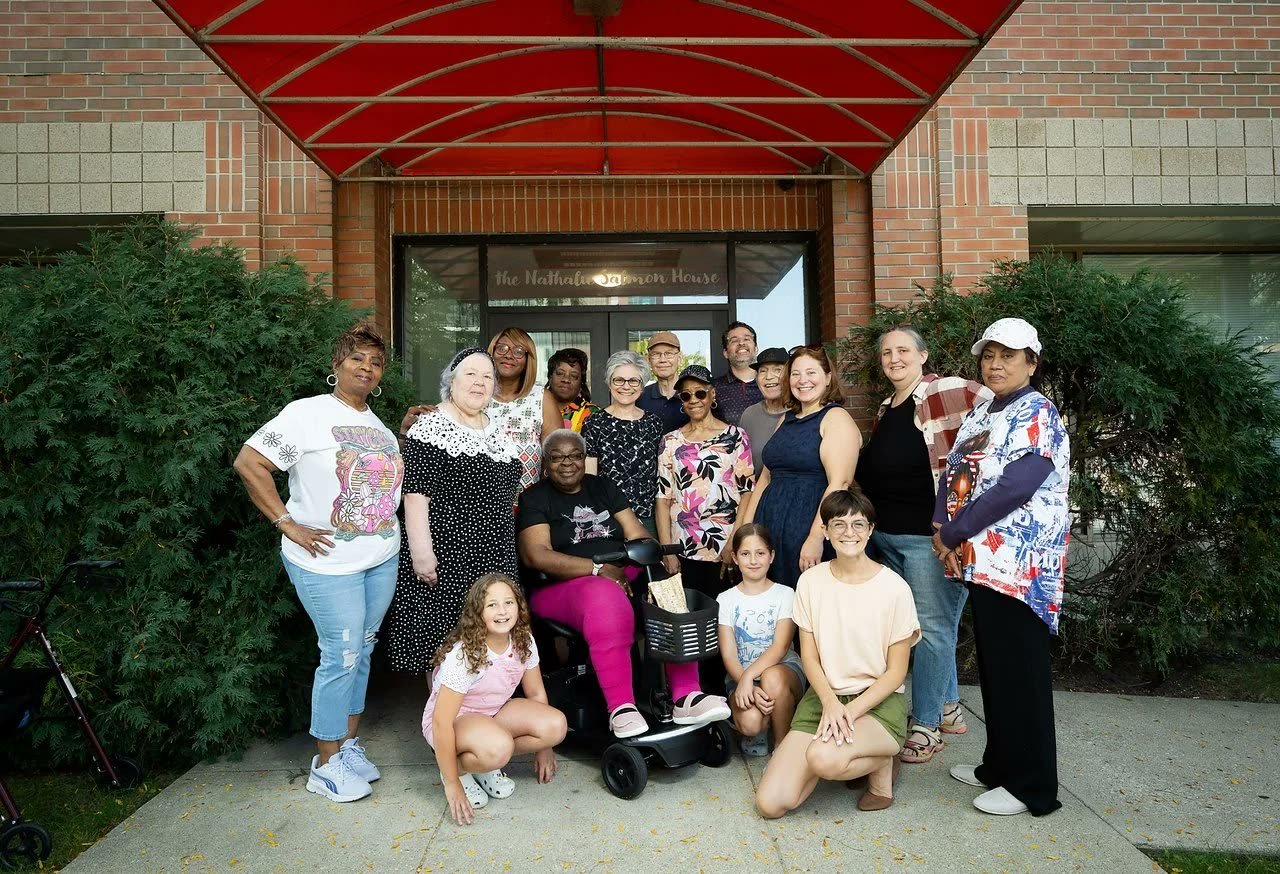
Run the numbers on one long-running example. Housing Opportunities & Maintenance for the Elderly — H.O.M.E. — owns and manages 78 apartments across three intergenerational buildings in Chicago, and has worked this way since 1982 (H.O.M.E.). Its Nathalie Salmon House in Rogers Park, opened in 1994, holds more than 43 seniors, six resident assistants and four families with minor children; the smaller Pat Crowley House, opened in 1983, holds 12 seniors, four resident assistants and one family (Shelterforce).
Resident assistants cook weekend meals for older residents and carry an on-duty phone in rotation. In exchange, an assistant pays $500 a month for a studio, against an average Chicago one-bedroom rent of $1,900 recorded by Zillow Rentals in August 2026 (Shelterforce). Older residents in private apartments pay 30 per cent of income. H.O.M.E.’s executive director Gail Schechter is blunt about what the arrangement is not: “This is not a nursing home,” she says. “This is not any medical model. This is regular, independent housing” (Shelterforce).
The model can also run in reverse. At New Life Village in Tampa, founded in 2008 to keep children out of the foster system, the older residents carry the service commitment — helping at events, babysitting, tutoring — for the adoptive, foster and kinship families who live alongside them. “Our seniors are pretty much the secret sauce to that,” says executive director Mariah Hayden (Shelterforce). Children there gain stand-in grandparents. Seniors gain a job worth showing up for.
Intergenerational homesharing, the one-spare-room version
You don’t need a 53-unit building. Intergenerational homesharing pairs one older host who has a spare room with one younger person who needs one. France gives the arrangement a legal shape — cohabitation intergénérationnelle solidaire — under which a host aged 60 or over can let part of their main home to someone under 30 for a modest financial contribution, with small agreed services on top (ToitChezMoi).
Berlin’s Sonay soziales Leben project, started in 2024 with Berlin Senate support, matches the same two pressures: more than 400 young people have registered, while 27 per cent of Germans over 65 who live alone occupy homes of at least 100 square metres, according to the Federal Statistics Office (Deutschland.de). Sonay screens matches by questionnaire — a quiet student won’t thrive under a hard-of-hearing host’s loud television — and one matched pair, aged 21 and 70, report “a lot of laughter” and more in common than either expected (Deutschland.de).
Students living with older adults need the boundaries in writing
None of this runs on goodwill alone. Students living with older adults can watch occasional presence harden into expected availability, and small favours can slide into unpaid work; homesharing guides are explicit that the younger housemate must not become a carer, housekeeper or substitute for professional services (ToitChezMoi). In Berlin, one young tenant’s first concern at the matching meeting was exactly that — whether care duties would be expected of her. They weren’t, because the question got asked before move-in day (Deutschland.de).
Buildings have their own frictions. H.O.M.E. once gave assistants free room and board plus heavier duties; some older residents read that as freeloading, so the organisation switched to a paid rent with fewer duties and the tension eased (Shelterforce). Regulation bites harder still: Schechter says current low-income housing tax credit rules requiring private kitchens and bathrooms in every unit are “definitely preventing us from doing new development” on the shared-space model (Shelterforce).
Design helps where rules allow. Put the laundry beside a rooftop garden instead of in a basement and people linger, Steinig notes. “A place that’s good for a wheelchair or a walker is also good for a stroller” (Shelterforce).
Analysis: the pattern across Chicago, Tampa, Berlin and the French scheme is that the exchange works when it is specific — named duties, a stated rent, a written agreement, rooms designed for bumping into people. Vague neighbourliness curdles. Written-down neighbourliness, it turns out, holds.
Photo: H.O.M.E. (Housing Opportunities & Maintenance for the Elderly)
Sources
- https://shelterforce.org/2026/08/26/what-happens-when-a-community-is-designed-to-bring-generations-together/
- https://homeseniors.org/intergenerational-housing
- https://www.deutschland.de/en/topic/life/intergenerational-living-in-berlin-mixed-age-flatsharing
- https://www.toitchezmoi.com/blog/en/intergenerational-homesharing
Leave a comment
Comment as a guest and verify your email, or sign in or create a reader account. Guest comments reach our review queue after email verification; account holders can submit directly for review.