Listen to this article
Take the story with you. Choose a voice and a pace that suits you.
Or listen in another language / choose a voice
Getting your device voices ready…
The voice follows the displayed language and your browser’s regional preference when available. You can choose another narration voice.
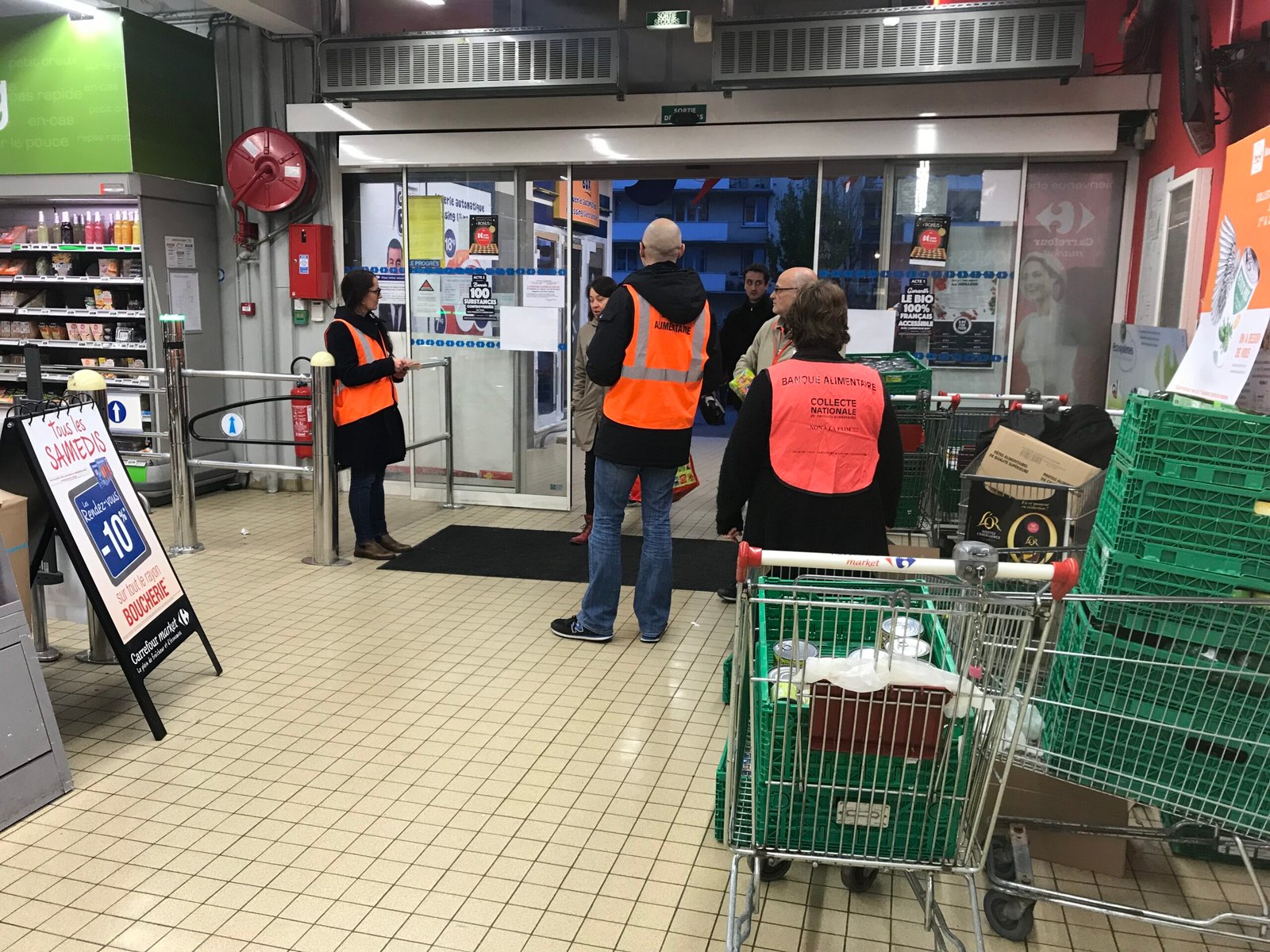
The France food banks national collection 2026 closed on Sunday 8 November, three weeks earlier than the drive usually runs. For three days, volunteers took in food and hygiene products at collection points in supermarkets, schools, town halls and workplaces across the country (WHIF). The federation, the Banques Alimentaires, put the network at nearly 9,000 collection points and says the weekend normally supplies about 9% of everything it distributes in a year (Banques Alimentaires). Information verified through 9 November 2026.
Nine percent sounds modest. It isn’t. This is the stock the system starts winter with.
France food banks national collection 2026: how the three days worked
The mechanics stayed simple. Shoppers added extra items to their baskets on 6, 7 or 8 November and left them with volunteers at the store exit; the goods were then sorted, stored and passed on through more than 6,000 partner associations and municipal social action centres (Banques Alimentaires). The federation asked for shelf-stable food — tinned vegetables, fish and ready meals, rice, pasta, semolina and lentils, oil, flour and sugar — plus baby food, nappies and hygiene products such as soap, shampoo and toothpaste (Banques Alimentaires). People who could not get to a shop could give money online through Mon Panier Solidaire, which lets local branches buy the products they are short of (Banques Alimentaires).
AFP reported that organisers moved the date forward to avoid an increasingly crowded end of November and to start restocking sooner for winter (WHIF). In a typical year the collection mobilises around 130,000 volunteers at more than 9,000 points and gathers the equivalent of 23 million meals, according to the CMA CGM Foundation, a federation partner since 2022 (CMA CGM). Last year’s drive brought in about 9,750 tonnes of products, roughly 19 million meals (WHIF). This year’s total will not be known until the sorting finishes.
Food aid demand in France is a trend, not a spike
The federation now helps 2.4 million people in food precarity (Banques Alimentaires). A French Senate budget report on solidarity spending recorded the same climb from the federation’s own figures: the number of people seeking food aid rose from 1.8 million to 2.4 million from 2023, and the profile changed too — more working people in precarious jobs, more young people than before the inflation crisis (Senate). Repeat visits by the same households have also increased, which is the detail that changes the story. A one-off emergency visit is a bad month. Returning, month after month, is a budget that no longer works (WHIF).
The Senate report added a quieter point: even as overall solidarity credits fall for the first time in a decade, the rapporteurs describe food aid funding as preserved — held apart from the cuts because need is still rising (Senate). The state, in other words, is budgeting for this to continue.
Food bank volunteers in France, and the cost of moving food
A donated tin still has to travel. RTL reported on 8 November that the network’s 550 trucks cover about five million kilometres a year and burn roughly 500,000 litres of diesel — so when fuel prices rise, part of every donation is spent before it reaches a shelf (WHIF). That is why the federation pushes financial donations alongside physical ones: money lets a local branch fill the gaps a collection leaves, instead of holding plenty of pasta and no baby food.
The system stays deliberately local. Goods collected in a department are redistributed through nearby partners, which keeps journeys short and lets each area respond to its own shortages (WHIF).
France is not alone in leaning on organised goodwill this autumn. In Catalonia, the Aprofitem els Aliments campaign closed its October edition on 6 November having recovered more than 21 tonnes of food with 4,042 participants, including over 100 restaurants serving 3,177 meals cooked from recovered ingredients (Demócrata). Different country, different model — rescue there, donation here — same underlying pressure.
Analysis: the earlier date is the tell. A charity drive moves three weeks forward when its organisers expect winter demand to arrive before the shelves are ready, and when the late-November calendar no longer has room. The collection still works — the volunteers showed up, as they have for 42 editions — but it now functions less like an annual appeal and more like scheduled infrastructure for 2.4 million people. Infrastructure is not supposed to depend on whether shoppers remember the tinned fish.
Photo: Benoît Prieur, via Wikimedia Commons (CC0)
Sources
- https://www.banquealimentaire.org/collecte-nationale-des-banques-alimentaires-2026-faites-un-don-les-6-7-et-8-novembre-8012
- https://www.whifnews.com/stories/food-banks-national-collection-final-day-2026/
- https://www.senat.fr/rap/l25-139-329/l25-139-329_mono.html
- https://www.cmacgm-group.com/en/news-media/cma-cgm-employees-support-the-french-federation-of-food-banks-national-collection
- https://www.democrata.es/en/agriculture-food/the-aprofitem-els-aliments-2026-campaign-closes-with-21-7-tons-of-recovered-food/
Leave a comment
Comment as a guest and verify your email, or sign in or create a reader account. Guest comments reach our review queue after email verification; account holders can submit directly for review.