Listen to this article
Take the story with you. Choose a voice and a pace that suits you.
Or listen in another language / choose a voice
Getting your device voices ready…
The voice follows the displayed language and your browser’s regional preference when available. You can choose another narration voice.
The global river discharge decline 2023 2024 was not a local drought story. A study published in Science on 26 November found that river flows worldwide ran about 5.7 percent below the long-term average across 2023 and 2024, while the active water stored in lakes and reservoirs fell 9.5 percent (Phys.org). No comparable two-year drop appears anywhere in the study period, which runs from 1991 to 2025 (Phys.org).
The finding cuts against a common assumption. A warmer atmosphere holds more water vapour, so a hotter world should be a wetter one, right? Senior author Günter Blöschl of TU Wien puts the correction bluntly: a warmer atmosphere can hold more vapour, but that does not mean more water is available to us; what matters is where and when rain falls, and how much is lost to evaporation (Phys.org).
How the global river discharge decline 2023 2024 was measured
The team, led by Yongqiang Zhang of the Chinese Academy of Sciences, combined discharge measurements from 150 large river basins with satellite data covering more than 1.2 million lakes and reservoirs, then reconstructed global water availability from 1991 to 2025 using hydrological models and machine learning (Phys.org). The record falls into three phases: fluctuation from 1991 to 2006, relative stability from 2007 to 2022, then abrupt disruption in 2023 and 2024 (Brightsurf).
In absolute terms, global river flow fell by about 2,040 cubic kilometres per year against the 1991–2020 average, and lake and reservoir storage by about 640 cubic kilometres, the largest decline since at least 1991, according to Zhang (ConnectSci). Rain did not vanish from the planet. Precipitation over the oceans increased while it decreased over land, and land received about 1,360 cubic kilometres per year less rain than normal (Phys.org; ConnectSci). The water went to the wrong address.
Zhang treated the two years as a natural experiment, since 2023 and 2024 were the two warmest years on record, with global temperatures exceeding 1.5°C above pre-industrial levels (ConnectSci). The study grew out of work on the World Meteorological Organization’s State of Global Water Resources 2024 report, where the team first saw river flows and lake storage falling at the same time in many regions (ConnectSci).
South America, and the Amazon river flow lowest in four decades
One continent carried most of the loss. South America accounted for about 70 percent of the global decline in river flow, with streamflow down 17.8 percent and surface water storage down 16.5 percent, even though parts of the continent saw extreme rainfall and flooding in the same period (ConnectSci; Brightsurf). The Amazon basin recorded its lowest flow in four decades (ConnectSci).
The mechanism was an unlucky pairing of oceans. El Niño warmed the tropical Pacific while the tropical North Atlantic was exceptionally warm at the same time; the combination shifted circulation so air sank over South America and moisture was drawn away, producing severe rainfall deficits (Phys.org). Zhang describes El Niño as the trigger and the warm Atlantic as the amplifier, and notes that the tropical Atlantic now warms about 1.2°C more for every 1°C of global warming during El Niño peaks, even though El Niño itself is not getting stronger (ConnectSci).
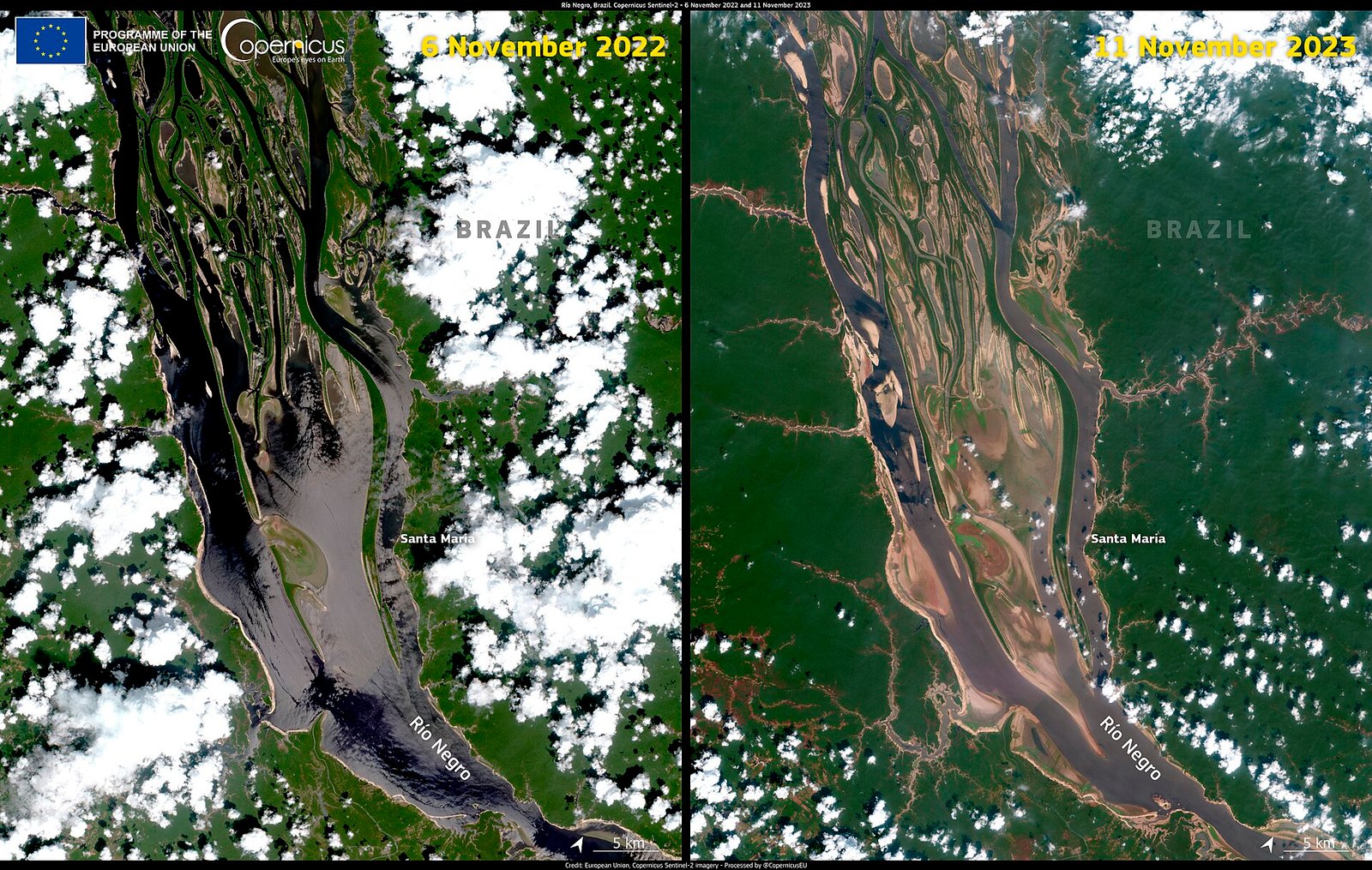
The human and ecological costs were concrete. The Rio Negro at Manaus fell to its lowest level since records began in October 2023, then broke that record again in October 2024; Brazil’s Santo Antônio hydropower plant on the Madeira River suspended operations, and Ecuador imposed blackouts as drought drained its hydropower reservoirs (ConnectSci). In the Brazilian Amazon in autumn 2023, more than 200 pink river dolphins died at Lago Tefé as drought pushed water temperatures above 40 degrees (Phys.org).
An El Niño warm Atlantic drought pattern that can return
River flows recovered toward their long-term average in 2025, which tells its own story: the collapse came from a specific combination of conditions, not heat alone (Phys.org). The authors suggest warming may make severe El Niño-related droughts more likely by intensifying Atlantic warming (Brightsurf). One summary of the study also flags the limits readers should keep in mind: the work centres on a single extreme two-year event, draws on 150 major basins rather than every river, and its regional figures are the authors’ estimates (Europe Says).
Austria offers a smaller, nearer echo. GeoSphere Austria recorded the twelve months from August 2025 to July 2026 among the driest since records began in 1850, with rainfall about a third below the long-term average into autumn 2026 (Phys.org).
Analysis: the planning lesson is about variance, not averages. Water systems are usually designed around gradual trends and known dry regions. This study describes the opposite failure mode: a sudden, synchronised drop hitting humid regions that considered themselves water-rich, driven by two ocean basins warming at once. Zhang’s advice to water managers is to plan for sudden, large drops in supply, not only gradual change (ConnectSci). Reservoirs, hydropower contracts and irrigation plans built on the assumption that wet places stay wet now have a documented counterexample, measured across 1.2 million lakes.
Information verified through 28 November 2026.
Photo: Satellite comparison of the drought-hit Rio Negro in Brazil. Contains modified Copernicus Sentinel data, via Wikimedia Commons
Sources
- Phys.org — Why a warmer atmosphere doesn’t guarantee more water in rivers: https://phys.org/news/2026-11-warmer-atmosphere-doesnt-rivers.html
- ConnectSci — Climate change is making Earth’s water cycle more volatile: https://connectsci.au/news/news-parent/10479/Climate-change-is-making-Earth-s-water-cycle-more
- Brightsurf — Extreme global heat triggered unprecedented decline in surface freshwater: https://www.brightsurf.com/news/8OMXGQE1/extreme-global-heat-triggered-unprecedented-decline-in-surface-freshwater.html
- Europe Says — Record Heat Drained the World’s Rivers and Lakes in 2023 and 2024, a New Science Study Finds: https://www.europesays.com/3404143/
Leave a comment
Comment as a guest and verify your email, or sign in or create a reader account. Guest comments reach our review queue after email verification; account holders can submit directly for review.