Listen to this article
Take the story with you. Choose a voice and a pace that suits you.
Or listen in another language / choose a voice
Getting your device voices ready…
The voice follows the displayed language and your browser’s regional preference when available. You can choose another narration voice.
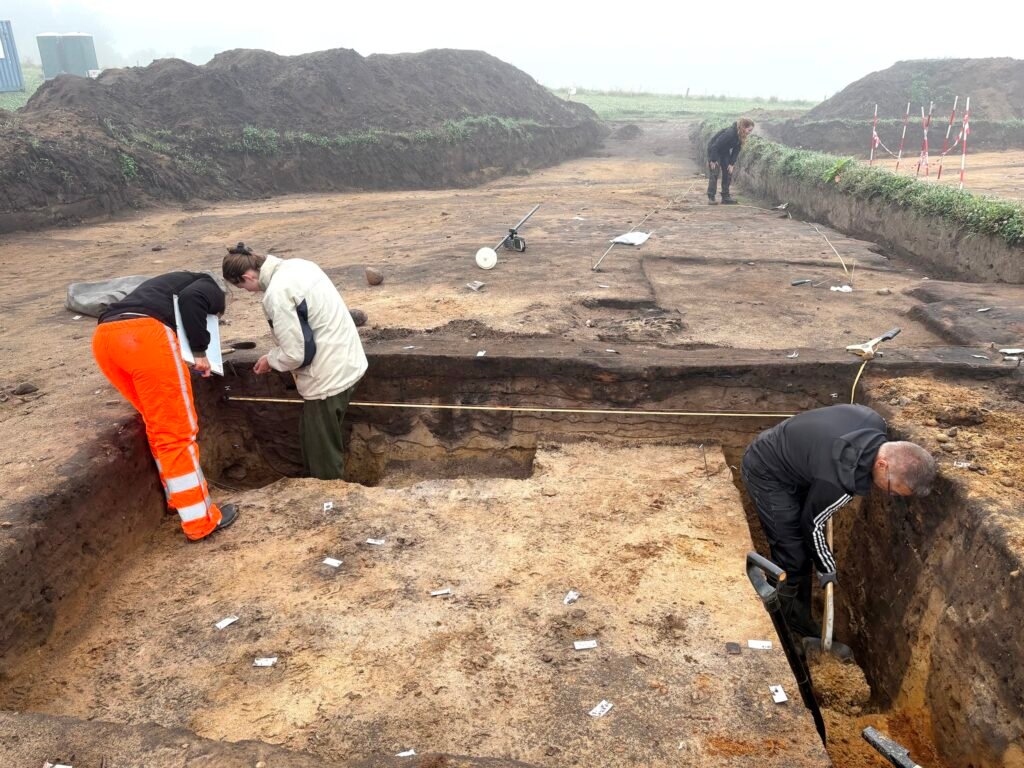
The Hedegård Iron Age temple stood for perhaps three generations, burned, and then waited two thousand years under grass. What archaeologists have now detailed at Hedegård, near Ejstrupholm in central Jutland, is not a farmstead with pretensions. It is a fortified settlement with workshops, an elite residence, Scandinavia’s largest and richest burial site from its era, and at its centre a ritual building unlike anything else known from Denmark at that date (New York Post). Museum Midtjylland, which leads the work with Museum Horsens and Moesgaard Museum, calls the site unique in Northern European archaeology — “an early and unparalleled display of military, economic, and religious power” (New York Post). Information verified through 11 November 2026.
A Denmark Iron Age temple discovery forty years in the making
This Denmark Iron Age temple discovery began, as these stories often do, with graves. In 1986 archaeologist Orla Madsen uncovered an unusually rich burial ground at Hedegård, dense with weapon graves that signalled high status from the start (Arkeonews). Excavations paused in 1993 and the meadow went quiet for more than two decades. Museum Midtjylland resumed work in 2016, and in the summer of 2023 surveys confirmed what the graves had been hinting at: the cemetery belonged to a large enclosed settlement, complete with workshops, elite residences and defensive structures (GKToday). The temple itself was carefully examined in 2025, and a further excavation season began last August (Arkeonews; New York Post).
“Everything at Hedegård is bigger and wilder than usual,” museum inspector Martin Winther Olesen told Denmark’s DR. “When we talk about this site, nothing is ordinary” (Arkeonews).
Inside the Hedegård Iron Age temple and its fortified settlement
The temple at the heart of the Hedegård fortified settlement measures roughly 15 by 16 metres. A ring of strong round posts formed a covered colonnade around a smaller inner building with deeply set supports and walls of split planks and clay; plaster fragments suggest those walls were once painted white (Arkeonews; New York Post). At the exact centre sat a raised clay hearth, about two metres square, decorated with stamped and linear ornaments and showing no sign of cooking — a ritual fixture, not a domestic one (GKToday).
Beneath the burn layer, excavators found two temple phases. In the younger phase a new ornamented hearth was built partly over the earlier one, and the building shifted about 80 centimetres north while staying otherwise nearly identical (New York Post). Olesen dates the pagan structure to between 50 BC and AD 50 — roughly a millennium before Christianity reached Scandinavia — and stresses what it gives researchers: “This gives us our first real picture of what a religious building from this period looked like. Until now, we only had examples that were several hundred years younger” (Arkeonews; New York Post).
Around the temple, the settlement produced workshops for gold, bronze, iron and amber work, plus weapon production, and finds running from Celtic weapons to prestige items from Roman workshops (Arkeonews; New York Post).
An Iron Age power centre in Denmark, facing Rome
Why build all this, here, then? Hedegård controlled the most important road up through Jutland, Olesen notes, and its floruit coincides with Rome’s advance north to the River Elbe, uncomfortably close to home (New York Post; GKToday). Archaeologists read the palisades and fortifications — built with an awareness of Roman techniques — as a plausible answer to that pressure: an Iron Age power centre in Denmark announcing itself in timber and ditchwork (Arkeonews).
Its connections ran far past the Elbe. The temple was carefully cleared before being deliberately burned, likely a ritual closure, and almost nothing was left behind — except two glass beads. One, turquoise and about four centimetres long, likely came from Egypt; the other, a delicate gold-foil bead, was traced to the Levant (Arkeonews). Glass beads are extremely rare in early Iron Age Scandinavia. Their presence in a Jutland temple ties this settlement to trade networks stretching thousands of kilometres.
Then, after roughly three generations, Hedegård disappears from the record (New York Post). Nobody yet knows why.
Cleared, burned and then protected
The site’s second life is quieter and better organised. In December 2024 Denmark’s Agency for Culture and Palaces bought the land outright, and agricultural activity there is now permanently banned (Arkeonews). “I am extremely relieved,” Olesen said. “Now it is secured for future generations” (Arkeonews).
Analysis: Hedegård rearranges a familiar picture of the period, in which power in the north supposedly arrives late and stays local. Here is a settlement organising ritual, craft production, defence and Mediterranean trade around the turn of the Common Era — then vanishing within a century. The temple’s two hearths, one built respectfully over the other, may be the most telling detail: this was a community renewing its sacred centre, not abandoning it. Whatever ended Hedegård, decline doesn’t look like the mechanism.
Photo: Museum Midtjylland
Sources
- https://nypost.com/2026/03/17/science/temple-from-christs-time-reveals-lost-powerful-society-archaeologists-say/
- https://arkeonews.net/2000-year-old-iron-age-temple-discovered-in-denmark-reveals-powerful-northern-european-center/
- https://www.gktoday.in/denmarks-iron-age-temple-unearthed-at-hedegaard/
- https://www.europesays.com/dk/15661/
Leave a comment
Comment as a guest and verify your email, or sign in or create a reader account. Guest comments reach our review queue after email verification; account holders can submit directly for review.