Listen to this article
Take the story with you. Choose a voice and a pace that suits you.
Getting your device voices ready…
The voice follows the displayed language and your browser’s regional preference when available. You can choose another narration voice. Enhanced device voices are preferred; availability varies.
Event date: 9 October 2026. Information verified through 20 October 2026.
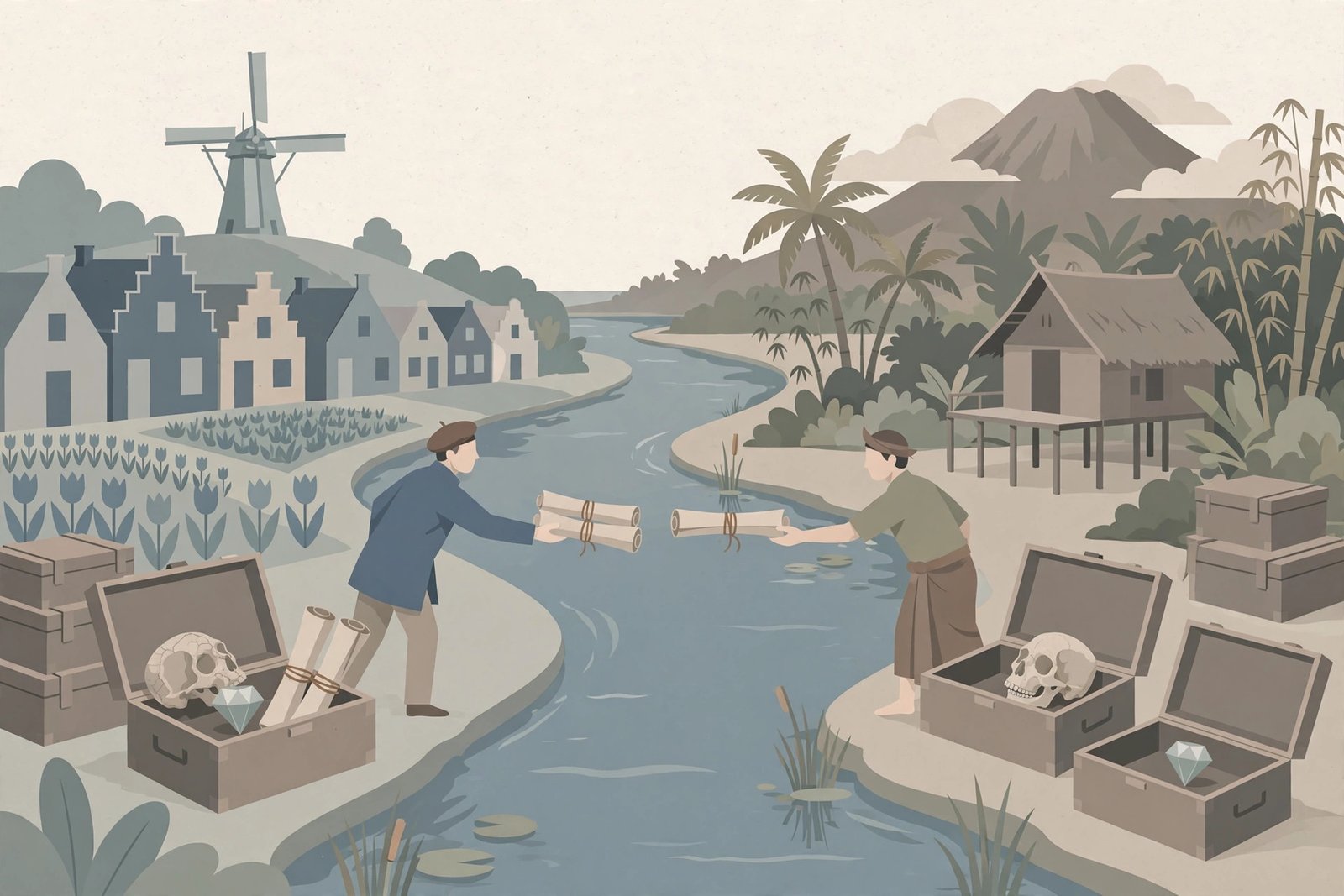
Thirty thousand is a hard number to picture. Try this instead: a skullcap, a molar and a thigh bone, dug from the banks of the Bengawan Solo River on Java about 130 years ago, shipped to Leiden, and argued over ever since (Archaeology Magazine). Those fossils — the Homo erectus remains known as “Java Man” — are the famous tip of a far larger collection, and on 9 October 2026 Indonesia and the Netherlands signed two agreements covering its return (Indonesia Business Post).
The agreements cover 30,190 items from the Eugène Dubois Collection and 20 historical cultural objects taken during the colonial period (Indonesia Business Post). Indonesian Culture Minister Fadli Zon called the Dubois return Indonesia’s largest repatriation in terms of both the number of objects and their scientific value (Indonesia Business Post).
What is actually in the crates
Under the next phase, 29,763 objects and 427 ancestral skeletal remains will be returned from the Naturalis Biodiversity Center in Leiden (Indonesia Business Post). Reporting of the signing, carried by the Antara news agency, breaks the 20 cultural objects down further: the Banjarmasin Diamond, a Sikin Panjang sword from Aceh, a Quran manuscript linked to Teuku Umar, four manuscripts from the Aceh Sultanate, six Wayang Beber scrolls, a tomb panel from Aceh, and six Acehnese-style tombstones (Antara via TravelText). IndonesiaNow gives the diamond’s size as 38 carats and describes the Quran as belonging to the family of national hero Teuku Umar (IndonesiaNow).
This is not the first shipment. On 17 December 2025, four items from the Dubois Collection — a Homo erectus skullcap, a molar, a femur and an engraved shell — were returned and are now displayed at the National Museum of Indonesia (Indonesia Business Post). Archaeology Magazine, reporting that earlier return, notes the skullcap, molar and thigh bone are now thought to have come from different individuals (Archaeology Magazine).
A request first made in 1949
Indonesia first requested the return of the Dubois Collection in 1949, after gaining independence from Dutch rule (Archaeology Magazine). In 2020, a Dutch government advisory committee recommended restitution, stating that the fossils were likely removed against the will of the people, who had been coerced into revealing fossil sites (Archaeology Magazine). IndonesiaNow reports that the current repatriation is based on recommendations from the Dutch Colonial Collections Committee (IndonesiaNow).
Naturalis general director Marcel Beukeboom described the key fossil this way: “This fossil bears witness to an important link in human evolution, while also representing part of Indonesian history and cultural heritage” (Archaeology Magazine). Indonesian scientists will now be able to compare the Java fossils with material they have found on Sumatra and Sulawesi (Archaeology Magazine).
The words both sides chose
Zon framed the agreement as repair, not accusation. “We do not intend to reopen old wounds. We want to heal them,” he said, as quoted on the Indonesian Ministry of Foreign Affairs website (IndonesiaNow). His formal statement called the agreement an affirmation of “historical justice, the restoration of cultural sovereignty, and recognition of the dignity and cultural identity of the Indonesian nation” (Indonesia Business Post).
After the return, Indonesia’s Ministry of Culture says it will manage the collections under three priorities: preservation and conservation, collaborative scientific research, and broader public access through education (Indonesia Business Post). IndonesiaNow renders the same three principles more briefly — care, research, educate (IndonesiaNow).
The file is not closed
At the same bilateral meeting, Zon pushed for joint research to trace the origins of the Raden Saleh collection and ancestral remains in the Theodor Verhoeven Collection, both still held in the Netherlands (Antara via TravelText). “The Raden Saleh collection is also of great importance to Indonesia,” he said, arguing that further repatriation should proceed “based on robust historical and scientific study” (Antara via TravelText).
Antara also puts the longer count in view: since 1975, Indonesia has repatriated 2,338 historical cultural objects from museums in Amsterdam and Rotterdam, including the Pita Maha Collection and the Lombok Treasure (Antara via TravelText). Set that figure beside 30,190 and the scale of this single agreement snaps into focus. It is more than twelve times everything returned across the previous five decades, by count.
Analysis: the scientific and the symbolic returns are doing different work, and both matter. The fossils give Indonesian researchers direct custody of evidence about human evolution found on Indonesian soil. The diamond, the sword and the manuscripts do something else — they return objects whose meaning was never primarily scientific. A single agreement that handles both kinds honestly, ancestral remains included, is harder to negotiate than either alone. That, more than the headline number, is what took until 2026.
Sources
- Indonesia Business Post — “Indonesia, Netherlands sign landmark agreement to return more than 30,000 historical objects and fossil collections” (12 October 2026): https://indonesiabusinesspost.com/7557/geopolitics/indonesia-netherlands-sign-landmark-agreement-to-return-more-than-30-000-historical-objects-and-fossil-collections
- Antara via TravelText — “RI pushes for research on Raden Saleh collection held in the Netherlands” (11 October 2026): http://traveltext.id/2026/10/11/ri-pushes-for-research-on-raden-saleh-collection-held-in-the-netherlands/
- IndonesiaNow — “Netherlands Returns 30,000 Indonesian Cultural Heritage Items” (12 October 2026): https://www.indonesianow.co/news/8702864/netherlands-returns-30-000-indonesian-cultural-heritage-items?utm_campaign=detikcomsocmed&utm_medium=oa&utm_source=facebook&utm_content=indonesianow
- Archaeology Magazine — “‘Java Man’ Fossils Returned to Indonesia” (19 December 2025): https://archaeology.org/news/2025/12/19/java-man-fossils-returned-to-indonesia/
Leave a comment
Comment as a guest and verify your email, or sign in or create a reader account. Guest comments reach our review queue after email verification; account holders can submit directly for review.