Listen to this article
Take the story with you. Choose a voice and a pace that suits you.
Or listen in another language / choose a voice
Getting your device voices ready…
The voice follows the displayed language and your browser’s regional preference when available. You can choose another narration voice.
Investigation — Evolving Humanities. Evidence checked and tiered — documented, contested, unverified — through 8 November 2026. Allegations are attributed; nothing in this report treats an allegation as a finding.
TL;DR: The casting is real, the 2013 tweet is real, and the pattern of roles is real: Harriet Tubman, Aretha Franklin, and now Afeni Shakur, three foundational Black American women played by a London-born actress of Nigerian parentage. Her explanation for the tweet is on record; a formal apology is not. The wider claims travelling with the story are weaker: the famous dinner-table clash was real but happened on a different show than the one usually named, and the viral statistics about skin bleaching and paternity fraud in Nigeria and Jamaica — repeated as settled fact — do not survive sourcing. The grievance has a documented core. The numbers pinned to it do not.
The announcement
On Wednesday 4 November 2026, The Hollywood Reporter announced exclusively that Cynthia Erivo will play Afeni Shakur — activist, former Black Panther, and mother of Tupac Shakur — in Snoop, Universal Pictures’ biopic of Snoop Dogg. Universal confirmed the casting the same day. The film is directed by Craig Brewer and produced by Snoop Dogg himself, with Brian Grazer, Sara Ramaker of Death Row Pictures and Allan Mandelbaum. Jonathan Daviss plays Snoop; Camron Jones plays Tupac; Lauren London plays Snoop’s mother, Beverly Tate; Myles Bullock is Dr. Dre and Algee Smith is Warren G. Production is under way in Southern California, and Universal has dated the film for 6 August 2027.
Afeni Shakur is not a decorative role. She is one of the most revered women in hip-hop’s founding story — a Panther 21 defendant who represented herself in court, and the subject of Tupac’s “Dear Mama.” Within a day, EBONY was reporting that the casting “reignites debate over the British actor portraying Black American icons,” opening its piece with a three-word roll call: “Harriet. Aretha. Celie.” Online, the reaction among Black American commenters was immediate and mostly hostile. We sampled the 50 most recent replies on one widely shared post about the casting, out of 799 replies in total — a partial sample, and we label it as such. The dominant themes: that it “was already too much with her playing Harriet,” that “Cynthia Erivo doesn’t respect Black Americans and has made horrible remarks about Black Americans,” that Black American actresses should play Black American historical figures, and calls to boycott. A minority defended the casting on craft: “she’s a great actor”; “Loved her in Till”; “She’s perfect for Afeni during her Black Panther days.”
This investigation audits the claims underneath that reaction — what is documented, what is contested, and what is simply not supported.
The record in numbers
Claim one: “She mocked the way Black Americans talk”
Verdict: the remark is documented. The intent is contested. No formal apology appears on the record.
The document at the centre of this dispute is a tweet Erivo posted on 26 January 2013. The original post has been deleted, but a screenshot of the exchange survives in the September 2018 @eBoPeep thread — archived by Thread Reader App and cited as a source by the International Journal of Communication‘s 2024 study of this backlash — and the text is independently corroborated by that study and by EBONY’s reporting of 5 November 2026:
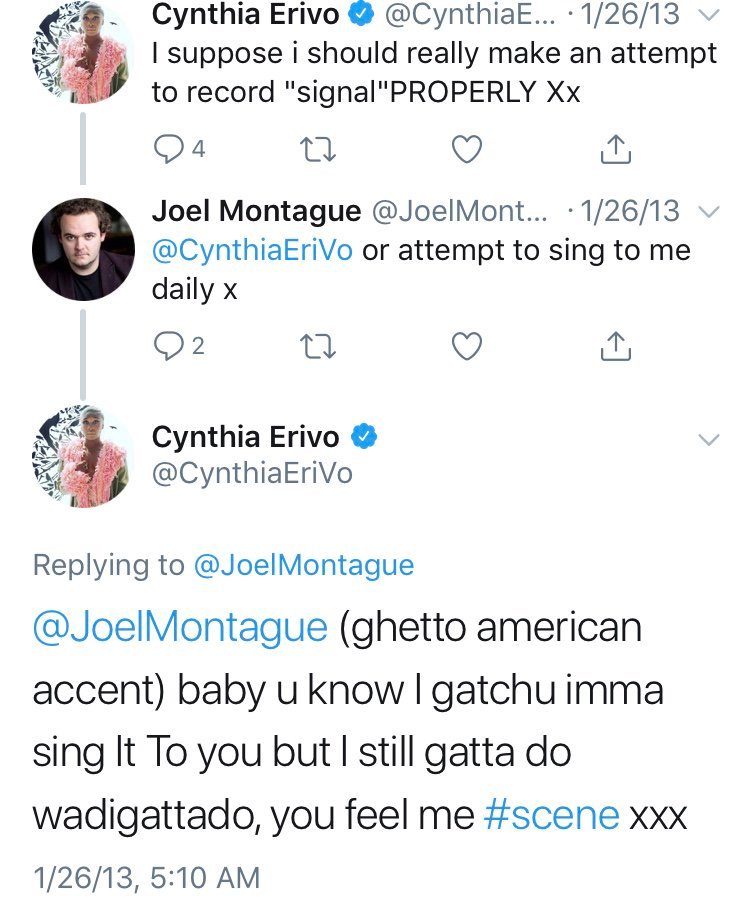
The International Journal of Communication‘s 2024 study of the backlash records the same text and concludes that in it she “characterized the African American accent as ‘ghetto’.” The tweet resurfaced in September 2018, as her casting as Harriet Tubman became a flashpoint: on 24 September 2018, a widely shared thread by the user @eBoPeep alleged — and we stress, alleged; the thread’s screenshots do not survive in the archive — “a troubling pattern of Cynthia repeatedly, deliberately, selectively choosing to not give respect to African-American heritage.” Erivo responded on Instagram on 15 September 2018, acknowledging that “there’s also anger and offense spurred on by my being from the UK,” and calling for “a bigger conversation to be had about heritage and experience, also about who Harriet really was.”
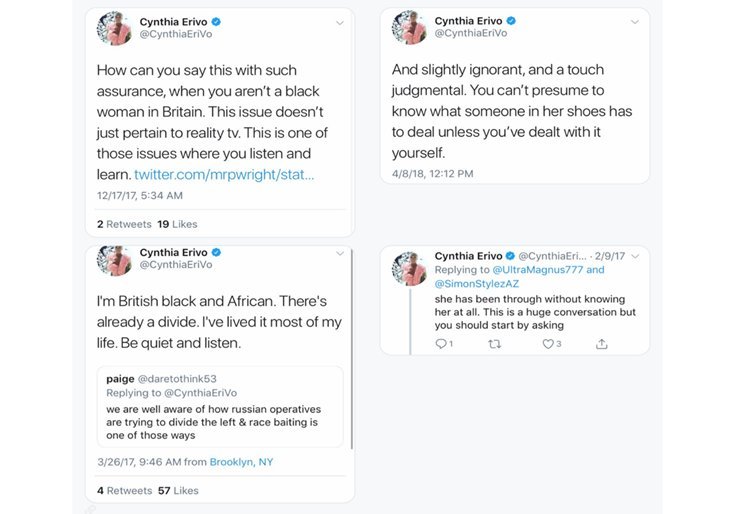
The same journal reproduced four further screenshots of Erivo’s posts from 2017–18 (its Figure 2), in which she argues the diaspora divide from her side — including, on 26 March 2017: “I’m British black and African. There’s already a divide. I’ve lived it most of my life. Be quiet and listen.” The screenshots are reproduced here as an exhibit; provenance is stated in the caption.
Her fullest defence came at the Toronto International Film Festival in September 2019, to Shadow and Act.
The tweets, she said, were “taken out of context… it wasn’t mocking anyone really… It was to celebrate a song I had wrote when I was 16.” She added: “I’ve never spoken negatively about people,” and, of Tubman: “I love this woman and I love Black people full stop.” To Oprah Winfrey the following month, her answer to critics was: “See it, and then make your judgments is what I say. Give me a chance.”
Two things can be true at once, and the record supports both: the sentence she published in 2013 reads, on its face, as a mock phonetic rendering of Black American speech labelled “ghetto”; and her consistent position since 2018 is that it was a private joke about a song, taken out of context. What the record does not contain — and we searched the trade coverage across 2018, 2019 and 2026 — is a formal apology for it. There is explanation. There is no “I was wrong, and I’m sorry.” By 2020 she had conceded ground partway: in a Hollywood Reporter conversation with Roxane Gay, she acknowledged that “valid points had been made.”
One caution this investigation applies throughout: a different, widely shared grid of tweets about Black Americans from 2010–11 belongs to the writer Luvvie Ajayi, not to Erivo. It is routinely misattributed to her in this debate. It is not hers, and we do not count it against her.
Claim two: “Hollywood keeps handing her Black American icons”
Verdict: the pattern of roles is documented fact. Why it happens is analysis, and is labelled as such below.
The filmography is not in dispute. Erivo, born in Stockwell, London, on 8 January 1987 to Igbo Nigerian immigrant parents and raised in South London by her mother, a nurse, has now been cast as:
| Role | Project | Year | Who she was |
|---|---|---|---|
| Celie | The Color Purple (Broadway) | 2015–16 | The fictional centre of Alice Walker’s novel of Black Southern life. The role won Erivo the Tony Award for Best Actress. |
| Harriet Tubman | Harriet | 2019 | The abolitionist who led enslaved people to freedom — the defining sacred figure of Black American history. |
| Aretha Franklin | Genius: Aretha (National Geographic) | 2021 | The Queen of Soul, born in Memphis and raised in Detroit. |
| Afeni Shakur | Snoop (Universal) | 2026 | Black Panther, Panther 21 defendant, mother of Tupac Shakur. |
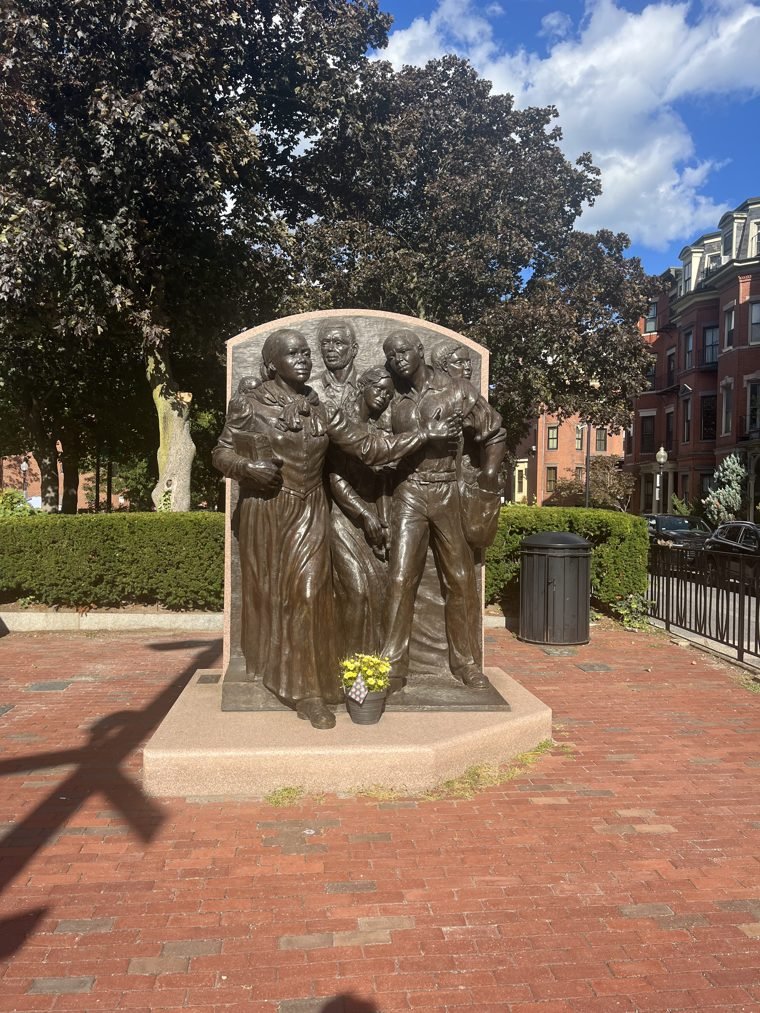
The Harriet director, Kasi Lemmons, defended the casting in February 2019 on two grounds: that she had sought a singer, and that she had wanted a performer with “recent ancestors from West Africa” — and she warned against a world in which an actor must have “a passport to play characters.” Both arguments are on the record and deserve to be stated fairly. Neither answers the objection actually being made, which is not about passports in general but about this lineage in particular: that Harriet Tubman is not a generic role but an ancestor of a specific people — Foundational Black Americans, descended from the enslaved population of the United States — and that casting her carries a duty of care toward that people’s account of itself. Black Americans are a nation formed in America, with their own lineage and culture; they are not a branch office of a global Black family, and their objection is framed in exactly those terms: heritage, not complexion.
The Aretha chapter is usually told too simply, in both directions. In October 2019 the Franklin estate, through representative Sabrina Owens, endorsed Erivo as “an extraordinary talent with an amazing voice!” In March 2021, after Genius: Aretha aired, the singer’s immediate family — including her son Kecalf Franklin — publicly withheld support. But the family’s grievance, on the record, was aimed at National Geographic and the producers for excluding the family from the production; Grace Franklin stated explicitly that the family had no grievances with the actors. The Aretha dispute is evidence of an industry that treats Black American families as consultants of last resort. It is not evidence against Erivo personally, and this report does not use it as such.
What turned a casting debate into a lasting grievance is the accumulation, and the tone of the replies. One week before the Afeni announcement — on 27 October 2026 — The Guardian asked Erivo about the continuing argument over her playing Black American icons. Her answer:
Whatever she intended, the sequence is now part of the record: the objection of a people to who plays their ancestors, described by the actress as a waste of everyone’s time, seven days before she was announced as Afeni Shakur.
The defence’s strongest case
Fairness requires the other side at full strength, and it is not nothing.
Erivo’s talent is not seriously in question: a Tony, a Grammy and a Daytime Emmy, three Academy Award nominations, and a Primetime Emmy nomination for Genius: Aretha. Her defenders note that she chooses these roles deliberately and reverently. In her 2024 EBONY cover interview she said:
Her director’s argument — that acting is precisely the craft of becoming someone else, and that a passport test for roles would impoverish everyone’s stage — is a serious position held by many working actors, including Black American ones. Samuel L. Jackson raised the mirror-image objection in March 2017, when he questioned Daniel Kaluuya’s casting in Get Out — “I tend to wonder what that movie would have been with an American brother who really feels that” — and was promptly answered by John Boyega and others; Jackson later clarified his remarks to the Associated Press. Kaluuya’s own answer, to GQ, was: “I resent that I have to prove that I’m black.” The casting question, in other words, has been argued from every seat in the room, and serious people land on both sides of it.
The strongest version of her case is the performance case: judge the work. It is the case she made to Oprah in 2019 — “Give me a chance” — and Harriet‘s box office and her Oscar nominations say many viewers did.
Claim three: “It’s not just her” — the London Hughes dinner
Verdict: the clash is documented, on camera, with named reporting. It did not happen on Girls Trip.
The incident most often cited alongside Erivo’s involves the British comedian London Hughes and the American singer and reality star Tammy Rivera. It is frequently described as happening on “Girls Trip.” It did not. Girls Trip is a 2017 film starring Regina Hall, Queen Latifah, Jada Pinkett Smith and Tiffany Haddish; Hughes is not in it. The documented incident took place on Peacock’s Eat Slay Love, a three-episode series that premiered on 7 November 2024, in which Nivea, Eva Marcille, Tammy Rivera and Hughes travelled in Vietnam — a girls’ trip, produced by Will Packer, who also produced the Girls Trip film. The conflation is understandable. It is still wrong, and this report publishes the corrected version.
What the reporting of the show documents is this. Hughes made repeated joking comments about Rivera’s hometown, Baltimore — the city of The Wire — and when Rivera told her it was where she grew up, Hughes told her she was “so sorry.” At a cast dinner, Hughes argued that the conditions associated with Black American poverty — crime, “ghetto” areas — do not exist in Britain in the same way. Rivera’s reply is on the record:
Hughes walked out of the dinner and left the trip early. Eva Marcille’s summary is also on the record: “there is a cultural difference as an American Black woman. It is a thing. If you’re not a Black American woman you don’t understand it” — and: “You can disagree without disrespecting.”
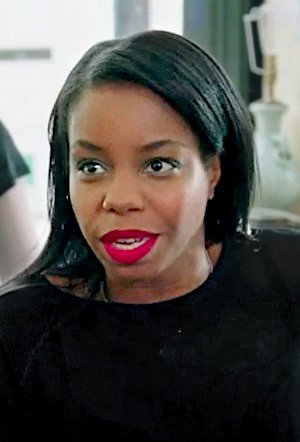
Two cautions belong with this section. First, there is no full episode transcript in the public record;
the wording above is what contemporary reporting (Distractify and BOSSIP, both 8 November 2024) documented, and we quote no further than they did. Second, in December 2025 Hughes alleged, in a social-media video, that she had been the one bullied on that production — called names including “whore,” “ghetto” and “anti-black,” and told by producers to keep acting friendly. No outlet has verified those allegations; the other cast members’ accounts dispute them. We record the allegation as an allegation, and it changes nothing about what the 2024 reporting documented on camera.
Hughes’s wider record cuts in more than one direction. In April 2025 she told EURweb that American racism is “way worse… blatant” where British racism is “insidious, institutional,” adding: “We don’t have Oprah. We don’t have a Beyoncé.” In February 2026, after a slur was broadcast during the BAFTA ceremony, she praised Black Americans in a video post: “Black Americans stand on business… we’re too polite. We’re too British.” The Eat Slay Love dinner is one documented evening. It is fair evidence for the pattern her critics describe — a guest in Black American spaces, explaining Black American life back to Black Americans, from a position of admitted unfamiliarity. It is not the whole of London Hughes, and this report does not pretend otherwise.
Claim four: “Neck and neck” — the bleaching and paternity numbers
Verdict: unsupported as stated. The famous figures do not mean what they are quoted as meaning — in either country.
The Erivo argument travels with two statistics about Nigeria and Jamaica: that the two countries lead the world, “neck and neck,” in skin bleaching and in paternity fraud. Both statistics are repeated constantly, including by officials. We traced both to their sources. Neither survives.
Skin bleaching. The claim that 77% of Nigerian women bleach comes, at the end of a long citation chain, from a survey conducted in three Lagos markets in 1998 among 450 traders — men and women — of whom 77.3% used skin-lightening products. The study’s own author, Dr Sylvia Adebajo, told Africa Check that the figure “should be limited to the traders and not generalised to all Nigerians.” The World Health Organization’s Africa office republished 77% in November 2023 without any new national survey behind it; Nigeria’s drug regulator NAFDAC declared bleaching a “national health emergency” in February 2023 citing the same number, attributed to a WHO “study in 2018” that fact-checkers could not find. In February 2026, Nigeria’s dermatologists cited a prevalence range of 40% to 84% — a spread so wide it amounts to an admission that no settled national measurement exists. The best pooled scientific estimate (a 2019 meta-analysis of 68 studies in the International Journal of Dermatology) puts lifetime skin-lightening use at 27.7% across studied populations, 27.1% for Africa.
Jamaica, by contrast, has actually measured itself. The Jamaica Health and Lifestyle Survey III (2016/17), a nationally representative survey, found 10.7% of Jamaicans had ever bleached and 3.3% currently did — real, documented, and nowhere near Nigeria’s famous number. There is no official or academic source anywhere that ranks Nigeria and Jamaica against each other on bleaching; the only direct pairing we found is a viral social video asserting it, with no data behind it. “Neck and neck” is not a finding. It is a meme wearing a lab coat.
Paternity fraud. The claim that Jamaica has the world’s highest paternity-fraud rate at 34.6%, with Nigeria second at about 30%, circulates in articles that attribute the ranking to “ResearchGate” — a hosting platform, not a study. No primary study, author, sample or date for the 34.6% figure could be found; there is no official global ranking of paternity fraud. What does exist is a Lagos laboratory, Smart DNA, which reports that 25% of the paternity tests it ran in its 2025 cycle excluded the presumed father (27% in 2024; 23.6% in its 2025/26 report). Smart DNA itself attaches the caveat, in every cycle:
The science explains why: Anderson’s 2006 survey of 67 studies in Current Anthropology found non-paternity of about 1.9% where fathers were confident, and exclusions around 30% where paternity was already disputed — because men who pay for a DNA test are, by definition, men with doubts. Bellis and colleagues’ 2005 review in the Journal of Epidemiology and Community Health found a median of 3.7% across studies. A DNA exclusion also measures biology, not “fraud”: it says nothing about what a mother knew or intended.
None of this makes bleaching or disputed paternity trivial in either country — NAFDAC’s emergency declaration happened; Vybz Kartel’s lightened image was a genuine national argument in Jamaica; families are broken by disputed paternity everywhere. But the specific claim that Nigeria and Jamaica stand “neck and neck” atop world rankings is unsupported by any source we could find, and publishing it as fact would repeat the exact failure this investigation exists to check. The perception is real. The rankings are not.
The welcome question
Underneath the casting fight sits a broader claim: that Black Americans have historically been welcoming to African and Caribbean newcomers — opening homes, churches, organisations and movements — while the regard has too often flowed one way, returned with distance, condescension or worse. That claim is an interpretation, and we label it as such. But it is not an interpretation invented on social media. The academic record has documented one half of it for a quarter of a century.
Mary C. Waters’s Black Identities (1999), based on New York fieldwork, found that first-generation West Indian immigrants often emphasised their ethnic identity precisely to distance themselves from native-born Black Americans — while their working-class children, raised in segregated American neighbourhoods, frequently rejected that distancing and identified simply as Black American. Christina Greer’s Black Ethnics (2013) compared native-born Black Americans, Afro-Caribbean and African immigrants in New York and found that ethnic identity, not just race, shapes how each group understands advancement in America. Onoso Imoagene’s Beyond Expectations (2017), from more than 150 interviews with second-generation Nigerians in the US and Britain, documents a generation deliberately forging an identity distinct from Black Americans’ — one chapter is titled, from an interviewee’s words, “You Are Not Like Me!?” And the record also holds the counter-evidence: Dialika Sall’s 2019 study of West African and Black American teenagers in the Bronx found the younger generation refusing to choose, holding ethnic and Black American identities at once. The honest summary is that distinction-making is documented, convergence is documented, and neither is universal.
What the scholarship cannot measure is the thing the commenters in our sample kept returning to: the felt experience of watching your ancestors handed, one after another, to performers from elsewhere — while your own objection to it is treated, in the current phrase, as a waste of everyone’s time.
What we could not verify
- The original 2013 tweets, on the platform itself. The primary posts are deleted. Screenshots preserved in the September 2018 @eBoPeep thread — archived by Thread Reader App and cited by the International Journal of Communication‘s 2024 study — are reproduced above as exhibits, and the text is corroborated by the journal and by EBONY’s 5 November 2026 reporting. We could not inspect the originals on Twitter itself.
- A formal apology. We found explanation and partial concession (“valid points had been made,” 2020), but no formal apology for the 2013 tweet in any trade source opened for this report.
- The exact date of the Harriet casting announcement. Most sourcing places the announcement in 2017; at least one secondary source says September 2018, which is when the backlash is documented to have flared. The dispute itself is not in question; the announcement date is inconsistently reported.
- Erivo’s citizenship status. Secondary sources conflict. This report makes no claim about it, because it verified none.
- London Hughes’s December 2025 counter-allegations about bullying on Eat Slay Love. Reported by no outlet and disputed in comments; recorded here as allegation only.
- The Jamaica 34.6% paternity figure and any Nigeria–Jamaica bleaching comparison. No primary source exists in anything we could open. Both are excluded from this report’s findings.
- The full wording of the Eat Slay Love dinner argument. No episode transcript is public; we quote only what contemporary reporting documented.
The bottom line
Strip the memes away and the documented core of this fight is small, hard and real. A performer published a sentence in 2013 that labelled Black American speech “ghetto” and rendered it in mock phonetics. She has explained it; she has not apologised for it. She has since played Harriet Tubman and Aretha Franklin, and will now play Afeni Shakur — three women who are not roles so much as inheritance. Asked, one week before the latest announcement, about the people who object, she called the argument a waste of everyone’s time.
Everything beyond that core should be held to the same standard this report has tried to keep. The grievance does not need invented statistics; the documented record is enough to argue from. And the defence does not need to pretend the record is empty; the tweet exists, the casting pattern exists, and “give me a chance” was a fairer answer in 2019 than “a waste of everyone’s time” is in 2026.
Harriet Tubman led her people out of bondage on foot, in the dark, at the risk of her life, and went back for more of them. Afeni Shakur beat the state of New York in a courtroom and raised the defining poet of a generation. The question Black American audiences are asking is not whether Cynthia Erivo can act. It is whether the industry that keeps choosing her understands whose house it is walking into. On the documented record, the question is a legitimate one — and it is not going away.
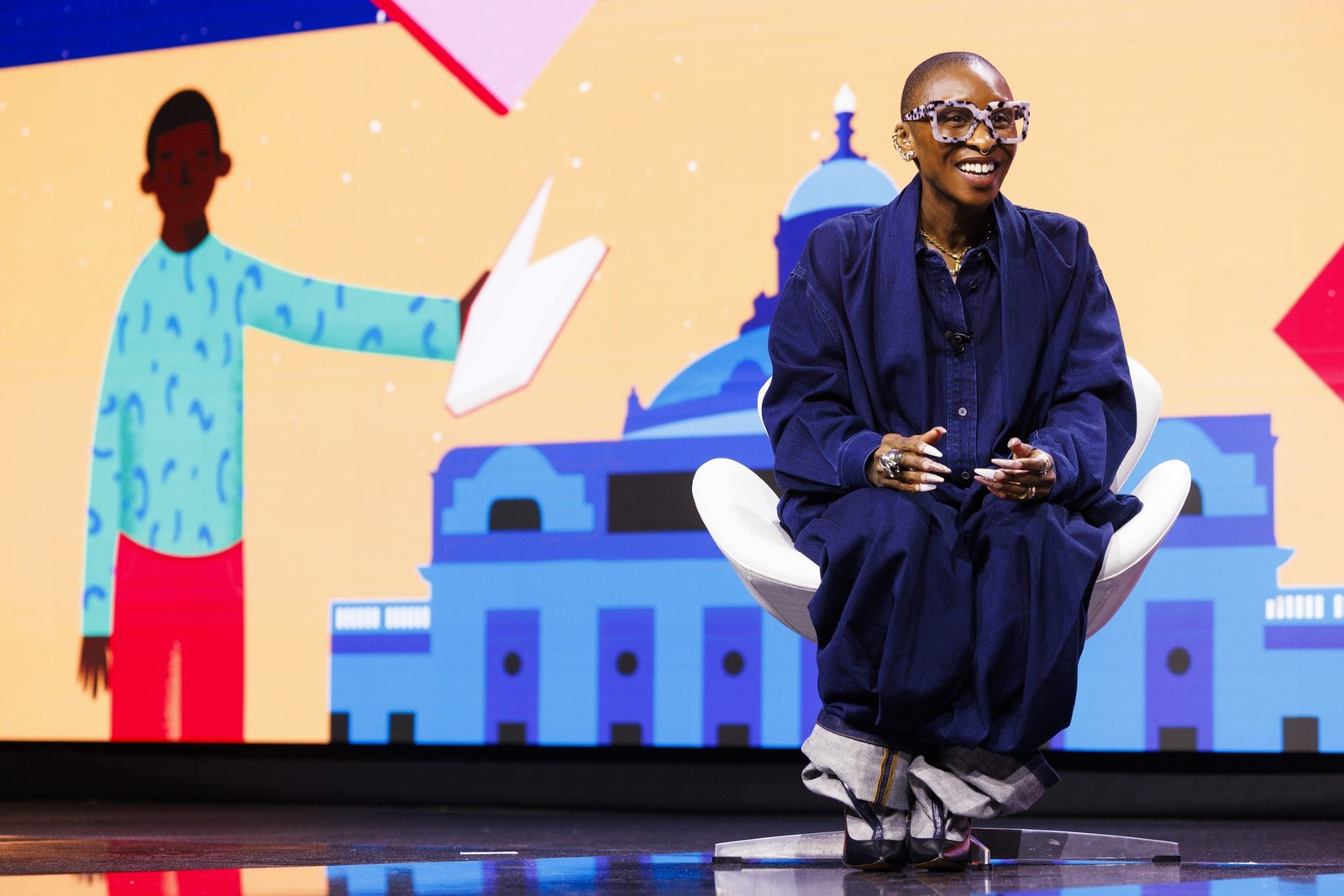
Featured image: Cynthia Erivo at the Library of Congress National Book Festival, 2026. Photo: Shawn Miller / Library of Congress, CC0.
Sources
- EBONY — Erivo cast as Afeni Shakur; the debate reignited, incl. the 2013 tweet and the 2024 cover interview (5 Nov 2026)
- XXL — Erivo cast as Tupac’s mother in the Snoop Dogg biopic (4 Nov 2026)
- HotNewHipHop — Erivo joins Snoop; the Guardian interview and the Harriet history (5 Nov 2026)
- The Hollywood Reporter — the original casting exclusive (Borys Kit, 4 Nov 2026); The Guardian — Erivo interview, Lanre Bakare (27 Oct 2026)
- International Journal of Communication 18 (2024) — study of 6,073 tweets on the Harriet backlash; the 2013 tweet text. Also: Shadow and Act (Erivo at TIFF, Sept 2019); Refinery29 (Kasi Lemmons, Feb 2019); NME (the Franklin family and Nat Geo, 21 Mar 2021)
- Distractify — Eat Slay Love cast on friendship and the London Hughes conflict (8 Nov 2024); BOSSIP (8 Nov 2024); EURweb — Hughes on racism in the US and UK (12 Apr 2025)
- Africa Check — “Three in four Nigerian women use skin-lighteners? No data supports claim” (18 Apr 2019, updated 2022)
- Dubawa — the WHO AFRO fact sheet and the 77% figure (2026)
- Jamaica Health and Lifestyle Survey III (2016/17), Vitals edition, Ministry of Health & Wellness (Dec 2024)
- Arise News — Smart DNA Nigeria 2025 annual report (30 Aug 2025); Vanguard (18 Aug 2025); Anderson (2006), Current Anthropology 47(3); Bellis et al. (2005), Journal of Epidemiology and Community Health 59
- Waters (1999), Black Identities; Greer (2013), Black Ethnics; Imoagene (2017), Beyond Expectations; Sall (2019), African and Black Diaspora
- Threads — the casting reaction sampled for this report (post by @ayoiknowher, 6 Nov 2026; 50 of 799 replies sampled)
Leave a comment
Comment as a guest and verify your email, or sign in or create a reader account. Guest comments reach our review queue after email verification; account holders can submit directly for review.