
Listen to this article
Take the story with you. Choose a voice and a pace that suits you.
Or listen in another language / choose a voice
Getting your device voices ready…
The voice follows the displayed language and your browser’s regional preference when available. You can choose another narration voice.
Investigation — Evolving Humanities. Golden Rice series, Part 5 of 6. Reporting verified November 2026.
TL;DR: In May and June 2016, two authoritative voices tried to settle the Golden Rice argument. The US National Academies read nearly 900 studies and refused both camps at once: no substantiated difference in health risk between genetically engineered and conventional crops, and no, Golden Rice had not been ready for a decade. Six weeks later, more than a hundred Nobel laureates demanded Greenpeace abandon its campaign, ending with a question about crimes against humanity that headlines turned into an accusation. Greenpeace answered twice, a statistician counted what the laureates actually knew about farming, and two anthropologists published the sentence neither establishment wanted. Nobody’s word settled anything. The only place this argument has ever closed is a courtroom — and even there, only for now.
At a glance
A year that was supposed to be an ending
By the spring of 2016, Golden Rice — rice engineered to make beta-carotene, the vitamin A precursor, in a grain that normally contains none — had been a proof of concept since 2000 and a field reality nowhere at all. It had survived a patent thicket of 70 rights held by 32 holders, a humanitarian licence letting poor farmers save and replant its seed for free, the destruction of a Philippine trial plot in 2013, and a children’s feeding study in China retracted in 2015 over consent. What it had never survived was contact with an actual harvest. No farmer was growing it commercially; no child was eating it in a programme whose effect on vitamin A status had been measured.
Exhaustion, in science politics, produces a specific genre: the closing statement. Not a new experiment — a declaration, by people whose standing is supposed to be beyond argument, that the argument is over. 2016 produced two within six weeks. One was a 400-page committee report that read almost everything and annoyed everybody equally. The other was an open letter signed by the most decorated scientists alive, written to annoy exactly one organisation.
This is the story of that year: what each document actually said, as opposed to what the headlines said it said; how the target answered, twice; how a statistician spoiled the group photograph by reading the name badges; and how two scholars concluded both sides were arguing about the wrong cause. It is also, quietly, the story of an aubergine. While the laureates fought over a rice that did not yet exist in any farmer’s field, a genetically engineered brinjal was already growing on tens of thousands of small farms in Bangladesh, generating randomised, peer-reviewed evidence — measured in pesticide bills and poisoning symptoms — of exactly the kind the rice debate had talked about for sixteen years without producing. Nobody put the aubergine on a poster. That tells you something about what the war of 2016 was actually for.
A note on method. Every quotation below is verbatim from the primary documents or the reporting that reproduced them; sources are listed at the end. Where a number depends on a date — and the most famous number in this story depends on nothing else — we give the date with the number. Where a claim rests on a single advocacy source, we say so in the text and in the box at the end. Nobody in 2016 comes out clean, and that is why the year is worth a whole part of this series.
Feel, first, how stale the air had become — because both camps’ strongest cases were genuinely strong. The pro case: vitamin A deficiency blinds and kills children; Philippine surveys put deficiency among children aged six months to five years at 15.5% in 2018–19, in the same grim neighbourhood before 2016. Rice is what the poorest households actually eat, daily, in quantity, so a rice carrying provitamin A would reach children that supplementation, fortification and dietary advice miss. The technology existed, given away for humanitarian use — no trait fee, seed-saving allowed, public varieties only. And yet it did not arrive. From inside that frustration, obstruction feels like the explanation. People had called Golden Rice’s critics “murderers” for over a decade before 2016, as Glenn Davis Stone noted at the time. The letter did not invent its register. It inherited it, and gave it letterhead.
The counter-case, at its strongest: sixteen years is not a delay, it is a result. GR1 made so little beta-carotene that a child would have needed implausible quantities of rice to meet a full daily requirement from it alone — Greenpeace’s 2001 arithmetic, correct for that version. GR2 made far more in the laboratory, but its lead event, GR2-R, performed badly in real varieties, as the developers themselves reported by 2014. The one children’s feeding study was retracted over consent. Meanwhile interventions that work — supplementation, conventionally bred orange-fleshed sweet potato with measured efficacy in Mozambique and Uganda — went underfunded. On this account the unproven rice was agenda-setting: a flagship keeping the GM project respectable. Underneath sat sovereignty: who decides what gets bred, for whom, on whose research agenda.
Both cases contain true sentences. Both also contain a favourite sentence that is not true. The proponents’ favourite was readiness — Golden Rice had essentially been ready for a decade, only politics stood in the way. The opponents’ favourite, carried in every campaign graphic if never quite stated as a finding, was danger — eating this rice might harm you. In May 2016 the National Academies refused both sentences. In June the laureates asserted the first by implication and aimed the full moral weight of the Nobel name at the people repeating the second. The order matters. The referee spoke first. The prosecution spoke louder.

The prosecution
The central document can be read in the laureates’ letter itself, and every reader should, because the gap between the letter and its coverage is the first exhibit. Addressed “To the Leaders of Greenpeace, the United Nations and Governments around the world,” it was posted on 29 June 2016 at supportprecisionagriculture.org — the campaign styling itself “Support Precision Agriculture” — and launched on 30 June 2016 at a National Press Club press conference in Washington, DC. Its organiser, by his own account on the campaign site, was Sir Richard J. Roberts, who shared the 1993 Nobel Prize in Physiology or Medicine for split genes and serves as chief scientific officer of New England Biolabs: “I, Dr. Roberts, initially contacted and invited each of the Nobel Laureates to sign onto this letter.” Phillip Sharp is named as co-organiser in several launch accounts; Roberts fronted the press conference with Randy Schekman and Martin Chalfie.
Now the number, and we will be tedious about it, because the number is where the information war starts. How many signed? It depends — genuinely — on when you ask. Reporting at launch, 29–30 June 2016, converged on 107–110: the Washington Post headline used 107; wire reporting said “108 at last count,” including 41 medicine laureates; Spanish coverage used 109, then 110. The campaign site states: “As of December, 2016, 123 Nobel Laureates and more than 10,000 other individuals have signed the letter.” Roberts’s later retrospective gives 129. One German retrospective inflates it to “166” — no primary source supports it; we flag it only to warn readers off. The defensible sentence is the dated one: 107–110 at launch, 123 by December 2016. A hundred laureates signing anything is an event. It needs no inflating, and cannot be shrunk away.
The letter’s operative sentences, verbatim:
“We urge Greenpeace and its supporters to re-examine the experience of farmers and consumers worldwide with crops and foods improved through biotechnology, recognize the findings of authoritative scientific bodies and regulatory agencies, and abandon their campaign against ‘GMOs’ in general and Golden Rice in particular.”
“Scientific and regulatory agencies around the world have repeatedly and consistently found crops and foods improved through biotechnology to be as safe as, if not safer than those derived from any other method of production. There has never been a single confirmed case of a negative health outcome for humans or animals from their consumption.”
“Greenpeace has spearheaded opposition to Golden Rice, which has the potential to reduce or eliminate much of the death and disease caused by a vitamin A deficiency (VAD), which has the greatest impact on the poorest people in Africa and Southeast Asia.”
And the demands, in the letter’s own capitalisation:
“WE CALL UPON GREENPEACE to cease and desist in its campaign against Golden Rice specifically, and crops and foods improved through biotechnology in general; WE CALL UPON GOVERNMENTS OF THE WORLD to reject Greenpeace’s campaign … and to do everything in their power to oppose Greenpeace’s actions and accelerate the access of farmers to all the tools of modern biology, especially seeds improved through biotechnology. Opposition based on emotion and dogma contradicted by data must be stopped.”
The letter also accused opponents generally of having “misrepresented their risks, benefits, and impacts, and supported the criminal destruction of approved field trials and research projects” — including the August 2013 uprooting of a trial plot in Camarines Sur, Philippines: less than 1,000 square metres, roughly 400 participants on the best-documented count, one site of five. Criminal destruction is a fair description of uprooting a field trial, and the laureates were entitled to say so. What they were not entitled to is the inference the letter invites next: that because a trial was destroyed in 2013, destruction and campaigning explain why, in 2016, there was still no rice. That inference is the letter’s load-bearing wall, and the scholars test it below.
Then the ending:
“How many poor people in the world must die before we consider this a ‘crime against humanity’?”
Read it precisely. It is a question. It does not say “Greenpeace is committing a crime against humanity”; it asks how many deaths must accumulate before “we” consider “this” such a crime — the old device of the unanswered question that plants an accusation while retaining the defence that he only asked. As journalism it was hopeless: within hours, headlines had flattened it into the accusation it implied. One American magazine ran “100 Nobel Laureates Demand that Greenpeace Stops Killing Poor Children”; Spanish coverage announced a “crimen contra la humanidad” accusation. Roberts’s later retrospective even complained the laureates “never got a direct reply from Greenpeace” — oddly, since the campaign’s own website reproduces one at length. The flattening served everyone briefly: supporters got a body count, Greenpeace got a hyperbole grievance that became its strongest debating point. Only readers lost, believing a legal accusation had been made when what had been made was a moral argument in the form of a question.
Fairly stated, the prosecution’s case was not nothing. The consensus on the safety of approved GM foods was about as settled as consensuses get. Greenpeace had traded for years on quantities belonging to the obsolete first version. A destroyed trial destroys the very evidence critics then cite the absence of. Regulators in poor countries price in campaign risk, so a campaign can raise the cost of a decision continents away. If you believe a safe, effective technology is being kept from dying children by an unscientific campaign, moral language is not excess. That is the case, at full strength — and Greenpeace, to its credit, mostly tried to meet it there.
The defence
Greenpeace answered twice: in hours, for the news cycle, and in October, for the record. Both replies can be followed in Greenpeace’s response and the campaign’s own reproduction of the formal letter, and both are better documents than that summer’s shouting suggested.
The first came on 30 June 2016, from Manila — a dateline that made its own point, the Philippines being the one country where Golden Rice was ever likely to be planted first. Wilhelmina Pelegrina, agriculture campaigner for Greenpeace Southeast Asia, said:
“Accusations that anyone is blocking genetically engineered ‘Golden’ rice are false. ‘Golden’ rice has failed as a solution and isn’t currently available for sale, even after more than 20 years of research. As admitted by the International Rice Research Institute, it has not been proven to actually address Vitamin A Deficiency. So to be clear, we are talking about something that doesn’t even exist.”
“something that doesn’t even exist”
Strip the cadence and there are three claims, each checkable, and in June 2016 each was in substance true. Nobody was blocking a product not yet submitted for cultivation approval anywhere. The rice was not available at all, outside trials. And IRRI had been candid that efficacy against vitamin A deficiency had not been demonstrated in the target population — the only children’s study had been retracted the previous year. You cannot accuse someone of withholding a thing and concede the thing is unfinished; the letter never quite concedes it, and that is the seam Greenpeace pressed all year. Pelegrina also framed Golden Rice, in wire reporting, as corporations using it “to pave the way for global approval of other more profitable genetically engineered crops” — the Trojan-horse argument, about motives rather than rice, and weaker than her factual points. Greenpeace pointed to its report Twenty Years of Failure and its positive programme: dietary diversity, equitable food access, ecological farming — a real answer with its own delivery problems among the poorest. Still, “doesn’t even exist” was its most effective sentence of the year, because the laureates had no reply that did not involve the word “eventually.”
The formal reply came on 14 October 2016. Dr Paul Johnston, principal scientist at the Greenpeace Research Laboratories in Exeter, wrote to Roberts directly — the letter the campaign site reproduces as “the only direct response to our June 29th 2016 letter.” His verdict on the crime-against-humanity framing:
“misleading, dishonest and not a little hyperbolic”
Three jobs in one phrase: misleading about availability, dishonest in attributing deaths to a campaign, hyperbolic in legal register. Johnston noted that after twenty-plus years “Golden Rice is not yet available. No application for regulatory approval has been submitted” — true of cultivation applications then, with one nuance neither side foregrounded: a food-safety dossier was already in process in Australia and New Zealand, which cleared the rice as food in December 2017. He questioned whether beta-carotene would survive storage and cooking in target households — legitimate, since it degrades substantially in stored grain, worst in poor households’ conditions. He contrasted conventionally bred orange-fleshed sweet potato, which had what Golden Rice lacked: measured efficacy in children’s vitamin A status. He described GM agriculture’s history as “essentially one of 20 years of failure,” clarified that Greenpeace does not oppose contained pharmaceutical and research GM use or marker-assisted selection, and demanded disclosure of the campaign’s financier and New England Biolabs’ interests.
That demand became more interesting when Roberts answered it in print. The financier, he disclosed, was Matt Winkler, a philanthropist and biotechnology entrepreneur, who covered travel and hotel costs for the press event. Roberts stated: “Neither myself, my fellow Nobel Laureates, nor my employer, New England Biolabs, has any direct financial involvement nor financial relationship with any agri-business companies.” Johnston’s letter also quoted Roberts’s own solicitation email: “I am organizing a Pro-GMO campaign against the Green parties to try and convince them to change their position on GMOs.” Weigh those together, because together they describe the campaign accurately and neither caricature survives them. It was openly political in aim, by its organiser’s words, and modestly funded by a named biotechnology entrepreneur. It was not, on Roberts’s account, funded by seed or agribusiness firms — and no evidence in the material this series reviewed contradicts that account. Whether any industry funding existed beyond the disclosed seed funding sits, honestly, in our could-not-verify box. What is verified is enough: a political campaign, honestly labelled as one in private, presented in public as a spontaneous uprising of pure science. Not corruption — stage management, of exactly the kind the laureates accused their opponents of practising.
One more defence document is not Greenpeace’s. Agroecologists Angelika Hilbeck and Hans Herren replied in August 2016 in “Millions spent, no one served”: no functioning vitamin A rice in over twenty years; failure as agronomic non-performance, unacknowledged by proponents; and the concept itself reductionist — fighting malnutrition “one vitamin and mineral at a time,” a “preoccupation with the molecular scale” that mistakes a nutrient for a diet. You need not buy the ideology charge to feel the first points. They came from inside agricultural science — the same claim Pelegrina made from a campaign office: it wasn’t ready. When activists and credentialed specialists make the same checkable claim simultaneously, a wise establishment checks whether it is true. One establishment, that spring, already had.
The name badges: who actually signed?
Every open letter is an argument from authority, and every argument from authority invites the rude question: authority in what? Philip Stark, a statistician at the University of California, Berkeley, took the signatory list apart by prize category. His breakdown, circulated publicly and quoted in the critical coverage within days, ran: 1 peace laureate, 8 economists, 24 physicists, 33 chemists, 41 physicians. Counts shift slightly by snapshot date, for the same reason the total does, but the shape is stable: physics, chemistry and medicine dominate. The disciplines that study the letter’s subject — plant breeding, agronomy, agricultural economics, nutrition delivery, development practice — were not its centre of gravity.
This is not sneering. It is the difference between eminence and relevant expertise — a distinction the laureates’ own profession enforces ruthlessly elsewhere. A hundred agronomy laureates signing on particle physics would be received, correctly, as a stunt. The Nobel’s prestige is general; knowledge is not. When a letter’s whole force is “trust us,” asking what the signatories know at first hand about backcrossing a transgene into Philippine varieties, or beta-carotene retention in a sack of polished grain in a hot kitchen, is the necessary question. For most, the honest answer is: no more than an attentive lay reader. That does not make them wrong. It makes the letter an intervention by science’s most famous names into a policy fight, using fame as the instrument.
The launch drew a second criticism, and here the record thins. Critical coverage — principally The Ecologist and GMWatch, advocacy outlets on the anti-GM side, stated so readers can discount accordingly — alleged a professional PR operation, that NGO representatives were barred from the press conference by Jay Byrne, a former Monsanto public-affairs staffer, and that the campaign website redirected to the Genetic Literacy Project. The website facts were independently visible. The barring claim rests on single-chain advocacy sourcing, which this series could not verify. We do not assert it; it sits in the could-not-verify box. A series asking you to distrust stage management cannot stage-manage its own evidence.
The counter-critique deserves full strength too. Pro-biotechnology commentators, the Genetic Literacy Project most prominently, replied that regulatory delay was itself activist-shaped — the Cartagena regime and national campaigns built the approval maze whose length was then cited as proof of failure; that the 2013 destruction and later Philippine litigation were real obstruction; and that demanding agronomic credentials from laureates while accepting campaign claims from non-specialists is asymmetric. Force in all three — the asymmetry point especially: Greenpeace’s public faces were campaigners and a laboratory scientist, not rice breeders, and nobody checked their badges. Both establishments fielded prestige where the subject demanded field experience, and both pointed only at the other. Keep that symmetry. It is the psychological core of the year.
The referee who refused
Six weeks before the laureates launched, the most authoritative scientific body in the United States had already published its attempt to end the argument — the strangest and most honourable document in this series, because it refused to end it in anybody’s favour. Genetically Engineered Crops: Experiences and Prospects appeared on 17 May 2016 from the National Academies of Sciences, Engineering, and Medicine. Its full findings can be read in the National Academies report, and we recommend the primary text over every summary, including this one, because this report was looted by excerptors. Both camps mined it within hours. Both camps’ favourite sentences are really in it. So are the sentences each camp left on the floor.
The pro-GM camp’s sentence, verbatim from the Academies’ release and summary — the committee:
“found no substantiated evidence of a difference in risks to human health between current commercially available genetically engineered (GE) crops and conventionally bred crops, nor did it find conclusive cause-and-effect evidence of environmental problems from the GE crops.”
The committee, chaired by Fred Gould of North Carolina State University, had examined almost 900 publications across two decades of commercial GE cultivation. It “carefully searched all available research studies for persuasive evidence of adverse health effects directly attributable to consumption of foods derived from GE crops but found none.” Epidemiological comparisons — the US and Canada, eating GE food for twenty years, against the UK and Western Europe, largely not — found no pattern tying GE consumption to cancer, obesity, diabetes, kidney or gastrointestinal disease, allergies or autism. If the question is whether approved GE crops have been shown to harm the people who eat them, the Academies’ answer is no. Greenpeace’s literature has never metabolised that answer — Johnston’s October letter does not engage it at all — and it is the defence’s weakest flank.
But the report is a double document. Bt crops had reduced losses and insecticide use, with fewer insecticide poisonings in some settings; herbicide-resistant crops now faced evolved resistant weeds and insects. Gene flow occurs; no conclusive environmental harm from it was found. On yield — most inconvenient to promotional claims — US data showed “no evidence that GE crops had changed the rate of increase in yields,” though traits protect yield under pest pressure. Socioeconomic benefits were positive but heterogeneous; trait effects cannot be separated from the farming system around them. And the report insists on its limits, in passages excerptors drop: subtle effects are hard to detect, absolute safety cannot be proved. A Pesticide Action Network critic argued the press release “paints a decidedly more upbeat picture” than the report’s own caveats — a warning that applies to every summary ever written.
Then, Golden Rice. The Academies treated it as promising but unfinished — and then did what no other establishment voice that year would do. They checked the readiness claim:
“Golden Rice, which was produced through genetic engineering to increase beta-carotene content, is one of the most recognized examples of the use of genetic-engineering technology to improve a crop’s nutritional value… Varieties that yield well, have good taste and cooking qualities, and cause no adverse health effects from unintended changes in the rice could have highly important health effects (Demont and Stein, 2013; Birol et al., 2015). There have been claims that Golden Rice was ready for public release for well over a decade (Hefferon, 2015), but this is not the case.”
“is not the case”
Hold those four words against the summer that followed. The committee found a field-test publication only for GR1, the obsolete first version. It “could not find information on the newer, higher–beta-carotene Golden Rice in the peer-reviewed literature.” So it telephoned IRRI’s coordinator — Violeta Villegas, personal communication, 2015 — and learned a new lead event, GR2E, was progressing “because of difficulties with the previous lead event, GR2-R,” and was only then being backcrossed into varieties the Philippines, Bangladesh and others had requested. In committee prose translated plainly: in May 2016, the deployable Golden Rice was a replacement event still in breeding, adopted because its predecessor had failed in the field. Two months later the laureates would demand, in capitals, that governments “accelerate the access of farmers” to this rice, and ask how many poor people must die before obstructing it counts as a crime against humanity. Both documents are primary sources, produced by people at the summit of the same establishment. The tension between them is not a debating point; it is a fact of the record.
That is why this series calls the Academies report the most useful corrective document in its library. Not because it is hostile to genetic engineering — on health it is the opposite — nor because it vindicates Greenpeace, whose danger framing it dismantles. It treated both camps’ favourite claims as hypotheses and checked them. Danger? No substantiated evidence. Readiness? Not the case. And it was, predictably, useless as a weapon — too long to headline, its Golden Rice passage read by almost nobody who shouted about the letter. Authority that does its job properly turns out to be authority nobody can use.
The sentence neither side wanted
Glenn Davis Stone is an anthropologist at Washington University in St. Louis, doing field research on Philippine rice since 2013. Dominic Glover is a sociologist of agricultural technology who had written the structural account of how GM crops get shaped “as a technology for the poor” before a single field result exists. In 2017 — online in 2016, mid-letter-war — they published “Disembedding grain: Golden Rice, the Green Revolution, and heirloom seeds in the Philippines” in Agriculture and Human Values.
Their thesis: Golden Rice “is routinely depicted as a generic GM vitamin tablet in a generic plant bound for the global South,” while its Philippine reality is stubbornly specific. Comparing Green Revolution, Golden and heirloom rice by geographical embeddedness, they argue “the disembeddedness of Golden Rice that boosts its value as a public relations vehicle has also been the main impediment in it reaching farmers’ fields, as it has proved difficult to breed into varieties that grow well specifically in the Philippines.” Unpack the jargon; the idea is simple and devastating. A technology developed far from its destination, answering to donors and journals rather than to a province’s farmers, acquires enormous value as a symbol — a golden grain photographs and headlines beautifully — precisely because it is entangled in no real place. But rice is not a tablet: a variety must yield in this soil, resist this pest complex, taste right in this kitchen. The detachment that made Golden Rice a perfect emblem made it a hard plant to finish. Its PR value and its agronomic difficulty were one fact, seen from two ends.
Then the sentence. In the university’s release for the paper, June 2016 — the letter’s own month — Stone said:
“GMO opponents have not been the problem.”
In context: “Golden Rice is still not ready for the market, but we find little support for the common claim that environmental activists are responsible for stalling its introduction.” And: “The simple fact is that after 24 years of research and breeding, Golden Rice is still years away from being ready for release.” On the 2013 plot destruction, double-edged as honest judgements are: “Destroying test plots is a dubious way to express opposition, but this was only one small plot out of many plots in multiple locations over many years.” One destroyed plot can be a crime and a scandal without causing a sixteen-year delay, and Stone, who condemned it in the same breath, refused to let it carry weight it could not bear.
Who said it is why it matters. Stone is not an anti-GM writer; he was, by his own account, an early advocate for keeping an open mind about Golden Rice, and his wider work treats both camps’ communications as strategic, with peer-reviewed agronomy squeezed between. When a writer like that concludes the delay was primarily a breeding problem, it cannot be filed under campaigning. It has to be answered. The Genetic Literacy Project answered it within days: Stone understates how Cartagena-style regulation — itself an activist achievement — shaped every step, and “goes out of his way to absolve Greenpeace.” We cite that rebuttal beside Stone deliberately: whether a regulatory environment built partly under activist pressure counts as activists being the problem at one remove is genuinely contestable, and the literature draws that line in both places. What cannot be done honestly is what the letter did — draw it at Greenpeace’s door without mentioning the failed event, the breeding record, or the Academies’ four words.
Stone and Glover’s later work sharpened it further. Surveying 115 farmers in Nueva Ecija, they found variety choice driven by performance, market demand and fashion — and that Golden Rice had been bred into varieties already going out of fashion. Vitamin A deficiency is worst where those lowland varieties would not be planted, or where no rice is farmed at all: “Farmers are unlikely to plant [Golden Rice] in its current varieties, unless induced to do so.” Set that beside the letter’s premise — farmers straining for a tool, blocked only by a campaign — and the gap is the whole argument running the other way. In fairness, Stone’s thesis needs dating, as he would insist: before about 2013, delay was primarily breeding, where both camps’ serious scholars converge. After the Philippines granted the first cultivation permit in 2021, litigation became the binding constraint, as readers of the courtroom where the debate actually closed will know. Bangladesh fits neither story. The honest timeline has three phases and three causes, and every single-cause narrative fails on at least one of them.
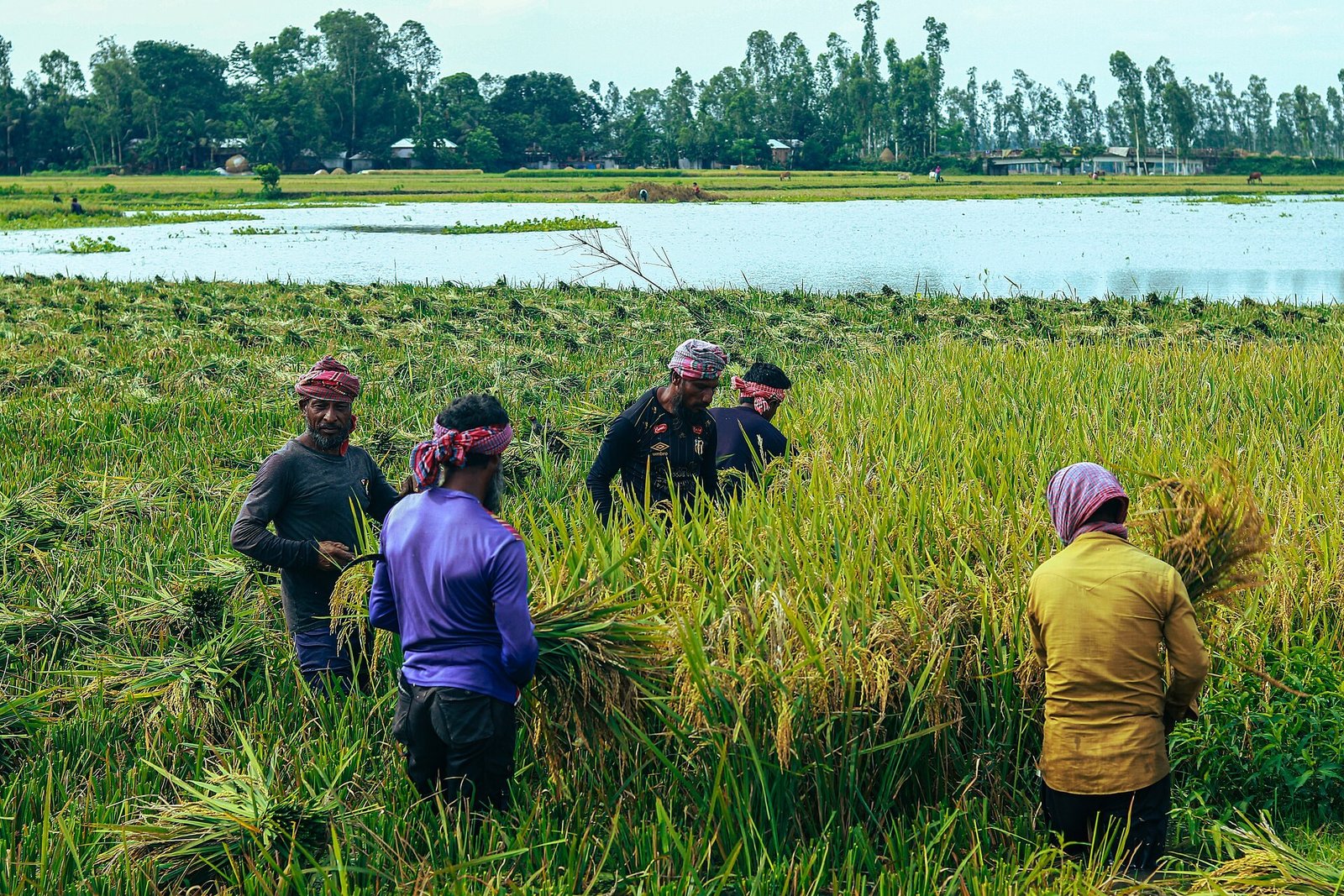
The quiet front: an aubergine in Bangladesh
If you want the war of 2016 as seen from a field rather than a press club, leave the rice. Take the brinjal. Bt brinjal — eggplant, aubergine — carries a gene from Bacillus thuringiensis making it resistant to the fruit and shoot borer, its devastating main pest. The event, EE-1, was developed by Mahyco and donated for public breeding in Bangladesh, India and the Philippines — making its three fates, in three neighbouring countries, the cleanest natural experiment in the entire GM debate. Same trait, same donation model, three regulatory cultures, three opposite outcomes.
Bangladesh approved four Bt brinjal varieties on 30 October 2013. Seedlings went to 20 farmers on 22 January 2014. By 2018, 27,012 farmers grew it — roughly 17–18% of an estimated 150,000 brinjal growers. Then came the thing the rice never produced: a randomised controlled trial. The IFPRI trial found Bt cultivation “reduces the cost of pesticide use by 47 percent,” driven by an 82% reduction in pesticides with adverse ecological impacts; net yields were 42% higher; farmers with conditions consistent with pesticide exposure, in treatment villages, were 11.5 percentage points less likely to report a poisoning symptom and 11 points less likely to incur medical expenses for it. An earlier survey found net returns of $2,151 per hectare for Bt growers against $357 for non-Bt — cited with its warning, as the papers attach it: a survey comparison, not a randomised trial, unpublished when first cited. A 2025 Pabna study confirmed the direction. This is what evidence looks like when a crop reaches farmers: a pesticide bill halved, a symptom not reported, a margin widened.
Now the honest shadow. Bt brinjal covers only about 3.5% of Bangladesh’s brinjal area, and discontinuation is substantial. Secondary pests — whitefly, thrips, mites, bacterial wilt — still need management. Most surveyed farmers report better control, lower costs and higher income; a quarter report no yield gain where secondary insects struck, and 59% report lower market prices for Bt fruit. A documented success, bounded in adoption, with real friction — mixed, measurable, arguable in percentages rather than crimes against humanity. The contrast with a rice still argued in absolutes in 2016, because no field record existed to argue in percentages about, is the sharpest commentary the evidence itself provides.
India took the same crop the opposite way, earlier, by a different instrument. On 14 October 2009 the Genetic Engineering Appraisal Committee recommended Bt brinjal for release. Environment Minister Jairam Ramesh suspended the decision within days, consulted publicly through the winter, and on 9 February 2010 imposed an indefinite moratorium: his duty, his decision document states, was “to adopt a cautious, precautionary principle-based approach and impose a moratorium on the release of Bt brinjal, till such time independent scientific studies establish, to the satisfaction of both the public and professionals, the safety of the product” — a standard requiring the public as well as the professionals to be satisfied, and therefore nearly unmeetable. He framed it as being “responsible to science and responsive to society.” The moratorium held through 2025; India has still never commercialised a GE food crop. No laureates’ letter was addressed to Jairam Ramesh. The crop simply stopped, by ministerial signature — and the information war, which needs a villain with a headquarters and a logo, largely looked away.
The Philippines supplies the third fate: the same event, bred at the University of the Philippines Los Baños, never reached one commercial planting, and in April 2024 was stopped together with Golden Rice by the same Court of Appeals decision. One technology: adoption in Dhaka, moratorium in Delhi, adjudication in Manila. The variable is not the plant, nor the science — the same dossiers travelled. It is the institution each country routes a food argument through. And Bangladesh adds the lesson that fits nobody’s story: its Golden Rice dossier, filed in November 2017, sat undecided for years with no court case and no mass movement — committees meeting, questions answered, an agriculture minister blaming an environment department’s “reluctance,” still at a standstill in USDA reporting of November 2025. Bureaucratic precaution alone, with no campaign anywhere near it, stopped a rice. Any theory of delay that requires a campaign must explain Dhaka first.
Authority as a weapon: what each side assumed
Step back and the year’s shape is psychological before it is scientific. Every actor reached for the same instrument — authority — and every reach reveals what they privately believed about whose word settles a food question.
The laureates assumed eminence settles it. Their letter contains no new data and reports no field visit; its whole mechanism is the signature block. That assumes the Nobel name is a general-purpose warrant, transferable from split genes to Philippine agronomy without loss. Stark named that assumption in public, which is why his arithmetic stung. And a letter demanding an opponent be judged by data, whose closing move is a body-count question, has stopped trusting data to do the work: the moral escalation is a confession that the factual case — readiness — would not carry. They were right not to trust it. It would not have.
Greenpeace assumed the movement’s word settles it — its standing as the people’s referee entitled it to certify which technologies count as failures. “20 years of failure” is not a finding; it is a verdict, delivered by a self-appointed court. And for all their factual strength on readiness, Greenpeace’s replies share the letter’s deepest habit: neither engages the strongest point against it. The laureates never mention Villegas or GR2-R. Johnston never mentions the Academies’ health finding, five months old, which dismantled the danger implication his organisation’s campaigns had traded on for years. Each side cited the referee only where the referee agreed with it.
The Academies assumed the literature settles it — read 900 studies, report exactly what you find, and the argument will cool to the evidence’s temperature. The noblest assumption of the three, and the most thoroughly falsified. The report was excerpted by both camps within the day; its Golden Rice passage was almost wholly ignored. A committee can settle what the evidence says. It cannot settle what the argument is for — and by 2016 the argument was for fundraising and membership on one flank, a technology platform’s respectability on the other, foundations’ legacies and ministers’ reputations. Stone and Glover alone assumed nothing would settle it by authority, locating the problem where authority cannot reach: a plant disembedded from a place, a process measured in backcrosses and seasons, not statements. Their reward was a rebuttal within days and neglect thereafter — the fate, in an information war, of the participant reporting from the field instead of firing from the capital.
A coda, in the present tense. The war of 2016 at least had establishments — flawed, self-interested, stage-managed, but institutions that signed their names and answered letters. The argument’s current habitat, examined in today’s referee-less discourse, has none of that: the argument now travels as a set of circulating claims — an advocacy statistic from 2014 presented as a measurement, an anachronism about an agenda that did not yet exist — and, verified across five languages, not one professional fact-check of claims now reaching more people in a weekend than the letter reached in a summer. The establishments earned plenty of the distrust that displaced them. But the 2016 file contains something the present does not: return addresses.
The verdict of the year
The finding this part was built to reach, as plainly as the record allows: in 2016, every institution that tried to close the Golden Rice debate by authority failed. The laureates tried eminence — a hundred-plus signatures, a press club, a crime against humanity held in reserve as a question — and the rice did not move an inch toward a field, because the obstacle they named was not, at that date, the obstacle that existed. Greenpeace tried incumbency — long ownership of the word “failure” — and its readiness points landed, while its refusal to absorb the safety consensus left its credibility where the letter could reach it. The Academies tried the literature, and produced the year’s only fully honest document, which changed no campaign, ministry or headline, because honesty without a constituency is a library, not a lever. The scholars tried fieldwork, and were filed under controversy. And Bt brinjal, the year’s quiet control experiment, showed what actually decides these questions: not voices, but venues — a ministry in Dhaka that signed, a minister in Delhi who would not, and, eight years later, a court in Manila.
That court is the bridge 2016 was unknowingly building toward. The debate laureates could not end with a question, and academies could not end with a report, was ended — provisionally, under appeal, on a rule of evidence rather than a finding of harm — by judges. If that seems an odd way for a scientific argument to conclude, you have understood 2016 correctly. Whether “proof of safety,” the standard the Philippine court left standing and nowhere defined, can ever be supplied by anyone for any technology is the question 2016 bequeaths: to the courts, to Bangladesh’s still-open file, and to the next golden grain being bred far from the fields its press releases describe.
The laureates asked how many poor people must die before we call something a crime. It was the wrong question — not because the deaths are not real; vitamin A deficiency kills, uncounted, mostly children — but because it assumed a defendant where the record shows a system: a failed event, a disembedded breeding programme, a regulatory maze, a frightened bureaucracy in Dhaka, a minister’s pen in Delhi, a movement that would not update, an establishment that would not admit, and a plant that was not ready. Systems do not stand trial. In 2024, for want of anyone else to hold responsible, a court held the paperwork responsible instead. The letter writers of 2016 spent their authority demanding a verdict. When one finally came, it satisfied almost nobody who had demanded it.
The timeline
| 14 October 2009 | India: GEAC recommends Bt brinjal for environmental release. |
| 9 February 2010 | India: Jairam Ramesh imposes an indefinite Bt brinjal moratorium, still in force for commercial cultivation. |
| 30 October 2013 | Bangladesh approves Bt brinjal. Twenty farmers plant in January 2014; 27,012 by 2018. |
| May 2016 | National Academies report: no substantiated health-risk difference for GE crops; Golden Rice “ready for a decade” claim “is not the case”; only GR1 field literature; GR2E only then replacing GR2-R. |
| 3 June 2016 | Stone & Glover release: “GMO opponents have not been the problem.” |
| 29–30 June 2016 | Laureates’ letter posted and launched, 107–110 signatories at launch; Pelegrina replies the same day. |
| August 2016 | Hilbeck & Herren, “Millions spent, no one served.” |
| 14 October 2016 | Johnston’s formal reply: “misleading, dishonest and not a little hyperbolic”; financier disclosure demanded; Roberts discloses Matt Winkler seed funding, denies agribusiness funding. |
| December 2016 | Campaign site records 123 signatories. |
| 2017 | Stone & Glover, “Disembedding grain,” in print, Agriculture and Human Values 34(1). |
| 2019 | IFPRI Bt brinjal RCT: pesticide costs −47%, net yields +42%, fewer poisoning symptoms. |
What we could not verify
- The exact signatory count at any single date. Counts are date-dependent: 107–110 at launch, 123 by December 2016, 129 in Roberts’s later retrospective. The German source’s “166” has no primary support. Any undated single number is unreliable.
- The Jay Byrne barring claim. That organiser Jay Byrne barred critics or NGO representatives from the June 2016 press conference rests on single-chain advocacy sourcing — a participant account via The Ecologist/GMWatch. No independent corroboration was found; it is not asserted in this article.
- Whether the campaign received any industry funding beyond the disclosed seed funding. Roberts disclosed Matt Winkler’s funding and denied agribusiness relationships. No contradicting evidence was found, but a private campaign’s full finances cannot be independently audited here, and absence of contradiction is not proof.
- The exact bibliographic identity of Stone’s “war on information” work as a standalone title. The framing is cited secondarily as Stone (2015); we rely on the verified disembedding paper and June 2016 release.
Sources
- Support Precision Agriculture — Laureates Letter and “Response to Greenpeace” — supportprecisionagriculture.org
- National Academies (2016), Genetically Engineered Crops: Experiences and Prospects — nationalacademies.org
- Greenpeace International (30 June 2016), Pelegrina statement — greenpeace.org
- Stone & Glover (2017), “Disembedding grain,” Agriculture and Human Values 34(1) — ideas.repec.org
- Washington University / Phys.org (3 June 2016), Stone & Glover release — phys.org
- Genetic Literacy Project (15 June 2016), rebuttal of Stone — geneticliteracyproject.org
- Robinson, C., The Ecologist (4 July 2016), critique of the Nobel campaign — theecologist.org
- Hilbeck & Herren (August 2016), “Millions spent, no one served,” via EU Reporter — eureporter.co
- Shelton et al. (2018), “Bt Eggplant Project in Bangladesh,” Frontiers in Bioengineering and Biotechnology 6:106 — pmc.ncbi.nlm.nih.gov
- Shelton et al. (2019), “Bt Brinjal in Bangladesh,” Cold Spring Harbor Perspectives in Biology 11(10) — pmc.ncbi.nlm.nih.gov
- Ahmed et al. (2019), IFPRI Bt brinjal RCT, Discussion Paper 1866 — agris.fao.org
- Hossain et al. (2025), Bt brinjal in Pabna District, GM Crops & Food 16(1) — pmc.ncbi.nlm.nih.gov
- MoEF India (2010), Decision on Commercialisation of Bt-Brinjal, via Stanczak & Ward (2023) — pure.ulster.ac.uk
- USDA FAS GAIN (2025), Bangladesh Biotechnology Annual BG2025-0011 — apps.fas.usda.gov and Other New Production Technologies Annual_Dhaka_Bangladesh_BG2025-0011.pdf
- Kettenburg et al. (2018), “From disagreements to dialogue,” Sustainability Science 13 — researchgate.net
Leave a comment
Comment as a guest and verify your email, or sign in or create a reader account. Guest comments reach our review queue after email verification; account holders can submit directly for review.