Listen to this article
Take the story with you. Choose a voice and a pace that suits you.
Getting your device voices ready…
The voice follows the displayed language and your browser’s regional preference when available. You can choose another narration voice. Enhanced device voices are preferred; availability varies.
Most opera houses start at a ticket desk. This one starts at a staircase you do not need a ticket for.
The Shanghai Grand Opera House, designed by Snøhetta with East China Architectural Design & Research Institute (ECADI), Theatre Projects and Nagata Acoustics, officially opened on 17 October 2026 along the Huangpu River. Information verified through 22 October 2026.
It has been a decade in the making. The project was selected through an international design competition in 2016 and developed over the following ten years, with the consortium formally commissioned in 2019. You can feel that long gestation in the scale: 146,786 square metres in the Expo Houtan district, built as part of the continuing transformation of Shanghai’s waterfront.
Three halls under one sweep
Inside sit three auditoriums with a combined capacity of 4,200 seats, alongside rehearsal, production, education, exhibition and hospitality space.
The largest is Harmony Hall. It holds 2,000 seats across five levels, with dark red tones and sculptural surfaces shaped by the acoustic demands of operatic performance. Snøhetta, in a statement reported by Smithsonian, describes it as a “finely tuned instrument, combining state-of-the-art theatre systems with carefully calibrated acoustics”.
The Soar Theatre is smaller and more intimate: 1,200 seats, suited to smaller-scale productions. Smithsonian notes it was designed with baroque and classical opera in mind.
Then the Open Stage breaks the pattern. It holds 1,000 seats, supports experimental performances through adaptable stage and seating configurations, and looks out toward the surrounding park. Flexibility is the brief there. Fixed ritual is not.
The opening is not a quiet ribbon-cut. The inaugural season, Born to Sing in ArchDaily’s account, runs through 20 February 2027 and features a programme of performances and cultural activities, with the opening concert also marking the start of the 25th China Shanghai International Arts Festival. Designboom puts the season at 82 performances across 47 productions.
The roof is the argument
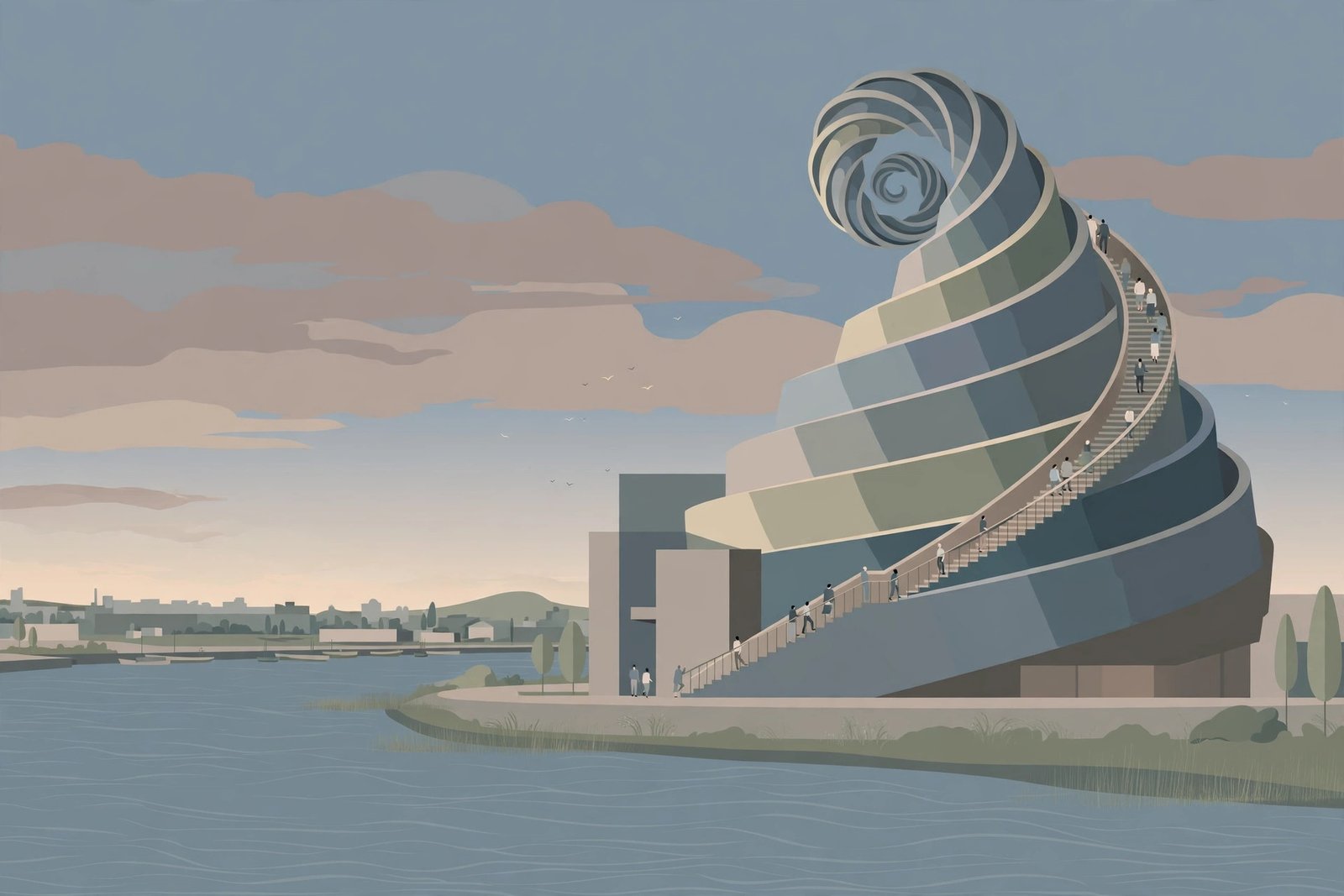
Everything sits beneath a sweeping roof that unifies the different programmes while extending the public realm vertically. A spiralling staircase connects ground level to the rooftop, which works as an observation deck and gathering space overlooking the Huangpu River and the skyline.
Designboom describes that roof as inspired by the movement of the Huangpu River and the unfolding geometry of a traditional Chinese fan, rising from the landscape in a continuous spiral. Smithsonian lists the same family of references — a traditional Chinese fan, a swirling dance movement, piano keys and the flow of the river — for a staircase it calls akin to a large public sculpture.
Words aside, the test is use. Can you go up there without a performance to attend? On the published accounts, yes. Public routes connect different levels of the complex, allowing visitors to access parts of the building independently of scheduled performances. Archiproducts makes the same point in plainer civic language: the roof is accessible throughout the year, acting simultaneously as a viewing terrace, meeting place and outdoor stage.
Co-founder Kjetil Thorsen, quoted via Dezeen in Smithsonian’s reporting, was blunt about why: “Buildings like opera houses inevitably create thresholds through walls, doors and ticketed programs”. “We see it as our responsibility to challenge those thresholds and make the building as much a civic destination as a performance venue.”
White outside, deep colour inside
The contrast is deliberate. A predominantly white exterior gives way inside to richer rooms, with expansive glazed surfaces introducing natural light into public areas and the main public hall described as a stark white space with sharp red accents. Archiproducts notes the palette gradually shifts from darker to lighter tones across the three halls, giving each venue a distinct character while keeping a shared identity under the roof.
Outside, the landscape follows the building rather than decorating it. A radial landscape derived from the geometry of the building connects the opera house with the park, city and river, contributing to the regeneration of the Expo Houtan district. Passive design strategies, daylighting and landscape integration are cited across the coverage as the project’s environmental approach — stated as design intent in the sources, not as measured performance data, which has not been published in the pieces read for this article.
Analysis: Snøhetta has run this play before in Oslo, where a walkable roof turned an opera house into a piece of the city. Shanghai is that idea at a different scale and in a different river city — 4,200 seats, three halls, a festival launch and a skyline to look back at. The risk is familiar too. A public roof photographs beautifully on opening week. Whether it stays genuinely open, busy on non-performance days and woven into daily routes through Expo Houtan will be decided by management and by weather and by habit, not by the spiral alone. The architecture has made its offer clearly. The city now has to accept it, repeatedly, on ordinary Tuesdays.
Shanghai has been adding cultural buildings at pace. Since 2021 the Museum of Art Pudong, Shanghai Museum East, West Bund Grand Theatre and Shanghai Literature Museum have all opened their doors, in a city Smithsonian puts at roughly 25 million people. This opera house enters that crowded new map with one distinction nobody else on the list can claim: you can stand on top of it, look at the river, and never go inside at all.
Sources
- ArchDaily — “Snøhetta’s Shanghai Grand Opera House Opens With a Sweeping Roof and Panoramic River Views” (19 October 2026): https://www.archdaily.com/1187067/snohettas-shanghai-grand-opera-house-opens-with-a-sweeping-roof-and-panoramic-river-views
- Designboom — “Snøhetta’s Shanghai Grand Opera House opens in China” (October 2026): https://www.designboom.com/architecture/snohetta-shanghai-grand-opera-house-spiraling-staircase-public-rooftop/
- Smithsonian Magazine — “Shanghai’s ‘Audacious’ New Opera House Just Opened Its Doors — and a Gravity-Defying Staircase — to the Public” (21 October 2026): https://www.smithsonianmag.com/smart-news/shanghais-audacious-new-opera-house-just-opened-its-doors-and-a-gravity-defying-staircase-to-the-public-180989726/
- Archiproducts — “Shanghai Grand Opera House Opens as Snøhetta’s New Landmark” (19 October 2026): https://www.archiproducts.com/en/news/shanghai-grand-opera-house-apre-il-nuovo-landmark-di-snøhetta_111205?s=112102
Leave a comment
Comment as a guest and verify your email, or sign in or create a reader account. Guest comments reach our review queue after email verification; account holders can submit directly for review.