Listen to this article
Take the story with you. Choose a voice and a pace that suits you.
Getting your device voices ready…
The voice follows the displayed language and your browser’s regional preference when available. You can choose another narration voice. Enhanced device voices are preferred; availability varies.
Event date: 19 October 2026. Information verified through 20 October 2026.
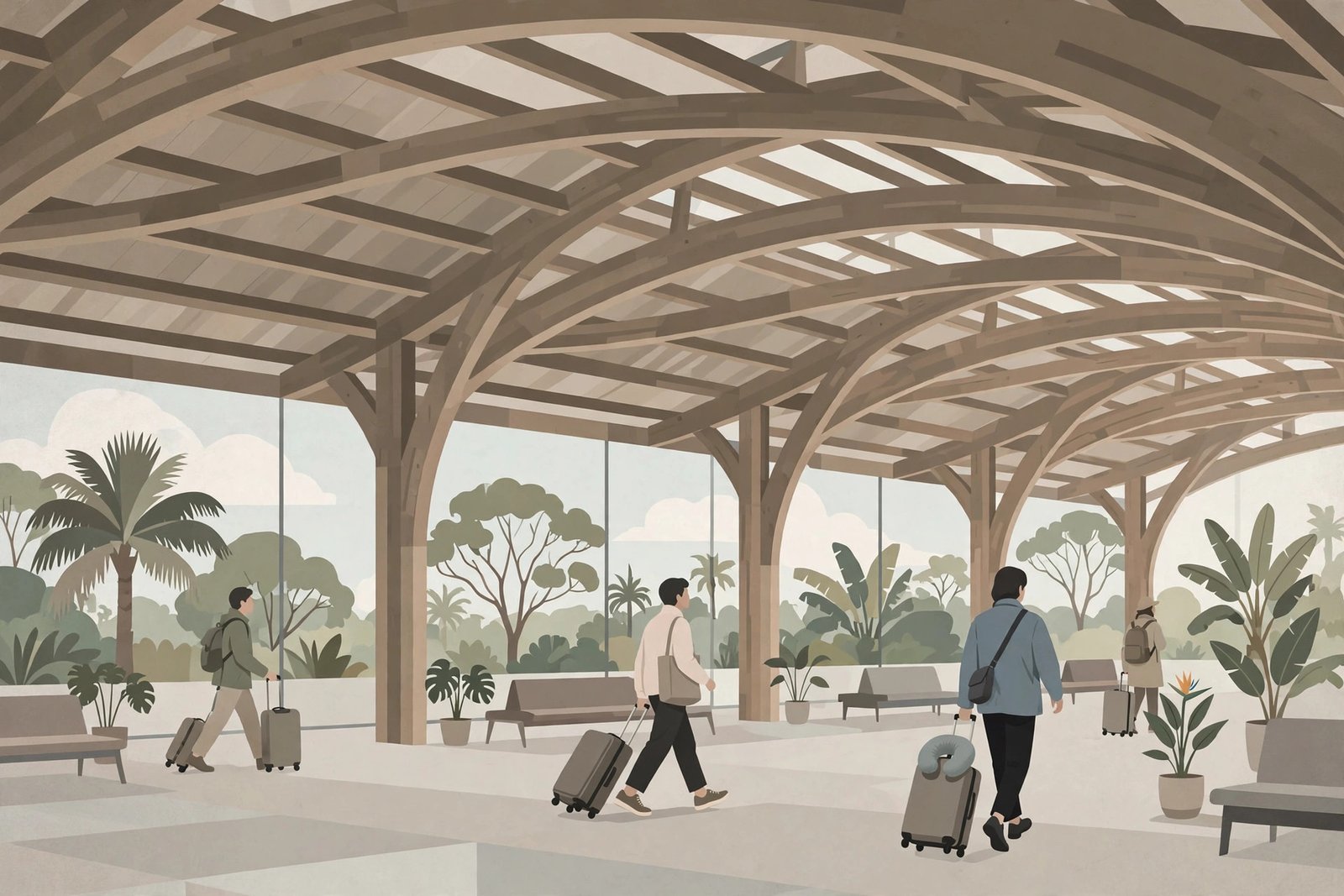
Airports are usually steel, glass and a particular kind of tired light. At Sunshine Coast Airport in Queensland, the newest piece of the building going up overhead is wood — around 30 tonnes of it, with installation now underway as of 19 October 2026 (Airport World).
The timber is engineered glulam, also called GLT, and it is being installed to form the terminal’s raking roof frames, described as a defining architectural feature of the project (Airport World). The design is by the Australian team of Populous: Fentress Studios, working in partnership with builder McNab (Airport World). When complete, the airport says, this will be Australia’s first mass-timber engineered terminal (Airport World).
Why timber, at an airport?
Matt Findlay, principal and head of aviation for APAC at Populous: Fentress Studios, did not pretend this is standard practice. “It’s genuinely rare for an airport to use timber at this scale,” he said, noting that most terminals of this size rely on steel and concrete (Airport World). The airport puts the installation’s weight in a local comparison: about the same as an adult humpback whale, a familiar sight migrating past the Sunshine Coast coastline each year (Airport World).
The carbon case is real but modest, and the reporting says so if you read closely. Using timber over traditional steel and concrete gives an estimated Global Warming Potential saving of roughly 40 tonnes of CO2 equivalent for this element of the build (Airport World). That is a saving, not a transformation of the project’s whole footprint — a distinction worth keeping when a single material starts carrying an entire sustainability story.
The design case may be stronger. Associate principal Sean Powyer pointed to place: “The Sunshine Coast is the only place in the world that’s home to three continuous UNESCO Biospheres, and our airport serves as a gateway to three of Australia’s five Biosphere Reserves” (Airport World). Timber, he said, was a natural choice reflecting the surrounding subtropical rainforest (Airport World). The airport describes the approach as biophilic design, using warm, exposed timber in place of concrete and steel in the expectation of a calmer passenger environment (Airport World).
Robin Mace, the airport’s general manager for projects and planning, expects the frames to become “one of the most recognisable features of our new terminal” (Airport World).
A terminal nearly doubling, in stages
The timber sits inside a much larger A$170 million Terminal Redevelopment Project. The full expansion will almost double the terminal footprint, from 6,100 square metres to 11,750 square metres, triple the departure lounge, and lift departure gates from five to seven (Sunshine Coast Council). Check-in gains 18 self-service kiosks and 10 automatic bag drops (Sunshine Coast Council).
Passengers are already using finished pieces of it. The new arrivals precinct, opened earlier in October, has a baggage claim hall almost three times the size of the previous facility, with a 92-metre baggage carousel (OurSC). Around 20,000 passengers arrive through the airport each week; about 1.8 million travelled through it in FY26, with numbers forecast to reach 2.4 million by 2030 (OurSC). The full terminal expansion is expected to be completed in 2027 (Sunshine Coast Council).
Council Mayor Rosanna Natoli tied the build to the region’s self-image: the transformation, she said, is creating “a facility that reflects the growth and ambition of our region” (Sunshine Coast Council). The airport’s own project summary lists the wider sustainability package alongside the timber — rainwater harvesting, expanded solar panels, energy-efficient heating, ventilation and air conditioning, and climate-sensitive design (Sunshine Coast Airport).
Analysis: the interesting decision here is not timber as decoration. Glulam is doing structural work, as the roof frame, in a building type that defaults to steel for reasons of span, fire engineering and habit. If those frames perform as designed through a Queensland summer and a full operating year, the precedent matters more than the press release — other mid-size airports get a worked example, not a rendering.
Judge it on that basis when the terminal opens in 2027: whether travellers actually read the roof as the place they have landed in, and whether the rest of the sustainability package — the rainwater, the solar, the systems you cannot photograph — was delivered with the same care as the whale-weight headline over their heads.
Sources
- Airport World — “Sunshine Coast building Australia’s first mass timber engineered terminal” (19 October 2026): https://airport-world.com/sunshine-coast-building-australias-first-mass-timber-engineered-terminal/
- Sunshine Coast Council — “New arrivals precinct opens at Sunshine Coast Airport” (8 October 2026): https://www.sunshinecoast.qld.gov.au/news/new-arrivals-precinct-opens-at-sunshine-coast-airport
- OurSC — “New arrivals precinct opens at Sunshine Coast Airport” (October 2026): https://oursc.com.au/business/new-arrivals-precinct-opens-at-sunshine-coast-airport
- Sunshine Coast Airport — “Sunshine Coast Airport soars to new heights” (project fast facts, 2026): https://www.sunshinecoastairport.com.au/corporate/media/media-releases/sunshine-coast-airport-soars-to-new-heights/
Leave a comment
Comment as a guest and verify your email, or sign in or create a reader account. Guest comments reach our review queue after email verification; account holders can submit directly for review.