Listen to this article
Take the story with you. Choose a voice and a pace that suits you.
Or listen in another language / choose a voice
Getting your device voices ready…
The voice follows the displayed language and your browser’s regional preference when available. You can choose another narration voice.
The first Ambasz-MoMA prize Friendship Centre result is a deliberate provocation to prize culture. On 12 November 2026, the Museum of Modern Art in New York named the Dhaka-based office Kashef Chowdhury/URBANA winner of its inaugural Ambasz–MoMA Annual Prize for Nature-Reconciled Architecture, for a rural training hall in Gaibandha, Bangladesh, completed back in 2011 (MoMA; ArchDaily). Not a new tower. Not a starchitect’s museum. A low brick complex on a flood plain, chosen from nearly 140 projects worldwide. Information verified through 26 November 2026.
How the nature-reconciled architecture prize is set up
The prize is new, annual, and unusually structured. It carries a total value of $200,000, which MoMA describes as the largest award for a single project in architecture (MoMA). Half — $100,000 — goes directly to the winning architect. The other $100,000 goes to a non-profit to plant trees in the project client’s name. This year that money goes to Fundación Gran Chaco in Formosa, Argentina, for reforestation in the Gran Chaco forest, in honour of Friendship, the NGO that commissioned the centre (Architectural Record).
Eligibility reaches backwards. Any project completed anywhere in the world in the past 30 years can win, provided it is judged exemplary in repairing architecture’s relationship with nature (MoMA). The candidate pool came from research by MoMA’s Ambasz Institute plus nominations from 30 experts asked to identify projects from their own regions (ArchDaily).
The jury mixed the museum with outside weight: Martino Stierli, MoMA’s Philip Johnson Chief Curator of Architecture and Design; Evangelos Kotsioris, director of the Ambasz Institute; assistant curator Paula Vilaplana de Miguel; plus Shelley McNamara of Grafton Architects and Wang Shu of Amateur Architecture Studio (ArchDaily). The prize is named for Emilio Ambasz, MoMA’s curator of design from 1968 to 1976, and is funded by a major gift from the Legacy Emilio Ambasz Foundation (Architectural Record). The award will be presented at a ceremony at MoMA on 12 December 2026 (ArchDaily).
The Friendship Centre Gaibandha Bangladesh built, on low ground
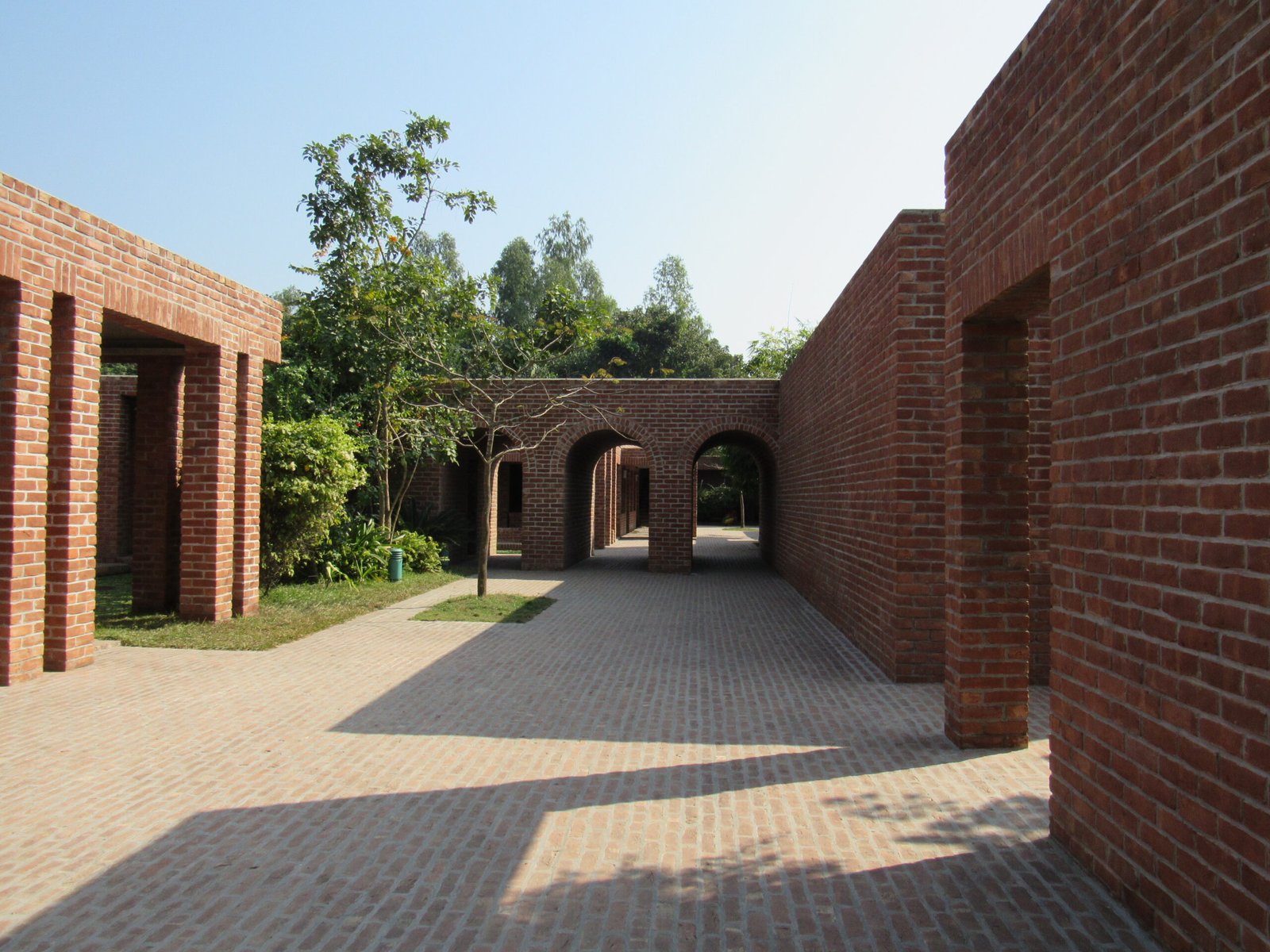
The winning building works for a living. The Friendship Centre is a training facility and meeting space for underserved communities in the flood-prone Jamuna River delta, run for the NGO Friendship, whose work serves mostly agricultural communities in the region (ArchDaily; The Architect’s Newspaper). Two quadrangular blocks hold offices, classrooms, a library and meditation spaces in one, dormitories and dining in the other (MoMA).
Its flood strategy is old, literally. A compacted earthen embankment protects the complex, and the buildings sit directly on the original low-lying ground rather than on expensive piles — a choice that also answered the site’s low soil-bearing capacity (ArchDaily; The Architect’s Newspaper). The walls are local clay brick, handmade by community members, laid out as a labyrinth of arches, courtyards and trees (The Architect’s Newspaper). Green roofs, open-air courtyards and interconnected rainwater pools cool the complex and ventilate it naturally; the pools collect rainwater and help with microclimatic cooling (Architectural Record).
The plan takes its cue from Mahasthangarh, the third-century BCE city nearby — one of Bangladesh’s oldest urban archaeological sites (ArchDaily). Chowdhury made the point himself in his statement: the centre “has been in service to an underserved community for 14 years. Yet, it is not a building of 14 years of age, but rather 2,300 years of age, as it draws its inspiration for flood protection from the nearby third-century B.C. settlement of Mahasthan” (Architectural Record).
What the Ambasz-MoMA prize Friendship Centre decision rewards
Kotsioris, speaking for the jury’s thinking, praised “a remarkable economy of means” yielding “a richness of spatial experience,” and called the centre “a compelling vision of how architecture might reconcile with nature” (ArchDaily; The Architect’s Newspaper). Stierli framed the wider claim: excellent architecture, he said, “can be both a cultural and an ecological practice at the highest level” (MoMA).
This is not the building’s first honour. The Kashef Chowdhury Friendship Centre award shelf already held one of the six 2016 Aga Khan Awards for Architecture (Architectural Record). A second major prize, a decade later, for the same modest complex says something about where juries now look for ecological design: not at buildings that announce their greenness with technology, but at ones that never had the budget for anything except climate sense.
Some context on the money, since MoMA’s “largest” claim invites it. The Pritzker Prize is $100,000 and goes to a person; the Driehaus Prize is $200,000 but honours a practitioner, not a project; the Aga Khan Award is $1 million split among several recipients on a three-year cycle (Architectural Record). On a per-project basis, MoMA’s claim holds up — and the tree-planting half makes the prize itself perform the reconciliation it celebrates.
Whether an annual prize can shift practice is an open question. Prizes mostly reward what already exists. Still, a first winner this quiet — handmade brick, borrowed flood wisdom, rainwater for air conditioning — sets the terms for every shortlist that follows. The next 139 projects now know what “nature-reconciled” has to beat.
Photo: Afifa Afrin, via Wikimedia Commons (CC BY-SA 4.0).
Sources
- MoMA — The Museum of Modern Art announces the winner of the inaugural Ambasz–MoMA Annual Prize for Nature-Reconciled Architecture: https://press.moma.org/wp-content/uploads/2026/11/MoMA_Ambasz-Prize-Winner-Announcement-PR_FINAL.pdf
- ArchDaily — Kashef Chowdhury/URBANA receives the first Ambasz–MoMA Annual Prize for Nature–Reconciled Architecture: https://www.archdaily.com/1188667/kashef-chowdhury-urbana-receives-the-first-ambasz-moma-annual-prize-for-nature-reconciled-architecture?ad_medium=gallery
- Architectural Record — Kashef Chowdhury of Urbana wins Ambasz–MoMA Annual Prize for Nature–Reconciled Architecture: https://www.architecturalrecord.com/articles/18552-kashef-chowdhury-of-urbana-wins-ambaszmoma-annual-prize-for-naturereconciled-architecture
- The Architect’s Newspaper — Kashef Chowdhury wins Ambasz–MoMA Annual Prize: https://www.archpaper.com/2026/11/urbana-kashef-chowdhury-prize/
Leave a comment
Comment as a guest and verify your email, or sign in or create a reader account. Guest comments reach our review queue after email verification; account holders can submit directly for review.