Listen to this article
Take the story with you. Choose a voice and a pace that suits you.
Getting your device voices ready…
The voice follows the displayed language and your browser’s regional preference when available. You can choose another narration voice. Enhanced device voices are preferred; availability varies.
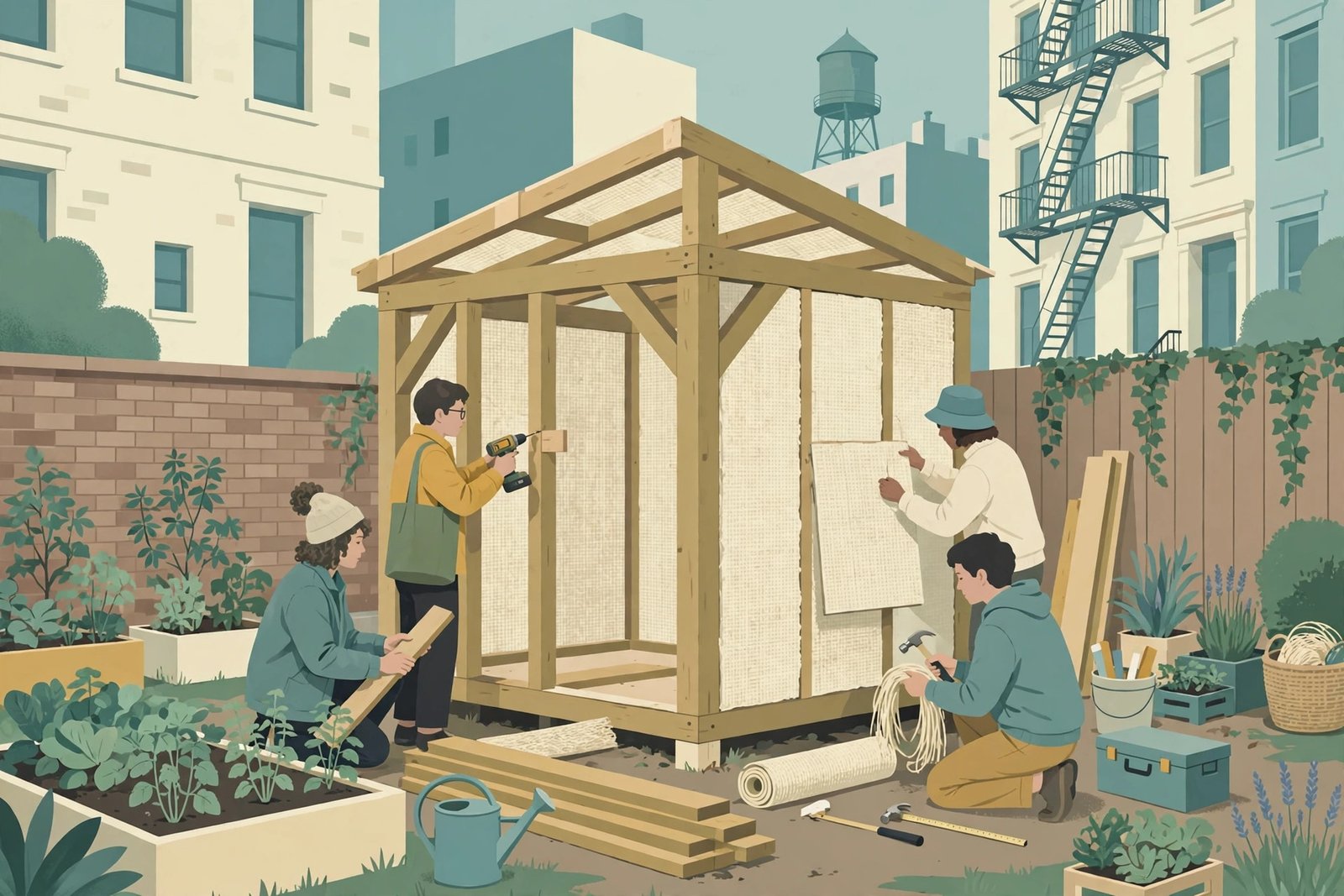
One material. That was the constraint. Each student team at Parsons had to design and build an entire accessory dwelling unit — a backyard house, a granny flat, a small second home on an existing lot — using only fiber, only mineral, or only timber. The results stand full-scale in the ground-floor gallery at 72 Fifth Avenue in an exhibition called “The New ADU: Beyond Petroleum,” on display until 31 October 2026. Information verified through 21 October 2026.
The timing isn’t academic decoration. The prototypes were built in Parsons’ Spring 2026 Design Workshop, taught by David J. Lewis and Dr. Sharon E. Sutton, and they speak directly to New York’s City of Yes for Housing Opportunity — under which ADUs are projected to deliver roughly 30% of anticipated new housing units. Read that again. Nearly a third of a housing programme, at city scale, in the small-buildings category. What those thousands of units get built from is not a footnote.
Doing less bad is not the brief
Standard construction leans hard on petroleum- and plastic-based products — foams, membranes, synthetic insulation. The exhibition positions itself explicitly against that default, organising the work around fiber, mineral and timber as regenerative, biogenic material families. Lewis states the studio’s bar without hedging: “The goal can no longer be doing less bad” — students must demonstrate systemic change, not shave percentages off a bad baseline.
The project deliberately complements the city’s own ADU for You programme by covering ground that, in The New School’s phrasing, code-and-speed might leave out: material health, full life-cycle carbon, regenerative construction systems and green-building workforce development. That’s a polite way of naming a real tension. A city racing to legalise small units wants them fast and cheap. Fast and cheap, left alone, means plastic.
Student Michael Wilson, M.Arch ’27, supplies the exhibition’s most useful testimony — about weight, not vision statements. Choosing sustainable materials on paper is easy, he says; building exposed what sustainable choices actually cost, with transport, local availability, disassembly and ease of construction deciding the material. His conclusion deserves quoting to every materials library in the country, in paraphrase: sustainability isn’t one decision, it’s dozens of small, difficult ones. The Design Workshop, running since 1998, forces those decisions into the open by requiring budgeting, fabrication and full-scale prototyping rather than renderings alone.
Reuse is the other half of the argument
Parsons is working the small end of a shift visible at every scale this month. Washington, D.C., has become a conversion leader, with 8,479 office-to-residential units underway — second only to New York’s 16,358 — and its first tax-incentivised conversion, Aviator House, has just opened as 157 apartments in a 1972 office building that was about 50% leased after the pandemic. Its project lead, Peter Epstein, describes the shared puzzle honestly: financially it has to work, physically the building has to be able to convert.
In Houston, the same instinct takes institutional form. Construction has begun on OMA’s conversion of the 1930s J. A. Folger & Co. coffee plant into a 6,050-square-metre tuition-free charter school, historic façade kept, classrooms run along the perimeter. And the global backdrop is stark: UN-Habitat’s World Cities Report 2026 puts the number of people lacking adequate housing at up to 3.4 billion. Against a deficit that size, both halves matter — new units built from materials that don’t poison their occupants or the carbon ledger, and existing shells refused a demolition date.
Analysis: The honest limits should be stated in the same breath as the enthusiasm. These are prototypes and an exhibition, not permitted, costed housing; no per-unit price, embodied-carbon figure or code-compliance pathway is published in the university’s account, and a one-material rule is a teaching device, not a building code anyone should adopt literally. Real ADUs will mix materials. What transfers isn’t the purity — it’s the discipline of asking, for every layer of a small building, whether a grown or quarried alternative was even priced before the petroleum default won by habit.
That question scales down to a single backyard surprisingly well. A homeowner adding one unit can’t reform a supply chain. They can, though, refuse to let “standard practice” make dozens of small decisions invisibly on their behalf — which is, in the end, exactly the skill Parsons spent a semester teaching with ladders, deliveries and full-scale timber. The exhibition closes 31 October. The housing programme it answers will run for years.
Sources
- The New School News — “Parsons M. Arch Students Create Sustainable ADU’s for Design Workshop Course” (16 October 2026): https://blogs.newschool.edu/news/2026/10/m-arch-students-create-sustainable-adus-for-design-workshop-course/
- Smart Cities Dive — “3 notable office-to-residential conversions in DC” (19 October 2026): https://www.smartcitiesdive.com/news/recent-office-to-residential-conversions-dc/833355/
- ArchDaily — “UN-Habitat Highlights Housing Initiatives and sauerbruch hutton Completes Timber-Hybrid Building in Berlin: This Week’s Review” (15 October 2026): https://www.archdaily.com/1186880/un-habitat-highlights-housing-initiatives-and-sauerbruch-hutton-completes-timber-hybrid-building-in-berlin-this-weeks-review
Leave a comment
Comment as a guest and verify your email, or sign in or create a reader account. Guest comments reach our review queue after email verification; account holders can submit directly for review.