Listen to this article
Take the story with you. Choose a voice and a pace that suits you.
Or listen in another language / choose a voice
Getting your device voices ready…
The voice follows the displayed language and your browser’s regional preference when available. You can choose another narration voice.
Spain is asking a hard question, and nobody in authority wants to answer it alone. The Spain train crash investigation into the collision near Urda, in Toledo province, on Wednesday 28 October 2026 has to explain how a high-speed Renfe train was allowed to accelerate into the back of a stationary Iryo train on the Madrid–Seville line, killing 69 people (Associated Press via Business Mirror). A judge and a special government commission are running separate investigations; Prime Minister Pedro Sánchez has pledged answers (Associated Press via Business Mirror).
Information verified through 3 November 2026.
What the Spain train crash investigation has established so far
The government’s own timeline starts with a failure, not a decision. On the morning of the crash, the line’s LZB safety system went down. LZB monitors the position of trains and can trigger automatic braking to prevent a collision; when it failed, human controllers at a control post in Madrid took over responsibility for a 63-kilometre stretch of track carrying six trains (Associated Press via Business Mirror).
Minutes later, a controller told the Renfe train it could restart at normal speed. The Iryo train, some 25 kilometres down the line, had also tried to restart but could not override its automatic stop, and its driver told the controller so. The collision followed, derailing carriages and shredding parts of both trains (Associated Press via Business Mirror). Measurements taken on the afternoon of the accident suggest the Renfe train was travelling at between 170 and 180 kilometres per hour when it hit — nowhere near the 40 kilometres per hour maximum that applies when drivers must run on sight under manual control (The Conversation via European Financial Review).
Transport Minister Óscar Puente, who is under pressure to resign, called the decision to let one train restart at full speed while the other stood still “inexplicable” and “erroneous”, and said the Renfe train should never have been told to move while a stop signal was active on the line (Associated Press via Business Mirror). King Felipe VI, visiting injured passengers in a Toledo hospital, put the public expectation plainly: “This investigation must determine how and why this catastrophe happened” (Associated Press via Business Mirror).
The LZB signalling system failure did not come out of nowhere
The unions say the controller is the last link in a long chain. Raquel Ayllón, speaking for the SCF traffic controllers’ union, told the Associated Press that workloads are regularly too much for current staffing to handle safely, that controllers have asked for more personnel for years, and that the safety systems keep failing. “Human error isn’t incomprehensible,” she said. “What is incomprehensible is that the safety system is regularly failing” (Associated Press via Business Mirror).
The engineers’ union SEMAF makes the same point about the kit itself. The LZB system is three decades old, survives only on the Madrid–Seville line while it is being phased out elsewhere, and has gone offline repeatedly before, leaving human operators to manage on their own, its spokesperson Diego Martín said (Associated Press via Business Mirror). The Madrid–Andalusia line is the only one still using LZB; its replacement, the European Rail Traffic Management System, already runs on the Madrid–Barcelona and Madrid–Levante lines, and EU legislation aims for it to replace national systems across the bloc by 2050 (The Conversation via European Financial Review).
Context does not stop at signalling. Spain opened its high-speed network to private operators in 2021, traffic has grown since, and both of this year’s collisions involved one Renfe train and one Iryo train. A spokesperson for the train workers’ union, Joan Rodríguez, told TVE the increase in use had not convinced workers that upkeep had kept pace (Associated Press via Business Mirror). Train workers struck on Thursday, in an action planned before the crash, over safety commitments made after January (Associated Press via Business Mirror).
Near Adamuz, further south on the same line, one train jumped the track and hit another, killing 46 people (Associated Press via Business Mirror). Passenger traffic on the Madrid–Seville line fell by more than 30 percent after it (The Conversation via European Financial Review). Two disasters, one corridor, nine months apart.
Urda train crash victims identified from twelve countries
The Madrid Seville train crash was an international disaster, not only a Spanish one. The forensic work has moved faster than the argument about blame. By late Sunday, authorities had identified 66 of the 69 people killed, 54 of them Spanish nationals and 12 foreign citizens, including four Americans and one citizen each from Argentina, Canada, the Czech Republic, France, Japan, Mexico, Portugal and Tunisia; three people were still missing (The Financial). Identifications have relied on fingerprint analysis and DNA testing while relatives travelled to Spain (The Financial).
Infrastructure manager Adif has said the crash happened at kilometre point 118, between Mora, Orgaz and Urda, and opened assistance points for passengers and families in Madrid, Seville, Córdoba and Málaga, while disruption on the Madrid–Andalusia route continued (The Financial). No final finding on cause has been issued. Under European rules, the technical inquiry exists to establish causes and improve safety rather than assign liability, and detailed reports of this kind take months (The Financial).
Analysis: the sharpest dispute here is not really about one controller. It is about what a safety case is worth when the automatic layer fails. A system designed so that a single tired human, working a failing panel, can send a train at full speed into an occupied stretch of track has failed at the design level first — the unions’ argument, and the investigation’s hardest question. The minister’s account and the unions’ account can both be partly true. Neither explains away the second catastrophe on the same line in one year, on a railway still waiting for the signalling its newer lines already have (The Conversation via European Financial Review).
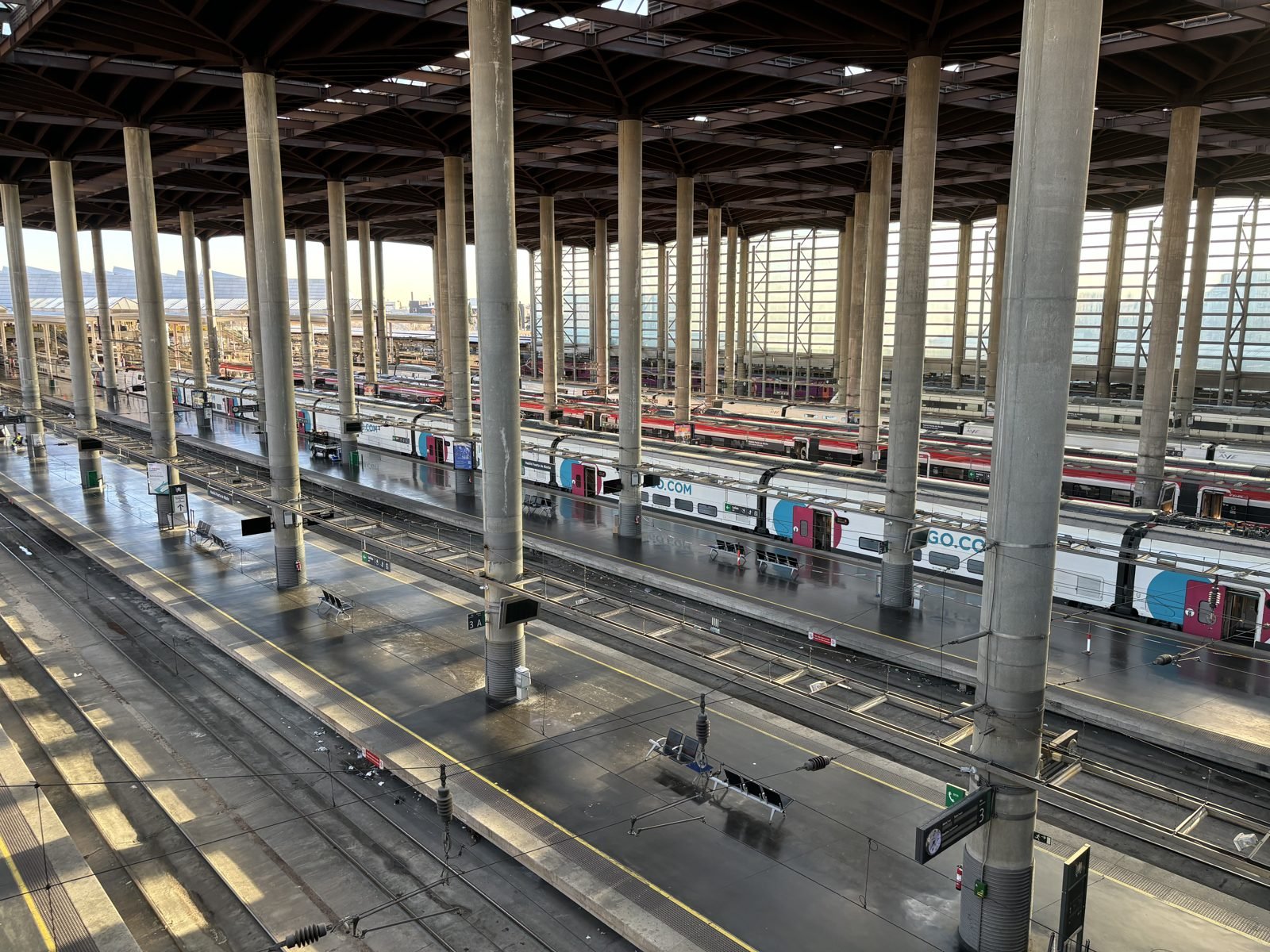
Photo: Mattsjc, via Wikimedia Commons (CC BY-SA 4.0)
Sources
- https://businessmirror.com.ph/2026/11/01/spains-latest-deadly-train-crash-puts-human-error-and-systemic-failure-under-scrutiny/
- https://www.europeanfinancialreview.com/spains-high%e2%80%91speed-train-network-is-plagued-by-old-signalling-systems-they-may-have-caused-the-deadly-crash/
- https://finchannel.com/four-americans-are-among-69-dead-in-spains-high-speed-train-collision/140367/world-2/2026/11/
Leave a comment
Comment as a guest and verify your email, or sign in or create a reader account. Guest comments reach our review queue after email verification; account holders can submit directly for review.