Listen to this article
Take the story with you. Choose a voice and a pace that suits you.
Or listen in another language / choose a voice
Getting your device voices ready…
The voice follows the displayed language and your browser’s regional preference when available. You can choose another narration voice.
The BepiColombo Mercury arrival happened quietly. On 21 November 2026, the European Space Agency announced that its spacecraft had inserted itself into orbit around the innermost planet, ending an eight-year cruise (Nature). No live picture showed the moment. A signal, a set of manoeuvres, and a spacecraft that left Earth in October 2018 was finally where it was built to be.
That BepiColombo arrives at Mercury at all is the story underneath the headline. Getting there means falling toward the Sun without being captured by it — shedding speed, not gaining it.
What the BepiColombo Mercury arrival actually involved
ESA describes BepiColombo as a mission led by ESA in close collaboration with the Japan Aerospace Exploration Agency, JAXA, and the first mission to orbit Mercury with two spacecraft at the same time (ESA). The two orbiters are ESA’s Mercury Planetary Orbiter, known as MPO, and JAXA’s Mercury Magnetospheric Orbiter, called Mio.
They did not travel separately. The pair launched together in a stacked configuration, carried by a Mercury Transfer Module that provided propulsion for the long cruise. That transfer module separated on 3 September 2026, according to ESA, leaving the joined orbiters to complete the approach on their own (ESA).
Arrival, in other words, was not a single burn and a done deal. Sky & Telescope reported that capture on 21 November kicked off a multi-burn sequence, with the combined spacecraft first entering an orbit of about 590 by 11,640 kilometres before working its way lower over the coming weeks (Sky & Telescope). Nature put it in similar terms: the insertion on 21 November began a months-long series of manoeuvres (Nature).
The next hard date is already on the calendar. MPO and Mio are due to separate on 9–10 December 2026, ESA says, each then following its own orbit at a different altitude (ESA). Until that split, the two probes remain conjoined — two spacecraft, still travelling as one.
Why did the trip take eight years? The route was deliberately indirect. BepiColombo completed nine planetary flybys — one of Earth, two of Venus and six of Mercury — to gradually slow itself enough to be captured, Scientific American reported (Scientific American). A thruster problem in 2024 forced a trajectory change and pushed arrival back from December 2025 to November 2026, according to Eos (Eos). Heat is the other constant problem: Sky & Telescope noted that teams have rehearsed contingency procedures for the separation events, when protective coverings must close correctly or the spacecraft could be seriously damaged (Sky & Telescope).
The second spacecraft to orbit Mercury
Context matters here. BepiColombo is only the second spacecraft to orbit Mercury, after NASA’s MESSENGER, which circled the planet from 2011 to 2015 (Nature). Before MESSENGER, the only other visitor was NASA’s Mariner 10, which flew by three times in 1974 and 1975 and never entered orbit (Scientific American). Eos counts it slightly differently: BepiColombo is only the third mission to visit Mercury at all (Eos). Three visits in fifty years. That scarcity is physics, money and risk — a small planet deep in the Sun’s gravity well, punishing any spacecraft that arrives too fast.
What will BepiColombo study at Mercury?
Start with the planet itself, which does not behave the way a planet its size should. Mercury has an iron-rich core extending about 85 percent of the way from its centre to its surface, compared with about 55 percent for Earth, Scientific American reported (Scientific American). One leading explanation, cited by ESA project scientist Geraint Jones in Sky & Telescope, is that a huge impact stripped away much of Mercury’s outer mantle (Sky & Telescope). Testing that means measuring the interior precisely.
Then there is the ice. Radar and MESSENGER data point to water ice in permanently shadowed craters near Mercury’s poles (Sky & Telescope). MESSENGER covered the north well and the south poorly. BepiColombo should give far better southern coverage, Jones said.
The division of labour is clean. MPO is the planet-facing spacecraft: it will map the surface, study its composition and geology, measure topography, and pin down the size of the core, according to Eos (Eos). Mio, by contrast, will trace wide ellipses between about 500 and 11,000 kilometres, sampling Mercury’s magnetic field and its interaction with the solar wind, while MPO descends until March 2027 to an orbit between about 400 and 1,500 kilometres (Nature).
That magnetic field is a puzzle in its own right. Mercury is the only rocky planet besides Earth with a global magnetic field, Sky & Telescope noted, yet scientists do not fully understand what sustains it or why it is offset from the planet’s centre — questions Mio was built to help answer, according to Eos (Sky & Telescope; Eos). Flying two spacecraft at once lets researchers measure that field from inside and outside the magnetosphere at the same time, something a single orbiter cannot do.
Do not expect the science floodgates to open next week. ESA puts the start of the science phase in April 2027, after commissioning through March (ESA; Sky & Telescope). The nominal science mission is planned to last a year, with a possible extension.
Analysis: the arrival’s real significance is less the orbit itself than the pairing. A surface orbiter and a magnetosphere orbiter, measuring the same planet at the same time, turn Mercury from a place visited twice into a system that can be watched as it reacts — to sunlight, to solar wind, to its own slow cooling. Whether that yields a lander one day is a question for the next decade.
For now, the work is unglamorous and exact: burns on schedule, a separation in December that has to go right, instruments to commission through the winter. Eight years of travel bought a few months of careful setup. That trade is the mission.
Information verified through 23 November 2026.
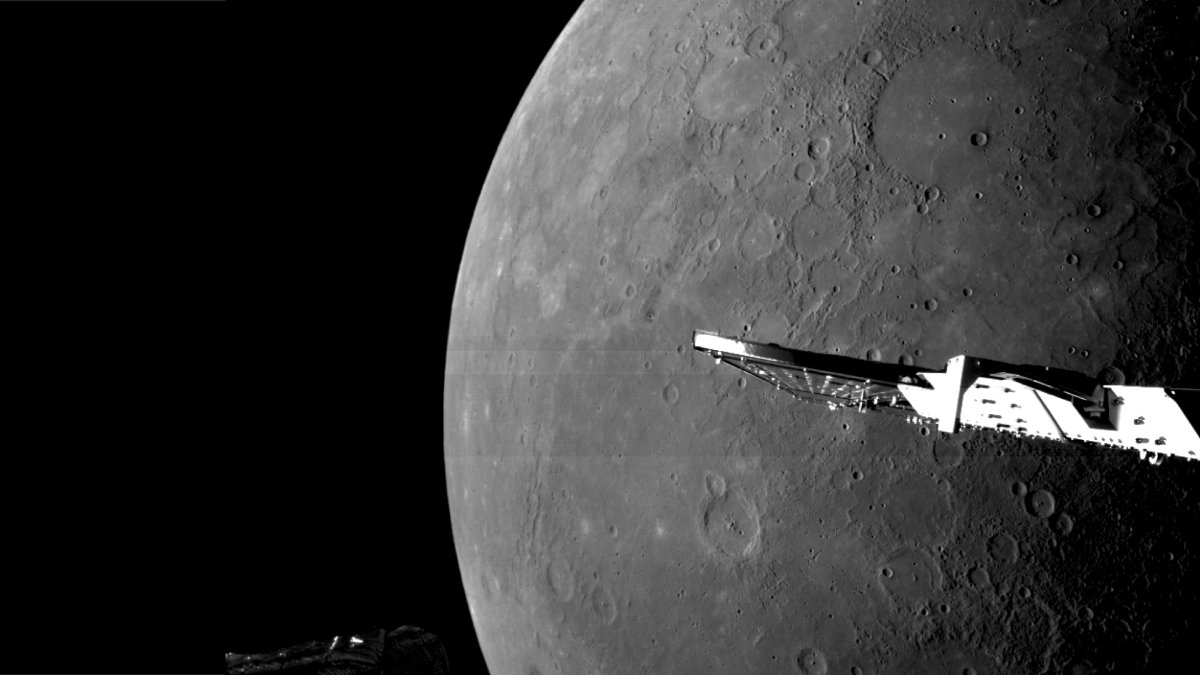
Photo: ESA/BepiColombo/MTM, via Eos (CC BY-SA 3.0 IGO)
Sources
- European Space Agency — Media invitation: briefing on BepiColombo arrival at Mercury on 27 November: https://www.esa.int/media-advisories/media-invitation-briefing-on-bepicolombo-arrival-at-mercury-on-27-november
- Nature — BepiColombo finally reaches Mercury after eight-year odyssey: https://www.nature.com/articles/d41586-026-03803-8
- Sky & Telescope — BepiColombo Arrives at Mercury After 8-Year Odyssey: https://skyandtelescope.org/astronomy-news/bepicolombo-arrives-at-mercury-after-8-year-odyssey/
- Eos — BepiColombo Arrives at Mercury: https://eos.org/research-and-developments/bepicolombo-arrives-at-mercury
- Scientific American — Two probes are about to arrive at Mercury for an up-close look at this puzzling planet: https://www.scientificamerican.com/article/two-probes-are-about-to-arrive-at-mercury-for-an-up-close-look-at-this-puzzling-planet/
Leave a comment
Comment as a guest and verify your email, or sign in or create a reader account. Guest comments reach our review queue after email verification; account holders can submit directly for review.