Listen to this article
Take the story with you. Choose a voice and a pace that suits you.
Or listen in another language / choose a voice
Getting your device voices ready…
The voice follows the displayed language and your browser’s regional preference when available. You can choose another narration voice.
The Philippines Australia defence cooperation arrangement 2026 was signed in Manila on Sunday 15 November, and its selling point fits in one sentence from the man who signed it. “Rather than 100 steps to do a single thing, it will just now take 10,” Philippine Defence Secretary Gilberto Teodoro Jr. told reporters, in remarks reported by the Chronicle. No new alliance. No new base. Just far less paperwork standing between two militaries and the work they already do together. Information verified through 16 November 2026.
Teodoro signed alongside Australian Ambassador Marc Innes-Brown at the Eva Macapagal Cruise Terminal, Pier 15, Manila South Harbor, with Australian Prime Minister Anthony Albanese watching, according to the Philippine News Agency. The timing was deliberate. The signing came ahead of the 49th ASEAN Summit, which the Philippines is hosting as ASEAN chair, and in the year the two countries mark 80 years of diplomatic relations.
The Philippines Australia defence cooperation arrangement 2026 replaces a 1995 framework
The new arrangement updates a 1995 memorandum of understanding on defence cooperation that had governed the relationship for three decades. Australia’s own release describes it as a contemporary framework covering maritime awareness and activities, information-sharing, strategic dialogue, planning, training, interoperability and defence infrastructure development.
It follows a path the two governments laid down last year. Teodoro and Australian Deputy Prime Minister and Defence Minister Richard Marles signed a Statement of Intent on Enhanced Defense Cooperation on 22 August 2025, committing both sides to modernise the old framework. Sunday’s signing was the delivery of that promise, fifteen months on.
What the arrangement is not matters as much. Reporting on the signing is explicit that it does not create a new mutual defence treaty or an automatic military response obligation, and it establishes neither a four-country alliance nor a permanent Australian or American base in the Philippines. Anyone reading it as an alliance announcement is reading past the text.
How the Philippines Australia Status of Visiting Forces Agreement SOVFA gets faster
The machinery underneath is the Philippines Australia Status of Visiting Forces Agreement SOVFA, signed in 2007 and in force since 2012, which sets the legal terms for visiting personnel. Teodoro called the new arrangement “the mechanism by which the SOVFA will work” and, in the same breath, “the anti-red tape measure of our SOVFA.”
Speed has practical consequences. Teodoro said coordination would quicken for maritime patrols between the two countries and with other like-minded nations, and that the deal would bring more maritime, air and land activity plus faster humanitarian assistance and disaster response. In an archipelago hit regularly by typhoons, disaster response is not a footnote. It is often the first real test any visiting-forces arrangement faces.
Canberra added money to the message. Australia committed investment through its Southeast Asia Maritime Partnerships, supporting aerial and surface drones, secure communications support and operator training for regional partners, a programme reported at A$160 million over ten years, from 2024 to 2034.
South China Sea deterrence Philippines Australia — and the words both sides chose
The geography explains the urgency. Teodoro said the deal would serve as deterrence in the West Philippine Sea, Manila’s name for waters in the South China Sea claimed by the Philippines and disputed by Beijing, adding: “Our stance in the West Philippine Sea, of the President, is all entitlements are Philippine entitlements.” South China Sea deterrence Philippines Australia is the frame Manila brought to the signing table.
Albanese chose different words. He denied the deal targeted any particular country — “This isn’t aimed at any one country. This is about supporting sovereignty of every country” — and noted that most of Australia’s trade passes through the South China Sea. Foreign Minister Penny Wong put Canberra’s position as an interest in a region where “sovereignty is respected, international law is upheld and countries can make their own choices.”
So what does the Philippines Australia defence pact change, in the end? Analysis: less than an alliance, more than a photo opportunity. The legal architecture was already there — a 1995 framework, a visiting forces agreement, a statement of intent. What was missing was pace. If the 100-to-10 claim holds in practice, joint activity stops being an annual negotiation and becomes routine, and routine is what deterrence is actually made of. The test arrives with the first patrol, exercise or relief operation run under the new steps. Neither government announced a schedule on Sunday, so that test has no date yet. Watch for one.
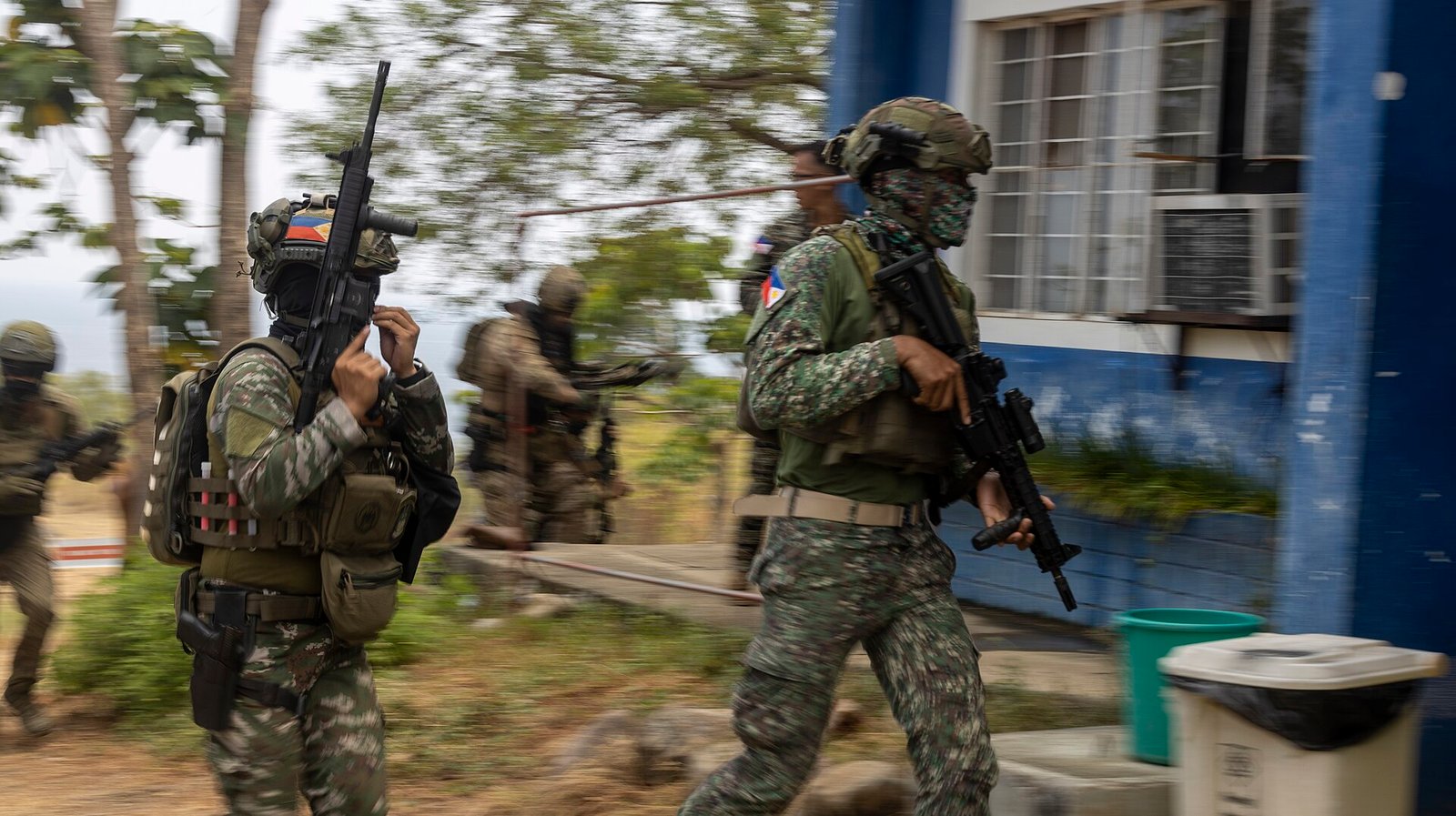
Photo: U.S. Marine Corps photo by Sgt. Adeola Adetimehin, via Wikimedia Commons (public domain)
Sources
- https://www.pna.gov.ph/article/ph-australia-ink-updated-defense-pact
- https://www.ibtimes.sg/100-steps-10-australia-philippines-defence-pact-signals-bigger-south-china-sea-push-96247
- https://thechronicle.com.ph/philippines-australia-sign-renewed-defense-pact-to-strengthen-military-cooperation/
- https://www.foreignminister.gov.au/minister/penny-wong/media-release/enhancing-defence-cooperation-and-maritime-security-southeast-asia
Leave a comment
Comment as a guest and verify your email, or sign in or create a reader account. Guest comments reach our review queue after email verification; account holders can submit directly for review.