Listen to this article
Take the story with you. Choose a voice and a pace that suits you.
Or listen in another language / choose a voice
Getting your device voices ready…
The voice follows the displayed language and your browser’s regional preference when available. You can choose another narration voice.
The FAA nationwide ground stop November 2026 stopped departures at every US airport on Friday 13 November, after controllers began seeing inconsistent radar and communications data. Planes already in the air kept flying to their destinations. Planes at gates stayed put. For more than four hours, the busiest aviation system in the world ran in one direction only: down.
The Federal Aviation Administration lifted the order at 8:15 p.m. Eastern Time, but lifting it didn’t restart the system like a light switch. Aircraft were in the wrong cities. Crews were out of position. Passengers who’d missed connections had nowhere obvious to go. Information verified through 14 November 2026.
What triggered the air traffic control communications failure
Transportation Secretary Sean Duffy said the trouble began at 3:36 p.m., when air traffic control centres experienced instability in radar and communications systems. His account was blunt: switches and routers got overloaded with data and started producing inconsistencies, so the system was shut down rather than trusted.
The FAA’s own order, issued just before 4 p.m., cited “extraordinary circumstances and for reasons of safety” and told all departing traffic to remain on the ground until further notice, with inbound international flights handled case by case.
Duffy posted at 4:16 p.m. that the stop followed “a communication issue impacting all Air Route Traffic Control Centers”. That’s the detail that made this different from a bad day at one hub. A failure at a single facility slows a region. A failure touching every centre leaves the agency with one safe option, and it took it.
Two airline officials told Reuters the outage appeared to involve a telecommunications network overseen by L3Harris Technologies, which handles critical radio frequencies controllers use to talk to pilots. L3Harris did not respond to a request for comment in that reporting.
Was it an attack? Homeland Security Secretary Markwayne Mullin said there was “zero evidence” so far of a cyberattack or a rogue system, while noting investigators hadn’t ruled anything out. He called it a telecommunication outage and said, plainly, “This is not another 9/11.”
US flights cancelled ground stop: the numbers kept moving
Counts differ by tracker and by hour, so treat any single total with care. Reuters, citing FlightAware, reported more than 1,000 flights cancelled and nearly 10,000 delayed during the stop itself.
A separate Reuters report, citing FlightRadar24, put the wider toll at more than 6,600 flights cancelled and 8,600 delayed, with another 1,500 already cancelled for Sunday. Those figures aren’t contradictory so much as snapshots taken at different moments of a rolling collapse — cancellations kept being added after the stop ended, because an airline can’t fly a plane that never arrived.
At Newark, one traveller summed up the gate-area mood. Louise Maher, 47, hoping to reach London on British Airways, told Reuters: “I might cry at some point but not yet.” Edward Kargbo, scheduled on a 9 p.m. Ethiopian Airlines flight to Lomé, planned instead to spend the night at the airport before a 6 a.m. rescheduling. “I’m stranded,” he said.
One hard fact for stranded passengers: US airlines won’t be required to compensate them for this disruption, because the carriers were not responsible for the FAA system failures. Airline shares still took a hit in after-hours trading, with American, United and Delta down between 1% and 2% and JetBlue down about 3%.
Only the second stop of its kind since 9/11 — and not the first warning
Friday’s halt was only the second nationwide ground stop of all departures since the September 11, 2001 attacks, and the longest such shutdown since then. The other one, in January 2023, lasted about 90 minutes after contractors accidentally deleted files in the Notice to Air Missions system, delaying more than 10,000 flights.
The warnings since then read like a drumbeat. In September 2026 the FAA halted flights to New York, Philadelphia, Boston and Washington for eight hours after a Philadelphia facility’s primary and backup data links failed, delaying or cancelling about 9,500 flights while 130 world leaders were travelling to the UN General Assembly. In 2025, a Dallas data outage forced ground stops at two airports, and repeated outages around Newark and Philadelphia stretched across weeks — during one, a controller told a freighter pilot the radar scopes had “just gone black again” and urged pressure on the airline to get things fixed.
When will US flights return to normal?
Not this morning, is the honest answer. Duffy warned departures would resume gradually — “It’s going to be slow” — and analysts cited by Reuters said a four-hour nationwide grounding could disrupt schedules for days. American Airlines said it was prioritising flights to smaller cities outside its hubs and international destinations to get aircraft and crews back into position faster.
The money argument has already started. Congress approved $12.5 billion last year for upgrading antiquated air traffic control systems and hiring controllers. Before Friday’s outage, the White House had asked for another $30.1 billion. On Friday night Duffy raised the ask, calling for $50 billion to modernise the system and saying, “Give us the money to fix it.”
Analysis: The political fight will be about the price tag. The operational fact underneath it is harder to argue with. A system Duffy himself described as “incredibly old” failed in the one way it cannot afford to — everywhere at once — two weeks before the Thanksgiving travel peak. Whether Congress pays $30 billion or $50 billion, Friday showed what the cheaper option costs: a country standing still at the gate.
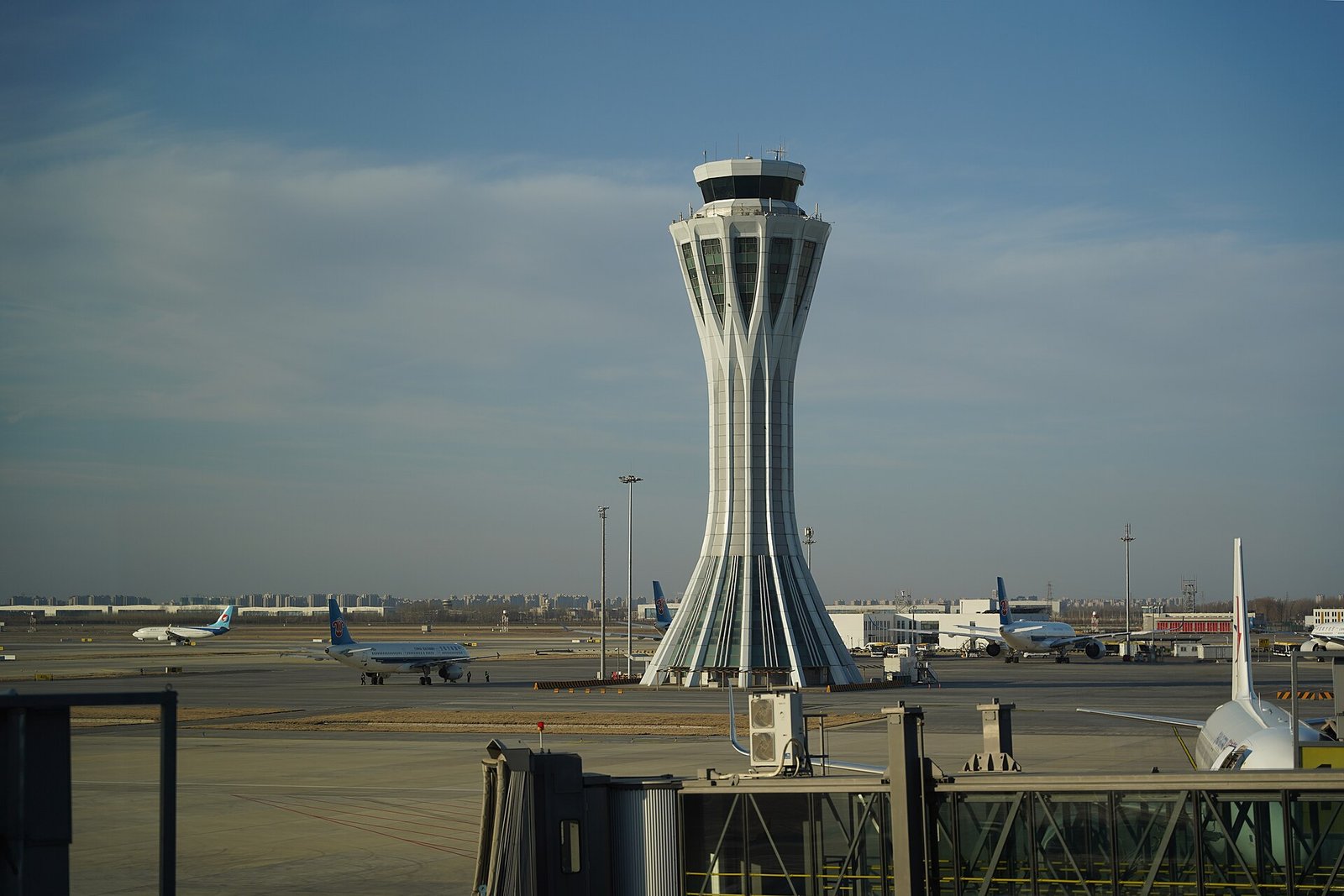
Photo: Benlisquare, via Wikimedia Commons (CC BY-SA 4.0)
Sources
- https://www.reuters.com/business/aerospace-defense/old-air-traffic-control-equipment-regularly-disrupts-us-flights-2026-11-14/
- https://www.northjersey.com/story/news/transportation/2026/11/13/ground-stop-us-airports-communication-issue-faa-safety/92765735007/
- https://www.1049thewolf.com/2026/11/13/us-to-resume-flights-after-air-traffic-network-failure-sparks-chaos/
Leave a comment
Comment as a guest and verify your email, or sign in or create a reader account. Guest comments reach our review queue after email verification; account holders can submit directly for review.