Listen to this article
Take the story with you. Choose a voice and a pace that suits you.
Getting your device voices ready…
The voice follows the displayed language and your browser’s regional preference when available. You can choose another narration voice. Enhanced device voices are preferred; availability varies.
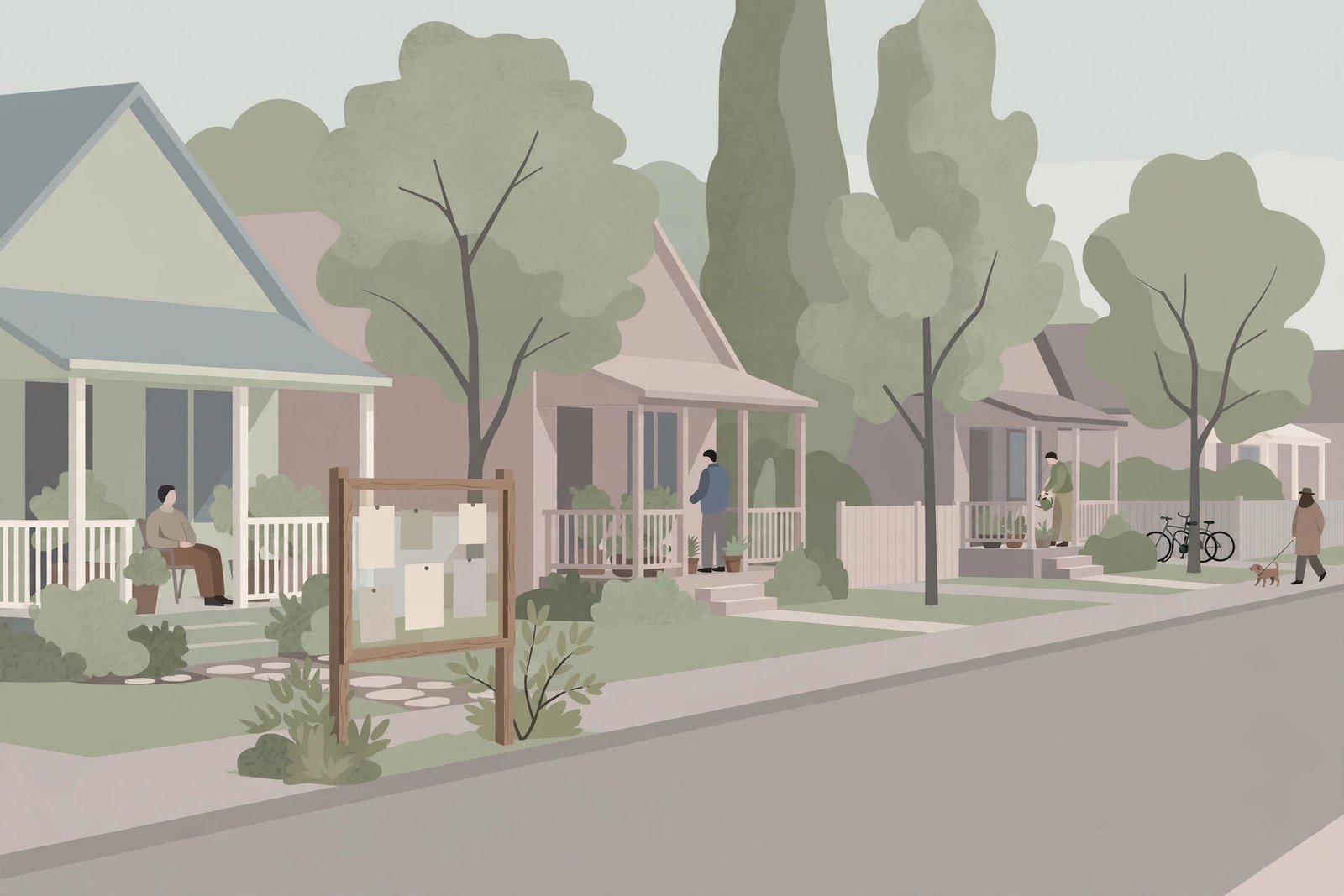
The people are there. The meetings are not.
Four in ten Americans report moderate to severe loneliness, according to the second annual Social Connection in America survey, released on 24 September 2026. Almost 70% get together with people they care about no more than once or twice a month, and one in five do so only a few times a year or less often. Information verified through 22 October 2026.
Not strangers. Not colleagues. People they care about — seen, for most adults, once or twice a month at best.
It is described as the nation’s first comprehensive, 25-year effort to track social connection, led by RAND and The Connection Institute with support from the Barnes Family Foundation. Its own summary is blunt: the 2025 patterns persist, and the conditions that help communities thrive remain weak.
Time, not indifference, is the barrier people name first
Asked what stops them seeing others more, respondents put time first, at 30.6%, ahead of distance at 14.8%, the effort it takes to get together at 13.3%, and anxiety in social situations at 11.1%.
That ordering matters. The top answer is not “I prefer being alone.” It is a diary problem.
Dr Anita Chandra of RAND, a co-director of the initiative, made the structural version of that point in the release: “Many of the forces weakening social connection are hiding in plain sight. We often interpret them as individual choices or modern conveniences, when they are also the result of broader social and structural conditions”.
Her co-director Dr Julianne Holt-Lunstad stressed the pattern over any single number: “What concerns me is not any single finding, but the pattern of disconnection across the data”.
Screens are not filling the gap. Nearly twice as many disagree (43.9%) as agree (24.4%) that virtual interactions satisfy their need for connection as much as in-person interactions. Nor has a newer substitute taken hold: 84.9% rarely or never use an AI companion.
Allina Health, writing on 13 October, put a clinician’s frame on similar numbers. Psychologist David Nathan said a recent study found 42% of Americans report feeling lonely or not having any close friends, pointing to the internet and working from home removing the need to go out and practise social skills. That figure comes from a different study; it points the same way, but it is not the same measurement.
The empty middle: no club, no volunteering, no service
Connection needs places where it repeats. Those places are thinning in the survey’s participation figures: 57% of Americans do not belong to clubs or organisations, 58% did not volunteer, and close to half, 49%, did not attend religious services in the last year.
A separate, larger mapping by Pew Research Center helps explain who does show up. Pew sorted adults into four groups — Mobilizers, Connectors, Spectators and Outsiders — from 19 measures of political activity, civic involvement, religious attendance and attention to news. Mobilizers, active across nearly everything, are just 9%. Connectors, centred on community life and giving but less political, are 28%. Spectators follow news closely but participate far less, at 31%. Outsiders, least involved across most activities, are also 31%.
GCN’s account of the same Pew-Knight work notes the groups were built from a survey of 5,195 adults conducted 8 to 14 September 2025, with a second survey of 5,393 adults used to classify people. Side by side, they describe the same thin bench: a small core doing a large share of the joining and volunteering, a third of adults largely outside it.
Place does not rescue the picture. Pew found Mobilizers make up about the same share in urban (9%), suburban (9%) and rural (10%) America, with Outsiders at 35%, 30% and 35% respectively. Suburban residents were more likely to have volunteered in the past year (31%, against 26% urban and 26% rural). Rural groups were far more likely to interact mostly in person — 63%, against 47% for urban groups. GCN put it plainly: isolation, measured by the Outsider share, is nearly identical in urban and rural America at 35% each.
What has not collapsed
In the Social Connection survey, most Americans, 70.6%, report feeling they belong in their neighbourhood, 58% say neighbours are willing to help one another, and 49.9% say neighbours can be trusted. Belonging is holding up better than behaviour. People feel attached to a place they rarely gather in.
The initiative’s partners say they are using the data, not just publishing it. The release states that YMCA of the USA and United Way Worldwide are using the findings to inform community strategies, and quotes YMCA president Suzanne McCormick on a new 10-year vision called Creating Connected Communities, built on the premise that connection does not happen by accident. Whether that changes next year’s numbers is what a 25-year tracking effort can test.
Analysis: Two surveys, built differently, land on an uncomfortable distinction. Americans have not stopped valuing neighbours — 70.6% belonging is not a collapsed society. What has thinned is the routine machinery that turns goodwill into contact: a club that meets whether you feel like it or not, a volunteer shift already in the diary. Time is the barrier people name first, and a standing commitment is the one device that protects time from everything else competing for it. The data do not prove rebuilding those routines would cut loneliness. They do show, twice, that goodwill without a schedule is producing once-a-month contact and four-in-ten loneliness at the same time. Dr Chandra’s aim was practical: “The goal isn’t just better data; it’s better decisions”. Next year’s edition will show whether anyone with a budget read this one that way.
Sources
- PR Newswire / Social Connection in America — “New Data Show Social Connection Remains Dangerously Weak in the U.S.” (24 September 2026): https://www.prnewswire.com/news-releases/new-data-show-social-connection-remains-dangerously-weak-in-the-us-302888523.html
- Pew Research Center — “How urban, suburban and rural Americans engage in society” (28 September 2026): https://www.pewresearch.org/short-reads/2026/09/28/how-urban-suburban-and-rural-americans-engage-in-society/
- GCN — “Suburban Americans lead in community engagement while urban residents dominate online group life, Pew finds” (2 October 2026): https://gcn.com/suburban-americans-lead-community-engagement-while/22120/
- Allina Health — “Why more Americans are feeling lonely and what you can do about it” (13 October 2026): https://www.allinahealth.org/allina-news/2026/10/why-more-americans-are-feeling-lonely-and-what-you-can-do-about-it
Leave a comment
Comment as a guest and verify your email, or sign in or create a reader account. Guest comments reach our review queue after email verification; account holders can submit directly for review.