Listen to this article
Take the story with you. Choose a voice and a pace that suits you.
Or listen in another language / choose a voice
Getting your device voices ready…
The voice follows the displayed language and your browser’s regional preference when available. You can choose another narration voice.
The RIBA Stirling Prize 2026 winner was announced on 15 October 2026 at Old Billingsgate in London, in the prize’s 30th anniversary year. The winner is not a museum, a station or a tower. It is Lion Green Road, a council-commissioned housing scheme in Coulsdon, south London, designed by Mary Duggan Architects with RUFF Architects (RIBA). The scheme provides 157 homes across five blocks, mixing privately owned and socially rented homes for Croydon Council (RIBA).
It was, by the bookmakers’ reckoning, the least likely winner on the six-strong shortlist. The Architects’ Journal reported odds of 6/1 against Lion Green Road, with two Cambridge college schemes joint favourites at 2/1 (Architects’ Journal). The outsider won anyway.
Information verified through 28 October 2026.
Why did Lion Green Road win the Stirling Prize? Start with the hill
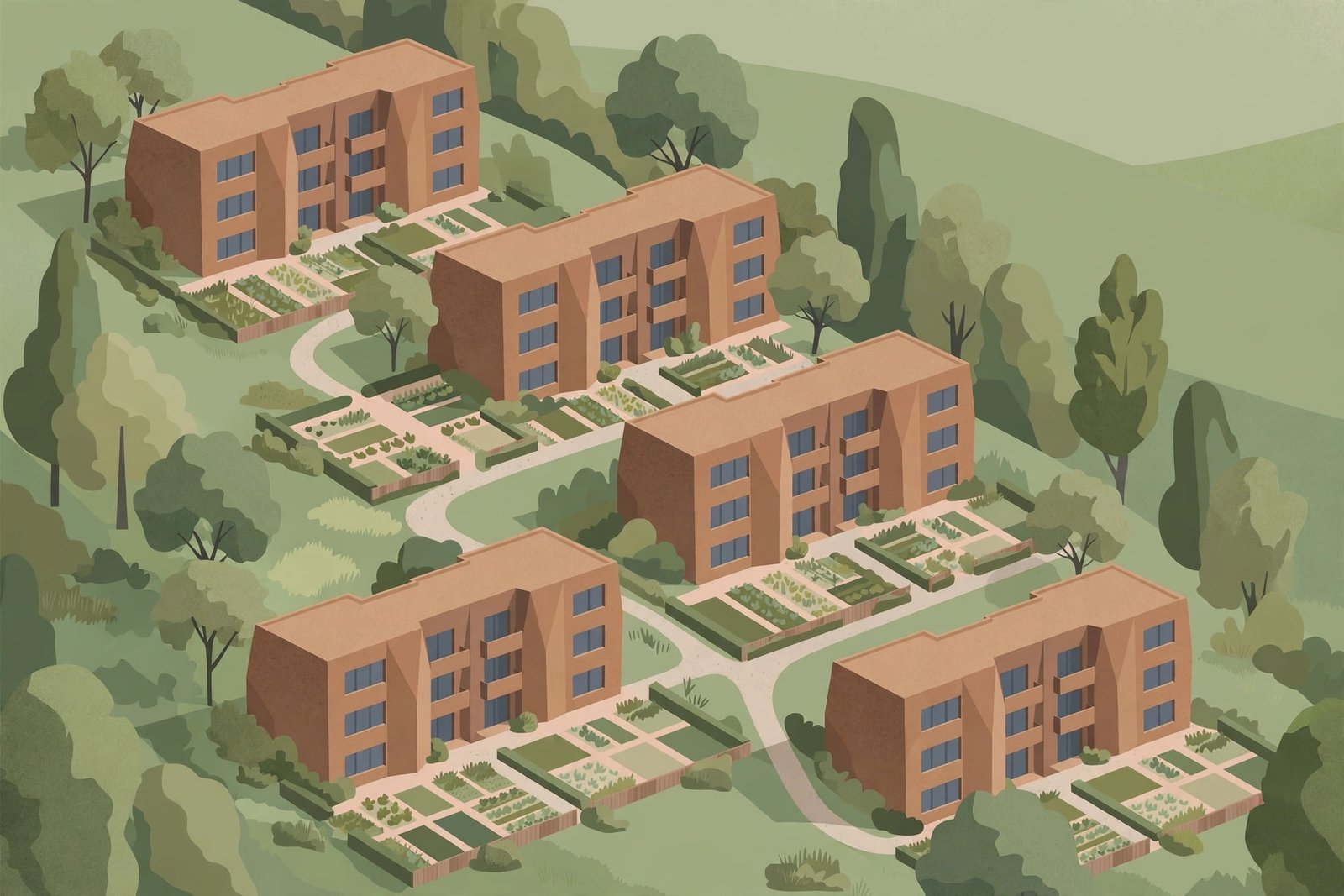
The site was a former car park. It drops eight metres from back to front, the sort of slope that usually gets flattened, terraced into submission or quietly left undeveloped (RIBA). The architects worked with the gradient instead. Each of the five sculpted blocks is built to the same specification, then rotated and positioned to answer the topography and open up distinct views, some towards a surviving fragment of the Surrey Iron Railway, described by RIBA as the world’s first fully independent public railway (RIBA).
Speaking for the jury, RIBA President Chris Williamson put the point plainly: “At a time when we urgently need to deliver more homes, Lion Green Road shows that density can be achieved without compromising the quality of the places we create” (RIBA). He called the result “a new kind of garden neighbourhood” and “a living landscape.”
The judges’ citation, published by the Architects’ Journal, describes five prismatic, 13-sided blocks traversing the hillside, with a landscape-first approach softening the scheme’s underlying density (Architects’ Journal). Inside, the homes are dual-aspect, which means windows on two sides, daylight pulled deeper into rooms and natural ventilation that single-aspect flats rarely get (RIBA). Private balconies are positioned to avoid overlooking neighbours directly, so the blocks can sit closer together without residents staring into each other’s kitchens.
Lion Green Road Coulsdon housing, up close
Three shades of brown brick unify the blocks. Small variations in pattern give each building its own identity within that shared palette (RIBA). Between the buildings, the shared ground does much of the work: open outdoor spaces, a new public pathway running from Lion Green Road through to parkland beyond, children’s play areas, a sensory trail and residents’ allotments (RIBA).
Dezeen described the blocks as faceted and star-shaped in plan, “stitched together by a series of shared green spaces,” and noted that the jury praised the scheme for providing environmentally considerate homes with access to light, nature and community (Dezeen). RIBA says the project was designed and built to reduce its environmental impact through efficient construction methods, simple finishes and a streamlined building process (RIBA). The scheme is home to 635 residents, according to RIBA.
Mary Duggan, accepting the prize on behalf of both practices and Croydon Council, framed the win as an argument about housing’s future: “architectural ambition, social value and generosity can co-exist within the realities of contemporary development” (RIBA). Her practice’s route here was not a straight line. The Architects’ Journal reported that the scheme was originally commissioned by Brick By Brick, Croydon Council’s arm’s-length development company; when that company was wound down, the council took over completion, and the finished project was sold on, with the council retaining a long lease on the affordable rented homes (Architects’ Journal).
The RIBA Stirling Prize 2026 winner is still a rare thing for council housing
Housing wins this prize far less often than you might expect. Lion Green Road is only the fourth housing scheme to take it in 30 years, after Accordia in Cambridge in 2008, Goldsmith Street in Norwich in 2019 and Appleby Blue Almshouse in London in 2025 (Dezeen). Two of those four wins have now come in consecutive years, both for publicly minded housing in London.
The University of Brighton, where Mary Duggan studied, made the local connection explicit in its report of the win on 23 October, calling the scheme proof that ambitious design can deliver the affordable homes the country urgently needs (University of Brighton). Creative Industries Minister Ian Murray struck a similar note in RIBA’s announcement, saying the council-commissioned housing shows “what’s possible when great design meets public need” (RIBA).
Analysis: read the jury’s language closely and a shift becomes hard to miss. The praise is not for a daring silhouette. It is for density handled with care, for shared ground, for homes that get light from two sides. A decade ago a car park in Coulsdon would have been an unlikely place to look for the year’s best British building. In 2026, with housing supply dominating public argument, the jury went looking for excellence in exactly the building type the country argues about most — and found it on a hill, in brick, behind a road most Londoners have never driven down.
Sources
- https://www.riba.org/news/riba-stirling-prize-2026-winner-announced/
- https://www.dezeen.com/2026/10/15/lion-green-road-riba-stirling-prize-2026/
- https://www.architectsjournal.co.uk/news/council-built-long-shot-wins-2026-riba-stirling-prize
- https://www.brighton.ac.uk/news/2026/brighton-alumna-wins-prestigious-riba-stirling-prize-for-landmark-housing-scheme
Leave a comment
Comment as a guest and verify your email, or sign in or create a reader account. Guest comments reach our review queue after email verification; account holders can submit directly for review.