Listen to this article
Take the story with you. Choose a voice and a pace that suits you.
Or listen in another language / choose a voice
Getting your device voices ready…
The voice follows the displayed language and your browser’s regional preference when available. You can choose another narration voice.
Start with the starkest finding. The count of Rhode Island cost burdened households 2026 rose to 148,766, up from 142,920 the year before, according to the 2026 Housing Fact Book released on 23 October by HousingWorks RI at Roger Williams University (Providence Journal; HousingWorks RI via RWU Law). That’s more than a third of all households in the state spending over 30% of their income on housing, the threshold the report uses to define cost burden (RWU Law).
And there’s no escape hatch on the map. For the third consecutive year, no Rhode Island municipality had a home affordable on the state’s median homeowner income, and for the second straight year no community had an average two-bedroom apartment affordable on the median renter income (Providence Business News).
Information verified through 28 October 2026.
Rhode Island cost burdened households 2026: the numbers behind the label
How many households are cost burdened in Rhode Island? 148,766, on the Fact Book’s count. Of those, 65,649 spend more than half their income on housing, which puts them in the severely cost-burdened category — nearly 45% of the cost-burdened total (RWU Law). Nearly half of renter households are cost burdened, including 80% of renters in the lowest income group (RWU Law).
The prices explain the squeeze. In 2025 the median single-family price rose 5.3% to $499,900, while average two-bedroom rent rose 1.8% to $2,358 (RWU Law). Against that, the median homeowner household earns $115,286 and the median renter household $50,251 — neither enough, anywhere in the state (RWU Law).
Work doesn’t close the gap either. HousingWorks RI found that 78% of the state’s 20 fastest-growing occupations, including bakers, cooks and welders, don’t pay enough to afford an average two-bedroom apartment, and that only financial managers among those 20 earn enough to afford a median-priced home (Providence Business News).
Why is housing unaffordable in Rhode Island?
The Fact Book points to a simple divergence, stretched over years. Since 2018, wages in Rhode Island have risen less than 30%, while housing costs have climbed more than 60% (Providence Business News). Two lines moving at different speeds. Eventually the gap stops being a statistic and becomes a monthly choice about what else doesn’t get paid.
Rhode Island isn’t an outlier so much as a small-scale version of a national pattern. Research published on 20 October by John Burns Research and Consulting found the US has 135 million households instead of the 139.3 million it would have if 2010 living patterns had held — 4.3 million households that never formed because more adults are sharing homes (John Burns Research and Consulting). Realtor.com, reporting on the same study, noted a record 25.2 million adults under 35 lived with their parents in 2025, nearly 1 in 3 young adults, and that the median first-time buyer is now 40, up from 33 in 2020 (Realtor.com).
Older homes, older residents, and more generations under one roof
Rhode Island’s stock is old, and so are many people living in it. About 70% of households, more than 310,000, live in homes built before 1980, an age the report treats as an indicator of possible lead exposure, accessibility limits and air-quality concerns (RWU Law). Among residents aged 80 and older, 37% have an ambulatory disability, and 63% of households headed by someone that age consist of one person living alone (RWU Law).
One response shows in the household data itself. The Rhode Island multigenerational households increase was 32% between 2019 and 2024, and recent accessory dwelling unit law changes have expanded options for living near family (RWU Law). Sharing a roof isn’t always a failure to launch. Sometimes it’s care, in both directions.
Two insecurity measures did improve. Eviction filings for nonpayment fell nearly 17% in 2025 to 4,797, the lowest since 2015, and the point-in-time homelessness count fell 6% from 2025 to 2026 (RWU Law). Keep the context attached: the 2026 total remained more than twice the 2019 count, and unsheltered homelessness was nearly seven times the pre-pandemic figure (RWU Law).
A bond vote, more permits, and homes that still take years
Building is picking up, on paper. Rhode Island issued permits for 3,778 housing units in 2025, up 34% from 2024, with accessory dwelling unit permits up 76% to 287 (RWU Law). The report warns that permits aren’t completed homes and projects can take years to reach residents, and it names the lack of a permanent, predictable funding source as a continuing problem: Rhode Island ranks fourth in New England in per-capita state spending on housing and homelessness, at $25.18 per resident against $204.05 in Massachusetts (RWU Law).
Voters get the next say. Question 2 on the 3 November ballot asks Rhode Islanders to approve a $120 million housing bond, with $25 million for homeownership housing and up to $10 million for public housing (Providence Journal; Providence Business News). A WPRI poll found housing the second-most salient issue for voters, named most important by 17% (Providence Journal). The bond has critics too: only one of the three major candidates for governor supports it, the Providence Journal reported (Providence Journal).
Analysis: the Fact Book’s most telling detail isn’t any single price. It’s that the median no longer works anywhere — in all 39 municipalities, for buyers and renters alike. When the middle of the income distribution can’t clear the middle of the housing market, households adapt as both reports document: they double up, delay forming, or stay put in homes built before 1980. Permits and a bond can change the supply side. The numbers will tell, slowly, whether they change it fast enough for the 148,766 already over the line.
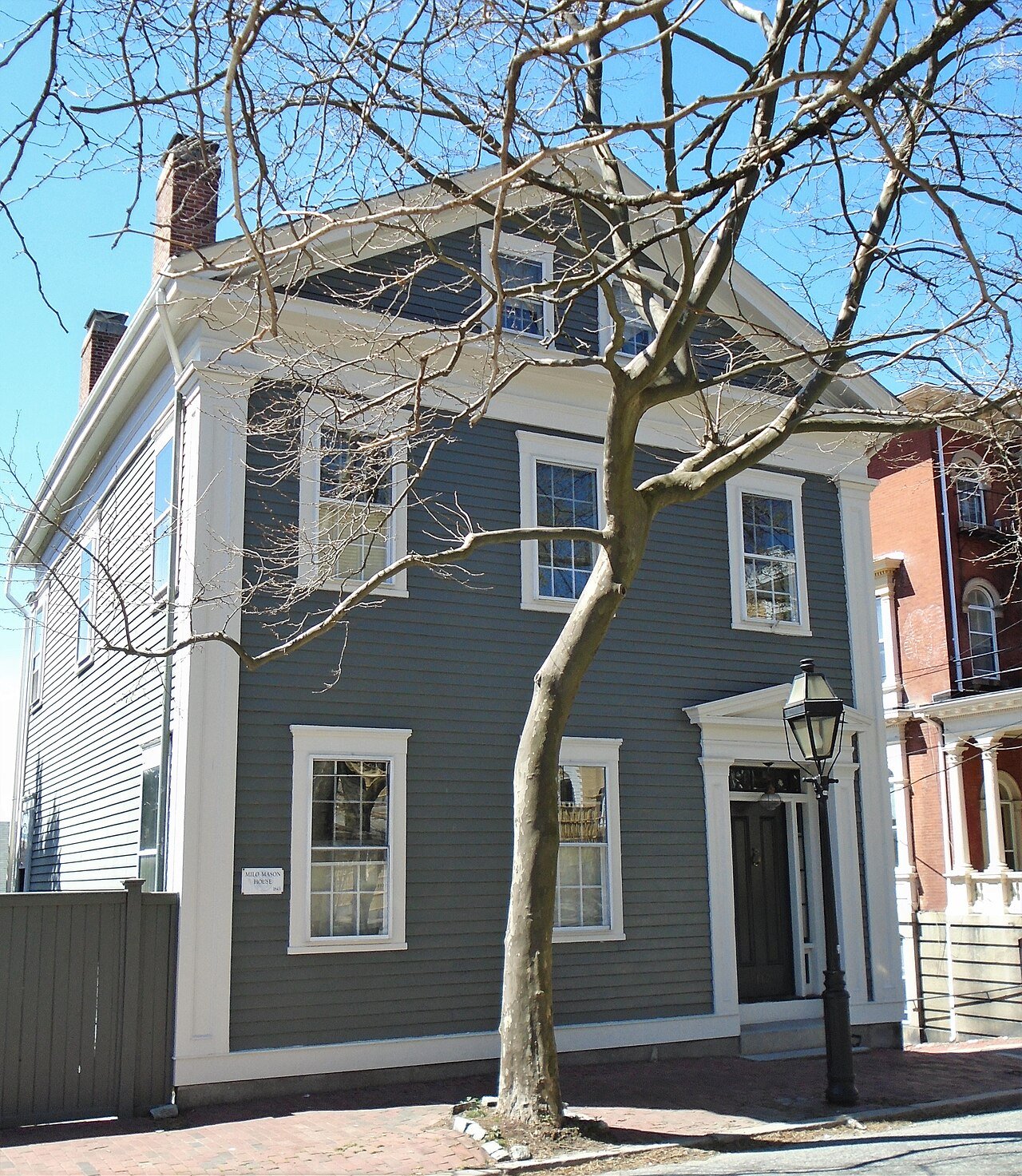
Photo: Beyond My Ken, via Wikimedia Commons (CC BY-SA 4.0)
Sources
- https://law.rwu.edu/news/news-archive/housingworks-ri-roger-williams-university-releases-2026-housing-fact-book
- https://pbn.com/more-pressure-on-cost-burdened-rhode-islanders-more-calls-for-housing/
- https://www.providencejournal.com/story/news/politics/elections/2026/10/27/120m-ri-housing-bond-has-key-critics-but-it-may-pass-anyway/92397715007/
- https://jbrec.com/insights/us-needs-more-small-homes/
- https://www.realtor.com/news/trends/millions-missing-households-young-adults-stay-home/
Leave a comment
Comment as a guest and verify your email, or sign in or create a reader account. Guest comments reach our review queue after email verification; account holders can submit directly for review.