Listen to this article
Take the story with you. Choose a voice and a pace that suits you.
Or listen in another language / choose a voice
Getting your device voices ready…
The voice follows the displayed language and your browser’s regional preference when available. You can choose another narration voice.
Ramesses II statues found in Egypt’s Nile Delta this month began with one man deciding not to keep a secret. A resident of Behbeit El-Hagar, in Gharbia Governorate, struck an inscribed stone block while working on land in front of his home and reported it to the local antiquities inspectorate. The rescue excavations that followed, announced by Egypt’s Supreme Council of Antiquities on 13 October 2026, uncovered the remains of two colossal royal statues (Heritage Daily).
Information verified through 29 October 2026.
Ramesses II statues found in Egypt: what came out of the ground
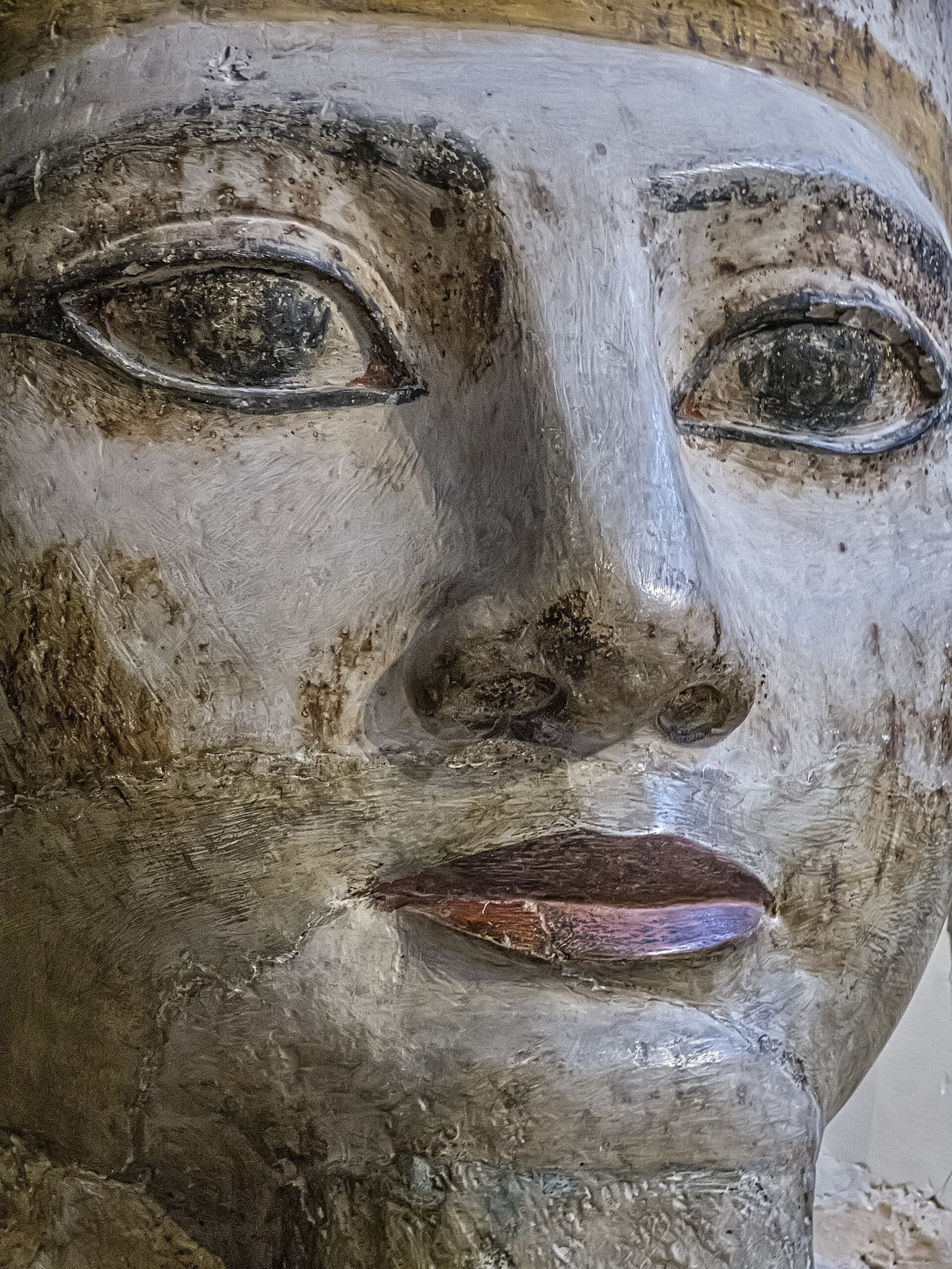
The first statue survives as a granite head about 1.60 metres tall. The king wears the double crown — the pschent, which combined the White Crown of Upper Egypt with the Red Crown of Lower Egypt to symbolise the union of the two lands (Heritage Daily). Identification here is not guesswork. Part of the statue’s back pillar survives, and its inscription carries the king’s Horus name, “Hor-ka-nakht-mery-maat” (Archaeology Magazine). From the head’s dimensions, the team estimates the complete statue, base included, stood about 8.5 metres tall (Science Report).
The second statue is a section roughly 2.40 metres long. Its legs and base are missing and the top of its headdress is damaged, but the face is well preserved beneath a striped nemes headcloth (Science Report). Its features closely resemble the first figure’s, which is why archaeologists believe it also represents Ramesses II — a belief they are careful to label preliminary, since no inscription naming the king survives on this piece (Archaeology Magazine).
About a metre north of the second statue lay a pink granite block some 1.30 metres long, carved with two of the king’s royal titles: “Nesu-Bity,” King of Upper and Lower Egypt, and “Sa-Ra,” Son of Ra (Heritage Daily). Whether the block belonged to either statue is still unknown.
Ramesses II — Ramses the Great — was the third pharaoh of the 19th Dynasty and reigned for more than six decades, from about 1279 to 1213 BC, filling Egypt and Nubia with monumental temples and statues of himself (Heritage Daily). An 8.5-metre image fits that pattern comfortably; a restored colossus of the king at Luxor Temple stands 11 metres (Science Report).
The Behbeit el-Hagar temple of Isis, and the wrong king problem
Behbeit El-Hagar is not a blank field. It is best known for the Iseum, a monumental temple to the goddess Isis built largely of granite, begun under Nectanebo II in the fourth century BC and completed under the Ptolemies (Hyperallergic). Its surviving remains are Late Period and Ptolemaic — centuries younger than Ramesses II (Heritage Daily).
So what were two colossal images of a New Kingdom pharaoh doing there? That is the genuine puzzle of this find, and archaeologists have not answered it. One possibility is that an earlier building of Ramesses II’s reign stood at the site, before the Isis temple rose. Another is that the statues were hauled there later, as spolia or as honoured antiques — Egyptian temples accumulated older royal sculpture often enough. The discovery raises, in Heritage Daily’s summary, the question of “whether the sculptures were originally erected at the site or were subsequently moved from another location” (Heritage Daily).
There is a hint, though it settles nothing. In 2017, Egyptologists Mahmoud Emam and Ehab Abd el-Zaher published two stone fragments bearing Ramesses II’s cartouches, recovered during infrastructure work near the later temple; they suggested the pieces might point to a building of his reign, while noting the stones could equally have been moved or reused (History and Myths). The Metropolitan Museum of Art’s documentation adds that an earlier temple at Behbeit was probably begun in the Twenty-sixth Dynasty — still well after Ramesses, but evidence the site had a sacred life before Nectanebo II (History and Myths).
Rescue excavations in the Nile Delta continue
The machinery around the find worked the way heritage law hopes it will. The inspectorate completed the legal procedures and filed its report; the Supreme Council of Antiquities formed a committee and sent a specialist team; Minister of Tourism and Antiquities Sherif Fathy praised the resident for reporting the block quickly, pointing to the role ordinary citizens play in protecting the country’s heritage (Archaeology Magazine). Secretary-General Hisham El-Leithy has said the excavations and studies will continue, in the hope of finding more pieces and working out how the objects relate to each other and to the site (Archaeology Magazine). No reconstruction or museum transfer has been announced (Science Report).
Analysis: Delta archaeology rarely gets gifts like this. The region’s sites sit under farmland and living villages, waterlogged and built over, which is why a find here starts with a farmer’s spade rather than a research design. The statues’ identity — for the first, at least — is as firm as an inscription can make it. Their biography is the open file. If excavation finds a Ramesside foundation, Behbeit’s history stretches back a thousand years before its famous temple. If it finds nothing but later fill, the statues become evidence of something subtler: a Ptolemaic-era sanctuary dressing itself in the authority of Egypt’s most monumental king. Either result is a discovery. The digging, not the head, will decide which one this is.
Sources
- https://www.heritagedaily.com/2026/10/archaeologists-uncover-colossal-statues-of-ramses-ii-in-egypt/159585
- https://archaeologymag.com/2026/10/giant-ramesses-ii-statues-found-in-behbeit-el-hagar/
- https://science.report/discover/colossal-statue-remains-may-depict-ramses-ii-in-egypt-107450/
- http://hyperallergic.com/massive-king-ramses-ii-statues-unearthed-in-egypt/
- https://www.historyandmyths.com/2026/10/behbeit-el-hagar-temple-of-isis.html
Leave a comment
Comment as a guest and verify your email, or sign in or create a reader account. Guest comments reach our review queue after email verification; account holders can submit directly for review.