Listen to this article
Take the story with you. Choose a voice and a pace that suits you.
Or listen in another language / choose a voice
Getting your device voices ready…
The voice follows the displayed language and your browser’s regional preference when available. You can choose another narration voice.
Marrakech’s most visited garden has a new building that is designed to disappear. The Nouala pavilion at Majorelle Garden opened to the public on 29 October 2026, a day after its inauguration, in the garden of Villa Oasis. It is a temporary, demountable structure by Moroccan architect Salsabil El Ouazzani, and it reinterprets the nouala, a traditional rural hut built from materials such as reeds and thatch.
Information verified through 1 November 2026.
The Nouala pavilion at Majorelle Garden has a two-year life
Nouala, subtitled the Mobile Refuge, is the second temporary pavilion produced through the Fondation Jardin Majorelle Prize, and El Ouazzani’s design was selected from 34 applications in the 2026 edition. The prize runs on a biennial rhythm: a new winner every two years, a new pavilion each time. Nothing about that cycle is accidental. The foundation’s press kit for the first pavilion describes an ephemeral structure “designed to last for a two-year cycle,” built with ecologically sensitive materials and placed in dialogue with the surrounding landscape rather than against it.
The construction follows the same logic. Nouala is light and demountable, assembled from simple natural materials with reversible building methods, so it can come down without scarring the ground it stood on. In a garden where almost everything else — the blue villa, the basins, the mature planting — is meant to last, a building that accepts its own end date is a deliberate contrast.
The Fondation Jardin Majorelle Prize and the pavilion it replaced
The programme began with the garden’s centenary. Madison Cox, president of the Fondation Jardin Majorelle, commissioned young Moroccan architect Hiba Bensalek to design a 100-square-metre pavilion in the Villa Oasis garden, and that first pavilion opened on 31 January 2025. It was, the foundation says, the first dedicated exhibition space inside the grounds since the garden opened to the public in 1947.
Bensalek’s biography in the same press kit sketches the profile the prize is built for: trained in Toulouse and Paris, experienced in Marrakech’s urban planning agency, a teacher at the city’s architecture school, and a practitioner whose work defends Moroccan building knowledge and ancestral techniques alongside a contemporary, sustainable outlook. The 2026 competition opened the commission to a national field of young Moroccan architects, and each future edition, the foundation says, will showcase a new generation of architectural expression within the garden.
El Ouazzani’s winning answer reaches further back than the garden itself. A nouala is a vernacular shelter, not a monument. Setting that form, in reeds and thatch, a short walk from a Cubist villa painted in patented blue is a pointed choice: Moroccan building culture presented as a living technique, not as decoration around a French painter’s legacy.
Birds inside the Villa Oasis garden pavilion
A pavilion needs a reason to linger, and Nouala has one with feathers. Inside is The Birds of Majorelle Garden, an exhibition presented since April 2026 that examines more than 30 bird species found on the site, developed with contributions from Raphaël Musseau, Rhimou El Hamoumi and Mohamed Radi.
That pairing of shelter and birdlife is neat, and not just as a theme. A hut is, among other things, a place creatures shelter in. The exhibition turns visitors’ attention from the planting — the thing everyone photographs — to nesting spaces, water and the species that actually use the garden day to day. The first pavilion made a similar move at smaller scale: its opening exhibition, Majorelle Flora: Living Collection, presented twenty emblematic or rare plants chosen from the garden’s four hundred species, overseen by Californian botanist Dean G. Kelch. Plants first, then birds. The garden is being read as an ecosystem, one pavilion at a time.
A fixed garden, a changing building
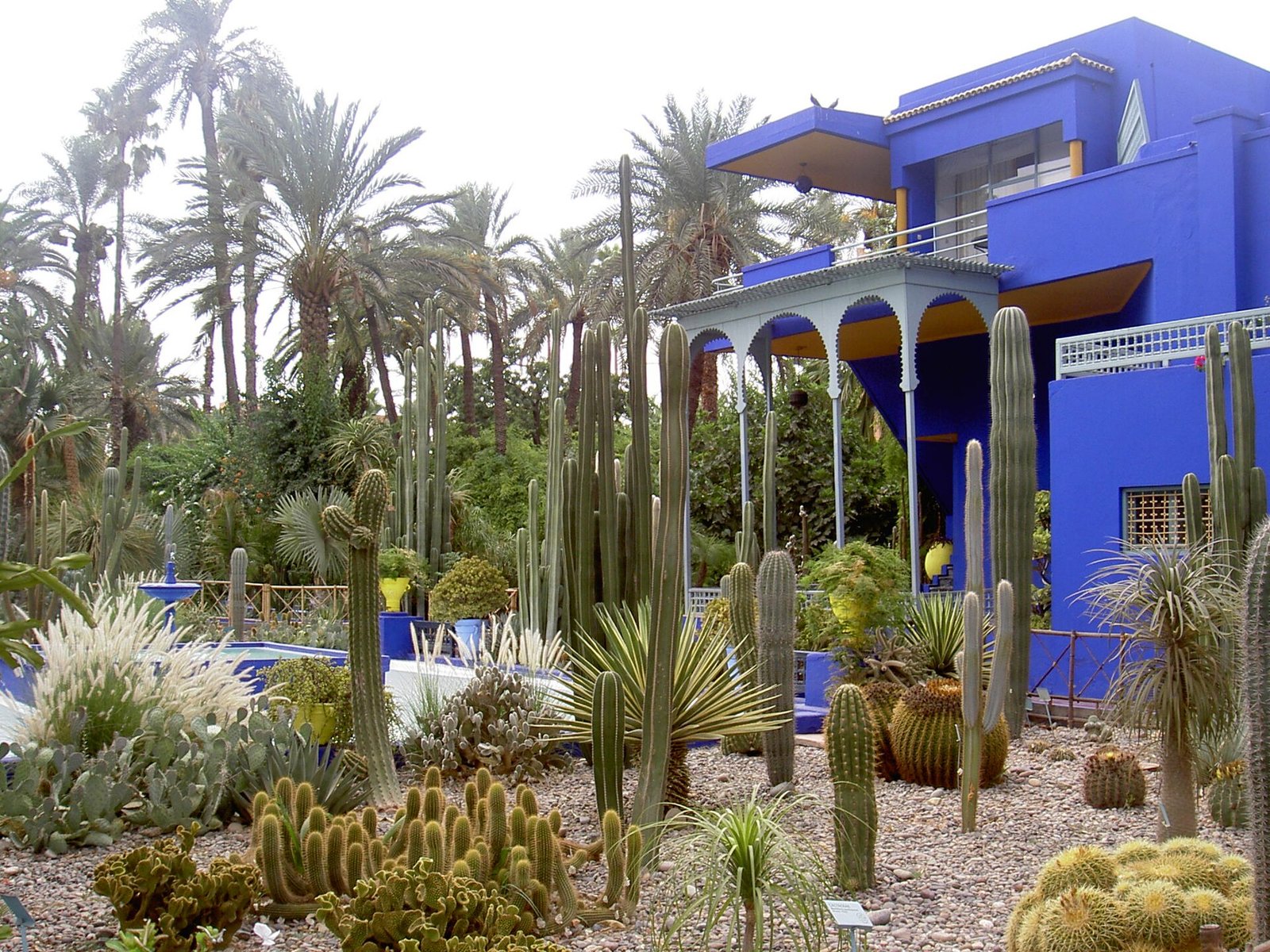
The setting does half the work. The garden covers 9,000 square metres and was developed over four decades after Jacques Majorelle began planting there in 1922, in a walled landscape shaped by Art Deco and Moorish design. Yves Saint Laurent and Pierre Bergé bought it in 1980 to stop it becoming a hotel development, and lived in the villa they renamed Villa Oasis. Nouala now stands in that villa’s garden, on Rue Yves Saint Laurent in the Guéliz district.
Analysis: Temporary pavilions are usually a museum’s way of looking current. Here the mechanism does something sharper. Because the commission renews every two years and is reserved for emerging Moroccan architects, the garden’s newest architecture will keep being Moroccan, young and short-lived, while its famous layer — a French artist’s garden rescued by French fashion — stays fixed. The temporary building is the one part of the site whose authorship keeps changing hands.
Practical notes are modest. The pavilion is part of the Villa Oasis visitor experience rather than a separate ticketed attraction, and the official site records the garden as wheelchair accessible, with pathways on different levels. Nouala will stand until the prize cycle replaces it. That is the point of it, and also, quietly, its argument: in a garden built to be permanent, the most honest new building may be the one that knows it is leaving.
Photo: Tipiac, via Wikimedia Commons (CC BY-SA 3.0)
Sources
- https://www.ad-hoc-news.de/unterhaltung/reisen/majorelle-garden-opens-nouala-pavilion-on-29-october-2026/70439281
- https://www.jardinmajorelle.com/wp-content/uploads/2025/05/PRESS-KIT-PAVILLION-TEMPORAIRE_eng.pdf
- https://www.nighty.ma/the-temporary-pavilion-at-jardin-majorelle-a-new-chapter-of-nature-architecture-and-artistic-exploration/
Leave a comment
Comment as a guest and verify your email, or sign in or create a reader account. Guest comments reach our review queue after email verification; account holders can submit directly for review.