Listen to this article
Take the story with you. Choose a voice and a pace that suits you.
Or listen in another language / choose a voice
Getting your device voices ready…
The voice follows the displayed language and your browser’s regional preference when available. You can choose another narration voice.
Lilly Endowment AI grants Indiana colleges were approved on 23 November, and the scale is hard to miss: 35 colleges and universities will share $291,710,000 to build their own responses to artificial intelligence (Lilly Endowment). Each award runs from $2.5 million to $25 million, sized by student enrolment, according to the Endowment’s published grants list (Lilly Endowment).
This is not a software shopping spree. The money pays for training, course redesign, campus policy, ethics work and technology infrastructure, and each campus wrote its own plan. Indiana now gets to watch 35 different answers to the same question: what should a college do about AI, beyond banning it or shrugging at it?
How the Lilly Endowment AI grants Indiana colleges money is divided
Three institutions received the maximum $25 million: Indiana University Foundation, Ivy Tech Foundation and Purdue University (Lilly Endowment). Five received $12 million each, among them Ball State, Indiana Wesleyan, Trine, Notre Dame and Vincennes, while six received $8.5 million and eighteen received $5 million (CASRAI). The smallest award, $2.5 million, went to Saint Mary-of-the-Woods College, and Holy Cross College received $4.73 million (Lilly Endowment).
The grants form the implementation phase of the Artificial Intelligence in Higher Education initiative, which the Endowment launched in November 2025 with $500 million allocated across planning, implementation and collaboration grants (Lilly Endowment). All 35 institutions first received planning grants in December 2025, so each campus spent a year assessing its needs before this money arrived (CASRAI). More awards are expected in December, for collaborations between two or more institutions (Lilly Endowment).
Ted Maple, the Endowment’s vice president for education, framed the tension plainly in the announcement: faculty worry that AI could impede original and independent thinking, yet campuses also see chances to improve teaching, student services and research (Lilly Endowment). The funded work reflects both sides of that worry. Some campuses will train faculty and staff; others will write governance rules, build ethical frameworks, study AI’s social and economic effects, or rework curricula and career advice around jobs the technology is already changing (Lilly Endowment).
Ball State’s plan, and the Ball State AI Navigator program
Ball State University in Muncie gave the round a concrete shape on 25 November. Its $12 million grant funds a three-year plan, running 2027 through 2029, covering AI literacy, teaching, workforce readiness, ethical decision-making and student success (Ball State University).
The centrepiece is the Ball State AI Navigator program, a digital course teaching students, faculty and staff what AI can and cannot do, how to check information it produces, and how to use it responsibly (Ball State University). Ball State plans university-wide availability by fall 2027 and wants at least 75 percent of students to complete it by the end of the grant period (Ball State University). The university also plans significant redesign of at least 20 percent of undergraduate courses, and an AI Workforce Ready Certification it hopes about 5,000 students will earn by 2029 (Ball State University).
Those numbers matter because they can be checked. A participation target does not prove students learned anything, as Foundation List noted in its 25 November summary, but it does give the public something firmer than a press-release promise to watch (Foundation List). Ball State’s planning drew on input from students, alumni, employers, community partners and more than 800 faculty and staff (Ball State University).
Other campuses are spending differently. The University of Southern Indiana’s $8.5 million plan includes professional development for staff and more than 350 full-time faculty, with pay and dedicated time for substantial course changes (Foundation List). DePauw University, with $5 million, announced its own three-year plan on 24 November (Foundation List).
The Indiana University Human + AI Learning Ecosystem
Indiana University will use its $25 million to build the Indiana University Human + AI Learning Ecosystem across its nine campuses through 2030, covering AI literacy for undergraduates, faculty support for reworking teaching and assessment, and AI-assisted workflows in advising, financial aid and career services (CASRAI). The University of Indianapolis, with $8.5 million, plans a Center for Artificial Intelligence for Human Performance in a renovated part of its library, revisions to as many as 330 courses, and nine AI micro-credentials (CASRAI).
Analysis: the design of this round is the story. One funder, one state, 35 campuses, and no single mandated curriculum. Small liberal-arts colleges and a nine-campus research university are running parallel experiments with the same broad brief, which should produce comparable evidence about what works: training mandates, course redesign, governance first, or employer-led credentials. The risk is just as visible. Money can buy platforms and workshops quickly; changing how a tired faculty member marks essays in February takes longer. The December collaboration grants, and whether campuses publish honest evaluations rather than completion counts, will tell us if this was a learning programme or a very large purchase order.
For students, the near-term change is mundane and real: expect AI rules in syllabuses, training modules at enrolment, and certificates with names like Ball State’s on job applications from 2027. Indiana’s experiment starts then, not with this announcement.
Information verified through 28 November 2026.
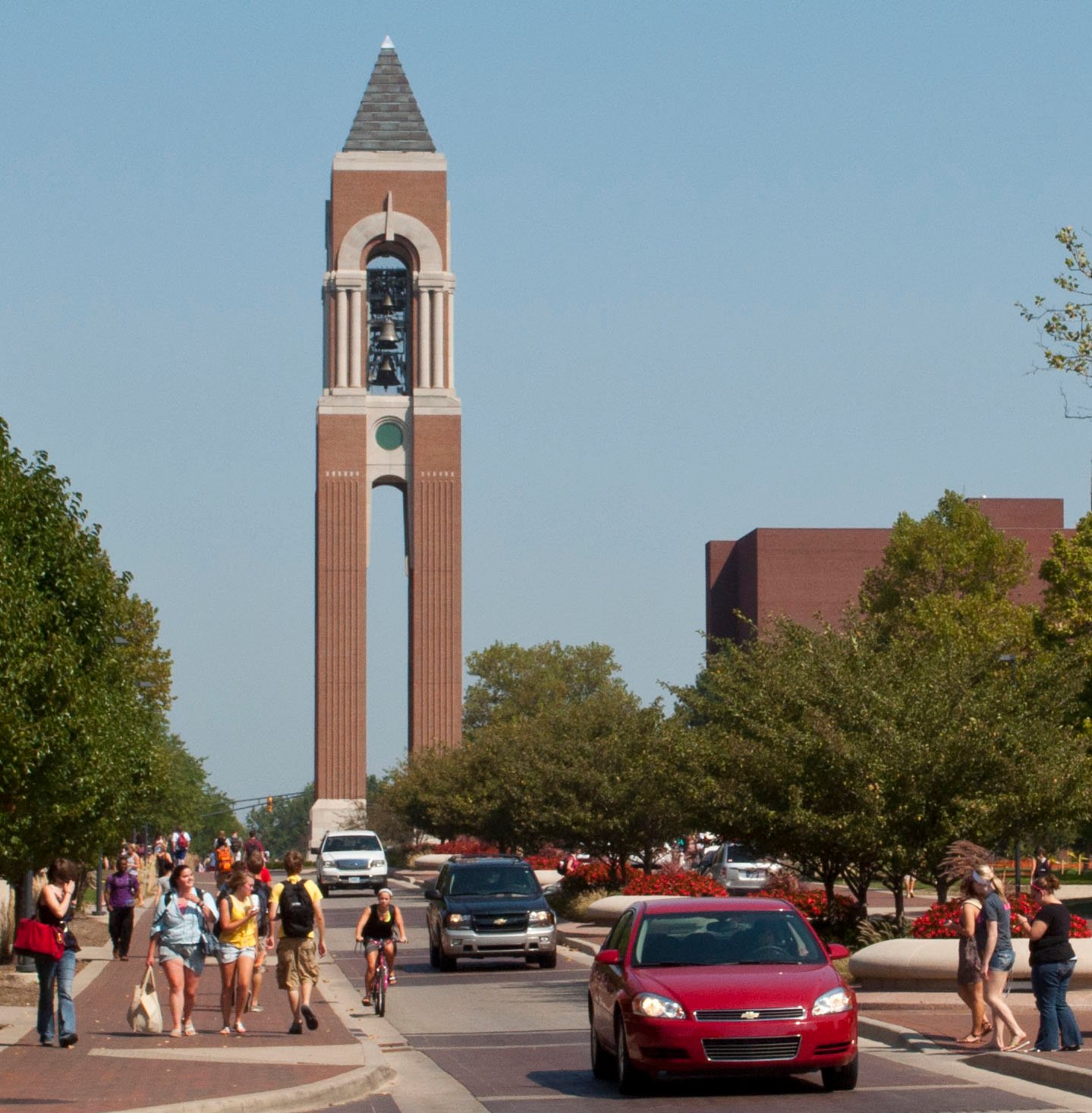
Photo: Shafer Tower at Ball State University in Muncie, via Wikimedia Commons (CC BY 2.0)
Sources
- Lilly Endowment — Grants will help Indiana colleges and universities meet the challenges and opportunities posed by artificial intelligence: https://lillyendowment.org/news/grants-will-help-indiana-colleges-and-universities-meet-the-challenges-and-opportunities-posed-by-artificial-intelligence/
- Lilly Endowment — AIHE Grants List 2026: https://lillyendowment.org/aihe-grants-list/
- Ball State University — Lilly Endowment Awards $12 Million Grant to Advance AI Education at Ball State University: https://www.bsu.edu/news/press-center/archives/2026/11/lilly-endowment-awards-12-million-grant-to-advance-ai-education-at-ball-state-university
- CASRAI — Lilly Endowment $291.7M AI Grants, 35 Colleges: https://casrai.org/news/lilly-endowment-ai-higher-education-implementation-grants-indiana-2026
- Foundation List — Lilly AI Grants: Indiana Colleges Detail Training Plans: https://www.foundationlist.org/lilly-endowment-indiana-colleges-ai-training-grants-2026/
Leave a comment
Comment as a guest and verify your email, or sign in or create a reader account. Guest comments reach our review queue after email verification; account holders can submit directly for review.