Listen to this article
Take the story with you. Choose a voice and a pace that suits you.
Getting your device voices ready…
The voice follows the displayed language and your browser’s regional preference when available. You can choose another narration voice. Enhanced device voices are preferred; availability varies.
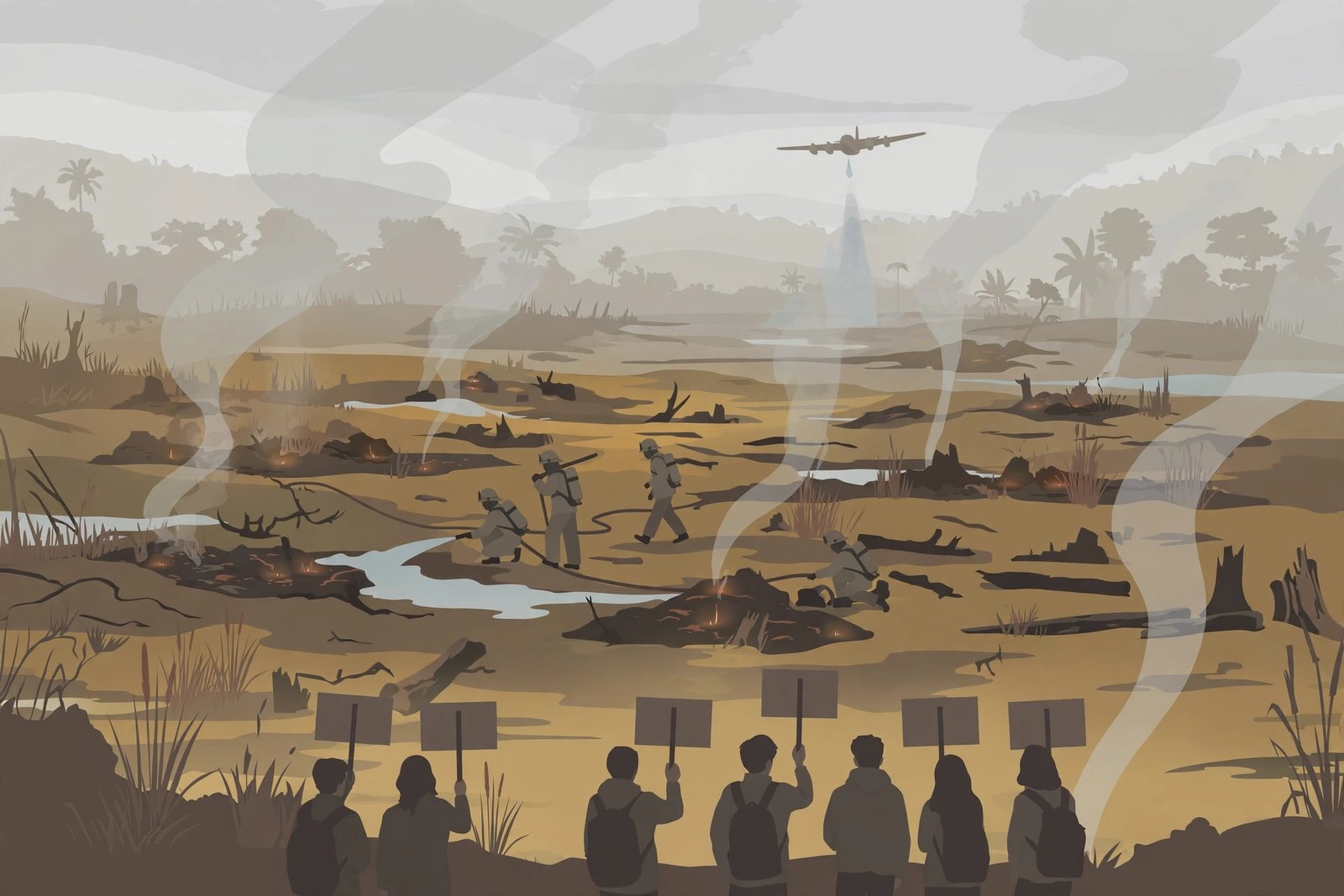
Indonesia forest fires October 2026 gave a small, uneasy reprieve on 22 October. Hotspots dropped sharply. Rain fell in places. Neither was enough to end a crisis officials still describe as a high alert, in what Reuters called the country’s most intense fire season in 11 years (Reuters, 22 Oct).
The headline number moved the right way. High-confidence hotspots stood at 565 on Thursday, down from more than 1,200 on 14 October, according to Sipongi, the forest ministry monitoring platform cited by Reuters (Reuters, 22 Oct). Carbon dioxide emissions fell too — 14.44 million metric tons from 15 to 21 October, down from 22.22 million tons in the preceding seven days, according to the EU’s Copernicus service cited in the same report.
Do not read that as recovery.
“The trend remains volatile and is not yet uniform across all regions,” disaster mitigation agency spokesperson Berton Panjaitan told Reuters (Reuters, 22 Oct). He warned that new hotspots could still emerge if rainfall stayed uneven and the sources of the fires were not fully addressed. Information verified through 23 October 2026.
What the Indonesia forest fires October 2026 numbers actually show
Scale matters here. By the end of September, 1.92 million hectares had burned, up from 895,650 hectares in August, according to Nusantara Atlas satellite data reported by Reuters on 20 October (Reuters, 20 Oct). That already passed the 1.39 million hectares burned by the same point in 2019, a year that ended with 2.63 million hectares scorched.
On the ground this week, the response got bigger, not smaller. More than 69,000 personnel are now deployed, up from around 44,000 in mid-September, with around 50 aircraft for waterbombing and weather modification, Reuters reported on 22 October (Reuters, 22 Oct). Teams are also testing special chemicals and dry ice for cloud seeding. You don’t expand a force like that for a fire that is finished.
Indonesia peatland fires keep burning under the surface
The hard part is underground. Indonesia peatland fires smoulder slowly beneath the surface, can re-emerge at any time and produce thicker smoke, Reuters noted in its 15 October report from Central Kalimantan and South Sumatra, the worst-affected areas (Reuters, 15 Oct).
Peat is not ordinary soil. It forms over thousands of years in waterlogged ground. Healthy, it stores carbon and holds water. Drained, it dries and burns. AFP’s explainer, published by Phys.org on 13 October, put Indonesia’s peatland at an estimated 24.2 million hectares, with 16.4 million hectares degraded and vulnerable to fire, according to the Pantau Gambut NGO (Phys.org / AFP, 13 Oct). The same explainer traced much of the drainage to canal networks built for timber, pulp, rice and palm oil plantations — some 285,000 kilometres of canals, by Pantau Gambut’s count.
Deputy food minister Hanif Faisol Nurofiq made a similar point for the government on 15 October. Massive drainage had “fundamentally altering the natural properties of the peat,” he said, identifying a 1990s food estate project as one cause (Reuters, 15 Oct). The government says it will drill wells to rewet peatland and improve canal management. In its earlier statement cited by AFP, it said it had rewetted 4.16 million hectares and built 45,000 canal barriers (Phys.org / AFP, 13 Oct). Greenpeace campaigner Belgis Habiba questioned that record, telling AFP some restored peat units had still burned and recorded high hotspot counts.
Indonesia haze health effects are the reason people are in the streets
Ask people in Palangkaraya why they protested, and the answer is in their throats.
Indonesia haze health effects have included hundreds of thousands of cases of respiratory illness, Reuters reported, with air quality badly affected in neighbouring Singapore and Malaysia as well (Reuters, 22 Oct). AFP reported more than 170,000 people in Indonesia required treatment for acute respiratory infections in August and September, according to the health ministry, and that Indonesia and Malaysia shut hundreds of schools over haze (Phys.org / AFP, 13 Oct). The smoke carries PM2.5 particles small enough to enter lungs and bloodstream, along with formaldehyde, hydrogen cyanide and ammonia, AFP added.
On 20 October, students protested in Jakarta, Bandung, Yogyakarta, Pekanbaru and Makassar, and residents in Palangkaraya described smoke inside their homes, falling income and weeks of coughing, AFP reported via Business Today (Business Today / AFP, 21 Oct). “Even inside the house, the smoke gets in,” said Sifra, a Palangkaraya resident quoted there. At least 100 students also rallied in Banjarmasin this week demanding more concrete action, while hundreds demonstrated in Pontianak and Samarinda on Wednesday, Reuters reported (Reuters, 22 Oct).
El Nino Indonesia wildfires and a rainy season that has not arrived
Weather is not helping yet. El Nino Indonesia wildfires have been driven by a dry season that started earlier than usual and lasted longer, Reuters reported, and the weather agency expects the rainy season — normally starting in October — to be delayed until November (Reuters, 22 Oct).
That delay leaves a narrow, tense window. Sporadic rain can knock down flames on the surface while peat keeps burning below. Patrols will be strengthened and extinguished fires watched so they do not reignite, Panjaitan said (Reuters, 22 Oct). Until steady rain arrives, the hotspot count is a weather report, not an all-clear.
Sources
- Reuters — “Indonesia’s fire hotspots ease but rain still not enough, official says” — 22 October 2026 — https://www.reuters.com/business/environment/indonesias-fire-hotspots-ease-rain-still-not-enough-official-says-2026-10-22/
- Reuters — “Indonesia’s burned land doubles in September as fires rage, data shows” — 20 October 2026 — https://www.reuters.com/business/environment/indonesias-burned-land-doubles-september-fires-rage-data-shows-2026-10-20/
- Reuters — “Indonesia blames peatland degradation for raging fires, vows restoration” — 15 October 2026 — https://www.reuters.com/business/environment/indonesia-blames-peatland-degradation-raging-fires-vows-restoration-2026-10-15/
- Phys.org / AFP — “Damaged and drained, Indonesia’s peatlands go up in smoke” — 13 October 2026 — https://phys.org/news/2026-10-indonesia-peatlands.html
- Business Today / AFP — “Indonesian Anger Builds Over Raging Wildfire And Toxic Haze” — 21 October 2026 — https://www.businesstoday.com.my/2026/10/21/indonesian-anger-builds-over-raging-wildfire-and-toxic-haze/
Leave a comment
Comment as a guest and verify your email, or sign in or create a reader account. Guest comments reach our review queue after email verification; account holders can submit directly for review.