Listen to this article
Take the story with you. Choose a voice and a pace that suits you.
Getting your device voices ready…
The voice follows the displayed language and your browser’s regional preference when available. You can choose another narration voice. Google US English is the default where your browser offers it; otherwise the best installed voice is used.
The Espace Riopelle pavilion opening in Quebec City is not just a new set of galleries. At the Musée national des beaux-arts du Québec (MNBAQ), visitors can now watch storage and conservation happen in the open, in a three-storey building designed around one artist’s restless way of working. The media ribbon-cutting was scheduled for 21 October 2026, followed by a public opening programme from 22 to 25 October (ArchUp). Information verified through 23 October 2026.
Jean Paul Riopelle (1923–2002) gets more than 130 works on display, drawn from a museum collection of 500 pieces, in what the museum describes as the largest public collection of his work (Canadian Architect). The building sits between the Gérard-Morisset and Charles-Baillairgé pavilions, at the heart of the complex, overlooking the Plains of Abraham and the St. Lawrence River (Smithsonian Magazine).
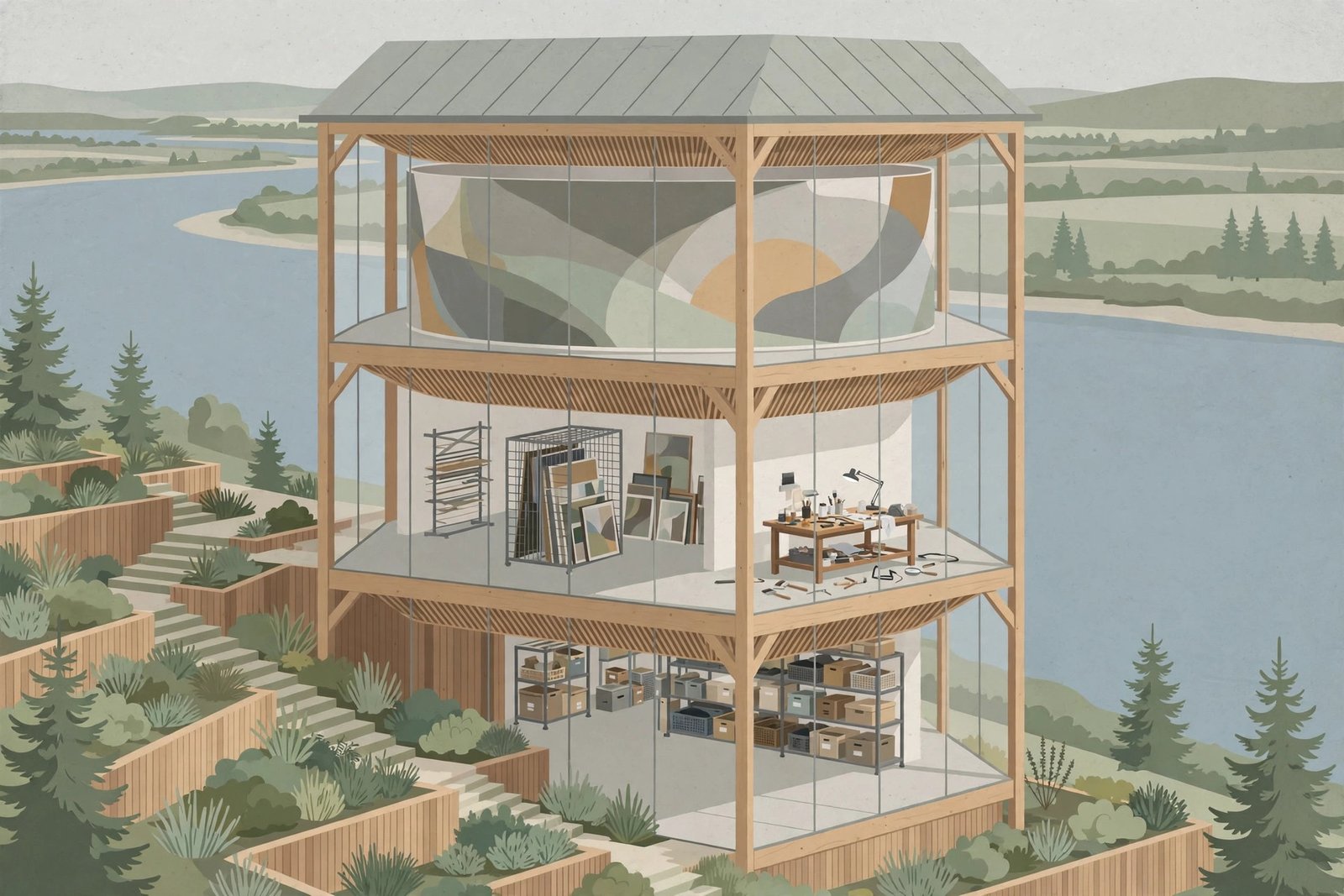
Inside the Espace Riopelle pavilion opening in Quebec City
Size first. The pavilion exceeds 5,000 square metres over three storeys (Canadian Architect). It replaces an existing entry structure and was built atop archival storage areas that stayed active through construction — an awkward constraint that shaped the job, since the collection underneath could not simply pause while builders worked above it.
The terraced design leans into material cues from Riopelle’s own life. Spruce ceilings nod to the artist’s studio, while planted patios recall the northern landscapes of L’Isle-aux-Grues (Canadian Architect). The museum’s opening release puts it in similar terms: steel, glass and spruce wood, with terraces and massive windows offering views of the Plains of Abraham and the St. Lawrence River (CNW / MNBAQ).
Architect Éric Gauthier put the brief bluntly at the opening: “Riopelle did not think small” (Canadian Architect). You feel that in the 17-metre-high spaces reported by ArchUp, and in a top floor given over to a single, enormous work.
Visible storage museum design, not backstage work
Most museums hide the unglamorous parts. Crates. Shelves. Conservators hunched over a cracked surface. Here that work is part of the visit.
The pavilion includes a visible storeroom and an art restoration laboratory alongside its café, boutique and multipurpose areas (Canadian Architect). ArchUp describes the programme as linking public display with work that usually remains backstage, so collection care becomes part of how a visitor understands the institution (ArchUp). The museum’s own release calls the combined space a 235-square-metre showcase where specialists unpack, frame and restore works in view of the public — though that figure comes from its earlier opening announcement, so treat the exact measurement as the museum’s own description.
Analysis: There’s a risk in this kind of transparency. Put conservation behind glass and it can turn into theatre, tidy and silent. Done well, though, it answers a question visitors actually ask — where do paintings go when they’re not on a wall, and who looks after them? The Riopelle building bets that showing the labour builds trust in the institution, not just admiration for the art.
The Riopelle pavilion FABG architects won in 2022
Les architectes fabg won the design through a 2022 competition (Canadian Architect). The Montreal-based practice, named FABG Architectes in other coverage, designed the building to evoke Riopelle’s rustic home studio (The Art Newspaper).
Money tells part of the story. The project cost C$84 million ($61 million), with the Québec government contributing more than C$40 million (The Art Newspaper). Canadian Architect reports half the funding came from the Québec government and $25 million from Michael Audain and Yoshiko Karasawa, Pierre Lassonde, and André Desmarais and France Chrétien Desmarais, with further support from the City of Quebec and the museum foundation (Canadian Architect). The Jean Paul Riopelle Foundation provided at least C$20 million, and Audain, Karasawa and Lassonde donated more than 60 works by Riopelle and his contemporaries (The Art Newspaper).
Museum director Jean-Luc Murray told The Art Newspaper: “Riopelle finally has a space entirely dedicated to him” (Smithsonian Magazine).
A Tribute to Rosa Luxemburg circular gallery built for one work
Some rooms are flexible. This one isn’t, and that’s the point.
A specially built circular gallery is dedicated to L’Hommage à Rosa Luxemburg (1992), Riopelle’s 40-metre-long triptych, created over three months after the death of his longtime companion Joan Mitchell (The Art Newspaper; Smithsonian Magazine). The museum release says the fresco is now mounted on curved panels, creating a nearly 360-degree panorama, with an olfactory experience developed by Chartier World LAB alongside it (CNW / MNBAQ).
Around it, four inaugural exhibitions open at once. Riopelle: The Expression of Gesture traces a career of more than 50 years in seven themes, from Automatiste works to 1950s “mosaic” paintings and landscape prints (Smithsonian Magazine). Challenging presents modern art in Québec through some 50 artists, while Art and Emotions invites visitors to record their responses as part of a research project (CNW / MNBAQ).
Whether crowds keep coming after opening week is a different question, and no attendance evidence exists yet. For now, Québec City has a building that argues an artist’s studio, a landscape, and a working storeroom belong in the same plan.
Sources
- https://canadianarchitect.com/espace-riopelle-michael-audain-pavilion-opens/
- https://www.smithsonianmag.com/smart-news/the-canadian-artist-jean-paul-riopelle-was-completely-absorbed-by-the-act-of-painting-his-abstract-works-finally-have-their-own-home-in-a-quebec-museum-180989735/
- https://www.theartnewspaper.com/2026/10/21/quebec-museum-opens-61m-pavilion-celebrating-local-artist-jean-paul-riopelle
- https://archup.net/espace-riopelle-opens-quebec-city/
- https://www.newswire.ca/news-releases/grand-opening-espace-riopelle-michael-audain-pavilion-803934368.html
Leave a comment
Comment as a guest and verify your email, or sign in or create a reader account. Guest comments reach our review queue after email verification; account holders can submit directly for review.