Listen to this article
Take the story with you. Choose a voice and a pace that suits you.
Or listen in another language / choose a voice
Getting your device voices ready…
The voice follows the displayed language and your browser’s regional preference when available. You can choose another narration voice.
Put a price on a choir practice, a shared lunch, a room where a new arrival can ask for help without an appointment. A new study of South Australia’s community and neighbourhood centres tries exactly that, and its headline finding is about the community centres return on investment local councils have long suspected but rarely quantified: the sector generated $99.31 million in benefits in 2024/25, and for every $1 of income it received, $2.59 in social benefits flowed back.
The study was commissioned by the Local Government Association of South Australia with Community Centres SA as project partner, and it updates a foundational 2013 assessment. Information verified through 30 October 2026.
Community centres return on investment: what the South Australia community centres study counted
The researchers surveyed 77 centres, representing about 60 per cent of centres across the state, and added seven case studies from metropolitan and regional areas. The LGA’s release puts the human traffic behind the dollar figure: centres welcome 2.57 million visitors a year, and 51,407 people attend in an average week, according to the summary report.
The biggest single slice of value was not a service at all. Social connection and wellbeing accounted for $34.9 million of the total, ahead of facilities hire at $13.5 million and community bus hire at $7.6 million, per the summary’s breakdown. Counselling added $4 million, childcare $1.6 million, and 59 centres provided food relief while 42 provided non-food relief.
That ordering matters. It says the spreadsheet case for these buildings rests less on what they rent out than on what happens between people inside them.
📚 Key terms
- Return on investment — here, a modelled ratio of social benefit to income: $2.59 back for every $1 the centres received — an estimate built from counts, not a bank statement.
- Social connection and wellbeing — the value of what happens between people inside the buildings; at $34.9 million it was the largest single slice of the study’s total.
- Volunteer hours — unpaid time the study counts as a contribution in its own right: 3,831 volunteers, 535,476 hours a year, valued at $31.1 million.
- Food relief — practical help with food (and, for many centres, non-food essentials): 59 centres provided it, 42 provided non-food relief.
- Preventative health infrastructure — the LGA’s framing for the centres: early, local help that reduces referrals onward to higher-cost services such as public hospitals.
Community centre volunteers hours value: the unpaid engine
Strip out the volunteers and the model collapses. The study counted 3,831 volunteers giving 535,476 hours a year, a contribution valued at $31.1 million, with a further $4.6 million counted as the wellbeing volunteers themselves gain. For every hour of paid work, volunteers contribute 3.3 hours of service, alongside 637 paid staff.
The wider state picture explains both the strength and the strain. Volunteering SA&NT’s 2025 report estimates about one million South Australians — 63.7 per cent of people aged 15 and over — volunteer each year, contributing almost 295 million hours. Yet that generosity has a price tag of its own: volunteers face an average out-of-pocket cost of $18 per hour and cover more than 90 per cent of volunteering expenses themselves.
The centres study reaches a matching conclusion from the other side. It flags volunteer sustainability — recruitment, training, retention — as an emerging challenge, and calls for stable operational funding and fit-for-purpose spaces rather than short project grants.
Who walks through the door
These are not clubs for the comfortable. Of the visitors surveyed, 46 per cent were people on low incomes, 27 per cent were from culturally and linguistically diverse backgrounds, 12 per cent were people living with disability and 54 per cent were aged 60 or over. The LGA adds that 11 per cent were recent refugees.
The case studies split along a familiar line. Regional centres leaned toward social isolation, ageing populations and transport barriers; metropolitan centres leaned toward multicultural inclusion, settlement support, food relief and youth engagement, according to the summary report. One gap showed up almost everywhere: unmet need among young people, around connection, participation, employment and education pathways.
Funding remains a patchwork. Centres secured about $15.8 million from diverse sources, with the state Department for Human Services contributing around $6 million a year and councils, other agencies and Commonwealth programs covering the rest. Around 45 per cent of centres are managed by local government.
🕐 Timeline
- 2013 — the foundational assessment of South Australia’s centres that the new study updates.
- 2024/25 — the year the new figures describe: $99.31 million in benefits generated, $2.59 returned for every $1 of income.
- 2025 — Volunteering SA&NT’s State of Volunteering report estimates about one million South Australians volunteer each year.
- 2026 — the new study — 77 centres surveyed, about 60 per cent of the state’s centres, plus seven case studies — is released.
How neighbourhood centres reduce loneliness — and hospital bills
The LGA frames the centres as preventative health infrastructure: they contribute strongly to early help, reducing referrals to higher-cost services such as public hospitals. The study’s own impact framework names four areas — social connectedness and wellbeing, empowerment and leadership, inclusion and equity, and resilience.
Analysis: A return-on-investment figure can flatter any sector that gets to price its own warmth, and readers should treat $2.59 as a modelled estimate, not a bank statement. Still, the method here is not invented for the occasion; it builds on the 2013 assessment and on social-return work in other jurisdictions, and its least contestable numbers — visits, volunteer hours, food relief sessions — are counts, not projections. The harder question the report leaves open is whether funders will pay for the unglamorous inputs, trained volunteer coordinators and stable leases, that the glossy ratio depends on.
LGA President Heather Holmes-Ross put the pitch plainly in the association’s release: centres are often the first place people turn to, and a place they are treated with dignity. Community Centres SA chief executive Rebecca Cox made the complementary point — the real gain, she said, is community capacity and cohesion. On the evidence of 2.57 million visits a year, South Australians have already voted with their feet.
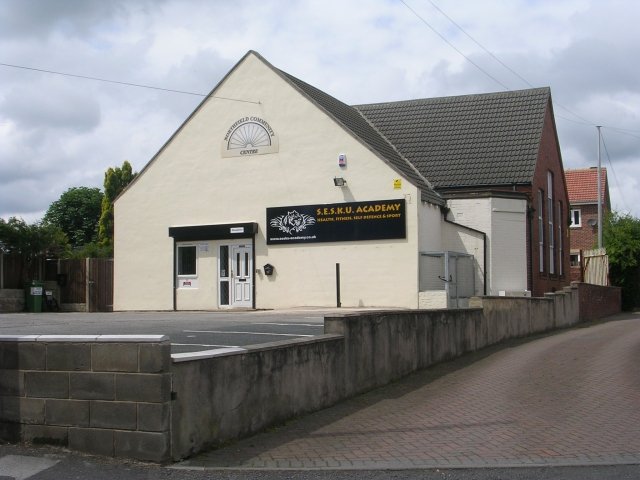
Photo: Betty Longbottom, via Wikimedia Commons (CC BY-SA 2.0)
✏︎ Try this
Aim these questions at the next community-facility funding claim you meet:
- What was actually counted? Separate hard counts — visits, volunteer hours, relief sessions — from modelled dollar values.
- Who walks through the door? A centre serving low-income, older or newly arrived visitors is doing different work from a general hire hall.
- What keeps it running? Ask whether funding covers coordinators and stable leases, or only short project grants.
❓ Check your understanding
- How much benefit did the study put on South Australia’s centres in 2024/25, and what was the return for every $1 of income?
- How many volunteers did the study count, how many hours a year do they give, and what was that time valued at?
- Which category was the biggest single slice of the total value, ahead of facilities hire and community bus hire?
Sources
- https://www.lga.sa.gov.au/news-and-events/news/latest-news/2026/millions-of-visits-to-community-centres-help-reduce-loneliness-and-social-isolation
- https://communitycentressa.asn.au/wp-content/uploads/2026/10/Socioeconomic-impact-of-community-centres-in-SA-Report-Summary.pdf
- https://vsant.org.au/wp-content/uploads/2026/06/Summary-2025-State-of-Volunteering-Report.pdf
Leave a comment
Comment as a guest and verify your email, or sign in or create a reader account. Guest comments reach our review queue after email verification; account holders can submit directly for review.