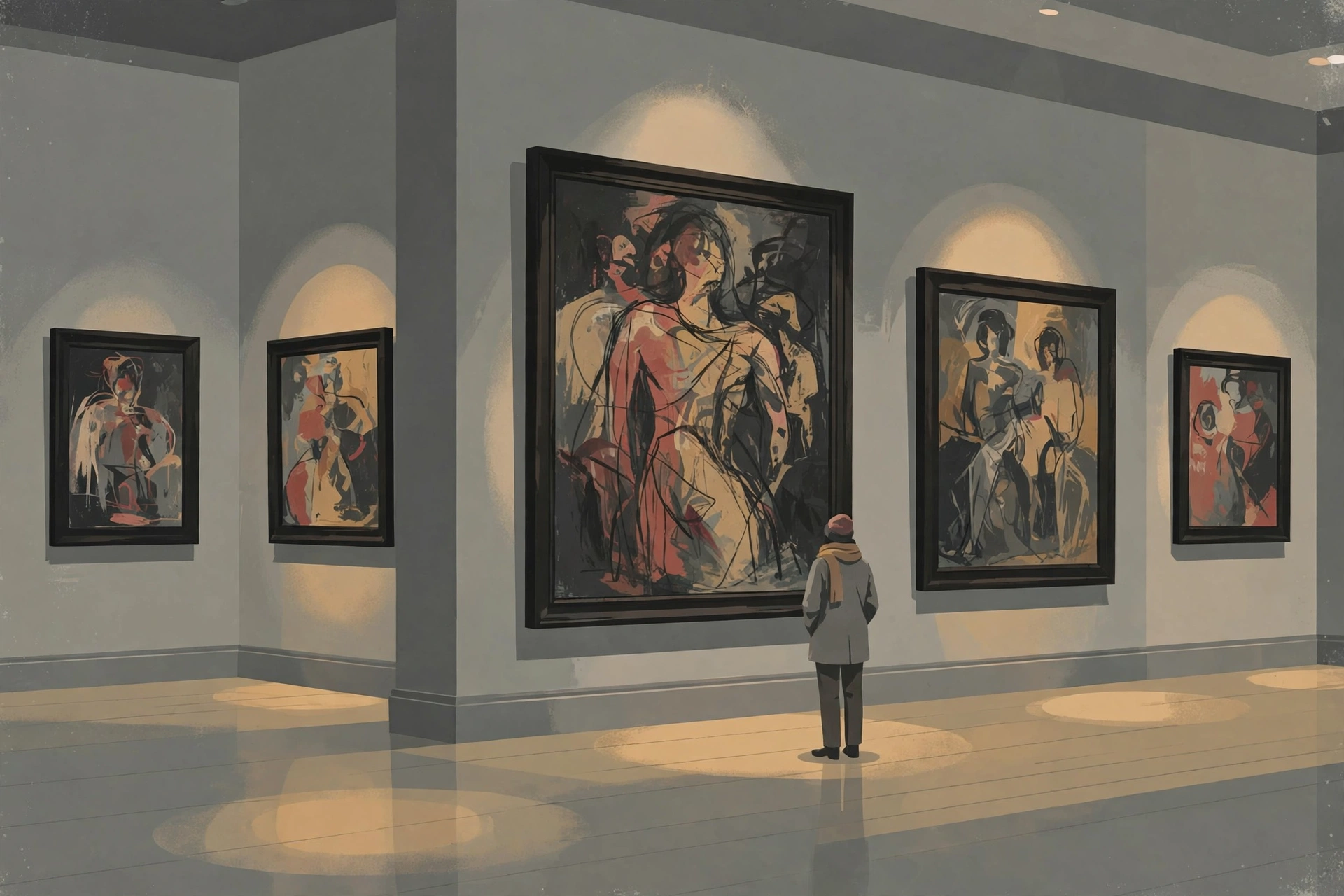
Boris Lurie never showed the most personal paintings of his life. He made them in 1946, fresh out of the camps, and then kept them private for the remaining six decades he lived. Those works — nearly a hundred paintings and drawings — now sit at the centre of Boris Lurie: Nothing To Do But To Try, which opened on 18 October 2026 at the Maltz Museum in Beachwood, Ohio, and runs through 27 January 2027. The run ends, deliberately, on International Holocaust Remembrance Day.
The exhibition brings together more than 200 artworks and archival objects, including personal materials that have never been exhibited before, according to the Maltz Museum’s announcement. It is organised by the Museum of Jewish Heritage — A Living Memorial to the Holocaust, working with the Boris Lurie Art Foundation, and curated by Sara Softness.
A boyhood ended in Riga
Lurie (1924–2008) was born in Leningrad and moved to Riga, Latvia, as an infant. He was sixteen when Nazi forces occupied the city in 1941. His mother, grandmother, sister and girlfriend were among the roughly 25,000 Jews murdered in the Rumbula massacre; Lurie and his father survived years of forced labour and concentration camps in Latvia, Poland and Germany before liberation in 1945, as the Boris Lurie Art Foundation’s exhibition text recounts. He reached New York the year after liberation, and started painting what he had seen.
The War Series: made to be kept, not shown
The “War Series” came first — camp scenes, forced labour, barbed-wire landscapes, distorted figures, nightmares. The Foundation describes the pictures as graphic and expressionist, with an unfinished, chaotic quality, “as pages ripped from a notebook.” Lurie treated them as private catharsis. He did not exhibit the series during his lifetime.
One painting singled out by the Maltz Museum is Roll Call in Concentration Camp (1946), drawn from the daily reality of camp life; others show forced factory labour, guards, camp-wide alerts. Around the paintings, the Cleveland presentation moves through five chapters of Lurie’s life, told through the things he kept: diaries, correspondence, documents, later work. Some of the most affecting objects may be the smallest. Lurie carried original family photographs from prewar Riga through the war, and a few still show creases from having been folded into a pocket.
The title comes from Lurie’s own hand. Writing about teaching himself to paint, he admitted: “since no one taught me anything about art, there is nothing to do but to try.” The Maltz Museum reads the line as the exhibition’s thread — survival as an act of creation, creation as an act of survival.
A show that began as a first
This Cleveland presentation has a history of its own. The exhibition first opened at the Museum of Jewish Heritage in New York on 22 October 2021, where it was that museum’s first contemporary art exhibition. It has since been shown at the Holocaust Center, whose presentation displayed key War Series works — the 1947 Portrait of my mother before shooting, the 1946 Liberation of Magdeburg — with their titles and dates recorded in the Center’s object list. Guest curator Sara Softness said at the first opening that setting Lurie’s biography, belongings and writings beside the early artwork “reveals a more nuanced portrait of the artist than ever before.”
Analysis: What has changed across the tour is the frame, not the pictures. A history museum took a chance on contemporary art in 2021 because the art was testimony; five years on, the same objects arrive in Cleveland as an established act of remembrance, timed to close on 27 January. Lurie’s own generation of survivors is nearly gone. Exhibitions like this one are how the witness changes hands — from the person who folded a photograph into his pocket to the stranger standing in front of it now.
If you go
The exhibition is on view at the Maltz Museum, 2929 Richmond Road, Beachwood, Ohio, from 18 October 2026 to 27 January 2027, presented in Cleveland by the Maltz Museum. Aaron Petersal, the museum’s executive director, has framed its purpose plainly: bringing visitors face-to-face with Lurie’s art and archive “offers a powerful opportunity to encounter one survivor’s experience and consider how memory continues to shape the way we understand ourselves and one another.”
Sources
- Maltz Museum — “Maltz Museum Presents Boris Lurie: Nothing To Do But To Try, Opening October 18” — https://www.maltzmuseum.org/articles/maltz-museum-presents-boris-lurie-nothing-to-do-but-to-try-opening-october-18/
- Maltz Museum — exhibition page, “Boris Lurie: Nothing To Do But To Try” — https://www.maltzmuseum.org/exhibitions-programs/boris-lurie-nothing-to-do-but-try/
- Boris Lurie Art Foundation — exhibition press text, Museum of Jewish Heritage presentation — http://borislurieart.org/exhibitions/22-boris-lurie-nothing-to-do-but-to-try-museum-of-jewish-heritage-a-living-memorial/press_release_text/
- The Holocaust Center — “Boris Lurie: Nothing to Do But To Try” exhibit page — https://holocaustcenter.org/exhibits/boris-lurie-nothing-to-do-but-to-try/