Listen to this article
Take the story with you. Choose a voice and a pace that suits you.
Or listen in another language / choose a voice
Getting your device voices ready…
The voice follows the displayed language and your browser’s regional preference when available. You can choose another narration voice.
The Tapa: Art of the Gift in Polynesia exhibition opens today, 2 November 2026, in Gallery 359 at The Met Fifth Avenue — and it asks you to look at cloth differently. Not as decoration. Not as a backdrop to “real” diplomacy done with documents and handshakes. In Polynesia, bark cloth was the diplomacy: a gift that carried status, kinship and obligation in its fibres (The Met).
Thirteen works. That’s the whole show. Fiji, Samoa, Futuna and Niue are represented, in a display that runs through 12 December 2027 (The Met).
What the Tapa: Art of the Gift in Polynesia exhibition shows
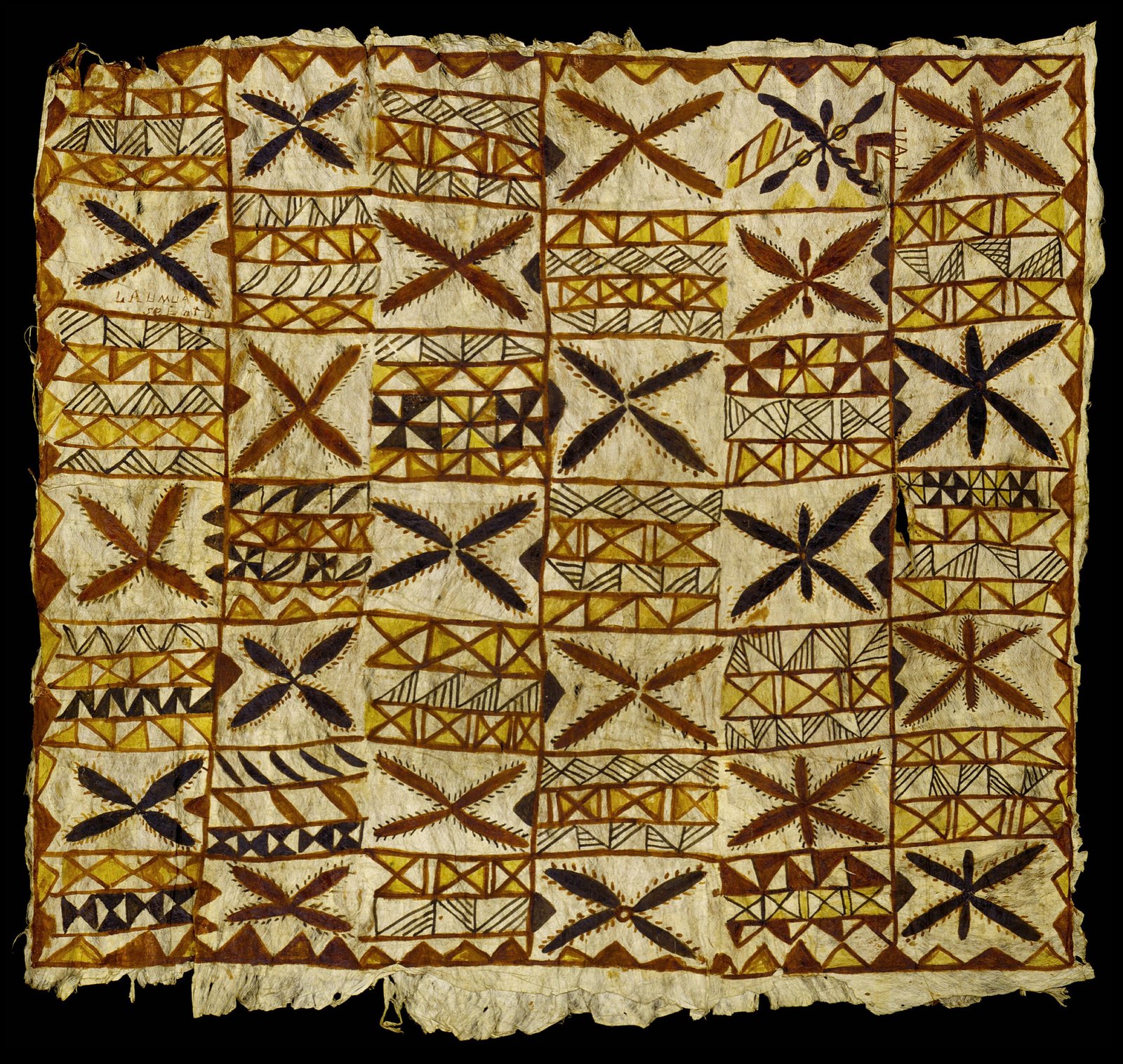
Tapa is made from the softened inner bark of trees. Locally it carries other names — masi in Fiji, siapo in Samoa, hiapo in Niue — and its surfaces hold geometric designs that are painted, stamped or stencilled on (The Met). The Met traces the tradition back more than 3,500 years to Southeast Asia, and describes how turning separate strips of fibre into one new surface echoes the reproductive potential of land, vanua or fanua, and its abundance.
Most of the works are 19th-century bark cloth from the Met’s own collection. One is not: an exceptional hiapo on loan from Te Papa Tongarewa, the national museum of New Zealand, joins the display (Markets Herald). Sculpted works sit alongside the textiles.
“This exhibition gives us the opportunity to showcase the Museum’s collection of bark cloths, not simply as skillfully designed and crafted objects but as active instruments of diplomacy and exchange,” said Max Hollein, the Met’s director and chief executive, in the museum’s announcement (The Met).
Curator Maia Nuku put the makers at the centre. The museum is “delighted to feature an exceptional set of 19th-century tapa produced by women” from the four island groups, she said, calling the works a vivid expression of ancestral associations with the land, made through hand-painted bark cloth (The Met).
Six cloths, one writer, and an argument about who held power
The sharpest story in the room involves a novelist. Among the works — many shown for the first time — are six textiles that high-ranking Samoan chiefs presented as diplomatic gifts to the Scottish writer Robert Louis Stevenson and his wife Fanny (The Met).
Stevenson lived in Samoa in his final years. He wrote A Footnote to History: Eight Years of Trouble in Samoa (1892), which attacked German, British and US interference in the islands and defended Samoan chiefs, the matai, and their customary governance. The Met argues the gifts change how that relationship reads: Samoan leaders were not passive hosts to a famous visitor. They were active participants in a crowded 19th-century colonial contest, using an established ceremonial framework to fold a newcomer into their own political relationships, on their terms (The Met).
That reframing is the exhibition’s engine. A cloth given is a relationship made — and, sometimes, a claim staked.
There’s a contemporary counterpoint, too. A large monochrome painting by Niuean poet and painter John Puhiatau Pule, born in 1962, joins the historic cloths. His early work drew on Niue’s hiapo designs, building a personal iconography about how Islanders met irrevocable change with creative ingenuity (The Met).
Bark cloth as diplomacy, not backdrop
Strip the romance away and the material facts still impress. Before imported cloth arrived, bark cloth was the cloth of Polynesia — pounded from the inner bark of the paper mulberry, strips felted or glued into sheets that could be small enough to wrap a precious object or large enough to dominate a ceremony. The Met’s own collection record for a Samoan barkcloth panel, siapo, describes pieces used in virtually every part of daily and ceremonial life, and exchanged as gifts at marriages and funerals (The Met collection).
So scale is meaning here. A big cloth took many hands, much bark, much time. Giving one away in public told everyone present exactly how much the recipient — or the relationship — was worth.
Inside the Rockefeller Wing’s In-Focus gallery
The show is the second presentation in the In-Focus gallery of the Michael C. Rockefeller Wing, the Met’s reworked home for the arts of Africa, the ancient Americas and Oceania (The Met). That wing reopened in May 2025 and has since welcomed more than 2.8 million visitors, the museum says.
Thirteen works in one gallery is a deliberate bet on slowness. You can read every label. You can go back to the first cloth after seeing the last and notice the pattern vocabulary change — island to island, hand to hand — which is precisely the variation in style and cosmological meaning the curators say they want visitors to see (The Met).
Practical details are simple. The exhibition is at The Met Fifth Avenue, Gallery 359, not at the Cloisters, and it stays open for more than a year, through 12 December 2027 (Ad Hoc News). No rush, then. But go early in its run if you can: small shows reward a quiet room, and this one’s whole argument — that a gift is a political act you can hold in your hands — lands best when you have space to stand in front of a cloth and think about who gave it, and why.
Photo: Siapo mamanu (tapa cloth), Samoa, 1890s, unknown author, via Wikimedia Commons (Public domain)
Sources
- https://www.metmuseum.org/press-releases/tapa-art-of-the-gift
- https://marketsherald.com/met-opens-tapa-art-of-the-gift-in-polynesia-in-new-york/
- https://www.metmuseum.org/art/collection/search/312122?where=Samoa
- https://www.ad-hoc-news.de/unterhaltung/reisen/metropolitan-museum-of-art-opens-tapa-on-2-november/70439157
Leave a comment
Comment as a guest and verify your email, or sign in or create a reader account. Guest comments reach our review queue after email verification; account holders can submit directly for review.