Listen to this article
Take the story with you. Choose a voice and a pace that suits you.
Getting your device voices ready…
The voice follows the displayed language and your browser’s regional preference when available. You can choose another narration voice. Enhanced device voices are preferred; availability varies.
The title is a line from a sonnet. The argument fills a hall.
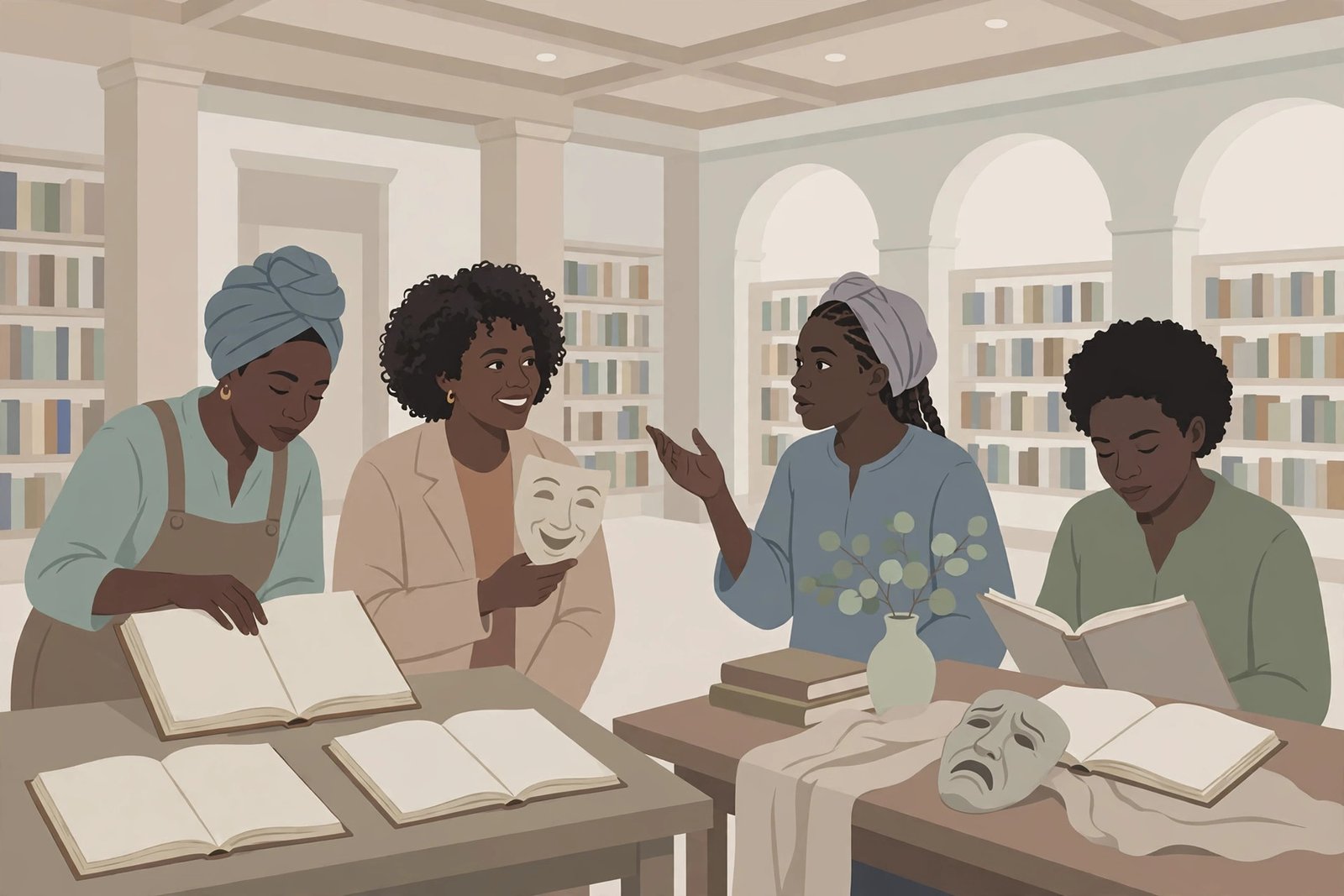
To Hear Her Speak: Black Women and Shakespeare is on view at the Folger Shakespeare Library in Washington, DC, running Oct 16, 2026 – May 2, 2027, the Folger’s own listing confirms. The library describes it as a landmark exhibition that explores the histories of Black women in Shakespearean performance and highlights how Black women have engaged Shakespeare’s language, stories and characters in their work. Information verified through 22 October 2026.
Four centuries. Performance, scholarship, rewriting, refusal — all of it, in one room.
Nearly 100 objects, not decorations
The exhibition brings together nearly 100 objects ranging from photographs, playbills, posters, books, diaries, illustrations, and costumes, according to the Folger’s announcement carried by PR Newswire. Nuvellum’s report on the show gives the same scale: nearly 100 items including photographs, playbills, books, diaries, illustrations, and costumes, alongside video displays of Black actresses performing Shakespeare.
Specific objects do the heavy lifting. Toni Morrison’s handwritten notes on her play Desdemona are on view. So is a playbill from Maya Angelou’s production of Macbeth at Wake Forest University. A copybook created by Phillis Wheatley sits in the show — Wheatley, described in the Folger announcement as the first Black American author to publish a book of poetry, in 1773. WiseVoter’s listing of the exhibition notes the same copybook, which contains passages from Shakespeare, and adds period details the organisers highlight: Frances DeBerry won $16,000 on a quiz show in 1956 and published a book on Shakespeare’s comedies in 1958; Angelou taught Shakespeare classes and directed Macbeth during the 1980s.
Names accumulate across the checklist. The Folger announcement lists writers, scholars, actors and artists including Maya Angelou, Phillis Wheatley, Ida B. Wells, Toni Morrison, Lorraine Hansberry, Adjoa Andoh, Esther Rolle, and Mae Turner. Local artist Suzanne Coley appears too, with books of Shakespeare’s sonnets featuring her own bindings, beadwork and embroidery.
This is the Folger’s largest and most ambitious temporary exhibition since it opened its new galleries in 2024, the announcement says. It sits in the Stuart and Mimi Rose Rare Book and Manuscript Exhibition Hall and draws on Folger holdings plus key loans.
The Folio with a plantation record beside it
One pairing will stop visitors mid-step.
Curator Dr. Patricia Akhimie, Director of the Folger Institute, confirmed with colleagues that First Folio 67 in the Folger collection was owned by a slave-owning family, the Fitzherberts, from the height of the slave trade until Henry and Emily Folger bought it at auction in 1924. A copy of a handwritten record of enslaved people forced to work at the family’s Turner’s Hall plantation will be on view with the Folio. Wheatley’s copybook goes beside it.
Nuvellum frames that section bluntly: the show features a First Folio bought by a slave-owning British family, records of enslaved people forced to work on that family’s sugar plantation, and tea caddies and sugar tongs carrying Shakespeare’s bust. Luxury goods, a canonical book, and the labour that paid for both — displayed together, not in separate centuries.
Akhimie’s own description, in the Folger announcement, is careful. “We are applying a wide lens to Shakespeare’s depictions of Black women,” she said. “The exhibition will show how Black women are represented — and misrepresented — through the eyes of early modern European artists and writers.” Visitors will also hear Black women’s voices across the more than four centuries the show covers.
The title itself comes from Sonnet 130. The Folger announcement says To Hear Her Speak is named with a line from Shakespeare’s Sonnet 130. Nuvellum adds that scholars have long speculated the sonnet was written about a Black woman — a speculation, presented as speculation, not as settled fact.
You sit in Hansberry’s living room
The show does not ask you only to read labels.
Visitors can sit on a set replica of Lorraine Hansberry’s New York apartment living room to watch clips of Hansberry and other Black women discussing Shakespeare, Nuvellum reported. There is a mini-archive to browse, writing activities, and an audio guide narrated by actor Adjoa Andoh. The playlist in the galleries runs from Aretha Franklin to Lauryn Hill to SZA, on the same account.
The Folger announcement fills in the production credits. The audio guide, narrated by Andoh — the Folger’s inaugural Director’s Resident — also features Akhimie and scholars Kim F. Hall and Joyce Green MacDonald, and lives on the Folger’s Bloomberg Connects guide. The exhibition was designed by Little Wing Lee and Studio & Projects. A full-colour catalog from ACMRS Press carries essays by Akhimie, curatorial consultant Verónica Betancourt, Hall, Ayanna Thompson and others.
WiseVoter’s summary notes the audio guide voiced by Andoh and modern photography by Kennedi Carter titled Flexing: New Realm. Different reports, same instinct: let people hear and sit, not just look through glass.
Folger Director Dr. Farah Karim-Cooper praised the research in the announcement. “This exhibition will lay to rest any question of whether Black women have had a long history of engagement with and affection for Shakespeare and it does so with impressive clarity,” she said.
Analysis: Exhibitions about absence usually fail in one of two ways. They plead, or they scold. This one, on the evidence of its checklist, does something harder: it accumulates. A quiz-show win in 1956. A Macbeth playbill. Handwritten notes toward Desdemona. A copybook. Put enough specific acts of reading, performing and rewriting in one hall and the old assumption — that Shakespeare belonged to someone else, and Black women arrived late to him — collapses under the weight of objects. You don’t have to accept every curatorial claim to feel that shift. You just have to walk the room slowly, and notice how early the dates start, and how they never really stop.
To Hear Her Speak runs at the Folger, a block from the Capitol, through 2 May 2027.
Sources
- Folger Shakespeare Library — Exhibition listing, “To Hear Her Speak: Black Women and Shakespeare, Oct 16, 2026 – May 2, 2027” (accessed October 2026): https://www.folger.edu/?cid=4143
- PR Newswire via ADVFN — “Folger Shakespeare Library to Present Major Exhibition Surveying 450 Years of Black Women and Shakespeare” (2026): https://www.advfn.com/stock-market/stock-news/98684313/folger-shakespeare-library-to-present-major-exhibi
- Nuvellum — “‘Shakespeare was a Black woman’: exhibition explores the playwright’s connection to Black culture” (18 October 2026): https://www.nuvellum.news/article/shakespeare-was-a-black-woman-exhibition-explores-the-playwrights-connection-to-black-cult
- WiseVoter — “Folger Library Opens Exhibition on Black Women and Shakespeare” (21 October 2026): https://wisevoter.com/world/us/dc/washington/2026/10/21/folger-library-exhibition-black-women-shakespeare
Leave a comment
Comment as a guest and verify your email, or sign in or create a reader account. Guest comments reach our review queue after email verification; account holders can submit directly for review.