Listen to this article
Take the story with you. Choose a voice and a pace that suits you.
Getting your device voices ready…
The voice follows the displayed language and your browser’s regional preference when available. You can choose another narration voice. Enhanced device voices are preferred; availability varies.
Start with the rule. Every person on Earth gets one prayer answered. Every 24 hours. No exceptions, no refunds, no taking it back.
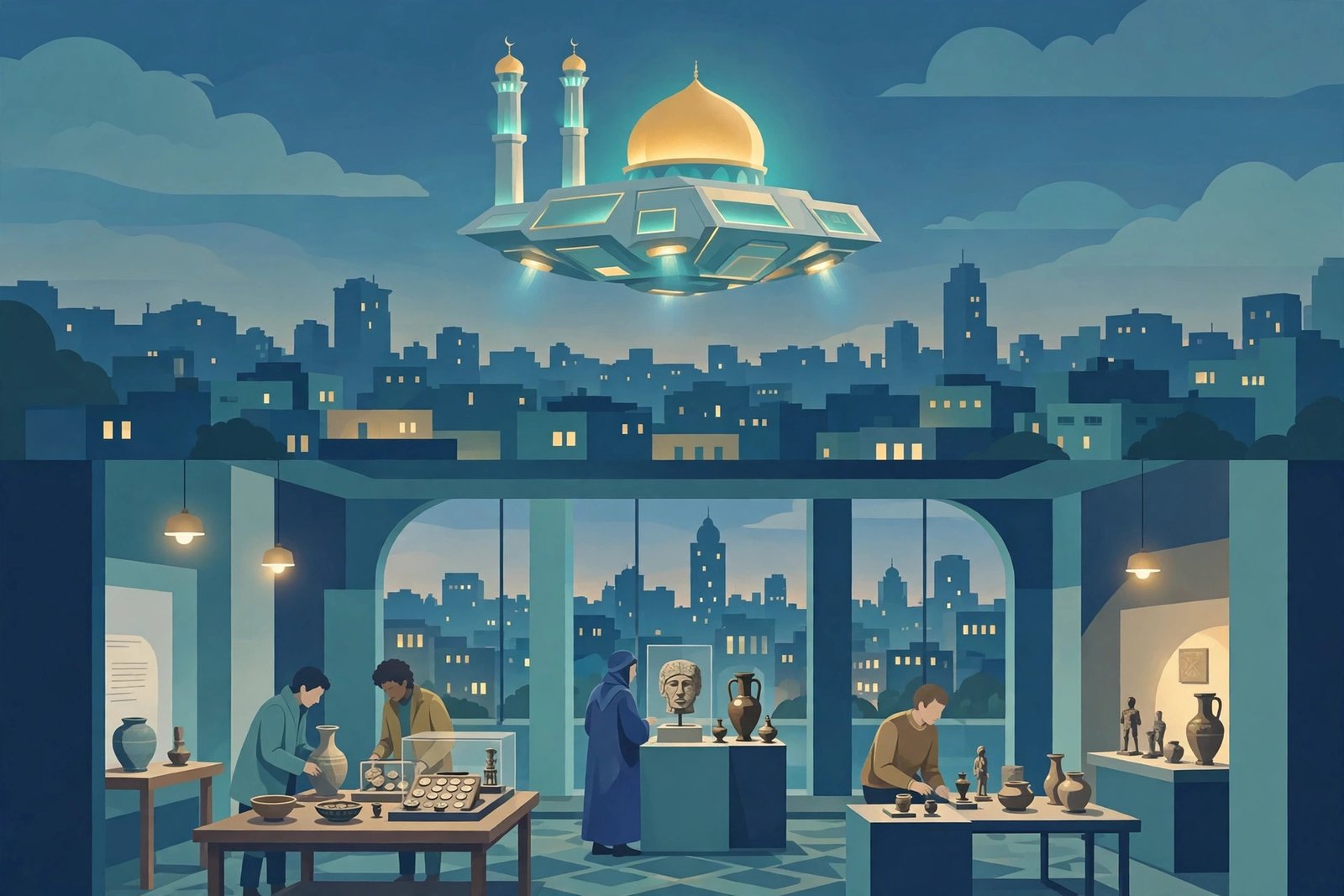
That is the engine inside Saks Afridi: SpaceMosque, which opens to the public on 24 October 2026 at the Aga Khan Museum in Toronto and runs to 7 March 2027. The exhibition constructs an alternative history in which a spiritually conscious vessel grants human wishes — and then shows you the wreckage and the wonder that follow when desire becomes power.
You do not walk into a story here. You walk into its evidence locker.
An archive for an event that never happened
The museum describes SpaceMosque as a speculative narrative examining a forgotten global event at the turn of the millennium, built from recovered artifacts, sound and archival traces. At its centre sits a mysterious, otherworldly vessel that appeared across cities worldwide in shifting forms, operating as a spiritually conscious prayer gateway that dissolves the boundaries between technology, architecture, memory and faith.
The Business Wire announcement fills in the mythology. The vessel was first sighted over Karachi, Pakistan, where it resembled a futuristic mosque — hence the name. What began as a miracle became a scramble, as governments, corporations and religious authorities sought to control it. Then it vanished, taking nearly all memory of the event with it.
Aicon Contemporary, which gave SpaceMosque its first major US solo outing, adds the darker economics. Prayer became the de facto global currency, greed and morality stayed at war, and global riots over the commoditisation of prayers may have driven the vessel away. Or perhaps, Aicon’s account suggests, enough people prayed for it all to go away and be forgotten.
Curator Marianne Fenton wants you to do the detective work yourself. “It is as though the archivists have stepped away for a coffee break, leaving objects under examination and evidence spread across their worktables,” she said in the announcement. “SpaceMosque invites us to consider what we wish for, who benefits, and what happens when private desires acquire public consequences.”
Afridi’s own starting point was smaller, and more personal. “SpaceMosque started with a question I couldn’t shake: if every prayer were answered, would it change the world — or just yours?” he said. He talked to journalists, economists, technologists and scholars as he built the world out, and watched it turn into a case study in what happens when capitalism and commercialisation take a dark turn.
For Toronto, Afridi and Fenton have added new immersive elements. Students from Toronto Metropolitan University’s architectural science programme contributed speculative designs examining how prayer and wants might be harnessed, commercialised and built into infrastructure — prayer, poured into concrete.
Practical details, because you may actually go: visitors can see the exhibition and the permanent collection free on BMO Free Wednesdays from 4 p.m. to 8 p.m., and visitors aged 25 and under get free admission at any time during opening hours, the announcement says.
Sci-Fi Sufism, and the insider outsider
Afridi has a name for what he makes. “Sci-Fi Sufism” — a self-defined genre the museum describes as a spiritual and speculative practice fusing mysticism, Sufi poetry, South Asian folklore, Islamic mythology, science fiction, architecture and calligraphy to explore the inner quest for meaning. Pakistan-born and based in New York City, he studied advertising at the Academy of Art and sculpture at the Art Students League of New York, and he still collaborates with painters, architects, artisans, designers, 3D modellers and fabricators.
In an earlier interview with Bayt Al Fann, he explained the pull plainly. Technology and mysticism both run on curiosity, he said, and science fiction’s mythical storytelling resembles religion’s. The idea of finding the source of our souls in the stars is where the two meet. The SpaceMosque concept itself fused in late 2017, he said, from Arthur C. Clarke’s Childhood’s End, Hiroshi Sugimoto’s Lost Human Genetic Archive, the Islamic story of Isra and Mi’raj — the Night Journey — and the Halo 3 Museum of Humanity campaign.
His other compass point is the “Insider Outsider” — his term, per the museum, for the pursuit of belonging while feeling out of place. Aliens, he told Bayt Al Fann, are icons of the ultimate outsider. He can relate.
Analysis: Para-fiction is a risky trick. Build a fake archive well enough and some visitors will leave half-believing it; build it loosely and the whole thing reads as a themed maze. Afridi’s defence is the question underneath, which needs no spacecraft at all. Most people, handed one answered prayer a day, would not end war on day one. They would fix a debt, a diagnosis, a person they miss. The exhibition’s bet is that watching private wishes collide at planetary scale — in markets, in ministries, in riots — tells you more about prayer than any sermon about unanswered ones. Toronto gets five months to test that bet, starting Saturday.
Dr Sascha Priewe, the museum’s Director of Collections and Public Programs, framed the show as part of a wider strategy of presenting contemporary artists whose work “challenges assumptions, connects cultures and invites meaningful dialogue about our shared future.”
Shared future. Or, in Afridi’s archive, a shared past that never happened — and that visitors now have to piece together from what the vessel left behind.
Sources
- Business Wire / Aga Khan Museum — “Aga Khan Museum Presents SpaceMosque, a Sci-Fi Art Exhibition Asking: What if all Your Prayers Were Answered?” (20 October 2026): https://www.businesswire.com/news/home/20261020767213/en/Aga-Khan-Museum-Presents-SpaceMosque-a-Sci-Fi-Art-Exhibition-Asking-What-if-all-Your-Prayers-Were-Answered
- Aga Khan Museum — “Saks Afridi: SpaceMosque” exhibition page: https://agakhanmuseum.org/whats-on/spacemosque/
- Aicon Contemporary — “Saks Afridi | SpaceMosque” press release: http://aiconcontemporary.com/exhibitions/saks-afridi-spacemosque/press-release
- Bayt Al Fann — “Sci-fi and Sufism, Saks Afridi” interview: https://www.baytalfann.com/post/sci-fi-and-sufism-saks-afridi
Leave a comment
Comment as a guest and verify your email, or sign in or create a reader account. Guest comments reach our review queue after email verification; account holders can submit directly for review.