Listen to this article
Take the story with you. Choose a voice and a pace that suits you.
Getting your device voices ready…
The voice follows the displayed language and your browser’s regional preference when available. You can choose another narration voice. Enhanced device voices are preferred; availability varies.
In 1926, a 22-year-old from Rotterdam hid in the engine room of the British cargo ship SS Shelley and crossed the Atlantic as a stowaway. He had trained as a night student at Rotterdam’s Academy of Visual Arts and apprenticed at a decorative arts studio, and none of it was enough to keep him. This autumn, a century later, Willem de Kooning’s work has come back the grand way: through the front door of the Rijksmuseum in Amsterdam, where Willem de Kooning at work opened on 9 October and runs until 17 January 2027. Information verified through 19 October 2026.
A retrospective built out of drawings
Most retrospectives lead with the famous paintings and treat the drawings as footnotes. This one inverts the order. The exhibition brings together more than 120 works, the large majority of them drawings, and it is the biggest showing of De Kooning in Europe since 1984. According to The Times, most of the work has never left the United States before.
The drawings span more than 65 years, from his student work in Rotterdam to the rapid charcoal sketches of his old age. Around them sits a smaller selection of the paintings and sculptures that built the reputation: Excavation (1950), lent by the Art Institute of Chicago — which co-organised the show with the Rijksmuseum and The Willem de Kooning Foundation — Pink Angels (c. 1945), Abstraction (1949–50) from the Museo Nacional Thyssen-Bornemisza in Madrid, and a Woman from 1983 on loan from Museum Ludwig in Cologne. Rarely seen drawings from private collections fill out the loans.
Not studies. The work itself.
The museum’s central claim is stated flatly on its exhibition page: De Kooning’s drawings are not studies for paintings. Drawing, for him, was the exploring itself — sketching, correcting, repeating, deliberately surprising himself, in the museum’s words. He had a saying for it, from 1981: “I have to change to stay the same.”
The curator, Marian Cousijn, makes the same point from the sheets themselves. “You can still see the under drawings; you can still see the hesitation,” she told The Times. “He’s scraping away things, he’s erasing things, sometimes he’s cutting, and he’s smudging.” That visible indecision is also why the figuration never quite leaves. “He never picks one side,” Cousijn said. “Even in his works that look really like 100 per cent abstract, you still will discover the human shape. He never goes really abstract.”
Next door to Rembrandt
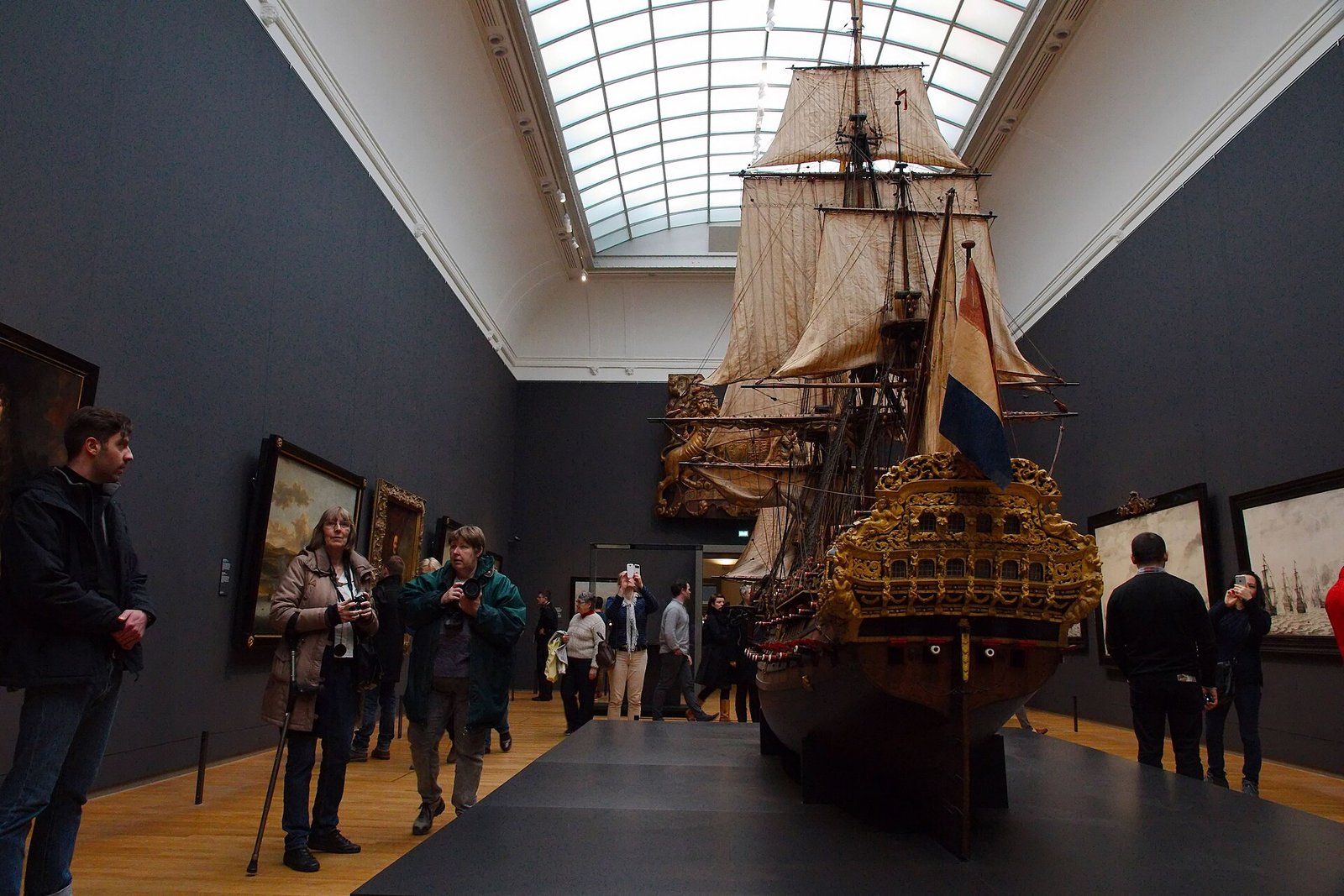
Then there is the gesture everyone will photograph. Two of the most celebrated paintings, Woman I (1950–52) and Woman and Bicycle (1952–53), are not in the exhibition galleries at all. They hang in the Gallery of Honour, the museum’s processional hall of Dutch Golden Age masterpieces, close to the Night Watch — slashing, gestural, unmistakably modern pictures installed among Rembrandt, Vermeer and Frans Hals as if they belonged to the same national story.
Cousijn argues the pairing is more than cheek. De Kooning was obsessed with art history and deeply influenced by Rembrandt, and what binds them, in her account, is precisely the habit this exhibition is about: “Rembrandt was also always drawing on every bit and piece of paper that was around him. So this act of drawing really binds them together.”
Analysis: The homecoming framing is generous, and it is also a little convenient. De Kooning became De Kooning by leaving — he took American citizenship in 1962, died in East Hampton in 1997, and, as Cousijn concedes, is still not a household name in the Netherlands. A national museum hanging him beside the Night Watch is partly an honour and partly an annexation: the country that could not hold him at 22 claiming a share of what he became. The drawings quietly resist the claim. They are the least national objects in the building — working papers, full of second thoughts — and they are the best reason to go.
Rotterdam keeps its share
Amsterdam does not get the centenary to itself. In Rotterdam, the city De Kooning actually left, the migration museum Fenix has placed three of his monumental bronze sculptures on the quay in front of the museum, on temporary display since 18 July 2026. It is a different kind of homecoming: outdoors, unframed, in a harbour city that now teaches art students at an academy bearing his name.
Back in Amsterdam, the show comes with a catalogue edited by the Art Institute of Chicago presenting new research on the drawings, a Dutch-language Rijksmuseum book on his trajectory, an audiotour, and a drawing workshop at the museum’s Teekenschool — a fitting extra for an exhibition arguing that drawing is where the thinking happens. The Guardian, quoted on the museum’s own page, gave it five stars and called it thrilling to watch. The more useful verdict may be Cousijn’s: “For many people, it will really be a discovery.” A hundred years after the engine room, the stowaway turns out to have been carrying the cargo that mattered.
Sources
- Rijksmuseum — “Willem de Kooning at work” (exhibition page: dates 9 October 2026 – 17 January 2027, collaboration with the Art Institute of Chicago and The Willem de Kooning Foundation, drawing as exploration, the 1981 “I have to change to stay the same,” Gallery of Honour hang, catalogue, Teekenschool workshop and audiotour, artist biography): https://www.rijksmuseum.nl/en/whats-on/exhibitions/willem-de-kooning-at-work
- The Times — “Stowaway who influenced Pollock comes home to hang with Dutch masters” (October 2026: the SS Shelley engine room crossing at 22, most works never previously outside the US, curator Marian Cousijn on figuration, process and the Rembrandt connection, his 1962 US citizenship and low name recognition in the Netherlands): https://www.thetimes.com/world/europe/article/dutch-expressionist-rijksmuseum-willem-de-kooning-6q9kb9tjg
- FAD Magazine — “Rijksmuseum to stage landmark Willem de Kooning exhibition” (20 July 2026: largest De Kooning exhibition in Europe since 1984, the loan list including the Thyssen-Bornemisza and Museum Ludwig works, Rotterdam training and the Gidding apprenticeship, Fenix’s three bronzes on the quay from 18 July 2026): https://fadmagazine.com/2026/07/20/rijksmuseum-willem-de-kooning-at-work-exhibition-2026/
Photo: Frans de Wit, CC BY-SA 2.0, via Wikimedia Commons
Leave a comment
Comment as a guest and verify your email, or sign in or create a reader account. Guest comments reach our review queue after email verification; account holders can submit directly for review.