Listen to this article
Take the story with you. Choose a voice and a pace that suits you.
Getting your device voices ready…
The voice follows the displayed language and your browser’s regional preference when available. You can choose another narration voice. Enhanced device voices are preferred; availability varies.
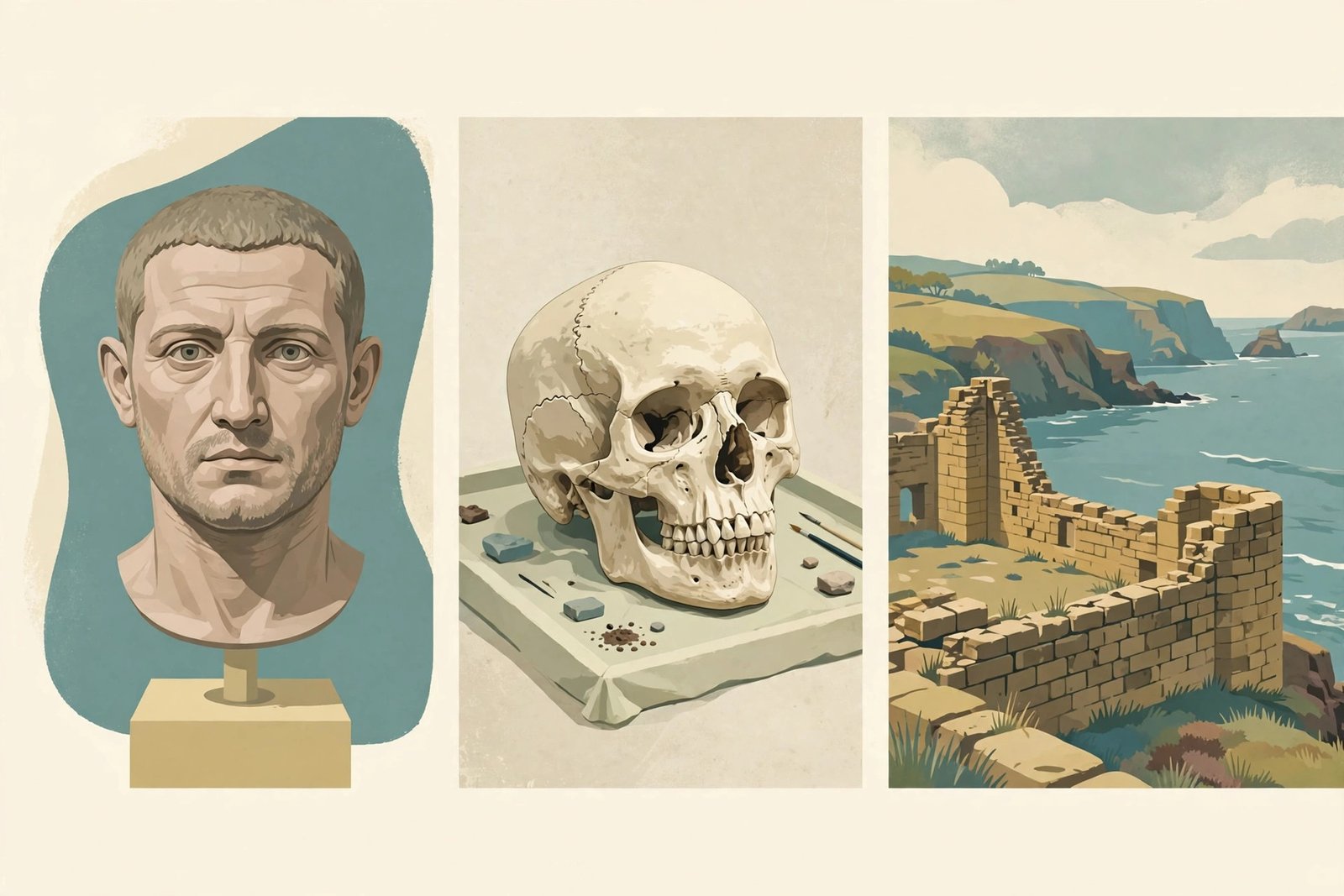
Look at the injuries first, because they rule out the obvious story. His nose had been broken and healed. Bone growth around his right elbow, probably caused by septic arthritis, left him with limited use of that arm. His front teeth were worn down — researchers think he held objects between his teeth to compensate for the arm. National Museums Scotland, which unveiled his reconstructed face on 20 October 2026, is blunt about the consequence: he certainly was not a soldier when he died, as he could not have swung a sword. Information verified through 21 October 2026.
So who was he? A man most likely in his early 50s, who died sometime between AD 140 and 165 at Inveresk, near Edinburgh, on Rome’s northern frontier. He had been born in southern Britain and travelled hundreds of miles to the shores of the Firth of Forth. The reconstruction gives him brown eyes, dark hair going grey, and lines that, the museum says, betrayed a hard and physically active life.
Four laboratories, one face
No single technique produced this portrait. The likeness rests on an osteoarchaeological assessment at National Museums Scotland, isotopic analysis led by scholars at Durham University, and ancient DNA work by teams at the University of York and Harvard Medical School. Dr Chris Rynn combined those findings to estimate the man’s appearance.
Curator of osteoarchaeology Dr Jess Thompson describes the result as uniting “cutting-edge science with artistic vision to create an instant connection with the past”. Principal curator Dr Fraser Hunter adds the necessary caveat, and it’s the most trustworthy sentence in the announcement: “We cannot know how exactly he looked, but we think his family and friends would have spotted the likeness.” Hold onto that “we think.” A reconstruction is an evidence-weighted estimate — tissue depth, pigmentation inferred from DNA, age read from bone — not a photograph recovered from the second century.
His skull will sit beside the digital reconstruction in Roman Scotland: Life on the Edge of Empire, opening at the National Museum of Scotland on 14 November 2026 and running until 18 April 2027. The exhibition covers soldiers, the families around military bases, and local people whose lands the invasion threatened.
The burials are the stranger story
He wasn’t alone, and this is where Inveresk gets genuinely odd. Burials are rarely found in Roman Scotland at all. Of the six adult men buried around the fort here, four were decapitated after they died. These are the first Scottish examples of post-mortem decapitation and among the earliest known in Britain.
Why? Nobody knows, and the museum says so plainly. The practice may have been a punishment, linked to beliefs about how a person died, or driven by supernatural concerns — and the reasons probably changed over time. That uncertainty is worth preserving exactly as stated. Popular coverage will be tempted to pick the darkest option and run. The evidence, at present, supports a question mark.
Analysis: What a face does that a grave-good catalogue can’t is collapse distance. Hunter puts it simply: archaeology tells us about people who had hopes and fears just like us. A civilian with a ruined arm, hundreds of miles from home, dying on a frontier he didn’t fight for — that biography corrects the default image of Roman Britain as legions and walls. Frontiers ran on labour, trade, service and migration. Most of the people who lived on them never held a sword, and some physically couldn’t.
This month’s heritage news carries the same lesson from the opposite direction. On 14 October, a latte stone taken from Rota more than a century ago was welcomed back to the Marianas in a ceremony where museum board chair Mona Mercado called it “a return of spirit, memory, and belonging”. Edinburgh is giving a man back his face; Saipan is giving a stone back its home. Different ethics, different histories — the Inveresk remains were excavated archaeologically, not looted — but a shared refusal to let the past stay as anonymous inventory.
Go in November, if you can. Stand in front of the skull, then the face. The gap between those two objects is the whole discipline: bone, inference, artistry, doubt. He’d have recognised the second one, maybe. You’ll recognise something in it too, and that recognition — not the technology — is the exhibit.
Sources
- National Museums Scotland — “2000-year-old face of Roman Scotland inhabitant revealed in new reconstruction” (20 October 2026): https://media.nms.ac.uk/news/2000-year-old-face-of-inhabitant-of-roman-scotland-revealed-in-new-reconstruction
- Museums + Heritage Advisor — “National Museums Scotland reconstructs face of 2000-year-old Roman inhabitant” (20 October 2026): https://museumsandheritage.com/advisor/posts/national-museums-scotland-reconstructs-face-of-2000-year-old-roman-inhabitant/
- BAJR — “Reconstruction of face from Inveresk in Roman Scotland” (20 October 2026): https://www.bajr.org/reconstruction-of-face-from-inveresk-in-roman-scotland/
- Isla Public — “Rematriated latte stone symbolizes resilience, identity, renewal” (14 October 2026): https://www.islapublic.org/news/2026-10-14/rematriated-latte-stone-symbolizes-resilience-identity-renewal
Leave a comment
Comment as a guest and verify your email, or sign in or create a reader account. Guest comments reach our review queue after email verification; account holders can submit directly for review.