Listen to this article
Take the story with you. Choose a voice and a pace that suits you.
Getting your device voices ready…
The voice follows the displayed language and your browser’s regional preference when available. You can choose another narration voice. Enhanced device voices are preferred; availability varies.
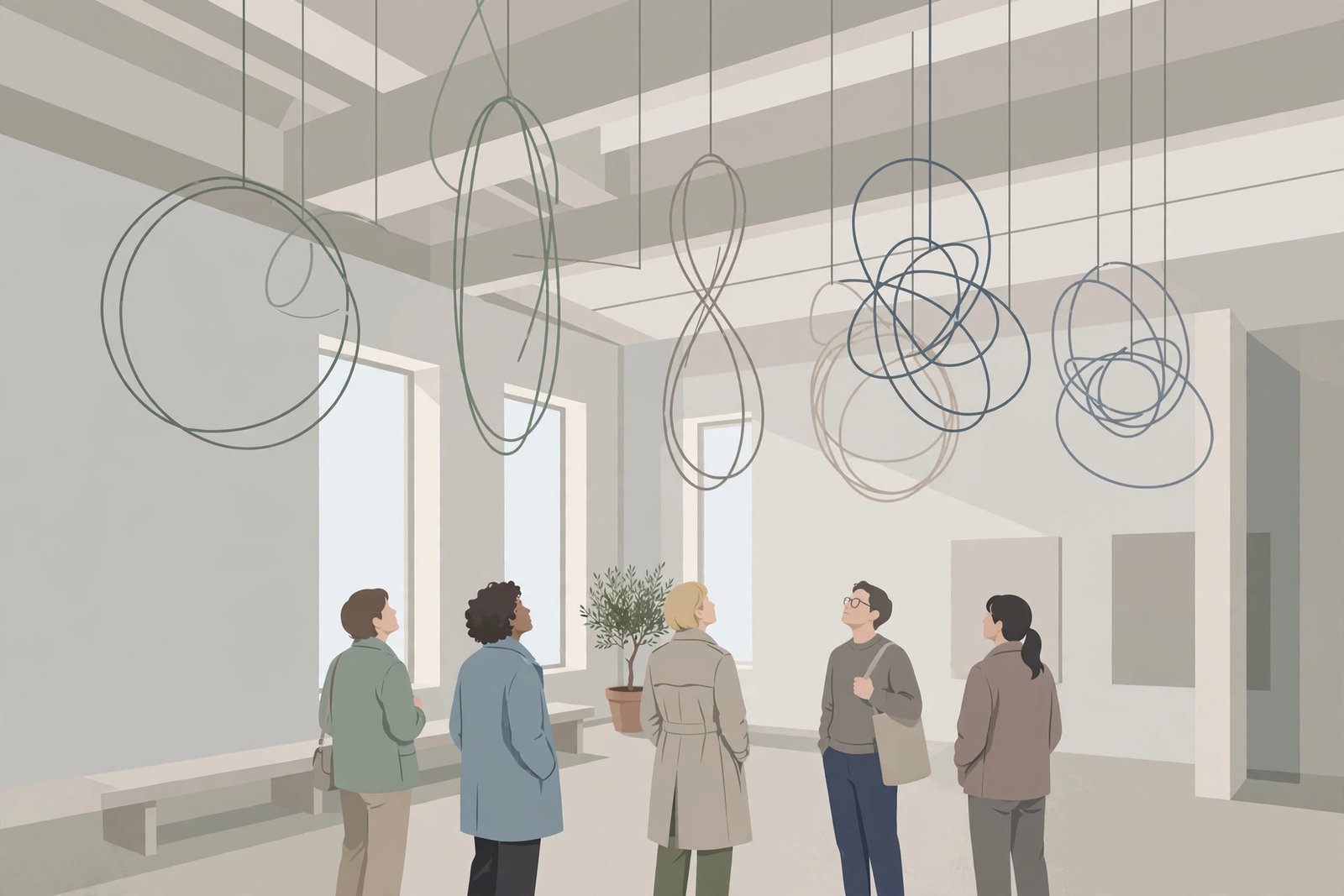
You can see through them. That is the first thing, and somehow also the last: Ruth Asawa’s suspended wire sculptures hang in the air as openwork volumes, loops inside loops, and the eye passes straight through the surface into the form. The first major European retrospective of her work opened at the Fondation Beyeler in Riehen, near Basel, on 18 October 2026 and runs to 10 January 2027. Information verified through 20 October 2026.
Asawa (1926–2013) is, as the Beyeler puts it, an artist celebrated in the USA being offered to Europe as a rare discovery. Sit with that for a second. She died thirteen years ago. Her work has been in American museums for half a century. The discovery framing says less about her than about which artists European institutions historically bothered to cross an ocean for.
The last stop of a long tour
Riehen is the fourth and final leg of the retrospective. It began at the San Francisco Museum of Modern Art, moved to the Museum of Modern Art in New York, then to the Guggenheim Museum Bilbao, and concludes at the Fondation Beyeler. The show is built on an exhibition partnership between SFMOMA and MoMA, with the Beyeler developing this final presentation.
The scale shifts a little depending on who is counting. VernissageTV’s preview puts the Beyeler hang at roughly 200 works spanning six decades. Ocula’s report on the tour’s announcement described some 300 objects across the full exhibition. Either way, the point is breadth: looped-wire and bronze sculpture, yes, but also drawings, prints, paintings, paper folds and material from the public commissions — fountains, murals, memorials — that filled her later career.
That breadth is the argument. Asawa’s fame rests on the hanging wire forms, and fame of that kind flattens. Artprice’s preview stresses that the retrospective places the interplay between her media at its heart: a line on paper is not a sketch for a line in space, and the drawings in this show stand as an autonomous practice, not a rehearsal.
Black Mountain, Mexico, San Francisco
The biography reads like a compressed history of twentieth-century American art, with its ugliest chapter near the start. Born in Norwalk, California, Asawa was incarcerated as a teenager with her family in wartime relocation camps, where she practised drawing with Japanese-American Disney animators who were interned alongside them. After the war came Black Mountain College in North Carolina — the experimental school where she studied in the late 1940s under Josef Albers, Buckminster Fuller and Merce Cunningham.
In 1947 she travelled to Mexico and took lessons with local weavers; Ocula notes those lessons helped inspire the metal sculptures she became known for. VernissageTV makes the same connection, tracing the looped-wire technique in part to traditional basket-weaving she encountered in Mexico. Craft knowledge, carried across a border, became fine art. The retrospective’s framing — blurring abstraction and figuration, art and craft, action and contemplation — is basically that journey stated as a theme.
From 1949 she lived in San Francisco. She raised six children with her husband Albert Lanier while producing the wire work, the calligraphic ink drawings and, from the late 1960s, a run of public commissions. She also became a force in arts education in the Bay Area — the Beyeler’s own summary calls her a strong advocate for arts education in the region and beyond. MoMA curator Cara Manes, who co-organised the tour with SFMOMA’s Janet Bishop, has described the show’s aim as reflecting what Asawa called the “total act” of artmaking.
Late, and later still
None of this recognition arrived on schedule. Ocula’s account states plainly that Asawa was largely overlooked during her lifetime and has drawn serious attention only in recent years: David Zwirner took on her estate in 2017, and the Whitney mounted a drawings exhibition, Through Line, in 2023–24. The machinery of canonisation — estate representation, museum retrospectives, a four-city international tour — assembled itself after her death.
Analysis: There is a temptation to treat this show as a correction, the record finally set right. Resist half of that. The work was always this good; what changed is the market and museum appetite for artists — women, artists of colour, artists who worked in craft media — whom an earlier system filed under minor. But a retrospective at the Beyeler is not a consolation prize. It is the institution with some of Europe’s deepest pockets and sharpest programming saying, on the record, that this career belongs in the main sequence of postwar art. European audiences who have never stood underneath a hanging Asawa — where the sculpture moves slightly, casts a second sculpture in shadow on the wall, and refuses to hold still for a photograph — are in for a genuine first encounter, not a history lesson.
Go before 10 January, if you can get to Basel. Stand under the wire. Look through it. The transparency is the technique, the ethic and, it turns out, the whole career: nothing hidden, every loop visible, the making left in plain sight.
Sources
- Fondation Beyeler — “Ruth Asawa” exhibition page (2026): https://www.fondationbeyeler.ch/en/exhibitions/ruth-asawa
- VernissageTV — “Ruth Asawa Retrospective at Fondation Beyeler” (19 October 2026): https://vernissage.tv/2026/10/19/ruth-asawa-retrospective-at-fondation-beyeler/
- David Zwirner — “Ruth Asawa: Retrospective” (2026): https://www.davidzwirner.com/news/2026/ruth-asawa-retrospective
- Ocula — “SFMOMA and MoMA Announce Major Ruth Asawa Retrospective” (30 October 2024): https://ocula.com/magazine/art-news/sfmoma-and-moma-announce-major-ruth-asawa-show/
- Artprice — “The Fondation Beyeler presents an unprecedented retrospective of American artist Ruth Asawa” (14 October 2026): https://news.artprice.com/en/16976/the-fondation-beyeler-presents-an-unprecedented-retrospective-of-american-artist-ruth-asawa
Leave a comment
Comment as a guest and verify your email, or sign in or create a reader account. Guest comments reach our review queue after email verification; account holders can submit directly for review.