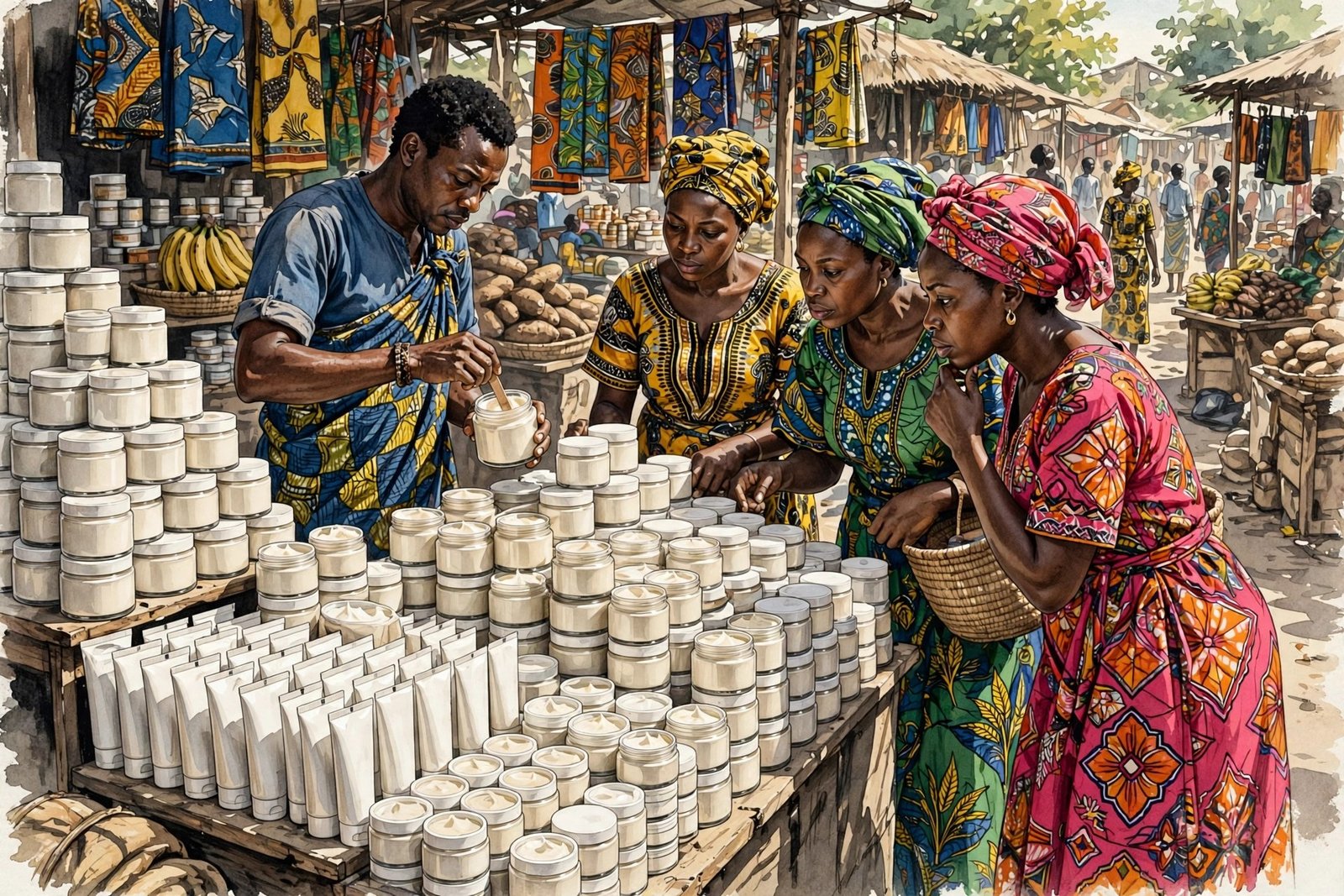
Susan Anderson was twelve when she first used a skin-lightening cream; her stepmother handed it to her and never said what it was for. By high school, friends had steered her to a stronger product, Dermovate. Nearly forty years of escalating creams followed. After one operation, doctors found her skin too eroded to hold a stitch. “They sewed it, but the stitches were not holding,” she told NPR. “I almost died at that point.” She is fifty-two now, in treatment at an Abuja dermatology clinic.
The scale of it
Anderson is not an outlier. A 2023 World Health Organization fact sheet, reported by the News Agency of Nigeria, put use of skin-lightening products among women at 77 per cent in Nigeria — the world’s highest rate — 66 per cent in Congo-Brazzaville, 50 per cent in Senegal, 39 per cent in Ghana, 32 per cent in South Africa and 25 per cent in Mali. NPR, citing the WHO, puts the African average at 27.1 per cent. Nigeria’s health minister, Dr Iziaq Salako, calls his country the “world capital” of skin bleaching. In Kano, NPR found billboards selling whiteness back to Black women, a standard it traces to colonial-era hierarchies that taught generations to read lighter skin as status and beauty.
What the creams do to a body
The chemistry is not cosmetic. The WHO’s information note on mercury in these products lists kidney damage first, then skin rashes, discoloration and scarring, weakened resistance to bacterial and fungal infections, anxiety, depression, psychosis and peripheral neuropathy. Hydroquinone can cause ochronosis — skin that darkens and can end up disfigured. Potent steroids do quieter damage. “The steroids that are used in addition to the bleaching agents, once you put them on your skin, they’re absorbed into your bloodstream,” Abuja dermatologist Dr Vivian Oputa told NPR. “They can wreak havoc and damage internal organs, your kidneys, your liver.” She has seen where that logic ends: “We’ve had several cases of newborns being bleached by their parents because they don’t want the kids to be dark.” In Kano’s Sabon Gari market, NPR watched sellers mix unmarked solutions and crack antibiotic capsules into jars of cream.
Governments push back. The markets shrug.
Ghana’s Food and Drugs Authority barred hydroquinone cosmetics imports from August 2016, announcing zero tolerance. “The acceptance for skin lightening products is going to be zero,” its spokesman James Lartey said. Nigeria’s 2019 regulations prohibit mercury in cosmetics and cap hydroquinone at two per cent. Rwanda went furthest. After President Paul Kagame posted in November 2018 that bleaching creams were unhealthy and told his health ministry and police to rein “this in very quickly,” enforcement teams swept shops and markets nationwide, seizing more than 5,000 banned products in a single month, police said. The pattern repeats across the reporting: bans on paper, weak enforcement, shelves still full.
“Part of the Ghanaian family”
Ghana’s Year of Return in 2019 marked four hundred years since the first enslaved Africans crossed the Atlantic. On 19 November 2024, in Accra, 524 members of the diaspora received Ghanaian citizenship. “Today, we embrace you as our own — as fellow citizens of this nation and as part of the Ghanaian family,” President Nana Akufo-Addo told them.
The podium says family. The market has other words. In a 2007 Journeyman Pictures documentary, Kwaku Asante and Dr Adwoaa Asatewaa, who left American lives behind for Cape Coast, get called “obruni” — the word for a white person, a foreigner — and quoted foreigner prices. “I’m not obruni. I’m bibini,” Asatewaa answers. I’m not white. I’m Black. Kwaku puts it plainly: “They don’t know us and we don’t know them.”
Land, prices, and a word that stings
At Asebu, near Cape Coast, the paramount chief set aside 5,000 acres for a Pan African Village; around 560 diasporans took plots. Farming families say the land had been theirs for generations. “I used to farm lime, coconuts, oranges. But it has been destroyed,” said Kwesi Otu Bensil, fifty-nine. The family says no compensation was offered; the fight is in court. NPR distils the local charge: newcomers arrive with foreign currency and access to land locals cannot get. Returnee Moyen Vivalee answers for her side: “We didn’t get anything free.” Every December the friction turns seasonal: the BBC reports Accra residents complaining of price gouging as 125,000-plus visitors, many of them diasporans, pour in.
The oldest version of the friction is a single word. “Akata” is Yoruba for “wild cat.” The Nigerian-American scholar Farooq Kperogi traces it to the first Yoruba immigrants’ impressions of Black Americans — wild, rude, aggressive, uncultured — an impression he calls crude and unrepresentative. The popular claim that the word means “cotton picker” or “slave” is, he argues, inaccurate. Usage has softened into a general label, but Kperogi still hears “a thinly veiled whiff of condescension and disdain” in it, and Black Americans hear an insult whatever the intent. Online, the quarrel has a genre name: “diaspora wars” — very old arguments, scholars of Black digital culture noted at a University of Michigan panel in November 2025, now running on platforms that pay for outrage.
Analysis
Here is the double mark the Black American carries off the plane in Accra or Lagos: returning kin in the official speeches, foreigner everywhere else. The podium offers an embrace and a citizenship oath. The street offers the obruni price, the land dispute, the slur that means wild animal. Black Americans are their own people, a nation formed in America across four centuries — and the welcome on offer keeps missing that, reaching for a family reunion instead of meeting the actual people in front of it: citizens of another country, with their own history, arriving as visitors and being billed as intruders. The grammar of the resentment is borrowed. Foreigners with money taking the land, pushing up prices, standing outside the nation’s real life — the charges Africans themselves face in Johannesburg, London and Houston. In Ghana the same sentences are aimed at Black Americans. A hierarchy that ranks human beings — lighter over darker in the bleaching aisle, native over newcomer at the land office — does not dissolve when it crosses the Atlantic. It finds new people to sort, and calls the sorting honesty.
Sources
- NPR, “Skin bleaching is terribly popular — and takes a terrible toll” (25 March 2025) — https://www.mtpr.org/2025-03-25/skin-bleaching-is-terribly-popular-and-takes-a-terrible-toll?_amp=true
- World Health Organization, information note, “Mercury in skin lightening products” (2019) — https://www.who.int/publications/i/item/WHO-CED-PHE-EPE-19.13
- News Agency of Nigeria report, “Nigeria: Minister seeks for revival of Black is Beautiful movement, warns against skin bleaching by African women” (January 2025) — https://www.worldstagenews.com/nigeria-minister-seeks-for-revival-of-black-is-beautiful-movement-warns-against-skin-bleaching-by-african-women/
- i-D, “Ghana is cracking down on the skin bleaching industry” (2016) — https://i-d.co/article/ghana-is-cracking-down-on-the-skin-bleaching-industry/
- CNN report on Rwanda’s enforcement, republished by Graphic Online (January 2019) — https://graphiconline.com/international/international-news/rwanda-deploys-officials-to-enforce-ban-on-skin-lightening-creams.html
- Ghana Tourism Authority, “Ghana Grants Citizenship to 524 Members of the Diaspora Community” (November 2024) — http://visitghana.com/ghana-grants-citizenship-to-524-members-of-the-diaspora-community/
- Journeyman Pictures, “Ghana Slavery” documentary transcript (2007) — https://www.journeyman.tv/film_documents/3474/transcript/
- NPR, “Pan African village for returning diaspora in Ghana becomes a source of bitterness” (2023) — https://www.northcountrypublicradio.org/news/npr/1222096349/pan-african-village-for-returning-diaspora-in-ghana-becomes-a-source-of-bitterness
- BBC report on “Detty December,” republished by BusinessGhana (December 2025) — https://businessghana.com/site/news/entertainment/340545/Ghana-official-not-comfortable-with-Detty-December-label
- Farooq A. Kperogi, “Notes From Atlanta” column on the insults exchanged between Africans and Black Americans (2013) — https://www.farooqkperogi.com/2013/02/insults-africans-and-african-americans.html
- DISCO Network, University of Michigan, “Diaspora Wars and Going 50/50” panel report (2025) — https://www.disconetwork.org/blog/event-spotlight-diaspora-wars-and-going-5050-sowing-disunity-in-black-communities-through-digital-propaganda
—