Listen to this article
Take the story with you. Choose a voice and a pace that suits you.
Or listen in another language / choose a voice
Getting your device voices ready…
The voice follows the displayed language and your browser’s regional preference when available. You can choose another narration voice.
On 17 October 2026, Joseph “Nana Kwame” Awuah-Darko, who posts as @okuntakinte, published Day 5 of his series Dismantling Rape Culture. He introduces himself in the series as a rape survivor living with PTSD, and as a Greco-Roman wrestler. The reel is a video essay about photography — about what certain images do to the people inside them, and what they train viewers to expect. Its argument is that dehumanisation is not always loud. Sometimes it is composition.
The central exhibit is Latin Lover, from The Perfect Man, Fall 2023, photographs by Ferran Casanova, fashion by Cristian Betancourt. The title image, viewed directly for the research behind this article, shows two men in a tango hold. The light-skinned partner is fully clothed — patchwork top, turquoise sequinned fringe, jeans, sneakers — facing the camera, his hand flat on his partner’s back. He has clothes, shoes, a face, a gaze and the touching hand. The Black model is photographed entirely from behind: nude as far as the frame shows, barefoot, his face never shown at all — not glancing over a shoulder, but absent. Across his own back, on a chain, hangs a yellow banana-shaped Fiorucci bag, resting at his buttocks. It is the only garment-like object on his body. Personhood goes to one model; nudity, anonymity and the joke prop go to the other.
A reading by the Brooklyn College Vanguard, in its analysis of the Latin Lover styling and its dog-whistles, held that banana imagery against a stripped, faceless Black model invokes the monkey comparison and dehumanises him. Against the image itself, that core reading holds. Three of its details do not: the bag hangs on the Black model’s own back, not in his partner’s hand; his face is absent, not looking over a shoulder; and no yellow speedo is visible. A second editorial image, in blue Moschino briefs, known from an attributed description, is the likely source of the reel’s Moschino reference.
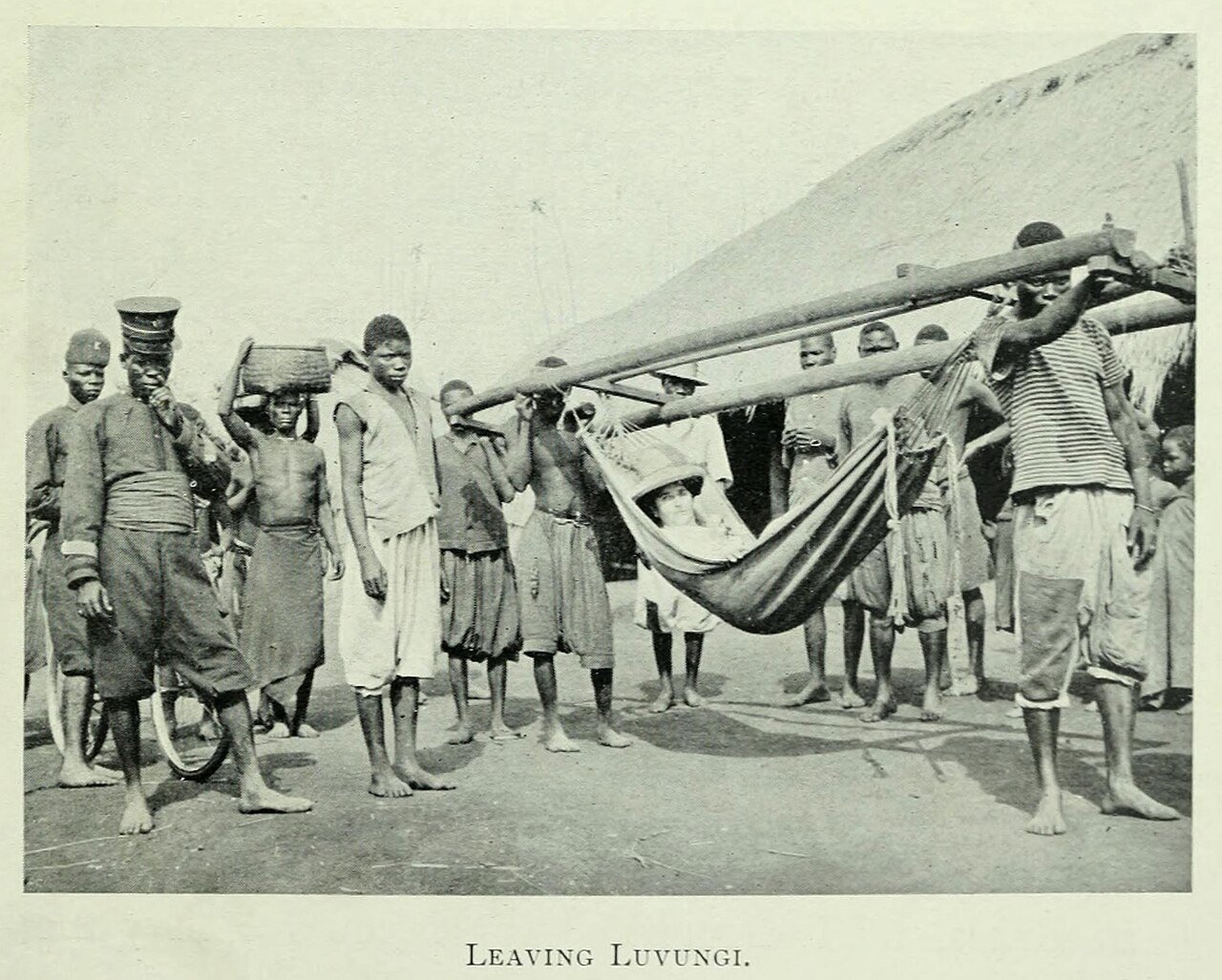
Photo: Photographer not credited; in Marguerite Roby, My Adventures in the Congo (1911), via Wikimedia Commons — Public domain
The composition did not arrive from nowhere. Between roughly the 1880s and the 1930s, expedition, hunting, mission and administrative photography returned repeatedly to the same arrangement: a European reclining in a hammock, litter or machila slung from a pole, borne by African carriers, posed for the camera. One example, from big-game hunter Richard John Cuninghame’s archive, shows the hunter suspended above the ground his carriers walk on, game in hand, labour arranged around him like equipment. Porterage was also waged, negotiated labour, and the images were usually staged — which is their value: they show how expeditions wished to be seen. Christraud Geary’s Postcards from Africa (2018) documents how postcards carried the genre to residents, travellers and collectors who never visited, images that often reflected the colonisers’ worldview. A body carried, a body carrying; a person at ease, other people as infrastructure. The tango hold in 2023 is not a litter in 1910, and no equivalence is claimed. The visual grammar is older than either: personhood distributed unevenly, along racial lines.
That grammar has a life attached to it. Before the apps, before porn categories, before fashion editorials, a woman was exhibited in London and Paris whose body was displayed while her personhood was withheld. Her story has to be told on its own terms, and her name invoked only on evidence, not merely borrowed as symbol.
Sara Baartman: the displayed body, the withheld person
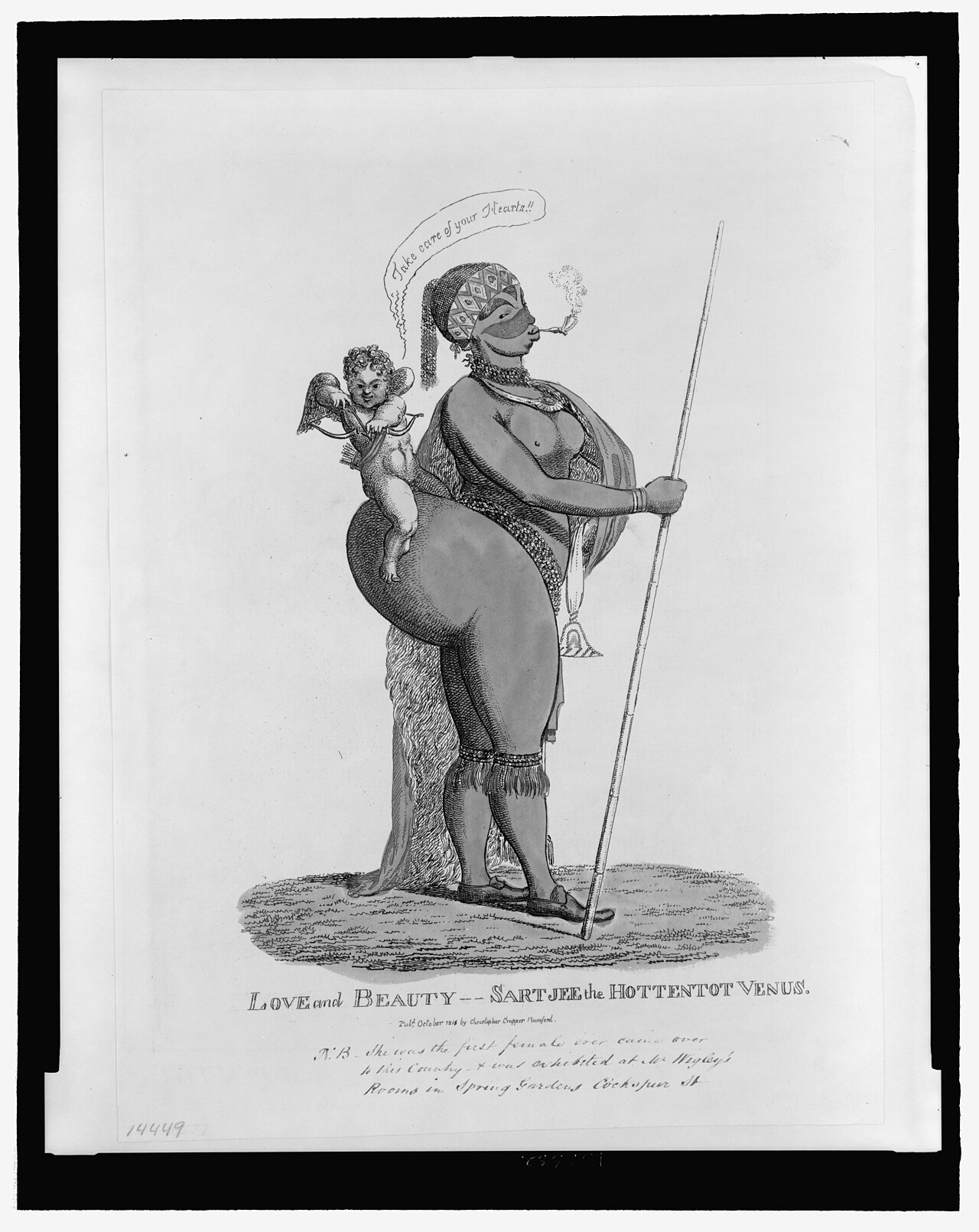
Photo: British Cartoon Prints Collection / Library of Congress (LCCN 2007680266), via Wikimedia Commons — Public domain
She is recorded as Sara Baartman, also Saartjie; the name in all its spellings is a colonial artefact, and her Khoekhoe birth name was never recorded. Her voice survives only in fragments: a courtroom statement through interpreters, and a scientist’s notes on her languages. Born around 1789 near the Gamtoos River — her biographers Clifton Crais and Pamela Scully themselves argue for a 1770s birth — she was taken to London in 1810 by Hendrik Cezar and Alexander Dunlop and exhibited as the “Hottentot Venus” at two shillings a head, in a skin-coloured costume. Spectators could pay extra to touch her; abolitionist testimony described her ordered about “as any beast”. Crais and Scully argue the act probably began around 1808 at the British military hospital in Cape Town. Whether that early performing involved meaningful choice is not something the record can settle.
In November 1810 the African Institution brought a King’s Bench case. The hearing on 24 November 1810 was dismissed on the strength of her own testimony — given through interpreters, with Cezar excluded after she refused to speak in front of him, but with Dunlop, the scheme’s organiser, present in the room. That presence is precisely why historians doubt its independence. The archive documents coercion in detail; it documents consent only in that single compromised statement.
Sold in Paris in 1814 to S. Réaux, an animal exhibitor, she was exhibited at the Palais-Royal and at private parties; Crais and Scully report some evidence, flagged as such, of a collar at one point. Over three days in March 1815, naturalists at the Jardin des Plantes examined her to verify a rumour from travel writing about the so-called “Hottentot apron”. She steadfastly refused, even for money, to expose her genitals. In life, that part of her body was never surrendered to the scientific gaze.
She died on 29 December 1815, aged about 26, cause never established. Georges Cuvier dissected her but conducted no autopsy into the cause. His 1817 monograph recorded her intelligence, memory and fluent Dutch, and in the same text compared her ears to an orangutan’s. The anatomy she had refused to show was then “confirmed” from her corpse, which could no longer refuse. The gaze was constructed in stages: travel writers’ rumour, stage spectacle, a scientific examination demanding the body verify the rumour, dissection manufacturing the verification, museum display freezing it as fact. Sander Gilman (1985) described the “female Hottentot” as a sign of pathological sexuality in European thought; Z.S. Strother’s “Display of the Body Hottentot” (1999) remains the standard art-historical account of the display.
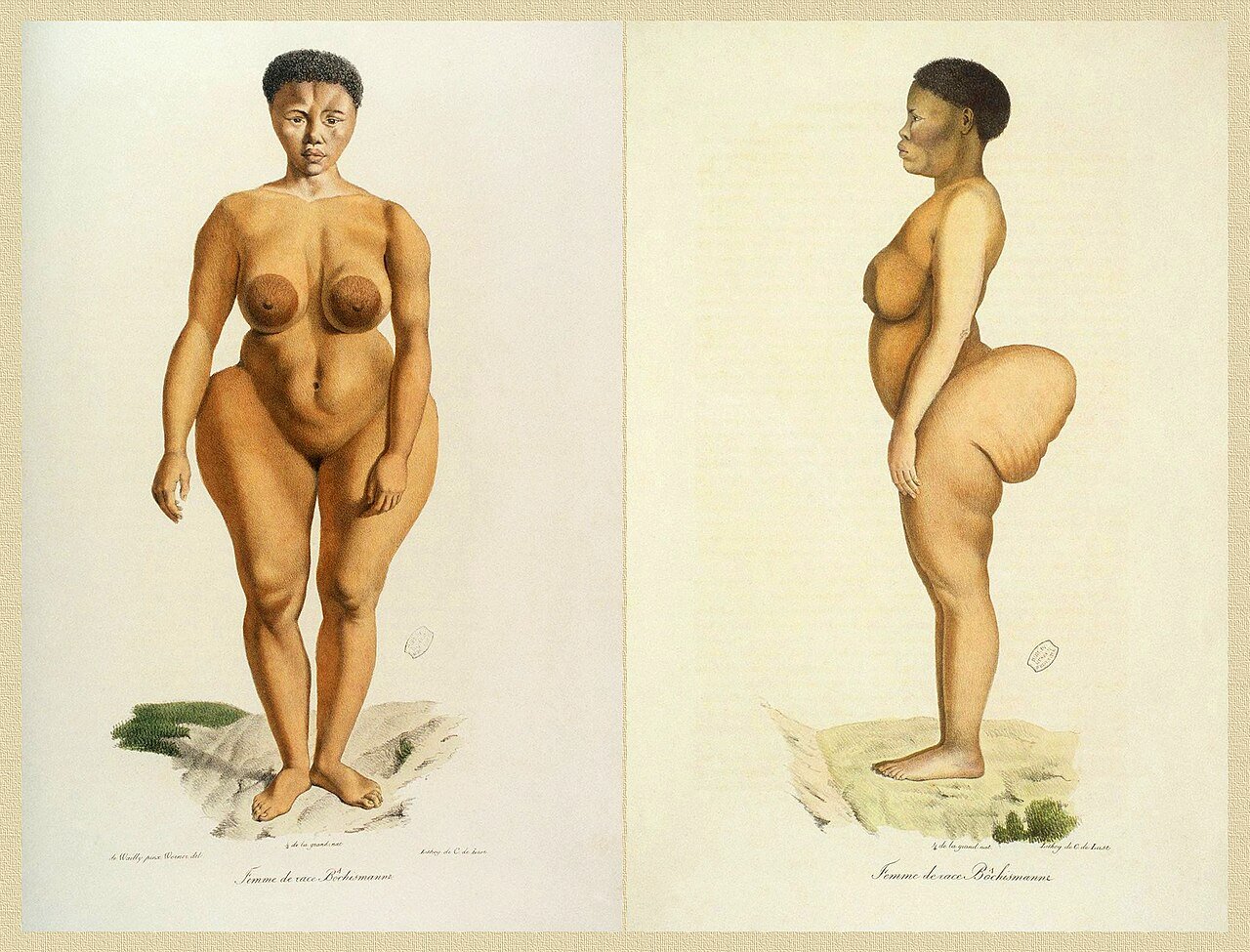
Photo: Werner, Maréchal & Huet; C. de Lasteyrie (lithograph); in Geoffroy Saint-Hilaire & F. Cuvier, Histoire Naturelle des Mammifères, via Bibliothèque nationale de France / Wikimedia Commons — Public domain
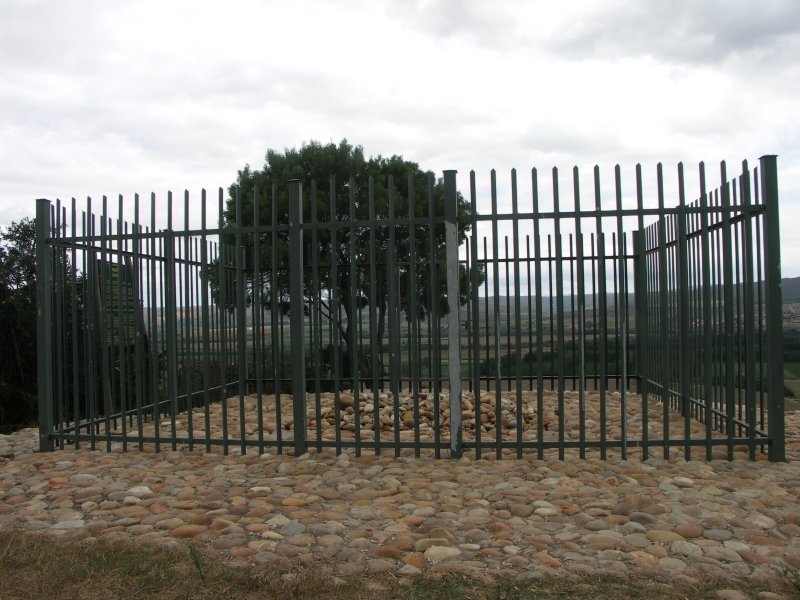
Photo: NJR ZA, CC BY-SA 3.0, via Wikimedia Commons
Her skeleton and body cast were displayed at the Musée de l’Homme until 1974, the cast about two years longer; her preserved brain and genitals were kept in the collections, stored, not displayed. Stephen Jay Gould’s The Mismeasure of Man (1981) returned her to public attention. What museums claim when they hold human remains in this way, and on what authority, is taken up in a close reading of a museum’s claims about colonial history. Nelson Mandela requested her return in 1994; Diana Ferrus published “I’ve Come to Take You Home” in 1998; curator Philippe Mennecier defended retention on the record — “for us she remains a very important treasure”. Because French museum collections were legally inalienable, return took a special act of Parliament on 6 March 2002. She was buried at Vergaderingskop, Hankey, on 9 August 2002. The legal fictions that dressed possession as stewardship are the same terrain as the return of a Benin artefact associated with Oba Ewuare after 129 years.
| Date | Event, as documented |
|---|---|
| c.1789 | Born near the Gamtoos River; Khoekhoe birth name never recorded; biographers argue for a possible 1770s birth. |
| 1810 | Taken to London by Cezar and Dunlop; exhibited as the “Hottentot Venus” at two shillings a head. |
| 24 Nov 1810 | King’s Bench case dismissed on her testimony, given through interpreters with Dunlop present. |
| 1814 | Sold in Paris to an animal exhibitor; exhibited at the Palais-Royal and private parties. |
| March 1815 | Examined over three days; refused, even for money, to expose her genitals. |
| 29 Dec 1815 | Died, aged about 26; cause never established; dissected by Cuvier. |
| 1817 | Cuvier’s monograph records her intelligence and fluent Dutch, compares her ears to an orangutan’s. |
| Until 1974 | Skeleton displayed at the Musée de l’Homme until 1974, the cast about two years longer; brain and genitals kept in collections, not displayed. |
| 1994 | Mandela requests her return. |
| 6 Mar 2002 | French act of Parliament authorises return, required because collections were legally inalienable. |
| 9 Aug 2002 | Buried at Vergaderingskop, Hankey. |
Table 1: Sara Baartman — timeline from the documented record.
The scholarship argues about her, and that is part of the record: Crais and Scully’s recovery of a life beyond inevitable victimisation, against Desiree Lewis’s warning that writing her “agency” risks inventing an interior life the archive lacks. Zine Magubane (2001) warned that Baartman is easily turned into a free-floating metaphor — invoked everywhere, engaged nowhere. This article keeps the discipline that warning requires. Documented invocations, both within days: Guardian commentator Hana Riaz named Baartman in coverage of the 2014 photograph discussed next; critics of Kim Kardashian’s 2014 Paper cover named her, the precise claim being about recycled iconography — Jean-Paul Goude recreating his own 1976 photograph of a Black model — not equivalence between the women. Symbolic use, flagged as such: Suzan-Lori Parks’s play Venus (1996), which invents dialogue knowingly; the Victorian bustle-dress thesis, single-author and speculative, not consensus; and a January 2016 Beyoncé biopic rumour her representative denied outright — there was no film. A parallel case — a man grave-robbed around 1830, displayed in Catalonia until 1997, buried in Botswana in 2000 — shows display outliving death was a practice, not an aberration.
“For us she remains a very important treasure.” — Philippe Mennecier, curator at the Musée de l’Homme, defending the retention of Sara Baartman’s remains
What the video got wrong: a chair, a photograph, and a credit line
The photograph is famous, which is part of the problem. Dasha Zhukova, a wealthy white editor, sits smiling on a chair whose base is a bound, near-naked Black female figure on all fours — a woman made into furniture. Published on Martin Luther King Jr. Day in 2014, it drew immediate condemnation. Claire Sulmers called it “white dominance and superiority, articulated in a seemingly serene yet overtly degrading way”. Bustle made the distinction this article also keeps: the sculpture alone can argue about degradation; the seated portrait performs hierarchy.
The reel framed the photograph as part of Ferran Casanova’s photography. It is not his. Its photographer is unknown. The honest credit line — the only one it has ever carried — is:
Photographer unknown; published by Buro 24/7, 20 January 2014.
The photograph illustrated the original Buro 24/7 interview with Dasha Zhukova, a web interview published on 20 January 2014. It was never a Garage magazine cover, although Zhukova edited Garage and the reel also described it that way. The article is still live, carries no photographer credit for any image, and the chair image was removed from it long ago — Buro cropped the chair out afterwards, judging the image could not be defended as published, only amputated. Its files sit in Buro staff upload folders, the signature of an in-house shoot. Every outlet that reproduced it — Mic, Fashionista, Perez Hilton, Dezeen, eCanadaNow — credited only “Buro 24/7”. Getty Images never carried it. On Casanova’s side the negative is clean: Barcelona-based, active since at least March 2010, his documented output from 2010 to 2026 is uniformly male-model fashion editorial, his portfolio contains no such image, and no search pairing his name with Buro, Garage or Zhukova returns anything except summaries of the reel itself. No professional pathway connects him to a Moscow interview shoot.
The conflation arose in four documented steps: the essay’s own frame, billing the whole video as Casanova’s photography, so every montage image sits under his name; montage adjacency, the chair following Latin Lover with no distinguishing credit; an error that travelled with the story, “Garage cover” for a web-interview illustration; and summary drift, the platform’s narrative stating the attribution as flat fact while a share-summary even misdated Latin Lover to 2014. One caveat stands: without a verbatim transcript, it cannot be proved Awuah-Darko spoke the exact attribution, as opposed to his framing being hardened by summarisers. But the video as presented ties the image to his Casanova frame. The photograph has attracted confident wrong attributions since it appeared — an apology at the time credited the chair to Allen Jones instead of its maker — and the Casanova claim is the latest in that chain.
The chair’s lineage, briefly: Allen Jones’s Hatstand, Table and Chair (1969), fibreglass women as furniture, protested from 1970; Bjarne Melgaard’s 2013 remake re-cast the set with Black mannequins. The 2014 portrait took the sculpture out of the gallery argument and used it as a prop. Critics at the time kept the two objects apart, and so does this article. Of the reel’s six checkable claims, five checked out in primary or near-primary sources. The one structural error is the load-bearing one, stated precisely here so it does not contaminate the rest.
The word itself: a category, not a coinage

Photo: Santeri Viinamäki, CC BY-SA 4.0, via Wikimedia Commons
“BBC” — Big Black Cock — is a porn-industry category, not a Black coinage and not lived language. Its lineage runs from slavery-era hypersexualisation myth, through the lynching-era “myth of the Black rapist” Angela Davis named, through the “Mandingo” figure fixed by Kyle Onstott’s 1957 novel and the 1975 film, through Behind the Green Door (1972), whose interracial scene billed Johnnie Keyes literally as “African Stud”, through a 1990s Usenet acronym, into tube-site taxonomy. In 2022 it was Pornhub’s 20th most searched category.
What the term carries is not a measurement but a bundled script. Trevon Logan’s Economics, Sexuality, and Male Sex Work (2017) documents it: size plus dominance plus aggression plus the white partner’s submission. The category assigns a role before any particular man has spoken. On the demand side the direction is documented as one-way. In Stacey and Forbes’s “Feeling Like a Fetish” (Journal of Sex Research, 2022), fetishisation was rare in public profiles but prevalent in private messages, fetishising profiles were overwhelmingly presented by white men, and men of colour described feeling objectified, blocked from connection, and boxed in to a stereotype. Mikelle Street’s MEL Magazine feature, “Living With the Myth of the Big Black Cock” (2017), is built on the dick/cock observation: Street and all ten Black friends he asked said “cock” was something they had only heard white people say.
15,521 men
Veale et al. (2015) reviewed clinician-measured studies covering 15,521 men and found no evidence for penis-size differences linked to race. Within-population variation dwarfs any claimed between-population difference. Source: Veale et al., BJU International, 2015.
The lexicography turns Street’s observation into dictionary record. In Black Southern US usage, “cock” historically meant the vagina. Green’s Dictionary of Slang labels the sense “(US, chiefly black/Southern) the vagina”; the Historical Dictionary of American Slang labels it “So. & Black E. a. The vulva or vagina; cunt”. Green’s citations run from London flash songsters of 1833 and 1841 through W.C. Handy (1923) and Lucille Bogan (1935) to UGK (1996). The Dictionary of American Regional English usage note — north of roughly the Mason-Dixon line “cock” means the male genitals, in the South its use is restricted to the female genitals — is quoted through secondary reproductions, because that dictionary is paywalled and was not read directly; its substance is corroborated by Green and the historical dictionary.
“Cock-opener”, meaning penis, is attested in Clarence Major’s Juba to Jive (1994, p. 102), dated 1920s–1940s and labelled US Black, and in Charles Mingus’s Beneath the Underdog (1971), in a sentence performing the whole system at once: her “cock” the vagina, his “cockopener” listed with “dick” in the same sentence, “dick” supplied by Mingus himself as the ordinary word. Bob Margolin confirms Muddy Waters used the same split. Green’s “cock-opener” entry rests on Major alone — a one-link chain, stated plainly. Two print attestations across a century is a thin written record, but that thinness is the normal profile of oral family vernacular, not evidence against the usage. The lineage is British low print first, probably from the shell metaphor, then Southern naturalisation among Black and white speakers, then longest survival in Black Southern speech. No source proposes an African etymology, and none is invented here. The conclusion follows: in that vernacular “cock” was already taken, by the vagina, so “Big Black Cock” could not have been coined inside it. Its authorship sits with the industry that categorised it and the consumers who learned to ask for it by that name.
Europe today: the apps, the asylum system, and worlds kept apart
Photo: Ruud Zwart (Sherpa), CC BY-SA 2.5 NL, via Wikimedia Commons
Race-based exclusion and race-based fetishisation are routine, measurable features of gay hookup apps. Denton Callander, Christy Newman and Martin Holt, surveying 2,177 Australian gay and bisexual men, found tolerance of “sexual racism” tracks general racist attitudes — in Callander’s words, plain old racism disguised in the language of desire — while about 70 per cent of respondents did not consider sexual racism a form of racism at all.
Europe is where some of the sharpest documentation was made. Andrew Shield’s Immigrants on Grindr (Leiden and Copenhagen fieldwork) documents newcomers, asylum seekers among them, depending on the app for housing, friends, jobs and information, inside a scene that understands itself as post-racial — dependence that makes its racial dynamics hard to walk away from. Damani Partridge’s Berlin ethnography (2008) found white fetishisation of Black noncitizen men whose residency ran through white partners acting, in his phrase, as street bureaucrats over their status. French scholarship documents the same dynamics under republican colour-blind denial. A Dutch study of Grindr found Black users coping by performing into the racialised assumption. The Netherlands’ wider argument over racial imagery, far beyond the apps, is examined in an investigation of Zwarte Piet and blackface.
On Dutch social structure the evidence converges and is graded documented: InterNations surveys placed the Netherlands in the bottom tier for making local friends across 2019, 2021, 2022 and 2024, and network sociology supplies the mechanism — context-bound, early-formed, homogeneous core networks, stable in size over years (Gerhard Mollenhorst and colleagues; Beate Völker). For a newcomer whose first contacts are men who approached him as a body, that closure is the structure of his social life, not background colour.
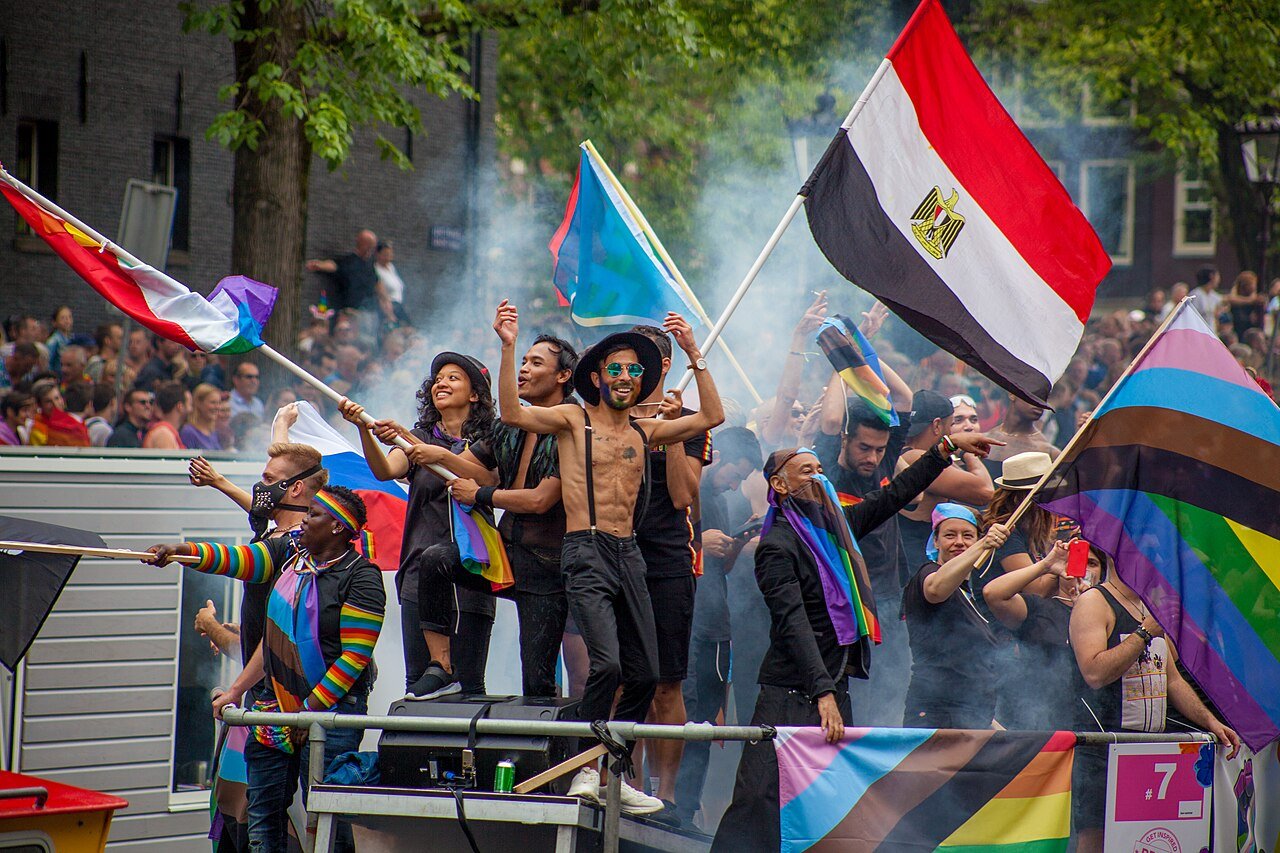
Photo: Tadeáš Bednarz, CC BY-SA 4.0, via Wikimedia Commons
Sixty-two UN member states criminalise consensual same-sex acts (ILGA World, 2024). Jamaica’s Offences Against the Person Act still stands, its Constitutional Court holding in Tomlinson (October 2023) that a savings clause bars review; Uganda’s Anti-Homosexuality Act 2023 was upheld in large part on 3 April 2024. Men fleeing those jurisdictions claim asylum in the Netherlands, the United Kingdom and Spain. No EU member state counts sexual-orientation claims as a series, and the Netherlands publishes neither a count nor a grant series. What can be known comes from file-level research: Sabine Jansen’s Pride or Shame? (COC Netherlands, 2018), examining 267 IND files, with findings in the chart below and in ECRE’s interview with Sabine Jansen on LGBTI asylum in the Netherlands. Rejections were assessed against stereotyped expectations of awareness and self-acceptance; a 2022 follow-up found the reasoning persisting. COC reported in October 2025 that 57 per cent of LGBTI asylum seekers in Dutch reception report discrimination. The Court of Justice of the EU twice barred degrading proof demands: A, B and C (2014, Dutch cases: no films, medical tests or explicit questions) and F v Hungary (2018: a Nigerian man’s rejection on Rorschach and Szondi tests, struck down).
CHART 1 — The Dutch credibility gauntlet
Rejections where the stated orientation was not believed — 85%
Files that eventually ended in a grant — 63%
Jansen, Pride or Shame? (COC Netherlands, 2018), 267 IND files.
Photo: FrDr, CC BY-SA 4.0, via Wikimedia Commons
Compartmentalisation is where scene and structure meet. In conversations the author came across while reporting, a pattern was described repeatedly: a white partner, out as gay, who keeps a Black partner in a sealed-off world, never around his friends or family. The verdict is documented. Every mechanism is on the record — fetishisation hindered platonic and intimate connection (Stacey and Forbes, 2022); visible interracial relationships carry measured stigma costs (Rosenthal and Starks, 2015); total compartmentalisation is a studied practice among non-disclosing and married men (Schrimshaw and colleagues; Silva, Still Straight, 2021). The accounts the author came across while reporting describe the same configuration those studies record: the sealed compartment, the kept-apart world, the partner who is never brought into the light of a man’s ordinary life.
Predatory selection is documented where money or organisations mediate it, and attested in testimony at the interpersonal point. ZDF’s Frontal 21 (October 2017) caught Berlin shelter security guards brokering young male residents into prostitution, a guard’s on-record criteria being “from 16 years and up; the younger they are, the more expensive they are”, at a €20 commission. The Berlin Senate found no organised ring and no prosecution outcome is in the record — multiply corroborated investigative reporting, not a court finding. Linthout and colleagues (2026) on sex proposed for shelter in Brussels and Calais documented propositions in humanitarian settings and private homes, with racialised sexual objectification among the conditions. An Italian study found 79 per cent of African refugee male sex workers sampled (n=150) relied on sex work as sole income. Berlin Federal Police warned in March 2022 of a “helper with a room” pattern at arrival points. Marlene Spanger’s Berlin and Copenhagen research documents support inside the queer refugee-support economy itself being mediated by sexual intimacy as a form of currency, within racial hierarchies, sometimes leading to exploitation.
52.5%
Macapagal et al. (2018): of sexually experienced gay and bisexual boys aged 14–17 in the study, 52.5 per cent had used adult hookup apps, whose gate is a self-declared birthdate. Underage presence on the apps is documented at scale.
The lock is on the wrong door
The argument about protecting children online is usually aimed at dating apps, and the gate there is documented as fiction: a self-declared birthdate, ticked past in seconds, which is how boys of 14 to 17 come to be present on adult platforms at the scale Macapagal and colleagues measured. But the dating app is not the only door — and in the accounts gathered for this article, a great many of these encounters never pass through a dating app at all.
They arrive through ordinary social media: TikTok, Instagram and, above all, Snapchat. These are the platforms teenagers actually live on, formally open from the age of 13, again on nothing more than a self-declared birthdate. Snapchat is the discreet married man’s instrument for exactly the reason it is a teenager’s: the messages disappear. The compartment this article has traced through whole relationships — the sealed-off world, the partner nobody ever sees — is built into that app as a feature. A child lock fitted only to dating apps leaves that door standing open.
A serious lock, then, has to sit where children actually are: real age gates, and accounts for minors that are private by default and closed to contact from unknown adults, on the social platforms as much as on anything that calls itself a dating app. Until it does, the documented route stays open — an adult who wants a sealed compartment, and a minor who declared himself 18, or 16, or 13, meeting on ground designed to leave no trace.
Those open doors are where the human accounts in this article begin. Two accounts the author came across while reporting belong here, told relationally and without profile. In the first, a man told somebody who described it afterwards that he had assumed the person he was approaching was a refugee — that he would have taken advantage had that been so — and withdrew on hearing an accent that reclassified that person as someone with somewhere to stand. It is the research’s only record of refugee status itself named aloud, in a direct approach, as the targeting criterion, and of legible non-refugee status as protection. In the second, a man from Jamaica had lived in the country for some fifteen years and, on the account given, knew nobody beyond the men who had tried to hook up with him on arrival and his neighbours. He became depressed and died there; a neighbour seeking burial costs reached out through the dead man’s own phone and messaging account. The literature documents every stage of that arc separately and contains no longitudinal case of the whole. At its Dutch endpoint stands an institution: the eenzame uitvaart, the lonely funeral, a municipal funeral for those with no one to arrange or attend, at which a poet reads a poem written for the deceased. Rejected asylum seekers appear in its reports as named individuals, and nowhere as a counted category — the same silence as the missing asylum statistics.
The double exclusion beneath both accounts is documented (Kahn, Alessi and colleagues, 2018; Lee and Brotman, 2011; a 2022 systematic review): forced migrants cut off from diaspora communities by homophobia and from the gay scene by racism and fetishisation, community connection the scarcest resource. The small overlap exists only institutionally — buddy networks and refugee-led groups, small, urban, NGO-built, possibly hours from a man in a small-town centre. That the organic route fails is why they were built.
| Claim | Verdict | Basis, in brief |
|---|---|---|
| Asylum flows from criminalising states | Documented | 62 states criminalise (ILGA World 2024); Jamaica and Uganda rulings on record. |
| Dutch tight circles closed to outsiders | Documented | InterNations rankings; network sociology (Mollenhorst; Völker). |
| The BBC script among white Dutch gay men | Documented as behaviour | App and ethnographic record; “colonial mindset” is a gloss, not a finding. |
| Compartmentalisation and kept-apart worlds | Documented | Mechanisms documented across the studies; the accounts match the recorded configuration. |
| Wide age range, including older men | Partially documented | Script’s age documented; no cohort measurement of seekers. |
| Teenagers as young as 16 on the apps | Documented | Presence documented (Macapagal et al., 2018); boys “from 16 years and up” brokered on record (ZDF Frontal 21, 2017). |
| Discreet married men | Documented | Sealed-compartment use documented (Schrimshaw and colleagues; Silva, Still Straight, 2021). |
| Community blocked on both sides | Documented | Double exclusion replicated (Kahn 2018; Lee & Brotman 2011; COC 2025). |
| Small-overlap community as the only route | Documented as structure | Overlap exists institutionally only: small, urban, NGO-built. |
| “Needs to be studied” | Documented as a gap | The join, the compartmentalisers, age, Dutch counting and Spain remain unmeasured. |
Table 2: Claim-by-claim verdicts on the Europe testimony claims.
Deportation as leverage: when a permit becomes a weapon
A non-EU partner’s Dutch permit is grounded in the relationship. If cohabitation ends, the ground falls away, the permit is withdrawable, and both partners must report the end to the IND within four weeks. An independent permit normally requires five years as a partner plus the civic-integration exam — among the EU’s longest probationary periods, with three-year variants for some EU-citizen and Turkish association cases and narrow earlier exits for substantiated domestic violence, children or hardship. The domestic-violence route averaged only about 180 applications a year (2013–2020) against roughly 12,000 incoming marriage migrants a year.
Betty de Hart, Elles Verweij and Younous Arbaoui (VU Amsterdam, Heb geduld, 2022) found what that structure does: the dependent permit hands the sponsor “an instrument of power”; migrants are threatened with expulsion and sit out violent relationships; the sponsor holds an information monopoly; and dependence damages autonomy even where no violence occurs. De Hart frames it as state-manufactured deportability, after Nicholas De Genova (2002): what disciplines everyday life is not deportation but the permanent possibility of it. The coercive-control literature independently documents deportation threats as a standard instrument (Menjívar and Salcido, 2002; a 2023 King County study of protection orders).
The dependent permit hands the sponsor an instrument of power. — after De Hart, Verweij & Arbaoui (VU Amsterdam, 2022)
A case the author came across while reporting shows the mechanism in a single relationship. Somebody who described it knew a British expatriate living in Spain: a racist who held racist stereotypes about Black people even though he only dated Black people — exclusivity and stereotypes running simultaneously, a pattern the record documents; what scholarship has not done is isolate this configuration in a studied subject, and it is the naming of this case, not the pattern, that stays partial. He was in a relationship with a refugee from Ethiopia. On the account, he started the arguments and fights; when his partner withdrew and stopped talking to him, he repeatedly threatened him with deportation. His father then gave him €10,000 to hire a lawyer to pursue it — deportation not as a shout but as a funded project. What stopped it, on the account, was not law or any institution: a bystander intervened, named what he was doing and the privilege operating in it, and asked what kind of human he was. He backed down.
Two gradings must stay plain. For a man with his own asylum status, a partner has no lever over the permit itself — withdrawal needs state grounds — though residual levers remain: reports that can trigger scrutiny and months of fear, threats to out him at origin, and information asymmetry that makes every threat land at full weight. If a man’s stay ran through the relationship, the threat is simply a true statement of the law. And family money funding a deportation attempt, and its defeat by bystander intervention, appear nowhere in the literature searched. They exist in the record only as testimony. That makes the account a lead scholarship has not followed, and its decisive moment a person in a room refusing to let leverage pass unnamed.
Generations and the typology: the same script, recast by age
The literature measures exposure in months. The accounts the author came across while reporting measure it across a life. A Black man around the author’s age, whom the author came across while reporting this piece, described being approached by older white men at 13 and at 16; younger men only approached him in his 20s and again in his mid-to-late 30s; and in Europe, he described, all cohorts arrive at once — in his words, the pattern intensified, on steroids. The arc as a whole is testimony, not a finding, and this article grades it that way.
Adjacent findings are documented but do not join into that arc. Goff and colleagues (2014) found Black boys read as less innocent from age 10, with ages overestimated by about four and a half years in felony-suspect studies, the distortion predicted by an implicit Black–ape association. The adultification-to-exploitation link has been drawn in print for girls; for boys, the join is unmade. US age-discordant partnering research documents older partners in young Black men’s sexual development, but mostly same-race and HIV-framed. Silva’s Daddies of a Different Kind (2023; 39 daddies aged 43–70, 26 younger men aged 23–33) documents “daddy” as a structure of maturity and mentorship, typically adopted in men’s 40s in response to younger men’s approaches — and does not racialise the category at all.
The four-generations claim — one man fetishised by men spanning three to four generations from multiple unrelated families, while he alone ages — is untested in the literature. No study measures fetish behaviour by the seeker’s age cohort; a scholarly sweep for this research confirmed the hole is genuine, not a search failure. What is documented is the machinery that would produce continuity: a pre-internet script, porn metadata industrialising it for each new cohort, and porn socialising young men’s sexual scripts. Transmission, on this account, is cultural, not familial. Untested, not refuted.
| Seeker | Casting assigned | Constant |
|---|---|---|
| Younger seekers | The Black man as “daddy” — “daddy BBC” | BBC |
| Older seekers | The young Black “basketball player or rapper type”, also with BBC | BBC |
Table 3: The typology as described in testimony. Each archetype has a documentary trail; the cohort-relative rule is testimony-only and unstudied.
Each archetype separately has a trail: the Black stud is porn’s standing figure, the athlete’s body and the stud’s body read as the same casting, and “daddy” is an institutionalised app category. No source tests whether the archetype assigned varies with the seeker’s age. The toll, where measured, is real: Wade and Pear (2022, n=690) linked objectification by white men to higher depressive symptoms and lower self-worth, and the Healthy Young Men’s Cohort (2026, N=412, three waves) found app use leading to sexual racism leading to distress, buffered by racial and ethnic community connection — exactly the access the refugee configuration blocks. No study measures cumulative lifetime exposure or follows one man across successive cohorts.
Diffusion beyond white men: a script in other mouths
Does a script authored by an industry and carried, in the measured literature, overwhelmingly by white men stay with white men? The baseline says the ground was prepared elsewhere too. South Asian anti-Blackness is documented at every level: colourism fused with caste hierarchy, darkness at the bottom of the subcontinent’s own stratification — Glenn (2008) on the skin-lightening industry, Parameswaran and Cardoza (2009) on fairness advertising, and Dalmia’s 2025 ethnography of disgust at dark skin, in which colourism builds on casteism. The wider colour hierarchy is traced in reporting on skin bleaching, colourism and anti-Black xenophobia and in an overview of anti-Blackness in Asia. Directed at Africans in India, the baseline has a violent record — Bengaluru 2016, South Delhi 2016, Greater Noida 2017 — protested by African envoys and repeatedly classified by the government as non-racial. Vijay Prashad’s The Karma of Brown Folk (2000), written from inside, describes South Asians cast as a model minority and used, in his words, as “a weapon in the war against black America”.
Against that baseline, two message exchanges the author came across during reporting, shared for this piece, show the script arriving in new mouths. They establish existence, form and generational spread — not prevalence. A man in his mid-thirties stated his attraction as the colour itself: he liked Black people because of the colour, and did not like white skin. When the person he was addressing named the politics behind the preconceptions, including skin bleaching in India, he treated the naming as personal judgement, then left and removed the connection. A 19-year-old delivered the BBC line as a compliment, presenting it as a general truth about his own community, and defended himself with an individualist formula — that he would rather be judged by his words and actions than by someone else’s past experiences — before closing the conversation. The vocabulary is the taxonomy’s; the defences are the literature’s defences, reproduced by people who have never read it; and the older man’s dislike of white skin is an honest complication: diffusion must be a claim about the script’s authorship and distribution system, not about every adopter worshipping whiteness.
Non-white fetishisation of Black men is documented, unevenly. The Latino leg is strongest: Newcomb and colleagues (2015) found Black partners rated highest on stereotypically dominant characteristics by white and Latino raters alike. Smith’s El Paso thesis (2012) observed fetishism inside a Mexican-American sample analysed through Bonilla-Silva’s framework. For Asian men the evidence is discourse-level: Han’s framework places men of colour inside a dominant erotic hierarchy, and Thomsen (2020) recorded the stereotype voiced as scene knowledge in Seoul, traced to transnational gay culture in a country with no significant Black population to learn it from locally. The measurement problem shapes the record: the literature’s seeker is usually white because its samples are — one major sample was 86.6 per cent Caucasian — so a white-majority literature can neither confirm nor refute diffusion alone.
Internalised racial oppression reproduces racial inequality without white actors present in the room. — after Karen Pyke (2010)
The mechanisms are named scholarship, in parts. Kim’s racial triangulation (1999): relative valorisation of an intermediate group against Black people, with anti-Black scripts holding the intermediate position. Bonilla-Silva’s tri-racial order (2004) places Asian Indians explicitly in the honorary-white stratum, maintained by distance from the collective Black bottom; Smith (2012) is its single direct application to sexual racism. David and Okazaki’s Colonial Mentality Scale (2006) measures a dominant culture’s colour standards installed as automatic preference. Callander’s joint — the link between the attitudes a dominant culture sets and the sexual scripts that follow from them — completes the logic: if sexual scripts follow generic attitudes set by the dominant culture, their appearance in non-white mouths is the predicted output. The distribution system is global — platform taxonomy in every market, the porn-to-profile circuit documented in Delhi and Kolkata. The verdict, in parts: baseline documented; non-white fetishisation documented unevenly; South Asian gay men specifically a gap — no study measures them as seekers; mechanism documented in parts, the assembled synthesis ahead of the literature. It goes where scholarship has not gone: the people who see the whole pattern are the people it lands on, not the people studies sample as seekers.
What research has never studied
Photo: Arthur Weidmann, CC BY-SA 4.0, via Wikimedia Commons
The gaps, gathered, are specific enough to design studies from tomorrow. South Asian men as seekers have never been measured: no corpus coded by their ethnicity with Black targets, no interview study, no subsample analysis. Cohort-relative casting is unstudied: no work tests whether the archetype assigned to a Black man varies with the seeker’s age. The specific racial configuration of compartmentalisation — out white gay men, partner visibility by partner race — has never been directly studied, though every mechanism beneath it has. Family-money deportation attempts are absent from the literature, as is their defeat by bystander intervention. Beyond those four: the join itself, connecting the app, asylum, compartmentalisation and community literatures in one design following the same men; the Netherlands counted, since the state publishes no sexual-orientation asylum series; Spain studied at all; cumulative lifetime exposure, which no study measures; and the citizen “helper” exploiting a queer refugee in a private home, attested in testimony and unmeasured anywhere. The pattern in the list is plain: the unstudied questions are disproportionately those you would ask starting from the receiving end.
Close: the body displayed, the person withheld
Return to the reel. Its spine survived checking — the editorial, the runway moment it cited, the casting account, the critical judgements — and its one structural error has been corrected here at length.
The through-line is not a metaphor, and it has been kept to the points the record supports. In 1810, a court accepted consent given through interpreters, with Dunlop — the scheme’s organiser — present in the room. In 1815, a woman refused the scientific gaze, and after her death it took what she had refused, and a museum kept the cast for another century and a half and called her a treasure. In 2014, Buro 24/7 solved a portrait’s problem by cropping the chair out of the image. In 2023, an editorial clothed one model and faced him to the camera, and stripped the other, turned him away, hid his face and hung a banana on his back. On the apps today, an industry-authored category assigns a man a part before he has spoken, and in the asylum configuration it meets men whose housing, status and community may run through the people assigning it. The displayed body with the personhood withheld, from 1810 to now.
What would have to change is concrete. Research: cohort-stratified studies of fetishising approaches; seeker samples that do not presume whiteness; a Dutch asylum series, counted and published; longitudinal work across years. Platforms: taxonomy treated as an editorial decision, not neutral infrastructure, and age gates recognised as fiction. Asylum practice: the stereotyped inner journey retired, safety without enforced closeting, and dependence shorter than five years of permit-as-leverage. Only the standards each field already claims: measure what you assert, credit what you publish, and do not mistake a person for the use you have found for him.
Baartman was buried at Hankey in 2002, 187 years after her death, because a poet wrote that she had come to take her home, a president asked, and a parliament passed a law. The record since suggests the taking-home is unfinished: in the editorial meeting, the inbox, the reception centre, the relationship whose permit is also a leash. The measured conclusion is not that nothing has changed. It is that change, where it has come, has often come the way the deportation attempt in these pages was stopped — not by a system correcting itself, but by somebody present naming what was happening and refusing to let it pass as normal. That is a thin thing to rest a conclusion on. On the present record, it is also, too often, the only thing that has worked.
Sources and further reading
- The original Buro 24/7 interview with Dasha Zhukova
- The Brooklyn College Vanguard on the Latin Lover editorial
- Ferran Casanova’s portfolio
- Stacey and Forbes, “Feeling Like a Fetish”
- MEL Magazine, “Living With the Myth of the Big Black Cock”
- Veale et al. (2015), measurement review
- Linthout et al. (2026), sex for shelter
- Green’s Dictionary of Slang
- ECRE interview with Sabine Jansen on LGBTI asylum
- Smith’s El Paso thesis
- Dalmia (2025), “Ghinn”
- Anti-Blackness in Asia
- Skin bleaching, colourism and anti-Black xenophobia
- The Zwarte Piet blackface investigation
- Reading a museum’s claims about colonial history
- The Benin artefact return after 129 years
Leave a comment
Comment as a guest and verify your email, or sign in or create a reader account. Guest comments reach our review queue after email verification; account holders can submit directly for review.