Listen to this article
Take the story with you. Choose a voice and a pace that suits you.
Or listen in another language / choose a voice
Getting your device voices ready…
The voice follows the displayed language and your browser’s regional preference when available. You can choose another narration voice.
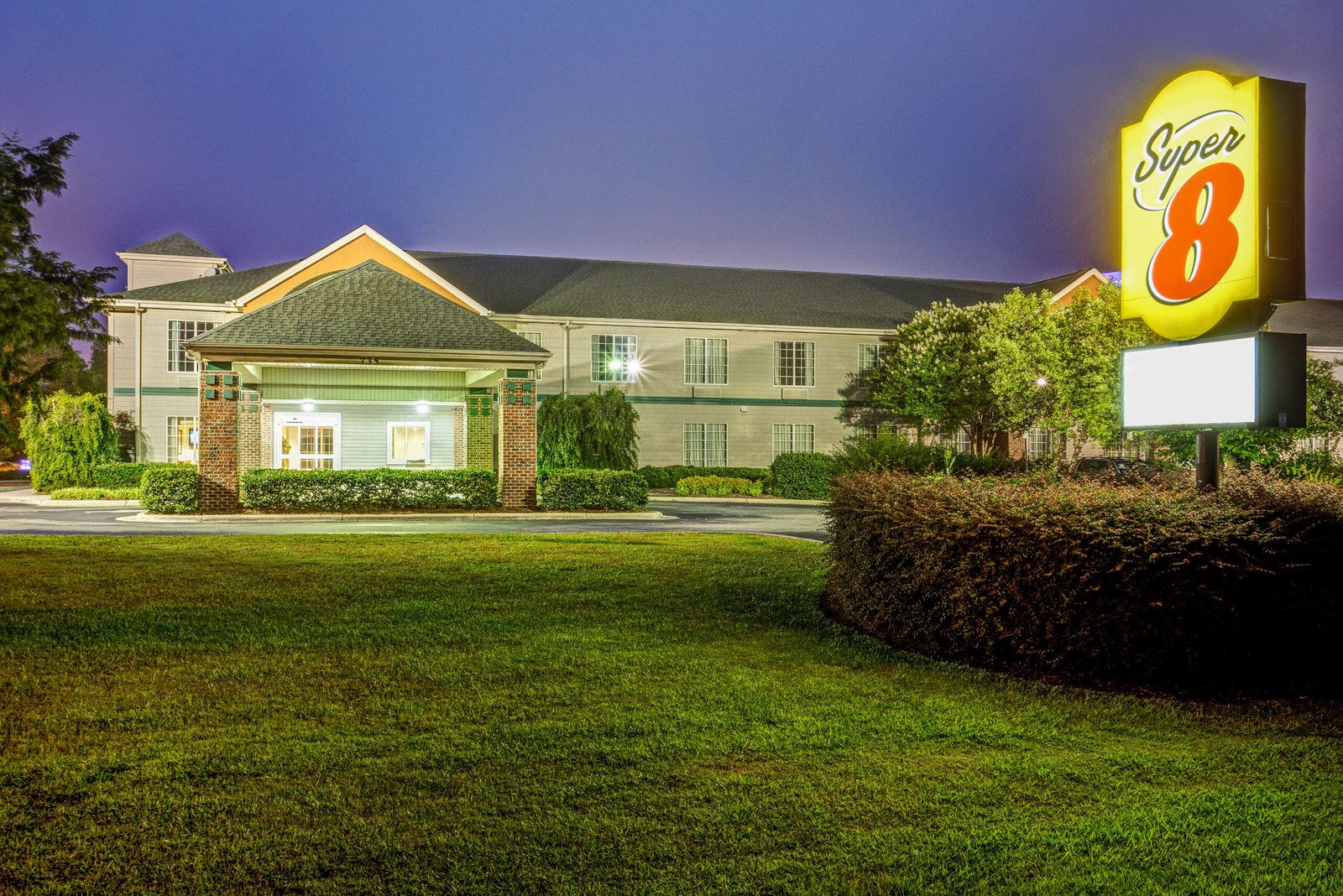
The Super 8 Smithfield worker fired this month did not just lose a job. He lost his home the same day, because the job and the home were the same thing: a room at the Super 8 by Wyndham Smithfield/Selma, an 80-room motel off Interstate 95 in Smithfield, North Carolina, where he had lived and worked for about six months. He says the work paid him almost nothing beyond that room — around $70 left to live on from each fortnight’s check — and he puts the wages he is owed at $24,000. No news outlet has covered this story. Neither the hotel, its owners nor Wyndham has responded publicly to any part of it.
Put out of his own room
The confrontation happened outside the motel, in daylight, with a police officer standing by. He first posted the footage to Instagram on 7 November; it is his account, and his alone, that this section follows. He had been accused, along with an older white co-worker, over a safe that was opened. By his account, the co-worker was scammed into opening it; Smithfield police investigated; no charges were brought against either of them. The co-worker kept her job. He was fired — and ordered off the property the same day, out of the room that was his only home.
The strongest material in this story is the owner speaking for himself. In the footage, the man who identifies himself as the owner offers terms: pay for the hours worked through the last night, one more night in the room, and money toward relocating. Beyond that, he says, the paychecks were already given — and anything more would have to be proved in court. Pressed on the removal itself, his position was four words long: “this is my property.”
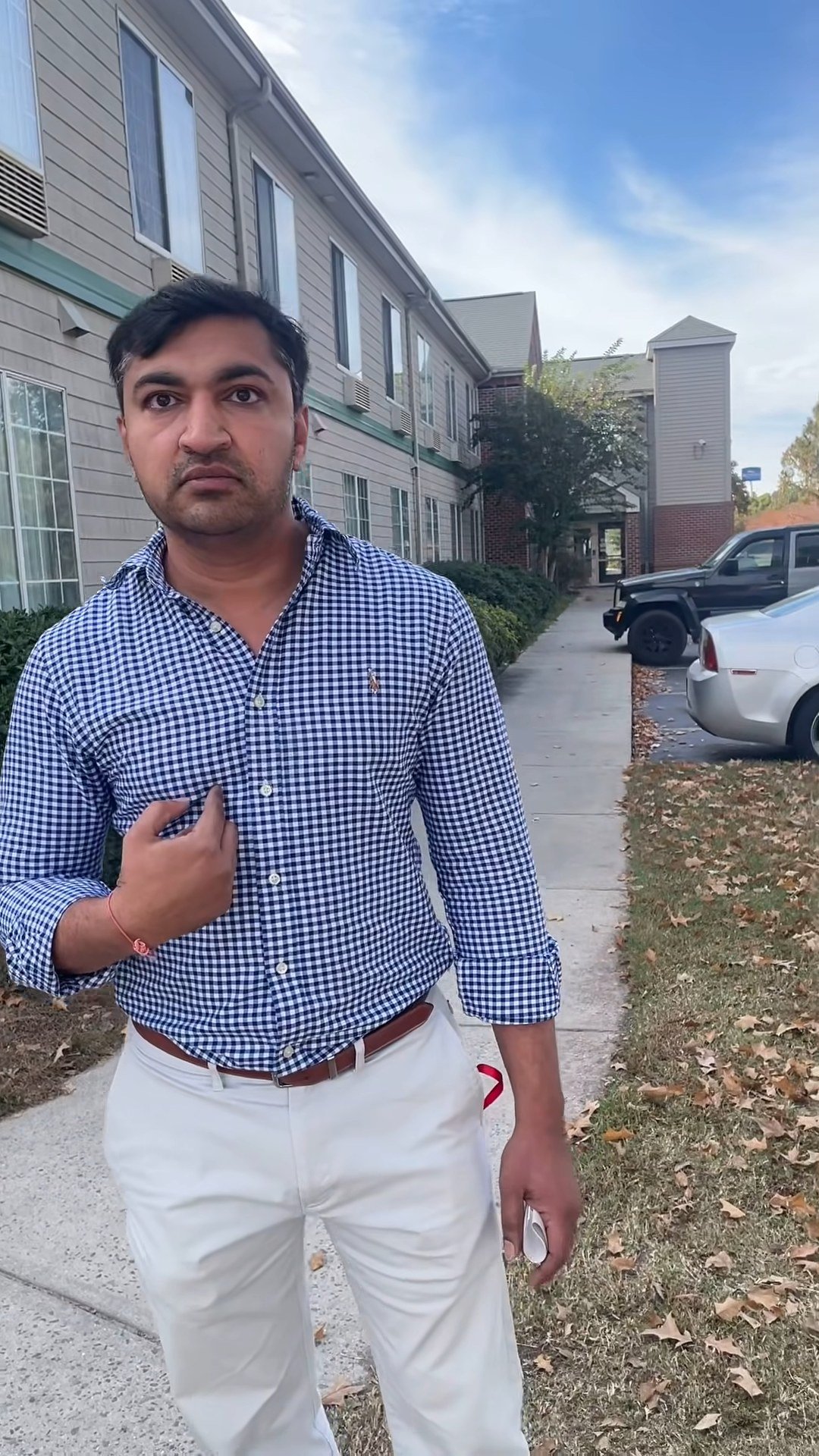
He refused the offer and refused, he says, to sign a paper that would have let the hotel fire him and put him out in a single day. A final check, he says, is still withheld by the manager he names. After he left there was no eviction notice; the room was resold; his plants and possessions were kept; and charges he calls fake were taken against him. He says he has taken the fight to the state wage authorities, and he names a Smithfield attorney, Aleta Ballard, as his lawyer — her involvement rests on his posts alone. In his comments he tags a Cary wage-and-hour firm founded by a former US Department of Labor wage investigator — a real firm, though being tagged is not being retained. He says around ten employees work under the same arrangement and are afraid to speak.
The room is the wage
The live-in hotel worker room as wages arrangement, in his telling: you live where you work, your pay is set so it covers the room and little else, and what reaches your pocket is pocket money. The arrangement was set, in his words, so pay covered the room at maximum, leaving roughly $70 to live on per biweekly check. Over six months of that, he says, he was in substance working for free — the source of his $24,000 figure.
Workers were clocked out at 40 hours, he says — and the work continued. Overtime was not so much refused as designed away: once the clock stopped at 40, every further hour was invisible. On top of that, he says, timesheets were changed. Federal rules (29 C.F.R. Part 516) require accurate time records — and where an employer’s records are wrong, the worker’s own reconstruction of his hours is allowed to carry the day. A pay system that caps the recorded week at 40 while the building still needs staffing manufactures unpaid overtime by design.
Under §3(m) of the Fair Labor Standards Act (29 U.S.C. § 203(m)) and 29 C.F.R. Part 531, an employer may count lodging toward wages — only if every condition holds: credited at reasonable cost, with no profit to the employer; customarily furnished; voluntarily accepted; lawful and code-compliant; and provided primarily for the employee’s benefit. A worker who must live on site so the motel has someone on hand is living there for the employer’s benefit — and lodging furnished for the employer’s benefit cannot be credited against wages at all. Substandard housing undermines the credit too, and the review record below corroborates mold and pests in these rooms. If the credit fails, every hour is owed in cash at no less than $7.25, plus time-and-a-half past 40.
North Carolina adds sharper edges. Under the NC Wage and Hour Act, final wages are due by the next regular payday after separation (§§ 95-25.6, 95-25.7): a withheld final check past that date is a per se violation — the cleanest single claim in this file. Wage deductions require the employee’s prior signed written authorisation and may never pull pay below the minimum wage (§ 95-25.8), the provision his “fake charges” allegation runs into. Wage claims carry an equal amount again in liquidated damages plus fees (§ 95-25.22; federally §§ 206, 207, 216(b)) — and §216(b) lets co-workers join as opt-in plaintiffs in a collective action. In North Carolina, wage theft is civil, not criminal — which is why the deadlines below matter.
The enforcement pattern is documented. In Riverton, Wyoming, the Labor Department recovered $189,466 for three clerks at a Motel 6 and a Super 8 paid $2.00–$5.15 an hour, from an employer investigated four times before. Black workers, a Center for Public Integrity analysis found, are roughly 50 percent more likely than white workers to be paid below the minimum wage. The Smithfield allegations sit inside a measured national pattern.
Guest or tenant? Six months is not a weekend stay
The owner’s four words raise the second fight: what, in law, was the worker when he was ordered out? North Carolina gives hotels a real answer, but a narrow one. Under G.S. § 72-1, a “transient occupancy” — the same guest in a hotel room for fewer than 90 consecutive days — is excluded from the state’s tenant-protection chapter (G.S. § 42-14.5). But the limit is 90 days, and this worker says he lived at the motel for about six months. Beyond that line, the older case law governs: in Baker v. Rushing (N.C. App. 1991), a hotel occupant whose room is his primary residence can be a tenant, whatever the building calls itself. The worker makes the point in his own caption: the room-and-board pay, he wrote, “also establishes residency on the property.”
If he was a tenant, removal had to go through court: summary ejectment, a magistrate’s hearing, and only the sheriff executing a writ of possession. Self-help eviction is banned outright (G.S. § 42-25.6). A tenant removed that way can recover actual damages under G.S. § 42-25.9, including for property kept outside the statutory process; and the NC Supreme Court has held a self-help eviction can also violate the Unfair and Deceptive Trade Practices Act (Stanley v. Moore, 1995), which trebles damages — the trebling comes from that Act, not § 42-25.9 itself. His account — room resold, possessions kept — describes exactly that conduct, if a court accepts it.
If he was fired for speaking up about wages, North Carolina’s Retaliatory Employment Discrimination Act requires a complaint to the Labor Department’s REDB within 180 days — for an early-November 2026 firing, that deadline falls in early May 2027. On the racial contrast at the story’s centre — the white co-worker who opened the safe kept her job; the Black worker lost his job and his home — the vehicle that reaches a small employer is 42 U.S.C. § 1981, with no minimum headcount and a four-year clock. Title VII reaches only employers with 15 or more staff, and whether this motel clears that line is unknown.
Follow the money: the S8 Hospitality LLC USDA loan
The motel changed hands recently, and the purchase was underwritten by the American taxpayer. S8 Hospitality LLC was incorporated in North Carolina in September 2023 and bought the Smithfield Super 8 on 4 January 2024. USDA Rural Development’s own awards chart records a Business and Industry guaranteed loan of $4,748,000. Of that, an interim note of $4,383,312 financed the purchase; the remaining $364,688 was to fund a property-improvement plan plus working capital and part of the closing fees. Borrower equity covered part of the $5.8 million consideration shown in recorded documents. The loan closed in fiscal 2024, when the federal guarantee stood at 80 percent: roughly $3,798,400 of a private First Bank loan is backed by the United States. It is a guarantee, not a grant — the borrower paid a 3 percent guarantee fee and pays an annual retention fee.
Recorded documents tie exactly one individual to S8 Hospitality LLC: Pareen Patel, a Raleigh-Durham investor whose signatures appear on the company’s mortgages, according to the records aggregator Elementix. His wider footprint is a small Apex–Clayton residential portfolio; this is his only hospitality asset on the record. No public record states his role or share, identifies him as the man in the footage, or corroborates a second Patel name that appears in the worker’s caption. The owners are Indian; their citizenship and immigration status are unknown, and stay unknown in everything that follows.
The context is an industry transformed: AAHOA puts its members’ share at about 60 percent of all US hotels, and Business North Carolina reported Indian owners holding more than half of the state’s 1,768 hotels and up to 80 percent of its independent motels. The live-in structure is one of this industry’s founding economics — built, in its original form, on family labour and living on site. The question is what happens when it is applied to employees rather than owners.
B&I eligibility turns on ownership: under 7 CFR 5001.8(a)(1), applied through USDA Form RD 5001-3, the lender must obtain a borrower certification that the entities owning it are at least 51 percent owned by US citizens or people legally admitted for permanent residence. A majority-foreign-owned company is ineligible, by rule. But the certification is a private document in First Bank’s file, and USDA publishes no borrower-ownership data — so compliance in this transaction can be neither proved nor disproved from the public record. If such a certification were knowingly false and material to the guarantee, exposure would run from False Claims Act treble damages (31 U.S.C. § 3729) to criminal false-statement liability (18 U.S.C. §§ 1014, 1001) — though we have no evidence that happened here. The realistic route for the question is the one built for it: a fraud, waste and abuse complaint to the USDA Office of Inspector General, which can open the file the public cannot.
Set the loan against the national numbers and the gap widens. B&I obligated about $1.8 billion in fiscal 2024, 98.24 percent of its allotment used — rationed capital. The Federal Reserve’s Small Business Credit Survey finds Black-owned firms fully approved 32 percent of the time against 57 percent for White-owned firms; the SBA’s published fiscal 2024 figures give Black-owned firms 7.2 percent of 7(a) loans and 3.2 percent of 504 loans. USDA’s B&I program publishes nothing equivalent: a business starved of capital cannot even look up who got the money instead. That is not an accusation against this borrower. It is a description of the system that financed him.
The conditions record
Whatever is disputed here, the state of the rooms is not — paying guests have documented it for years, on platform after platform, before and after the 2024 purchase. Scores as of 10 November 2026:
| Platform | Score | Reviews |
|---|---|---|
| 3.7/5 | 884 | |
| Wyndham (official listing) | 3.2/5 (cleanliness 3.2/5) | 244 |
| TripAdvisor | 3.4/5 | 149 |
| Expedia / Hotels.com | 7.2/10 (cleanliness 7.0/10) | 1,002 |
| Priceline | 6.5/10 | 783 |
| Better Business Bureau | D− · not accredited | 2 complaints in 3 years |
Read the reviews yourself: Wyndham’s official listing · TripAdvisor · Priceline · Expedia · the BBB profile · Google reviews via a Google Maps search for the hotel’s name.
The dated pattern is the evidence. October 2024: a roach on the wall, the room not cleaned. March 2025: dirty sheets, and a rat off the breakfast cereal containers, the manager laughing, the guest says. March and April 2025 brought bedbugs, cockroaches and dead bugs in the bed; through September, October and November 2025 the reports repeat one word — roaches. January 2026: “roach infested.” May 2026, on Priceline, a one-out-of-ten review whose listed cons read, in full: “Roaches, mold, dirty.” Some guests report good stays. The worker has a phrase for the visible upkeep: staff are only made to do “cosmetics work” — surface fixes, while the building underneath stays, in his word, a hazard. Those failures — pest control and housekeeping — are what a funded improvement plan exists to fix, and they are documented across the whole of the federally backed ownership’s first two years. The BBB grades the business D−, recording failure to respond to the two complaints filed against it. Across TripAdvisor’s 149 reviews, we found not one management response. Not one.
Wyndham’s own page advertises “updated guest rooms” on the same screen as its own 3.2-out-of-5 review widget. The Johnston County Visitors Bureau, the county’s tourism arm, markets the motel as “AAA approved” and “recently renovated.” North Carolina grades every lodging property’s sanitation at least annually under G.S. § 130A-248; below 70 percent, the permit is revoked, and the grade cards are public records. The one official inspection document we located, a January 2025 elevator inspection, passed with a minor paperwork violation. The sanitation grades for this address since January 2024 are the cleanest official before-and-after evidence in the story.
The questions nobody has answered
An investigation ends with what it could not establish:
- The improvement plan. Part of a $4,748,000 federally guaranteed loan funded a Wyndham property-improvement plan. What did it require, what was actually spent, and who signed off — Wyndham, First Bank or USDA? Guests were still reporting roaches and bedbugs in January 2026.
- The certification. Who signed the 7 CFR 5001.8(a)(1) ownership certification for this loan, and what did First Bank or USDA do to verify it?
- The second mortgage. A closed $4.4 million First Bank mortgage in S8 Hospitality LLC’s name was recorded in December 2023, weeks before the purchase closed, at a residential address in Clayton. Was it the interim note, and what secured it?
- The occupancy promise. USDA justified the award partly on projected higher occupancy under active management. Does USDA track whether B&I borrowers deliver — and did this one?
- The grade card. What sanitation scores has this address received from Johnston County since January 2024?
- The franchisor’s lever. Wyndham’s franchise agreements carry system standards, inspections and termination rights. How many quality inspections has this property undergone since the sale, and what did they find?
- The wage file. Has the NC Department of Labor opened a case on the worker’s complaint — and what does it find on the final pay, the one claim that is a violation on its face if the check was withheld past payday?
- The transparency question. The SBA publishes who its guaranteed loans reach. USDA’s B&I program publishes nothing equivalent. Why not?
The worker’s own deadline does not wait for answers: early May 2027 is when his retaliation-complaint window closes. The records that could settle the rest are held by institutions. Consider this the asking.
Photo: Wyndham Hotels & Resorts (official property photo)
Sources
- USDA Rural Development — Rural Partners Network awards chart (S8 Hospitality LLC loan record)
- USDA Rural Development — Business and Industry Guaranteed Loan program
- Federal Register — OneRD Annual Notice for Fiscal Year 2024 (80 percent guarantee)
- Form RD 5001-3 — Application for Loan Guarantee (lender certification, 7 CFR 5001.8(a)(1))
- Elementix — Pareen Patel investor profile (recorded documents, S8 Hospitality LLC)
- Wyndham Hotels — Super 8 by Wyndham Smithfield/Selma, official listing and reviews
- TripAdvisor — Super 8 by Wyndham Smithfield reviews
- Priceline — Super 8 by Wyndham Smithfield-Selma reviews
- Expedia — Super 8 by Wyndham Smithfield reviews
- Better Business Bureau — Super 8 Motel, Smithfield NC profile (D−)
- Johnston County Visitors Bureau — Super 8 listing
- Johnston County Environmental Health — lodging establishments and sanitation grades
- NC Department of Labor — how and where to file a wage complaint
- NC General Statutes, Chapter 95, Article 2A — NC Wage and Hour Act
- Federal Reserve Banks — Small Business Credit Survey, firms by race and ethnicity
- USDA Office of Inspector General — Hotline (fraud, waste and abuse complaints)
Leave a comment
Comment as a guest and verify your email, or sign in or create a reader account. Guest comments reach our review queue after email verification; account holders can submit directly for review.