Listen to this article
Take the story with you. Choose a voice and a pace that suits you.
Or listen in another language / choose a voice
Getting your device voices ready…
The voice follows the displayed language and your browser’s regional preference when available. You can choose another narration voice.
The South Africa municipal election results 2026 are still a partial picture, and everyone reporting them is saying so. With around 12% of votes counted early on Thursday, the African National Congress had about 32% of the vote, narrowly ahead of the Democratic Alliance on 30%, according to results from the Electoral Commission of South Africa cited by Reuters (Reuters). A later count, at 19% of votes counted, put the ANC at about 31.4% and the DA at 30.5% (Reuters).
The vote itself was held on 4 November 2026. Information verified through 5 November 2026.
South Africa municipal election results 2026: why a 12% count cannot settle the story
Reuters was explicit about the limits of the early tally. Only a small proportion of districts had reported in populous Gauteng and KwaZulu-Natal, home to some of the country’s biggest cities, so the early count was not yet representative of the national vote (Reuters). A rolling results portal drawing on IEC data showed 198 of 257 councils with results and 2,076 of 4,485 wards counted by Thursday morning, with eThekwini still waiting for its first results (TownPress / IEC data).
That uneven pace matters. Big metros count slowly. Small councils finish fast. A national share built from whichever places happen to report first can flatter one party in the morning and embarrass it by the evening, which is why the IEC dashboard, not any single snapshot, remains the record to watch.
The ANC vote share in the municipal elections tells a longer story
Even allowing for the partial count, the direction is hard to miss. The ANC won 46% of votes in the last municipal elections in 2021, down from 62% in 2011 (Reuters). An early share near 32% would be another steep fall, if it holds.
Reuters reported that the 4 November vote was widely predicted to see the ANC lose ground nationally, as voters punished it for high crime rates, corruption scandals and failing basic services such as water and electricity (Reuters). Municipal elections are exactly where those failures land. A national government can talk about growth. A council either fixes the burst pipe on your street or it doesn’t.
A projection from South Africa’s Council for Scientific and Industrial Research, based on 11.5% of voting districts having declared results, suggested the ANC could finish at about 32% in the final tally and the DA at 26% (Reuters). Treat that as a projection, not a result. It is a model reading an incomplete count, and its DA figure already sits below the share the DA was recording in later partial tallies.
Registration gives a sense of scale. More than 29 million people were registered to vote for council seats in 257 local and district councils, and counting continued into 5 November (Business Tech Africa).
Democratic Alliance Gauteng results put the metros in play
The metro figures are where this election gets interesting. The IEC-based portal showed the DA leading Johannesburg with 39.2%, Ekurhuleni with 43.7% and Cape Town with 61.3%, while ActionSA led Tshwane with 28.5% and the ANC led Buffalo City with 38.4% (TownPress / IEC data). In Gauteng as a whole, early reporting put the DA at 38.26% against the ANC’s 18.91% of votes counted so far (Business Tech Africa).
Markets noticed the same pattern. The rand strengthened on Thursday, trading at 16.3425 per dollar in early trade, on early signs that the pro-business DA had performed strongly in the local elections, alongside optimism over the Democratic victory in the US midterms (Reuters). A currency move is not a verdict on who should run a city. It does show which result investors thought they were seeing.
South Africa coalition councils in 2026 look unavoidable in the big cities
Here is the practical consequence. Major municipalities including Johannesburg are not expected to have any clear winner, meaning parties will have to negotiate to form coalition governments, with two weeks from the declaration of results — expected on Sunday — to do so (Reuters).
Coalition talks in a hung metro are not an abstract exercise. They decide who controls water, sanitation, waste collection and local budgets for the next term, and they decide it quickly, under a deadline, among parties that have just spent weeks campaigning against each other.
Analysis: the headline share — ANC first, DA second, both near a third — understates what changed. The ANC losing its majority nationally in 2024 was the first break. A municipal result in the low thirties, with the DA leading the country’s economic heartland metros in the early count, would be the second: power moving from one dominant party to permanent negotiation. Whether that negotiation produces working councils or revolving-door mayors is the story of the next fortnight, not election night. The count finishes first. Then the bargaining starts.
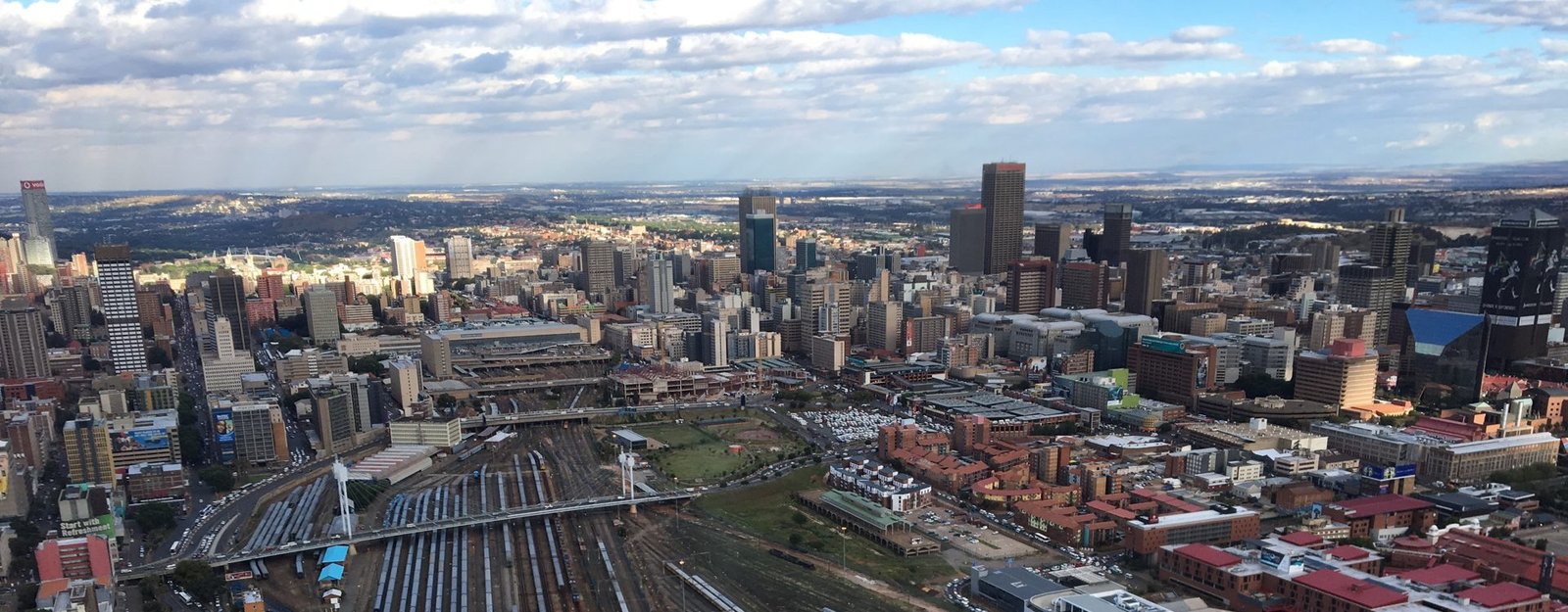
Photo: Mark Hillary, via Wikimedia Commons (CC BY 2.0)
Sources
- https://www.reuters.com/world/africa/south-africas-anc-32-vote-with-12-votes-counted-municipal-election-2026-11-05/
- https://www.reuters.com/world/africa/south-african-rand-gains-local-election-results-us-midterms-2026-11-05/
- https://townpress.co.za/election-results-councils/
- https://www.businesstechafrica.co.za/article/breaking-news-today-thursday-5-november-2026
Leave a comment
Comment as a guest and verify your email, or sign in or create a reader account. Guest comments reach our review queue after email verification; account holders can submit directly for review.